Quick Answer
It builds on traditional technical SEO fundamentals such as crawlability, indexability, canonicalization, internal linking, rendering, structured data, and site architecture. Technical GEO adds another layer: deciding which AI systems can access your content, distinguishing search crawlers from training controls, improving machine understanding, measuring AI visibility, and making interactive website elements easier for AI agents to use. See our full breakdown of Technical SEO vs Technical GEO for how the two disciplines relate.
Technical GEO is not an official Google ranking category. Google explicitly says its generative AI search experiences remain grounded in its core Search systems and that established SEO practices continue to be the foundation for visibility in AI Overviews and AI Mode. Google does not require special AI schema, an AI-specific sitemap, tiny content “chunks,” or an llms.txt file for its generative Search features.
The practical value of Technical GEO is therefore not inventing new Google ranking tricks. It is extending technical SEO across a broader machine-discovery ecosystem that now includes Google AI Search, ChatGPT Search, AI crawlers, retrieval systems, and browser-based agents.
What Is Technical GEO?
Technical GEO is the technical side of Generative Engine Optimization, or GEO.
It focuses on the infrastructure and machine-access layer that determines whether generative AI systems can discover your website, access your pages, retrieve your content, interpret your information, resolve your entities, use your content as grounding material, cite or link to your pages, and, increasingly, interact with your website through an AI agent.
A useful way to understand Technical GEO is to compare it with technical SEO. Traditional technical SEO asks questions such as: Can Google crawl the page? Can Google index it? Is the canonical URL correct? Can Google render the content? Can crawlers discover the page through internal links?
Technical GEO includes all of those questions, then adds others: Can ChatGPT Search access this page? Have we accidentally blocked OAI-SearchBot? Are our AI-search and AI-training permissions intentional? Can generative systems reliably identify our organization, products, people, and services? Can an AI agent understand our buttons, forms, and navigation? Can we measure whether our pages appear inside AI-generated search experiences?
That is why Technical GEO should not replace technical SEO. It should extend it.
Is Technical GEO a Real Google Ranking Discipline?
Not in the way some marketers describe it.
Google does not currently say that websites need a separate Technical GEO implementation to appear in AI Overviews or AI Mode. In fact, Google’s current guidance is explicit: its generative AI Search features are rooted in its core Search ranking and quality systems.
Google uses techniques including retrieval-augmented generation (RAG) to retrieve relevant pages from its Search index and query fan-out to generate multiple related searches when more information is needed.
Google’s position is essentially: good SEO remains good generative-search optimization. Google even addresses the terms AEO and GEO directly. From Google’s perspective, optimizing for its generative search experience is still part of SEO.
So why use the term Technical GEO? Because Google is only one part of the emerging AI discovery environment. A modern technical visibility strategy may need to account for Googlebot, OAI-SearchBot, GPTBot, Google-Extended, AI search participation controls, browser agents, accessibility trees, Search Console AI performance data, and AI referral measurement.
Traditional technical SEO audits often do not examine all of those layers. Technical GEO gives us a useful name for that expanded technical problem.
Why Technical GEO Matters
AI search does not remove technical dependencies. It adds more of them.
Before an AI system can quote, recommend, summarize, or cite information from your website, several things must go right. A simplified sequence looks like this: website → crawler or retrieval access → discovery → indexing or retrieval → content extraction → machine understanding → source evaluation → AI-generated response → citation, recommendation, or action.
A failure near the beginning of this chain can prevent everything that comes after it. If your firewall blocks the relevant crawler, excellent content may never be retrieved. If an important page is accidentally marked noindex, it may disappear from the search system entirely. If critical product information only appears after an unreliable interaction, systems may have difficulty accessing it. If your organization is described inconsistently across your website, machine understanding becomes harder.
Technical GEO is therefore about removing avoidable technical friction between your information and the systems that may need to use it.
The 8-Layer Technical GEO Stack
A practical way to audit Technical GEO is to divide it into eight layers.
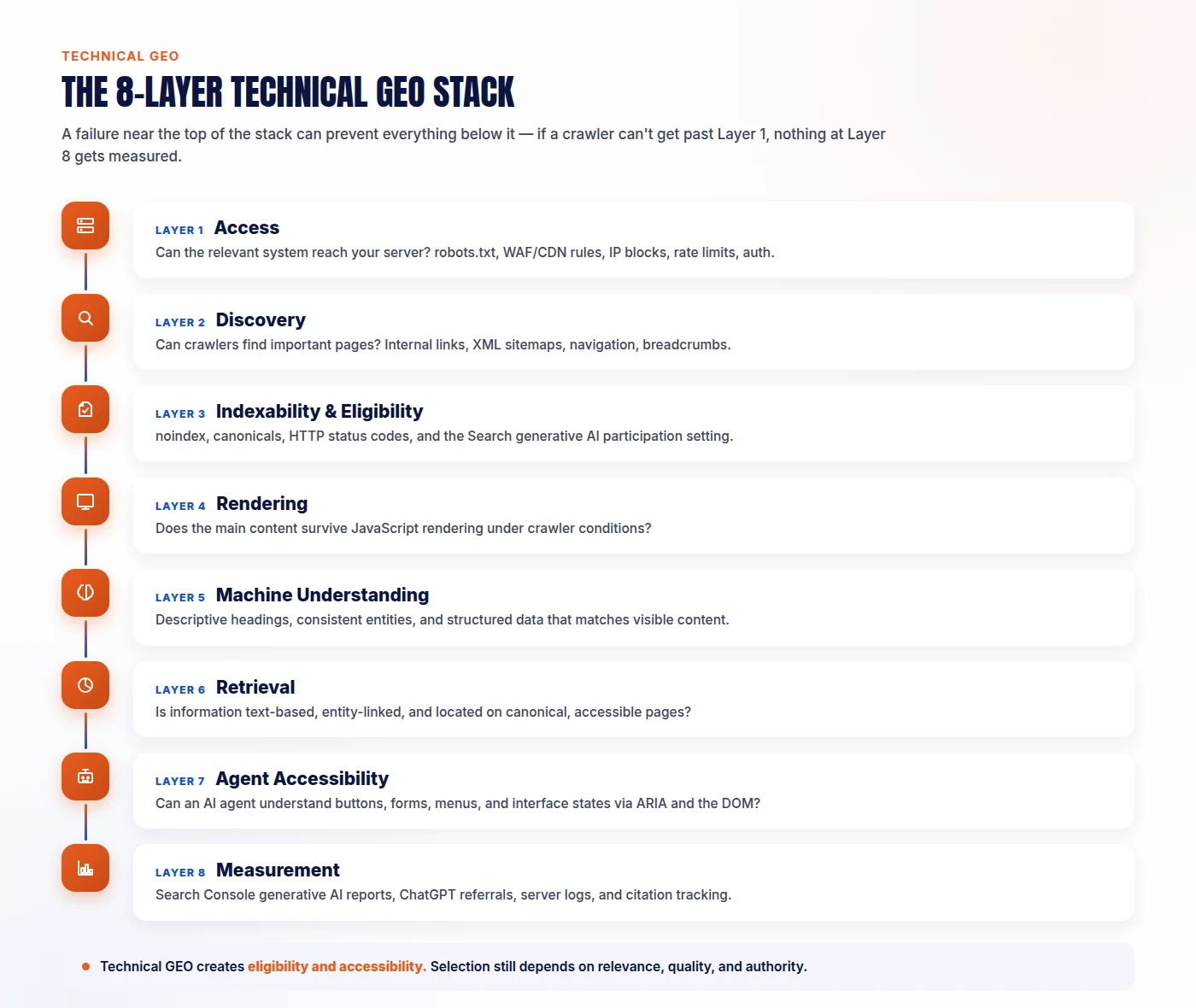
Layer 1: Access
The first question is simple: can the relevant system reach your website?
Potential barriers include robots.txt restrictions, CDN rules, web application firewalls, bot-management platforms, IP blocks, rate limits, authentication, and server errors.
A page may appear perfectly normal to a human using Chrome while returning a 403 Forbidden response to a crawler. This is particularly important with AI crawlers because some security platforms classify unfamiliar automated traffic aggressively.
For ChatGPT Search, OpenAI says publishers should ensure they are not blocking OAI-SearchBot if they want their content to be included in ChatGPT summaries and snippets. OpenAI also notes that bot-protection infrastructure can affect crawler access.
Technical GEO therefore begins before content optimization. It begins at the server.
Layer 2: Discovery
A crawler that can access your domain still needs to find your important pages.
Discovery signals include internal links, XML sitemaps, navigation, category structures, breadcrumbs, and crawl paths. A page that exists but has no crawlable internal link pointing to it may be technically accessible while still being poorly discoverable.
Google specifically continues to recommend making important content easily findable through internal links as part of its guidance for AI Overviews and AI Mode. This is another example of technical SEO and Technical GEO overlapping almost completely.
Generative search does not make site architecture obsolete. It makes good architecture useful across more interfaces. Understanding how those crawlers actually parse what they find once they arrive is its own discipline — see how AI crawlers understand your website.
Layer 3: Indexability and Eligibility
Crawlability and indexability are different. A crawler may be permitted to fetch a page while the page itself tells search engines not to index it.
Important controls include noindex, canonical tags, HTTP status codes, duplicate-page handling, and Search Console settings.
For Google AI Overviews and AI Mode, Google currently says a page needs to be indexed, eligible to appear in Search with a snippet, and meet the normal technical requirements for Google Search.
Google now adds another control. As of August 31, 2026, the Search generative AI control has been rolled out globally through Search Console. Site owners can choose whether their site’s links and content are eligible for AI Overviews, AI Mode, and generative AI features in Google Discover.
If a site is excluded, Google says its links and content will not appear in those generative features and cannot be used as grounding inputs there. Importantly, Google says that choice is not used as a ranking or inclusion signal for ordinary Search.
That means technical eligibility now includes an explicit business decision: do we want this site—or this section of the site—to participate in Google’s generative AI Search surfaces?
Layer 4: Rendering
Many modern websites rely heavily on JavaScript. That does not automatically make them unsuitable for AI search.
Google says it can process JavaScript content as long as the content and required resources are not blocked. However, Google also acknowledges that JavaScript-based SEO is generally more complex than working with simpler HTML delivery.
For Technical GEO, ask: Is the main content present in the rendered page? Does rendering fail under crawler conditions? Are important facts loaded only after user interaction? Are API failures leaving crawlers with incomplete pages? Is essential content hidden behind tabs, scripts, or widgets? Can systems access meaningful text without simulating complicated user behavior?
This does not mean every site should become static HTML. It means critical information should not depend on fragile delivery mechanisms.
Layer 5: Machine Understanding
Once systems can access your content, they need to interpret it. This is where page structure, entities, and structured data matter.
Useful technical signals include descriptive headings, meaningful page titles, semantic relationships, clear organization names, consistent product names, useful internal anchors, relevant structured data, and visible factual information.
Structured data can help search engines understand certain information and qualify pages for supported Search features. However, Google explicitly warns SEOs not to overstate structured data’s role in generative AI Search.
Google says there is no special schema.org markup required for AI Overviews or AI Mode. Structured data should remain part of a normal SEO strategy and must match the visible content on the page.
That distinction is important. Schema can improve machine clarity. Schema does not create a guaranteed AI citation.
Layer 6: Retrieval
Being indexed is still not the same as being selected. Generative systems retrieve information based on the user’s question. Google says its generative AI features use RAG and query fan-out. A user may ask one question while Google’s systems generate several related searches to gather enough information to answer it.
For example, a user might ask: “What is the best accounting software for a small construction company?” The search system could investigate related questions involving price, construction features, payroll, invoicing, integrations, user limits, and mobile access.
A website may therefore become useful even if it does not exactly target the original phrasing. This makes technical retrieval depend partly on content structure. Important information should be available as text, clearly associated with the correct entity, easy to identify, internally connected, and located on canonical, accessible pages.
Technical GEO creates the conditions for retrieval. Content GEO determines whether the information is actually worth retrieving. This is also the layer where why being crawlable isn’t enough for AI search visibility becomes most visible: a page can be perfectly accessible and still never get selected.
Layer 7: Agent Accessibility
This is where Technical GEO begins to extend beyond traditional search-engine crawling. AI agents can interact with websites rather than merely read them.
Google’s current generative AI optimization guidance says browser agents may gather information by examining visual renderings such as screenshots, the DOM, and the accessibility tree.
OpenAI gives similar guidance. OpenAI says making a website more accessible can help ChatGPT’s browser-based agent understand it. The company specifically points to ARIA roles, labels, and states for interactive elements such as buttons, menus, and forms.
This creates a new technical question. Traditional technical SEO asks: can a crawler understand the page? Agent readiness asks: can an AI understand what it can do on the page?
Examples include identifying the “Add to Cart” button, understanding which form field expects a phone number, recognizing whether a menu is expanded, distinguishing “Book Appointment” from generic icons, navigating a multi-step checkout, and understanding product variations.
That is a different technical challenge, and it is developing quickly as agent platforms mature — see how OpenAI Astra could change AI agents and search for where this is headed.
Layer 8: Measurement
If Technical GEO cannot be measured, it becomes easy to turn it into guesswork.
Google now provides a dedicated Generative AI performance report in Search Console. The report covers performance in AI Overviews and AI Mode and can show generative AI impressions by page, country, date, and device.
For ChatGPT, OpenAI says referrals from ChatGPT search include utm_source=chatgpt.com. That allows publishers to identify referral traffic through analytics platforms.
A mature Technical GEO measurement stack can therefore include Google Search Console AI impressions, ChatGPT referrals, server-log crawler activity, bot response codes, cited URLs, AI mentions, and AI referral conversions.
Technical GEO should move toward evidence, not speculation.
Technical GEO vs Content GEO
Technical and content optimization solve different problems.
| Technical GEO | Content GEO |
|---|---|
| Crawler access | Answer usefulness |
| robots.txt | Information quality |
| WAF/CDN configuration | Original evidence |
| Indexability | Expertise |
| Canonicalization | Citation-worthiness |
| Rendering | Clarity |
| Site architecture | Topic coverage |
| Structured data | Statistics and evidence |
| Entity relationships | Original research |
| Agent accessibility | Information gain |
| Measurement | Source quality |
The easiest way to remember the difference is: Technical GEO makes your information available to AI systems. Content GEO gives AI systems a reason to use it.
A technically perfect site with generic content may never become an important AI source. An exceptional research article that blocks relevant crawlers may never get the opportunity. You need both.
AI Crawlers Are Not All Doing the Same Job
One of the biggest mistakes in AI optimization is treating every automated bot as an “AI crawler.” Different systems have different purposes.
Search and Discovery Crawlers
These crawlers help search systems discover information that may be shown or cited. For OpenAI, the clearest example is OAI-SearchBot. OpenAI says websites that want their content included in ChatGPT search summaries and snippets should make sure they are not blocking OAI-SearchBot.
For Google Search, Googlebot remains foundational. Google’s generative Search systems use information retrieved from its Search index, meaning normal Google crawling and indexing remain central.
Training Crawlers and Training Controls
Training is not the same as search discovery. This distinction matters.
OpenAI distinguishes OAI-SearchBot for ChatGPT search discovery from GPTBot for potential model-training use. OpenAI says publishers that want content excluded from potential training should disallow GPTBot.
Google has a comparable conceptual distinction with Google-Extended. Google-Extended is not a separate HTTP crawler user agent. It is a robots.txt control token publishers can use to manage whether crawled content may be used for training future Gemini models and certain Gemini grounding uses. Google explicitly says Google-Extended does not affect inclusion in Google Search and is not used as a Google Search ranking signal.
This means a sophisticated crawler policy should ask two separate questions: do we want AI search discovery, and do we want this content available for model-training-related uses? Those are not the same decision.
User-Triggered Agents
A third category is fundamentally different. An AI agent may visit a website because a user asked it to accomplish a task. The agent might need to read information, inspect product options, navigate, click, fill forms, compare values, or complete steps.
This activity is not equivalent to conventional indexing. The website becomes an interactive environment. That is why accessibility, semantic controls, and interface clarity are increasingly part of Technical GEO.
Does Schema Markup Help Technical GEO?
Yes—but not in the exaggerated way it is sometimes marketed.
Structured data can help search engines understand explicit relationships and qualify content for certain supported Search features. Useful schema types may include Organization, Person, Product, LocalBusiness, Article, and BreadcrumbList.
But structured data should reflect what users can actually see. Google explicitly says there is no special schema required for generative AI Search.
So this would be misleading: “Add this AI schema to get cited by ChatGPT and AI Overviews.” There is no universal AI citation schema.
A more accurate statement is: structured data is one machine-understanding signal within a much larger technical and content ecosystem.
Do You Need llms.txt for Technical GEO?
This question needs a platform-specific answer.
For Google Search: No
Google says Search ignores llms.txt. Creating one will neither improve nor harm your Google Search visibility or rankings, including generative Search visibility. So do not create an llms.txt file because someone told you it is a new Google ranking factor. It is not.
For the Broader AI Ecosystem: Maybe
Google’s position does not prove that no other service can use llms.txt now or in the future. If a particular platform documents support for it and the implementation is useful, maintaining the file may make sense.
The Technical GEO rule should therefore be: follow documented platform behavior, not industry folklore.
Do You Need to “Chunk” Content for AI?
Not specifically for Google.
Some GEO advice recommends breaking every article into extremely small passages so AI systems can supposedly retrieve each “chunk.” Google explicitly says there is no requirement to break pages into tiny pieces for generative Search. Its systems can understand multiple topics within a page and retrieve relevant portions.
That does not mean structure is unimportant. Humans and machines both benefit from descriptive headings, focused sections, logical paragraphs, clear tables, and concise definitions.
The distinction is: structure content because it improves comprehension—not because an arbitrary 50-word AI chunk is a ranking factor.
Technical GEO for Google AI Overviews and AI Mode
For Google, the implementation is relatively straightforward. Google says normal SEO remains foundational. A page should meet Search technical requirements, be crawlable, be indexed, be eligible to appear with a snippet, contain important information in accessible textual form, use appropriate internal linking, and keep structured data consistent with visible content.
There is no separate AI sitemap, GEO schema, AI meta tag, or Google llms.txt requirement.
As of August 31, 2026, there is one additional participation decision: Search Console → Settings → Search generative AI.
Google says the default is inclusion. Excluding a site prevents its links and content from appearing in the controlled generative AI Search features and removes the content from grounding eligibility there, while ordinary Search ranking and inclusion remain separately handled.
Technical GEO therefore includes verifying that this control matches your business strategy.
Technical GEO for ChatGPT Search
ChatGPT uses a different ecosystem. OpenAI says any public website can potentially appear in ChatGPT search. To improve discovery and citation eligibility, publishers should make sure they are not blocking OAI-SearchBot.
Important Technical GEO checks include:
- robots.txt — verify OAI-SearchBot access intentionally.
- WAF and CDN rules — check whether legitimate crawler traffic receives
403s, challenges, or rate-limit failures. - noindex — OpenAI says it may sometimes surface only a URL and title when it learns about a disallowed page through other sources. Publishers that do not want this should use
noindex; however, the crawler needs access to the page to read that directive. - GPTBot — control this separately if your policy around potential training differs from your ChatGPT Search policy.
- Referral measurement — track
utm_source=chatgpt.com.
The key Technical GEO lesson is simple: “Allow ChatGPT” is not one setting. Discovery, training, indexing behavior, and user-driven interactions involve different controls.
Technical GEO for AI Agents
Search visibility is only one part of AI readiness. Agents may need to use the website.
Imagine a future customer asking: “Find three local roofers with strong reviews that serve my ZIP code, compare their services, and request estimates.” An agent may need to understand whether the company serves the location, which services it offers, where the quote form is, what each form field means, which button submits the request, and whether submission succeeded.
That is not a crawling problem. It is an interaction problem.
For an agent-friendly site, review:
- Semantic HTML — use native HTML elements where practical.
- Descriptive buttons — “Request a Quote” is easier to interpret than an unlabeled icon.
- Form labels — every field should have a clear purpose.
- ARIA — use appropriate roles, labels, and states where native semantics are insufficient.
- Navigation — keep menus predictable and understandable.
- Interface states — make selected, expanded, disabled, successful, and failed states clear.
OpenAI explicitly says accessibility helps its browser-based agent interpret websites, while Google says browser agents may inspect the DOM, rendered screenshots, and accessibility tree.
This could become one of the biggest technical differences between conventional SEO and the next generation of web optimization.
Does JavaScript Hurt AI Visibility?
JavaScript is not inherently bad for Technical GEO. But unnecessary complexity increases failure opportunities.
For Google, JavaScript content can be processed if it is accessible and implemented according to normal JavaScript SEO best practices. Technical risks include blocked scripts, failed API requests, client-side routing errors, missing server-rendered metadata, delayed main content, interaction-only content, and hydration failures.
The practical rule: do not remove JavaScript just for AI. Make sure important information survives technical failure and remains accessible to the systems you actually want to reach.
Does Semantic HTML Matter for Technical GEO?
Yes, but perfection is not required.
Google explicitly says perfectly valid semantic HTML is not required for generative Search and that Google can understand imperfect web pages. However, Google still recommends semantic HTML where practical because it improves accessibility and machine parsing for other systems.
That makes semantic HTML a good example of a Technical GEO principle: do it because it improves the web platform, not because it is a secret AI ranking factor.
Use elements such as <main>, <article>, <nav>, <header>, <footer>, logical heading levels, proper lists, real buttons, and properly associated form labels.
Clean structure benefits users, accessibility technologies, browser agents, and machine processing simultaneously.
How to Make Your Website AI-Ready
A practical Technical GEO implementation can follow this sequence.
- Audit every relevant crawler policy. Identify which bots and control tokens matter to your business: Googlebot, OAI-SearchBot, GPTBot, Google-Extended, and other relevant systems you intentionally support. Do not copy a random “allow all AI bots” robots.txt template without understanding what each bot does.
- Separate search permissions from training permissions. This is one of the most important Technical GEO practices. For OpenAI: OAI-SearchBot ≠ GPTBot. For Google: Google Search participation ≠ Google-Extended. Decide intentionally.
- Test real HTTP responses. Don’t only read robots.txt. Check whether desired crawlers encounter 200 responses, 403s, 429s, redirects, server errors, or bot challenges. Inspect server logs where possible.
- Fix indexability problems. Audit
noindex, canonicals, duplicate URLs, redirects, parameter pages, and HTTP status codes. If the correct page cannot become part of the relevant retrieval system, content improvements alone will not solve the problem. - Strengthen internal discovery. Ensure commercially and informationally important pages are linked logically. Avoid orphan pages. Use contextual internal linking to establish relationships between topics, products, services, and entities.
- Verify rendering. Test whether your most important content appears reliably after rendering. Pay particular attention to JavaScript frameworks, faceted ecommerce pages, client-rendered product data, dynamically generated FAQs, tabs, and infinite scroll.
- Put important facts in accessible text. Do not make machines extract every critical fact from images, video, canvas elements, or complex interactive widgets. Google specifically recommends making important content available in textual form. Use visual media as a complement rather than a replacement when the information matters for search.
- Use structured data where it has a real purpose. Use supported structured data that accurately reflects visible page content. Avoid inventing “AI schema.”
- Strengthen entity consistency. Keep important information consistent across the website: company name, products, services, people, addresses, locations, and organization relationships. Clear entities make information easier to interpret.
- Improve agent accessibility. Audit forms, menus, buttons, dialogs, selectors, and other interactive interfaces. Follow accessibility best practices because they increasingly matter to AI agents as well as people.
- Check generative search participation settings. For Google, verify the Search generative AI setting in Search Console. Do not assume the inherited setting is what you intended.
- Measure AI visibility. Monitor Google Generative AI impressions, pages appearing in AI results, ChatGPT referrals, AI citations, server-log crawler activity, and AI-assisted conversions. Google’s dedicated Generative AI performance reporting means this part of Technical GEO is becoming increasingly measurable rather than theoretical.
What Technical GEO Cannot Do
Technical GEO is important, but it has limits.
It cannot guarantee an AI citation, an AI Overview appearance, an AI Mode recommendation, a ChatGPT mention, a top ranking, or agent selection.
Technical readiness creates eligibility and accessibility. Selection still depends on factors such as relevance, quality, originality, authority, usefulness, and source competition.
Google explicitly says meeting technical requirements does not guarantee crawling, indexing, or serving. This is why promising a client that “Technical GEO will get your site cited by ChatGPT” would be misleading.
A better promise is: Technical GEO removes technical barriers that could prevent AI systems from accessing and using your information.
Common Technical GEO Mistakes
- Treating every AI bot the same. Search discovery, model training, and user-triggered browsing are different activities. Configure them separately.
- Blocking AI search accidentally. A broad robots.txt rule or aggressive WAF can remove desired visibility.
- Assuming crawlability means visibility. A crawlable page can still be irrelevant, weak, duplicated, or uncompetitive.
- Adding fake AI schema. There is no universal “GEO schema.”
- Installing llms.txt for Google rankings. Google says it ignores the file.
- Ignoring accessibility. Browser agents increasingly rely on structures originally designed to improve human accessibility.
- Ignoring traditional SEO. For Google in particular, technical SEO remains the foundation of generative Search visibility.
Technical GEO Checklist
Before calling a website AI-ready, check:
- Relevant crawlers can reach the server.
- robots.txt rules are intentional.
- Search and training permissions are separated.
- CDN/WAF rules do not block wanted bots.
- Important pages return 200 responses.
- Important pages are indexable.
- Canonicals are correct.
- Internal links expose important URLs.
- XML sitemaps are current.
- JavaScript content renders reliably.
- Important information exists in text.
- Structured data matches visible content.
- Entity information is consistent.
- Forms have clear labels.
- Buttons have descriptive purposes.
- Navigation is accessible.
- Google Search generative AI participation is intentional.
- AI crawler activity can be measured.
- Google AI visibility can be monitored.
- ChatGPT referrals can be identified.
If several of these fail, the site may be technically optimized for traditional search while still being poorly prepared for broader AI discovery. For a scored version of this list, see our AI Readiness Audit: 27 Technical Signals Every Website Should Check.
Bottom Line
Technical GEO is not a replacement for technical SEO and it is not a collection of secret AI ranking tricks.
Its purpose is much more practical. The web now has more machine consumers. Googlebot may crawl your pages for Search. Google’s generative systems may retrieve information from its Search index for AI Overviews or AI Mode. OAI-SearchBot may discover pages for ChatGPT Search. GPTBot and Google-Extended involve different decisions around model use. Browser agents may inspect the DOM, accessibility tree, and visible interface in order to perform tasks for users.
That expanded ecosystem creates technical questions that many traditional SEO audits were never designed to answer. A technically AI-ready website should therefore aim to be:
- Accessible — wanted crawlers can reach it.
- Discoverable — important pages can be found.
- Indexable — the intended URLs are eligible for relevant search systems.
- Renderable — critical content works under crawler conditions.
- Understandable — entities, structure, and relationships are clear.
- Retrievable — important information can be extracted when relevant.
- Agent-friendly — interactive elements are understandable and accessible.
- Measurable — AI visibility and crawler behavior can be monitored.
That is Technical GEO. And the most important strategic principle is this: do not optimize for an imaginary universal “AI crawler.” Optimize deliberately for the systems you actually want to reach.
Google Search, ChatGPT Search, model-training crawlers, and AI agents do not all use the web in the same way. Understanding those differences—and making intentional technical decisions around them—is what separates real Technical GEO from AI-search hype.
FAQ
What is Technical GEO?
Technical GEO is the technical optimization work that helps generative search systems, AI crawlers, retrieval systems, and AI agents access, interpret, retrieve, and potentially interact with website content. It extends technical SEO rather than replacing it.
Is Technical GEO different from technical SEO?
Yes, but they overlap heavily. Technical SEO focuses primarily on search-engine crawling, indexing, rendering, and ranking eligibility. Technical GEO extends the audit to AI search crawlers, training controls, generative-search participation, AI measurement, machine understanding, and agent accessibility.
Does Google require Technical GEO?
Google does not use Technical GEO as an official requirement. Google says conventional SEO best practices remain the foundation for AI Overviews and AI Mode, and that no special AI markup is necessary.
Do I need llms.txt for AI search?
Not for Google Search. Google says it ignores llms.txt, so maintaining the file neither helps nor hurts Google Search visibility. Other platforms may have different policies, so check their documentation individually.
Does schema markup improve AI visibility?
Structured data can help machines interpret page information and remains useful for supported Search features, but there is no special schema that guarantees AI Overview, AI Mode, or ChatGPT citations. Google explicitly says no special schema.org markup is required for its generative Search features.
What is OAI-SearchBot?
OAI-SearchBot is an OpenAI crawler associated with search discovery. OpenAI says publishers should allow it if they want their content eligible to appear within ChatGPT search summaries and snippets.
Is OAI-SearchBot the same as GPTBot?
No. OpenAI separates OAI-SearchBot search discovery from GPTBot controls related to potential model training.
What is Google-Extended?
Google-Extended is a robots.txt control token that lets publishers manage certain uses of crawled content for future Gemini training and specified Gemini grounding uses. Google says it does not affect inclusion or ranking in Google Search.
Should I allow AI crawlers?
That depends on what you want. If visibility in a particular AI search system is valuable, blocking its search crawler can work against that objective. Training permissions should be considered separately because search discovery and model training are not necessarily controlled by the same bot.
Can JavaScript hurt AI visibility?
JavaScript itself is not a problem, but implementation failures can make content harder to access. Google says it can process JavaScript content when it is not blocked but recommends following normal JavaScript SEO best practices.
Does being crawlable guarantee AI visibility?
No. Crawlability creates an opportunity for discovery. It does not guarantee indexing, retrieval, citation, ranking, or recommendation.
Can AI agents use my website?
Increasingly, yes. Browser-based agents can inspect page structure and interact with supported website elements. Google says agents may use the DOM, screenshots, and accessibility tree, while OpenAI recommends descriptive ARIA roles, labels, and states to improve agent compatibility.
How do I measure Technical GEO performance?
Use a combination of Search Console generative AI reporting, server logs, AI referral traffic, citation monitoring, and conversion tracking. Google now provides a dedicated Generative AI performance report for AI Overviews and AI Mode.