At the same time, OpenAI products already show where search and agents are converging. ChatGPT can search the web for current information, while ChatGPT Work’s cloud browser can read pages, click buttons, enter information into forms, and carry out multi-step tasks on supported public and signed-in websites.
If Astra-class capabilities eventually reach these types of systems, the customer journey could evolve from Search → Click → Research → Compare → Convert to Goal → AI Research → AI Comparison → AI Decision Support → AI Interaction → User Approval → Action.
For marketers, that creates a new visibility question: can an AI system not only find your business, but understand it well enough to select and interact with it? This article walks through the scenario in detail. For a closer look at the model itself, see What Is OpenAI Astra? Everything Marketers Need to Know.
Why OpenAI Astra Is Really an Agent Story
Most discussion around new AI models focuses on intelligence. Is the new model better at coding? Does it score higher on mathematics? Is it better at writing? Does it hallucinate less? Those questions matter. But Astra points toward another dimension of capability: autonomy.
OpenAI says Astra has reached its Critical cybersecurity capability threshold. Under that framework, one route to reaching the threshold involves the ability to identify and develop functional zero-day exploits across hardened systems without requiring a human to guide every individual step. Another involves devising and executing an end-to-end novel strategy against a hardened target from only a high-level objective.
Astra’s cybersecurity capability is not itself a marketing feature. But the structure of the work is important. The model must potentially understand an objective, examine an environment, decide what to investigate, use tools, interpret results, identify obstacles, revise its approach, continue working, and determine when the objective has been achieved.
That is fundamentally different from Prompt → Response. It is much closer to Goal → Plan → Act → Observe → Adapt → Continue. That is the architecture of agentic AI. For how this specific capability jump compares to OpenAI’s other current model, see OpenAI Astra vs GPT-5.6 Sol: What We Know So Far.
Is OpenAI Astra an AI Agent?
Not exactly. Astra is a model, not a standalone agent product. This distinction is important.
An AI model provides intelligence. An agentic system combines intelligence with additional capabilities such as tools, memory, browsing, APIs, computer control, application access, planning, execution, and monitoring.
Astra could therefore become the intelligence layer behind more capable agents without itself being sold as an “AI agent.” Think of it this way: Model = brain. Agent system = brain + tools + environment + permissions + ability to act.
OpenAI has not announced Astra’s complete production integrations, so marketers should not assume which agent products it will eventually power. What we can say is that Astra’s demonstrated ability to perform complex work with less human guidance could make it particularly relevant to agentic systems.
Search Is Already Moving From Answers Toward Actions
The shift toward agentic search did not begin with Astra. It is already happening.
ChatGPT Search can search the web when current information is needed and return answers containing links and citations to relevant sources. That represents the first stage: find information.
But newer AI workflows increasingly go further. OpenAI’s cloud browser for ChatGPT Work can read web pages, click buttons, enter information into forms, navigate supported sites, work on signed-in websites, and complete multi-step web tasks. That represents a different stage: interact with the environment.
The distinction is enormous. A search engine helps users locate a restaurant. An answer engine might recommend three restaurants. An agent could potentially understand the user’s preferences, research restaurants, compare menus, check locations, look at availability, identify the best option, and prepare or complete a reservation subject to appropriate user approval. Search becomes part of a broader task rather than the end product.
What Is Agentic Search?
Agentic search is a search experience in which AI does more than retrieve and summarize information. It uses search as one step inside a larger process for accomplishing a user’s goal.
Traditional search starts with a query. Agentic search starts with an outcome. Consider the difference.
Traditional search
User: “Best hotels near Marina Bay Singapore.” Search engine: displays websites. The user must then open results, compare properties, check prices, investigate reviews, check amenities, select dates, and complete the booking.
AI answer search
User: “Best hotels near Marina Bay Singapore.” AI: summarizes several options and may cite sources. The user’s research burden decreases.
Agentic search
User: “Find me a hotel near Marina Bay for three nights under $250 per night, breakfast included, review score above 8.5, and late checkout if possible.” An agent could potentially search hotels, inspect several booking sources, compare prices, verify breakfast, check review scores, identify late-checkout policies, eliminate unsuitable properties, present the strongest candidates, and help initiate the booking process.
The user’s request has moved from “give me information” to “help accomplish this outcome.” That is agentic search.
How Astra-Class Models Could Change Search Behavior
More capable autonomous models could change search in several ways. These are scenarios rather than confirmed Astra product features, but they follow logically from the direction of current agentic systems.
One user request could trigger many searches
In traditional search, marketers often think in terms of one keyword → one SERP. Agentic systems break that model. Consider: “Find the best CRM for my 25-person plumbing company.” The AI may need to investigate CRM products for service businesses, pricing, user limits, dispatch integrations, mobile functionality, QuickBooks integrations, call tracking, automated follow-ups, customer reviews, contract requirements, and onboarding costs.
One visible user request could therefore generate many invisible research actions. That makes the original keyword only one small part of the customer journey.
Search Sessions Could Become Much Longer
A conventional search interaction may last seconds. An agentic task could involve multiple stages over a much longer period. The system may research, compare, evaluate, revisit sources, collect information, perform actions, encounter problems, and change strategies.
OpenAI’s current cloud-browser documentation already describes ChatGPT Work handling multi-step web tasks and pausing when it needs user input, sign-in, or confirmation.
Astra’s emergence is important because OpenAI says the model can perform more consequential work and operate over extended agent tasks, while the company has developed monitoring capable of stopping potentially unauthorized activity. This suggests longer-running AI workflows will become increasingly important.
AI Could Revisit Your Website Instead of Visiting Once
Traditional SEO often treats a website visit as a single session. An AI agent may behave differently. It could visit your pricing page, product page, documentation, FAQ, terms, booking interface, and support pages — then return later because another step requires additional information.
This turns the website from a document being read into an environment being used. That change has major technical and UX implications.
Search and Conversion Could Begin to Merge
Historically, search sits near the beginning of the funnel. A typical journey might be: Search → Website → Research → Comparison → Conversion.
AI agents could compress those stages. An agent might search, research, compare, and interact inside the same task. That means the boundary between discovery and conversion becomes less distinct. For marketers, this creates an important strategic shift: optimizing only the discovery layer may no longer be enough.
From SEO to AI Agent Visibility
Businesses may increasingly operate across four different visibility layers.
1. Search visibility
Can conventional search engines find and rank the business? This remains traditional SEO. Metrics include rankings, impressions, clicks, and organic traffic.
2. AI citation visibility
Does an answer engine use or cite the business’s information? This is increasingly relevant to GEO. Metrics include AI citations, cited URLs, brand mentions, and answer inclusion.
3. AI recommendation visibility
Does the AI actually recommend the business? This goes beyond citations. An article may cite Salesforce while recommending HubSpot. Citation visibility and recommendation visibility are therefore different.
4. Agent accessibility
Can an AI agent successfully interact with the business? This includes whether the agent can understand the interface, navigate the website, select options, complete forms, access necessary information, and move toward a transaction. This fourth layer could become increasingly important as agents grow more capable. For how these layers connect to GEO strategy specifically, see Could OpenAI Astra Change AI Search and GEO?
What Is Agent Accessibility?
Agent accessibility is the ability of an AI agent to understand and interact reliably with a website or digital interface. This concept overlaps with traditional web accessibility, usability, structured data, technical SEO, and application design.
Consider two websites.
Website A
The booking button visually looks obvious to humans. But the button lacks a useful accessible label, important information is inserted dynamically in an unusual way, form fields have unclear names, and navigation controls are ambiguous.
Website B
Uses semantic HTML, descriptive labels, accessible controls, clear form names, predictable navigation, and explicit states.
Both sites may look equally attractive. But Website B could be easier for both assistive technology and AI agents to interpret.
This is not theoretical. OpenAI’s current developer guidance says making a site more accessible helps ChatGPT Agent in Atlas understand it. OpenAI specifically says the system uses ARIA tags — the same roles and labels used by screen readers — to interpret page structure and interactive elements. OpenAI recommends descriptive roles, labels, and states for elements such as buttons, menus, forms, and other interactive controls.
For marketers and developers, accessibility may therefore have a new strategic dimension. It is not only about human accessibility. It may also affect whether software acting on behalf of humans can successfully use the website. This overlaps closely with how crawlers parse a site in the first place — see how AI crawlers understand your website for the underlying mechanics.
Why Technical SEO Alone Will Not Make a Website Agent-Ready
Technical SEO solves questions such as: can a crawler find the URL? Can it index the content? Agent accessibility introduces another question: can software operate the interface?
A website could rank perfectly in Google while being difficult for an agent to use. Potential obstacles include unclear buttons, poorly labeled forms, ambiguous navigation, inconsistent page structures, inaccessible interactive elements, unnecessary modal windows, CAPTCHA challenges, login barriers, broken mobile interfaces, hidden pricing, confusing product options, and inconsistent inventory information.
That creates a new optimization layer beyond crawling and indexing.
How Agentic Search Could Change Ecommerce
Ecommerce provides one of the clearest examples. Today a user might search “best waterproof running shoes under $150.” The user then manually compares brands, models, prices, sizes, availability, shipping, and reviews.
An increasingly capable agent could potentially handle much of that research. The user could say: “Find waterproof running shoes under $150 in size 10 with strong reviews, available for delivery before Friday.”
Now product visibility depends on more than traditional rankings. The agent may need to understand product type, size, price, stock, shipping availability, color options, product specifications, and return policy. Retailers that expose accurate, understandable information could be easier for agents to evaluate.
How Agentic Search Could Change Local SEO
Local search could change significantly too. Consider “find a plumber near me.” Traditional local search returns options.
Agentic local search could interpret a much richer request: “Find a licensed plumber who can repair a leaking water heater this afternoon, has strong reviews, serves my neighborhood, and charges less than $200 for the callout.” That requires information about location, service area, availability, service type, licensing, ratings, pricing, and contact or booking options.
Local businesses may increasingly benefit from making operational information explicit rather than hiding it inside generic marketing copy.
How Agentic Search Could Change SaaS Marketing
B2B SaaS searches can involve substantial research. Consider: “Which project management platform should our 80-person construction company use?” An advanced agent could investigate company requirements, product features, pricing, integrations, implementation, security, reviews, industry suitability, and contract requirements. It could then produce a shortlist.
For SaaS marketers, this means strong landing pages alone may be insufficient. The AI may rely on official documentation, pricing pages, integration directories, security documentation, comparison pages, and third-party reviews. Product information must remain consistent across those surfaces.
AI Agents Could Change the Marketing Funnel
The traditional digital funnel often looks like: Impression → Click → Landing page → Research → Lead → Conversion.
An agentic funnel could look more like: User goal → AI research → Candidate selection → AI comparison → Recommendation → Agent interaction → User approval → Conversion.
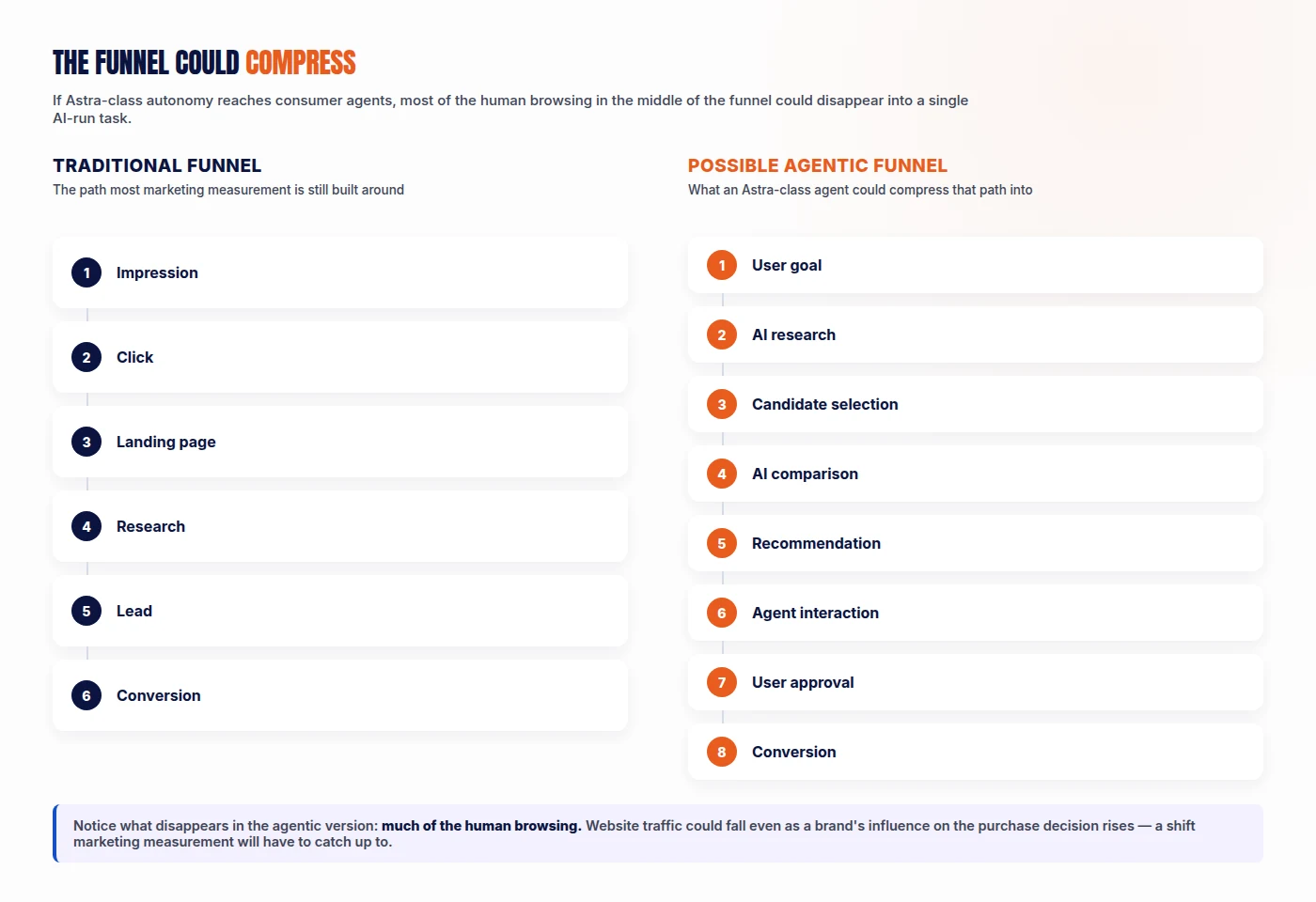
Notice what disappears: much of the human browsing. This creates a difficult but important possibility: website traffic could decrease even while a brand’s influence on purchase decisions increases.
If an AI agent researches your business, recommends it, and helps facilitate an action, the customer may need fewer conventional pageviews. Marketing measurement will have to adapt.
Traffic and Influence Could Become Different Metrics
SEO historically uses traffic as a major proxy for visibility. That works because the expected journey is visibility → click → website. AI weakens that relationship.
A brand could influence an answer without receiving a click. A business could appear in an AI shortlist without the user visiting its homepage. An agent could interact with a specific transactional page while bypassing most of the website.
This means marketers may increasingly need separate measurements for traffic, citations, mentions, recommendation frequency, agent referrals, and AI-assisted conversions. The strongest brands may eventually optimize for decision influence, not merely website sessions.
Will Websites Become Less Important?
No. But their role could change.
When AI can answer informational questions itself, users may have less reason to visit a site simply to read a generic explanation. That does not make websites irrelevant. It makes the website’s source-of-truth and transactional roles more important.
Websites could increasingly serve three audiences: humans who want to browse, research, learn, and buy; retrieval systems that need reliable information for generated answers; and AI agents acting on behalf of users that need to interpret and interact with the business. This creates a new design principle: build websites that are clear to humans and machines.
AI Agent Optimization Could Become a New Layer of Digital Marketing
It is tempting to immediately create another acronym for this. That is probably premature. We do not need to declare “AI Agent Optimization” a formal discipline before the ecosystem develops.
But the optimization requirements are already becoming visible. An agent-friendly business may need machine-readable information, accessible controls, clear navigation, consistent prices, understandable product attributes, accurate inventory, stable URLs, reliable forms, clear availability, explicit service areas, transparent policies, and structured confirmation states.
Some of these are already best practices for SEO, UX, accessibility, and conversion optimization. Agentic search potentially connects them.
Accessibility Could Become a Competitive Advantage
This is an area marketers should not overlook. OpenAI explicitly recommends WAI-ARIA best practices to improve compatibility with its agent experience in Atlas. That means developers should pay attention to several areas.
Buttons should have a descriptive purpose — “book appointment” is better than an ambiguous unlabeled icon. Forms should have clear labels, since an agent needs to understand whether a field expects a name, email, date, quantity, or location. Menus should have navigation relationships that are semantically understandable. States need to tell systems whether something is selected, expanded, disabled, or unavailable.
These changes improve accessibility for humans while also making interfaces more machine-readable. That is a strong example of human-centered design and AI readiness reinforcing each other rather than competing.
Websites May Need to Prepare for Authenticated AI Traffic
Agent interactions introduce another technical question. How can websites distinguish legitimate AI-agent activity from harmful bots?
OpenAI’s cloud browser uses Web Bot Auth to sign outbound HTTP requests. Website operators can verify signatures to confirm that requests originated from ChatGPT Work’s cloud browser.
That is strategically important. For years, website operators have treated automated traffic largely as crawler → allow or block. Agentic traffic is more complicated. A legitimate agent could be researching, filling a form, navigating an authenticated account, or completing work for a real customer. Automatically blocking all automation could eventually interfere with legitimate users delegating tasks to AI. Businesses may therefore need more sophisticated bot policies.
Could Astra Make Personalized Search More Important?
Potentially. Traditional search usually starts from a relatively short query. Agents can operate with much richer context — a user might provide budget, preferences, previous purchases, business requirements, location, deadlines, and constraints.
Two people entering what appears to be the same broad goal could therefore receive very different recommendations. For marketers, this means there may be no single “number-one result” for some agentic tasks. The relevant question becomes: for which users and constraints is my business the strongest match? This favors precise positioning. Companies that try to appear perfect for everyone may be less useful than brands with clearly defined strengths.
Could Search Rankings Become Less Important?
Less dominant, perhaps. Irrelevant, no.
AI agents still need to discover information. Search engines, web indexes, direct site access, APIs, structured data, and other retrieval mechanisms can all contribute. Traditional rankings can therefore continue to influence discoverability.
But an agent could add additional decision stages after retrieval. A page might rank first but lose the recommendation because pricing is unsuitable, information is outdated, product availability is unclear, another provider better fits the user’s constraints, or the website is difficult to interact with. This means businesses increasingly need to win retrieval + evaluation + interaction rather than retrieval alone.
Could Agentic Search Reduce Click-Through Rates?
For some searches, yes. If AI completes more of the research process itself, users may have fewer reasons to open multiple websites. That could particularly affect comparison searches, simple informational queries, travel research, product discovery, and local service research.
However, lower click-through rates do not automatically mean lower commercial opportunity. An agentic ecosystem could produce fewer but more qualified interactions. Instead of ten exploratory visits, a business might receive one interaction from an agent after the business has already survived a detailed comparison process. The economics may therefore shift from maximize visits toward maximize qualified selection.
Could Astra Replace Search Engines?
There is currently no evidence that Astra will replace Google, Bing, or conventional search engines. That framing is too simplistic.
Search behavior can fragment without search engines disappearing. The ecosystem may include conventional SERPs, AI Overviews, ChatGPT Search, vertical search engines, marketplaces, social search, AI assistants, and autonomous agents.
Users will choose different interfaces for different tasks. Someone wanting the latest football score may prefer a direct result. Someone researching a $100,000 software purchase may prefer an agent that spends substantial time investigating the decision. The future of search is therefore more likely to be multi-interface than “AI kills Google.”
Could Astra Change Conversion Rate Optimization?
Potentially. Traditional CRO asks: what helps a human complete the desired action? Agentic CRO may eventually add: what helps an authorized AI agent understand and complete the same workflow?
Those goals overlap heavily. Clear pricing helps humans and agents. Descriptive buttons help humans and agents. Accessible forms help humans and agents. Simple checkout helps humans and agents. Accurate product information helps humans and agents.
This means businesses may not need completely separate “agent websites.” The stronger strategy may simply be to build better structured, clearer, more accessible websites.
How Should Marketers Prepare for Agentic Search?
The goal is not to optimize specifically for an unreleased Astra product. Prepare for the broader direction.
- Make the business discoverable. Maintain strong SEO fundamentals. Ensure important pages can be crawled and indexed where appropriate. For ChatGPT Search specifically, OpenAI recommends allowing OAI-SearchBot if you want content eligible to be discovered and cited.
- Make the business understandable. State important facts explicitly. Make it easy to identify what the company does, who it serves, where it operates, what products cost, what services include, and what differentiates the offering.
- Make products easy to compare. Do not force customers — or AI — to guess fundamental information. Where appropriate, expose pricing, specifications, features, limitations, availability, service areas, shipping, and compatibility.
- Improve web accessibility. Follow semantic HTML and WAI-ARIA best practices. Use descriptive roles, labels, and states for interactive elements. OpenAI explicitly identifies accessibility as helpful for agent compatibility.
- Simplify forms. Avoid unnecessarily complex workflows. Use clear labels and predictable steps.
- Keep operational data current. An agent recommendation based on outdated information creates a bad experience. Keep pricing, stock, opening hours, availability, policies, and service areas accurate.
- Strengthen trust signals. Make important business facts easy to verify — company information, contact details, policies, professional credentials, certifications, warranties, and genuine reviews.
- Review bot and firewall policies. Do not assume every automated interaction is malicious. As legitimate AI-agent traffic grows, businesses may need ways to distinguish trusted automation from abuse.
- Measure AI-assisted journeys. Start separating AI referrals, AI citations, brand mentions, AI-assisted leads, and AI-assisted conversions where measurement is possible.
- Test your website like an agent. Ask a simple question: could someone unfamiliar with this website identify the correct action and complete it without guessing what elements mean? If the answer is no, an AI agent may struggle too.
What Marketers Should Not Do
Agentic AI creates opportunities for another wave of questionable optimization tactics. Avoid them.
- Do not build an “Astra landing page” for every product. There is no evidence this helps agent visibility.
- Do not create fake machine-only content. Information should remain useful and truthful for humans.
- Do not hide information from users while exposing it only to agents. This creates trust and potentially search-policy issues.
- Do not assume agents eliminate SEO. Agents still need discovery mechanisms.
- Do not sacrifice human UX for machines. A machine-readable website should also be a better human website.
- Do not expose sensitive actions without safeguards. Agent accessibility does not mean removing authentication, permissions, or confirmation for consequential actions.
- Do not assume Astra already powers agentic search. That has not been announced. Prepare for the capability direction rather than inventing product facts.
What Should Marketers Watch When Astra Launches?
Several Astra announcements would materially change the agentic-search discussion. Watch for whether Astra becomes available inside ChatGPT; whether OpenAI explicitly uses Astra for search or research; whether Astra powers longer professional workflows inside Work; how reliably Astra can interact with websites through the cloud browser; how effectively it can interpret and manipulate interfaces through computer use; whether it can coordinate APIs, apps, search, and other tools more effectively; how well it performs on long-horizon benchmarks requiring many sequential decisions; whether it can recognize when a strategy fails and recover; how the cost of completing tasks changes; whether latency stays practical for consumer workflows; how quickly developer API access arrives; and what permission and safety architecture governs what it can do without explicit approval.
These details will tell us whether Astra represents primarily an intelligence upgrade or a major step toward commercially useful autonomous systems.
The Bigger Shift: From Search Engine Optimization to Decision-System Visibility
The long-term marketing impact of AI agents may be bigger than another search interface. Search engines historically mediate discovery. Agentic AI could increasingly mediate decisions.
That changes the strategic question. Yesterday: “Can customers find us?” Today: “Can AI find and cite us?” Tomorrow: “Will AI evaluate us as the right choice for this customer?” And eventually: “Can an authorized AI agent successfully do business with us?”
This does not eliminate SEO. It adds layers on top of it. The complete visibility stack increasingly looks like: Discovery (can machines find the business?) → Understanding (can they accurately interpret what the business offers?) → Trust (can they verify important claims?) → Recommendation (does the business fit the user’s requirements?) → Interaction (can the agent navigate the website or application?) → Conversion (can the task be completed safely and successfully?).
Businesses that fail at any stage can lose the customer before a traditional website session ever begins. For the GEO-specific implications of this stack, see Could OpenAI Astra Change AI Search and GEO?
Bottom Line
OpenAI Astra could matter to search because AI is evolving from systems that retrieve information into systems that can increasingly act on information.
There is no confirmed Astra search engine, Astra agent ranking factor, or Astra-specific website optimization strategy today. But the direction is visible.
OpenAI’s current search product can already retrieve current information and cite sources. Its cloud browser can already navigate websites, click controls, enter information into forms, and complete multi-step web tasks.
Astra adds another signal. OpenAI says Astra can perform substantially more advanced autonomous cybersecurity work than GPT-5.6 Sol, including tasks where the system is not guided through every individual step. The company is sufficiently concerned about the consequences of this autonomy that it has developed additional monitoring designed to detect and stop potentially unauthorized model actions during extended tasks.
Those capabilities do not prove how Astra will behave in search. But they point toward a larger transition: AI systems are moving from answering questions toward pursuing goals.
For marketing, that changes the competitive landscape. The traditional objective was: rank where the customer searches. GEO added: become a source the AI trusts and cites. Agentic search adds another requirement: become a business the AI can understand, evaluate, recommend, and successfully interact with.
That means tomorrow’s strongest websites may not simply be the ones with the best content or highest rankings. They may be the businesses that are easiest for both humans and machines to understand and transact with. The emerging visibility stack therefore becomes: be found, be understood, be trusted, be selected, be usable, be convertible.
That is the real strategic implication of Astra for search. The biggest marketing change may not arrive when Astra produces a better search result. It may arrive when an Astra-class system can take a customer’s broad objective, research the market, narrow the alternatives, decide which businesses genuinely fit the requirements, interact with those businesses, and help move the customer toward a completed outcome. At that point, the competition is no longer only for the click. It is for a place inside the AI-mediated decision itself.
FAQ
Is OpenAI Astra an AI agent?
No. Astra is an upcoming OpenAI model rather than a standalone AI-agent product. However, its demonstrated ability to perform complex work with less step-by-step human guidance could make Astra-class models particularly useful as the intelligence behind future agent systems.
Will Astra power ChatGPT Search?
OpenAI has not announced that Astra will power ChatGPT Search. Any connection between Astra and future search products remains speculative until OpenAI confirms an integration.
What is agentic search?
Agentic search is an AI-driven search process where the system uses search as one step toward accomplishing a larger user goal. Instead of merely returning information, an agent may research multiple sources, compare options, interact with websites, and help complete tasks.
Can ChatGPT already interact with websites?
Yes. ChatGPT Work’s cloud browser can read pages, click buttons, enter information into forms, and carry out steps on supported public and signed-in websites.
Can AI agents fill out forms?
Some current agent systems can interact with supported website forms. OpenAI’s cloud browser, for example, can enter information into forms as part of web tasks.
What is agent accessibility?
Agent accessibility refers to how easily an AI agent can understand and interact with a website. This includes clear semantic structure, accessible navigation, properly labeled controls, predictable forms, and understandable information.
Do ARIA labels help AI agents?
They can. OpenAI says ChatGPT Agent in Atlas uses ARIA tags to interpret page structure and interactive elements and recommends WAI-ARIA best practices to improve compatibility.
Will AI agents replace websites?
No evidence suggests websites will disappear. Their role may evolve from primarily human-facing destinations toward sources of authoritative information and environments that both humans and authorized AI agents can use.
Will AI agents replace search engines?
Not necessarily. Conventional search, AI-generated answers, marketplaces, vertical search, social search, and AI agents are likely to coexist because different interfaces are useful for different tasks.
How will AI agents affect SEO?
SEO will remain important for discovery, but businesses may need to optimize beyond rankings. Future visibility could increasingly depend on whether AI systems can understand, evaluate, recommend, and interact with the business.
Could AI agents reduce website traffic?
Yes, particularly for informational research where AI can synthesize information without requiring users to open multiple pages. However, agentic systems could also produce more qualified interactions after the AI has already researched and compared potential providers.
How can I make my website more AI-agent friendly?
Focus on clear semantic HTML, accessible controls, meaningful ARIA labels, descriptive navigation, understandable forms, accurate product and service information, transparent pricing where practical, reliable server access, and simple conversion workflows. OpenAI specifically recommends accessibility best practices for improving compatibility with its agent systems.
Should I optimize specifically for OpenAI Astra?
Not yet. OpenAI has not announced Astra-specific search or agent optimization requirements. Businesses should focus on durable improvements in SEO, accessibility, structured information, trust, usability, and machine readability.