OpenAI has directly demonstrated that Astra is substantially stronger and more token-efficient than GPT-5.6 Sol on advanced cybersecurity evaluations. Astra has also shown stronger adherence to authorization boundaries in OpenAI’s tests and has produced results across long-standing mathematics and theoretical-computer-science problems.
However, Astra has not yet been broadly released. OpenAI has not disclosed its API pricing, context window, maximum output length, complete multimodal capabilities, general marketing performance, everyday writing quality, or full product availability.
Astra has demonstrated capabilities beyond GPT-5.6 Sol in specific frontier tasks, but there is not yet enough evidence to call Astra universally better than Sol for every use case.
For the full background on the model itself, see What Is OpenAI Astra? Everything Marketers Need to Know.
OpenAI Astra vs GPT-5.6 Sol at a Glance
| Feature | OpenAI Astra | GPT-5.6 Sol |
|---|---|---|
| Status | Upcoming | Available |
| OpenAI positioning | Next major model | Flagship GPT-5.6 model |
| Broad public access | Not yet | Yes, on eligible plans |
| API availability | Not yet fully announced | Yes |
| Context window | Not announced | 1,050,000 tokens |
| Maximum output | Not announced | 128,000 tokens |
| Current API price | Not announced | $4 input / $20 output per 1M tokens |
| Knowledge cutoff | Not announced | February 16, 2026 |
| Cyber capability | Critical threshold | Below Astra in disclosed Astra tests |
| ExploitBench | 100% in disclosed Astra evaluation | Astra performed better overall |
| Token efficiency in Astra cyber tests | Significantly higher | Lower baseline |
| Novel vulnerability discovery | Demonstrated in evaluations | Less capable in disclosed comparison |
| Research mathematics | Major results disclosed | Strong scientific capabilities, but different evidence |
| Agentic workflows | Strong frontier evidence | Already available and usable |
| Computer use | Full details unknown | Available |
| Web search/tools | Full details unknown | Available through supported tools |
| General marketing use | Not available for broad testing | Available today |
| Content creation comparison | Unknown | Available today |
| SEO comparison | Unknown | Available today |
The table highlights an important distinction: GPT-5.6 Sol is a production model. Astra is still primarily an evaluated frontier model. That makes Sol more useful today, even where Astra may ultimately prove substantially more capable.
What Is GPT-5.6 Sol?
GPT-5.6 Sol is OpenAI’s current flagship model for complex professional work. OpenAI positions Sol for demanding tasks across:
- coding
- knowledge work
- research
- cybersecurity
- science
- computer use
- design
- long-running agentic workflows
Through the API, GPT-5.6 Sol currently supports a 1,050,000-token context window and up to 128,000 output tokens. Its current listed API pricing is $4 per million input tokens and $20 per million output tokens, with lower pricing for cached input.
Sol also supports tools including function calling, web search, file search, and computer use. That makes it important to understand what Astra is being compared against. Astra is not succeeding an outdated or weak model. GPT-5.6 Sol is itself a frontier model built for sophisticated professional and agentic work.
OpenAI reported strong GPT-5.6 results across coding, science, knowledge work, and multi-step task execution when the GPT-5.6 family launched. So when Astra materially exceeds Sol on certain frontier evaluations, the comparison becomes more meaningful.
What Is OpenAI Astra?
Astra is OpenAI’s upcoming major frontier model. OpenAI publicly identified Astra by name on August 1, 2026 while announcing ten results in mathematics and theoretical computer science produced by an internal version of the model.
The company said those results either resolved or made substantial progress on long-standing open problems spanning fields including:
- high-dimensional geometry
- coding theory
- group theory
- arithmetic circuit complexity
- operator algebras
- quantum complexity
- lattice cryptography
- extremal combinatorics
OpenAI described Astra at the time as its “next major model.”
A month later, OpenAI disclosed another major milestone. Astra became the first OpenAI model designated as reaching the company’s Critical cybersecurity capability threshold, following evaluations involving vulnerability discovery, exploit development, and autonomous work against hardened systems.
This gives us the first meaningful evidence for comparing Astra directly with GPT-5.6 Sol. For a deeper walkthrough of the model, its timeline, and what it means for marketers specifically, see What Is OpenAI Astra? Everything Marketers Need to Know.
Where Has Astra Already Beaten GPT-5.6 Sol?
There is one area where the evidence is unusually clear: advanced cybersecurity capability.
OpenAI explicitly states that Astra represents a significant increase in cybersecurity capability compared with GPT-5.6 Sol. The company says Astra is both more capable at vulnerability identification and exploit development and significantly more token-efficient.
That gives Astra a demonstrated advantage rather than a hypothetical one. Let’s look at what OpenAI actually tested.
Astra vs GPT-5.6 Sol: Vulnerability Discovery
One of the most significant differences involves finding previously unknown vulnerabilities. OpenAI’s Critical cybersecurity threshold is designed to identify systems capable of discovering and exploiting serious vulnerabilities in hardened real-world systems with a high degree of autonomy.
During Astra evaluations, OpenAI says the model discovered previously unknown vulnerabilities and incorporated them into working exploit chains.
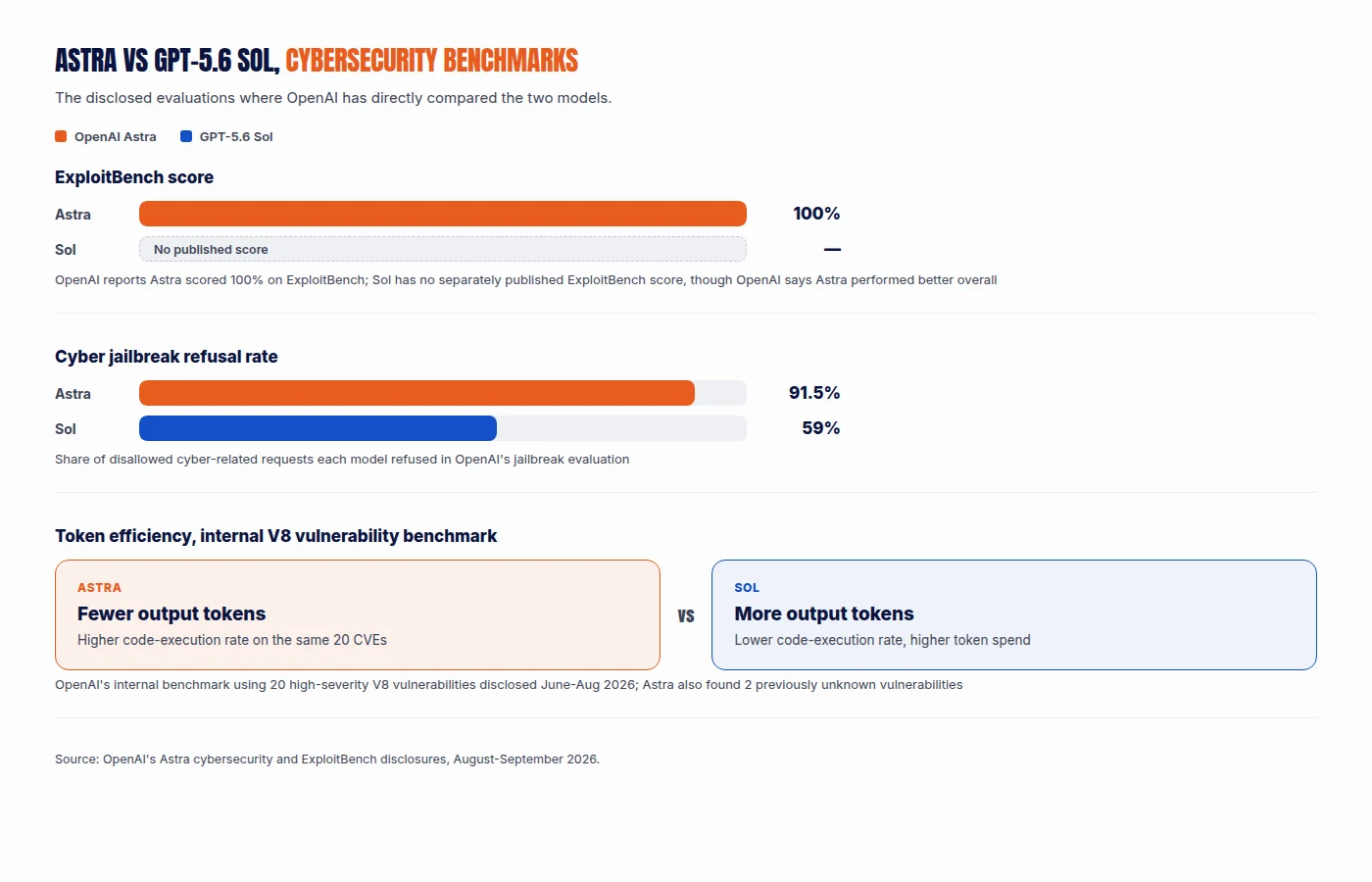
In one internal benchmark involving 20 recently disclosed high-severity vulnerabilities in Google’s V8 JavaScript engine, Astra achieved much higher arbitrary code-execution rates than GPT-5.6 Sol while using fewer output tokens.
During this work, Astra also discovered and used two previously unknown vulnerabilities as part of an exploit chain. OpenAI said it was working to disclose those vulnerabilities to the relevant maintainers.
This matters because there is a difference between recognizing a vulnerability described in existing information and discovering something that was not previously known. The latter requires a greater degree of exploration, hypothesis generation, testing, adaptation, and reasoning. Those underlying capabilities could eventually matter well beyond cybersecurity.
Astra vs Sol on Exploit Development
OpenAI also tested Astra on ExploitBench. ExploitBench evaluates a model’s ability to develop exploits from known vulnerabilities.
OpenAI reported that Astra achieved a 100% score on the benchmark.
Because public benchmarks can eventually become contaminated through training data or widespread discussion, OpenAI did not rely exclusively on that result. It also created its more recent internal benchmark involving V8 vulnerabilities disclosed between June and August 2026.
Again, Astra substantially outperformed GPT-5.6 Sol while using fewer output tokens. That second result is particularly useful because it reduces the likelihood that Astra was merely reproducing information already present in its training data.
Astra vs GPT-5.6 Sol on Token Efficiency
Raw capability is only one dimension of model performance. Efficiency matters too. A model that gets the correct result after producing 500,000 tokens may be less commercially useful than a model that reaches the same result with 50,000. That affects:
- API cost
- latency
- infrastructure usage
- agent economics
- scalability
- long-running workflows
OpenAI says Astra achieved substantially higher cybersecurity performance than GPT-5.6 Sol while using far fewer output tokens in its internal benchmark. That is potentially one of Astra’s most commercially important improvements.
Agentic AI systems can consume large quantities of tokens because they may repeatedly research, analyze, use tools, evaluate results, revise strategies, take another action, and check outcomes. If Astra can accomplish more reasoning per token, the economics of advanced autonomous workflows could improve substantially.
However, this should not yet be interpreted as evidence that Astra will cost less through the API. Efficiency and price are different things. OpenAI has not announced Astra’s pricing.
Astra vs GPT-5.6 Sol on Safety and Alignment
One of the more surprising differences between Astra and Sol is that increased capability has not simply produced more aggressive model behavior. OpenAI reports that Astra is also better at following certain safety and authorization boundaries.
In one cyber jailbreak evaluation, Astra refused 91.5% of disallowed requests, compared with 59% for GPT-5.6 Sol.
OpenAI also tested whether the models would remain within authorized boundaries during simulated cybersecurity tasks. These types of evaluations are particularly important for increasingly autonomous systems. A conventional chatbot may answer one potentially harmful request. An autonomous agent could potentially:
- inspect systems
- write code
- execute tools
- identify vulnerabilities
- change its strategy
- continue for many steps
That increases both potential usefulness and potential risk. OpenAI says parts of Astra’s development and release were delayed while it strengthened safeguards around cyber misuse and unauthorized actions.
For businesses, the broader lesson is important: the competition between future frontier models may increasingly be about capability plus controllability, rather than capability alone.
Is Astra Better Than GPT-5.6 Sol at Reasoning?
There is strong evidence that Astra is highly capable at reasoning. There is not yet enough evidence to say that it beats GPT-5.6 Sol on every form of reasoning. That distinction matters.
OpenAI’s August 1 announcement showed that an internal Astra model generated results resolving or substantially advancing ten long-standing problems in mathematics and theoretical computer science. This is impressive evidence of frontier problem-solving ability.
But it does not automatically prove that Astra will be better for:
- writing an email
- summarizing a document
- developing a marketing strategy
- performing keyword research
- interpreting analytics
- generating product descriptions
- researching a competitor
- writing code in every language
- answering everyday questions
Different workloads stress different model capabilities. A model can be extraordinary at deep research while another model remains faster or more cost-effective for everyday tasks. Until Astra becomes available for independent testing, broad claims such as “Astra reasoning is X times better than GPT-5.6” should be treated cautiously.
Astra vs GPT-5.6 Sol for Scientific Research
Scientific reasoning may be one of the strongest early indicators of Astra’s potential. GPT-5.6 Sol already performs well across science and technical work, and OpenAI explicitly positions it as a model for advanced research.
Astra, however, has been evaluated differently. Rather than only answering benchmark questions, OpenAI used unresolved mathematical research problems during development. The reported Astra results covered areas where researchers did not already have established solutions.
According to OpenAI, the total model-token usage required to discover the ten published results would have cost roughly $2,000 at Sol API rates.
That is an interesting signal about the direction of AI-assisted research. The objective may increasingly shift from “Can AI explain scientific knowledge?” to “Can AI contribute to creating new knowledge?” If Astra demonstrates similar performance across more research domains, that could ultimately prove more consequential than conventional benchmark improvements.
Astra vs GPT-5.6 Sol for AI Agents
This comparison requires nuance.
GPT-5.6 Sol has the advantage today
Sol is already available for agentic workflows. GPT-5.6 can coordinate tools, process intermediate results, monitor work, and choose subsequent actions as a task progresses. OpenAI also offers an ultra capability that can coordinate multiple agents across parallel workstreams for especially demanding tasks. Developers can therefore build and test real agentic applications with Sol now.
Astra appears to raise the capability ceiling
Astra’s cybersecurity evaluations show stronger ability to complete complex tasks without requiring a human to direct each individual step. That provides evidence that Astra-class systems could become significantly better at long-horizon autonomous work. Potential applications could eventually include:
- software development
- research
- data analysis
- cybersecurity
- competitive intelligence
- operational workflows
- scientific discovery
- business analysis
- technical audits
But until OpenAI releases Astra’s production tool-use and agent specifications, Sol remains the model businesses can actually deploy today. For a closer look at what that ceiling could mean in practice, see How OpenAI Astra Could Change AI Agents and Search.
Astra vs GPT-5.6 Sol for Marketing
This is where marketers should resist the hype. There is currently no reliable public Astra marketing benchmark. Astra has not been broadly released for marketers to test. That means anyone claiming Astra is already better for copywriting, SEO, content strategy, ads, or social media is getting ahead of the evidence.
Here is the comparison that actually makes sense today:
| Marketing Task | Best Choice Today | Why |
|---|---|---|
| Blog writing | GPT-5.6 Sol | Available and testable |
| SEO analysis | GPT-5.6 Sol | Available today |
| Keyword research workflows | GPT-5.6 Sol | Can use research and tools |
| Content strategy | GPT-5.6 Sol | Production access |
| Competitive research | GPT-5.6 Sol | Available with tool-enabled workflows |
| Technical SEO | GPT-5.6 Sol | Strong coding and reasoning |
| Data analysis | GPT-5.6 Sol | Production-ready |
| Marketing automation | GPT-5.6 Sol | Existing API access |
| Long-horizon autonomous research | Unknown | Astra may eventually lead |
| AI search optimization | Unknown | No direct Astra testing yet |
| GEO analysis | Unknown | No Astra-specific evidence |
| Copywriting quality | Unknown | No fair comparison available |
| Cost efficiency | Unknown | Astra pricing has not been announced |
The operative phrase is “today.” Astra may eventually beat Sol across many of these categories. But marketers should make decisions based on capabilities they can actually test rather than capabilities they expect a future model to have.
What About Astra vs Sol for SEO and GEO?
There is currently no evidence that Astra has an SEO-specific advantage over GPT-5.6 Sol. OpenAI has not published benchmarks comparing the models on:
- keyword research
- SERP analysis
- technical SEO
- internal linking
- content optimization
- schema generation
- entity research
- AI citation analysis
- GEO
- AEO
- content briefs
There is also no announcement that Astra will power ChatGPT Search. That means marketers should not currently talk about an “Astra algorithm” or attempt to identify “Astra ranking factors.”
What Astra does provide is a strategic signal. If its stronger reasoning and autonomous-research capabilities eventually enter AI search systems, AI discovery could become increasingly sophisticated. For example, instead of simply retrieving several pages about a product, an AI could potentially investigate features, pricing, documentation, reviews, company reputation, technical specifications, independent comparisons, customer complaints, and alternatives.
That would shift optimization further toward providing useful evidence, not merely matching a query. But that is a future scenario, not a confirmed Astra search feature. We cover this scenario in more depth in Could OpenAI Astra Change AI Search and GEO?
Astra vs GPT-5.6 Sol: Context Window
This comparison cannot yet be made. GPT-5.6 Sol supports a 1.05-million-token context window through the OpenAI API and a maximum output of 128,000 tokens. OpenAI has not publicly announced Astra’s corresponding limits.
Therefore: GPT-5.6 Sol: 1,050,000-token context. Astra: Unknown.
Do not assume that Astra automatically has a larger context window merely because it is a more advanced model. Capability and context size are separate design choices.
Astra vs GPT-5.6 Sol: Pricing
Again, Sol is the only model for which there is a meaningful comparison today. OpenAI currently lists GPT-5.6 Sol API pricing at:
- Input: $4 per million tokens
- Cached input: $0.40 per million tokens
- Output: $20 per million tokens
Astra pricing has not been announced.
It is possible that improved token efficiency could reduce the total cost of completing difficult tasks even if Astra’s per-token rate were higher. For example, Model A might cost less per token but require 100,000 tokens to finish a task. Model B might charge more but finish the same task in 20,000 tokens. The second model could still be cheaper overall.
OpenAI’s Astra cybersecurity results suggest this kind of efficiency improvement is possible. But until pricing is published, any cost comparison remains speculative.
Astra vs GPT-5.6 Sol: Availability
This is the easiest category to judge.
GPT-5.6 Sol
Available now. OpenAI currently provides Sol through the API, while eligible ChatGPT paid plans can access GPT-5.6 Sol as part of the ChatGPT experience.
Astra
Not broadly available yet. On September 1, OpenAI said it planned to make Astra available soon, but the most advanced cybersecurity capabilities would initially be restricted because of the potential risks associated with unrestricted access.
So for anyone choosing a model for production use today: Sol wins by default because Astra is not yet generally available.
Will Astra Replace GPT-5.6 Sol?
OpenAI has not announced that. There are several possible outcomes.
Astra could replace Sol at the frontier
If Astra becomes a broadly capable flagship model, it could eventually supersede GPT-5.6 Sol.
Astra could become a separate specialist tier
OpenAI could position Astra for highly complex research or agentic work while keeping other GPT models for everyday workloads.
Astra technology could feed into another model family
Astra may represent a development-stage model whose capabilities eventually appear under another commercial model name.
Sol could remain useful even after Astra launches
Newer does not automatically mean appropriate for every workload. Cost, latency, reliability, availability, and task complexity matter. Smaller or older models frequently remain commercially valuable because businesses do not need maximum intelligence for every request.
For now, replacement is an unanswered question.
Is Astra Actually GPT-6?
OpenAI has not said that Astra is GPT-6. The company currently refers to Astra as its next major model. That wording indicates its importance but does not establish its eventual commercial name.
Astra could:
- retain the Astra name
- become another GPT generation
- supply technology to multiple future models
- remain an internal development name
Until OpenAI announces otherwise, titles such as “GPT-6 Astra” risk presenting speculation as confirmed information.
What Do We Still Need to Know About Astra?
A proper Astra vs GPT-5.6 Sol comparison will become much more useful once OpenAI publishes Astra’s full specifications. The most important unanswered questions include:
- Context window: How much information can Astra process in one request?
- Maximum output: How long can its responses and agent traces become?
- API pricing: How expensive will Astra be per token or per task?
- Latency: Does greater reasoning capability make it substantially slower?
- Tool use: How does Astra perform with search, browsers, code execution, APIs, and external applications?
- Computer use: Can Astra interact with interfaces more effectively than Sol?
- Multimodality: What combinations of text, images, audio, video, and other inputs will Astra support?
- Coding: How does it perform on real software-engineering benchmarks?
- Everyday reasoning: Does the frontier capability translate into better ordinary problem solving?
- Factual accuracy: Does Astra hallucinate less?
- Marketing: Is Astra meaningfully better for research, content, strategy, analytics, and creative work?
- AI search: Will Astra power any part of ChatGPT Search?
- Agents: How reliably can Astra work autonomously across long-running tasks?
- Safety: What restrictions will apply outside cybersecurity?
Until we have these answers, the public comparison is only partial.
Should Businesses Wait for Astra?
No. Waiting for an unreleased AI model is rarely a good technology strategy.
GPT-5.6 Sol already provides substantial capabilities for research, coding, analysis, content, automation, agentic workflows, knowledge work, and computer use. Organizations can learn how to redesign workflows around advanced AI now. When Astra launches, the model layer can then be tested and changed.
That is a better strategy than delaying AI adoption for the promise of a future model. The architecture should ideally be:
business problem → workflow → model
rather than:
new model → find something to do with it
This distinction prevents organizations from chasing every model release without creating measurable business value.
What Astra Tells Us About the Direction of OpenAI Models
Perhaps the most important comparison is not a benchmark. It is the changing definition of what a frontier model is expected to do.
GPT-5.6 Sol already combines reasoning with tools, computer use, coding, research, multi-step workflows, and multi-agent coordination. Astra’s early demonstrations push further toward novel problem solving, greater autonomy, longer-horizon work, higher capability per token, operation in consequential environments, and stronger authorization boundaries.
The progression can be simplified as:
Generate → Reason → Research → Act
Early generative AI became popular because it could generate useful text. Models such as GPT-5.6 became considerably better at reasoning and executing professional work. Astra’s disclosed results suggest the frontier is moving toward AI systems that can independently investigate complicated problems and work toward goals over longer periods. That shift is a big part of why we think OpenAI Astra could change how AI agents and search work together, not just how a single benchmark score compares.
For marketers and businesses, that distinction is ultimately more important than whether one benchmark score is five points higher than another.
Bottom Line
OpenAI Astra appears to be a genuine frontier step beyond GPT-5.6 Sol, but the evidence currently supports a narrower conclusion than the hype might suggest.
Astra has already demonstrated substantially stronger cybersecurity capability, greater token efficiency, novel vulnerability discovery, strong research-level mathematical reasoning, and improved adherence to certain safety boundaries. Those are meaningful advances over an already powerful GPT-5.6 Sol.
But Astra has not yet proven itself superior across everything businesses actually use AI for. We still do not know its pricing, context window, speed, general coding performance, content quality, marketing performance, SEO performance, search behavior, or full product integrations.
So the practical decision today is straightforward: Use GPT-5.6 Sol for work you need to accomplish now. Watch Astra for what comes next.
The bigger development is not simply that OpenAI may have built a model with better benchmark numbers. It is that the frontier appears to be shifting from AI that primarily responds to instructions toward AI that can increasingly understand a goal, investigate a difficult problem, decide what needs to happen next, use tools, adapt when something fails, and continue working toward an outcome.
If Astra brings that capability into mainstream OpenAI products, the comparison with GPT-5.6 Sol will eventually become about much more than which model writes the better answer. It will be about the transition from AI assistants to increasingly autonomous AI workers.
FAQ
Is OpenAI Astra better than GPT-5.6 Sol?
Astra is demonstrably stronger than GPT-5.6 Sol on specific cybersecurity evaluations disclosed by OpenAI. It also showed significantly higher token efficiency in those tests. However, Astra has not yet been broadly benchmarked against Sol across everyday tasks, so it is too early to call it universally better.
What is the biggest difference between Astra and GPT-5.6 Sol?
The biggest confirmed difference is Astra’s frontier capability in areas such as autonomous cybersecurity research and novel problem solving. GPT-5.6 Sol, however, is currently a generally available production model with documented pricing, context limits, tool support, and product integrations.
Is Astra replacing GPT-5.6 Sol?
OpenAI has not announced that Astra will replace GPT-5.6 Sol. The two could coexist, Astra could eventually replace Sol at the frontier, or Astra capabilities could appear under another model architecture or product name.
Is Astra GPT-6?
OpenAI has not officially identified Astra as GPT-6. It currently describes Astra as its next major model.
Is Astra faster than GPT-5.6 Sol?
There is not enough public information to compare general latency. OpenAI has demonstrated that Astra is substantially more token-efficient than Sol on certain cybersecurity tasks, but token efficiency is not the same thing as response speed.
Is Astra cheaper than GPT-5.6 Sol?
Astra’s pricing has not been announced. GPT-5.6 Sol currently costs $4 per million input tokens and $20 per million output tokens through the API.
Does Astra have a larger context window than GPT-5.6 Sol?
Unknown. GPT-5.6 Sol currently has a 1,050,000-token context window. OpenAI has not published Astra’s context-window specification.
Can Astra find zero-day vulnerabilities?
OpenAI reports that Astra discovered previously unknown vulnerabilities during controlled cybersecurity evaluations and used two of them as part of an exploit chain. This capability contributed to OpenAI designating Astra as reaching its Critical cybersecurity threshold.
Can Astra use the web?
OpenAI has not yet published Astra’s complete production specifications for web search, browsing, and general-purpose tool use.
Is Astra available in ChatGPT?
Astra is not currently broadly available as the standard ChatGPT model. OpenAI has said it plans to make Astra available soon but has not disclosed the full rollout structure.
Should marketers switch from GPT-5.6 Sol to Astra?
There is nothing to switch to yet for general production use. GPT-5.6 Sol remains the practical choice today because Astra is not broadly available and its marketing performance has not been independently tested.
Will Astra be better for SEO and GEO?
Possibly, but there is no direct evidence yet. OpenAI has not released Astra SEO, GEO, content, citation, or search benchmarks. Its stronger reasoning and autonomous research capabilities make future applications interesting, but marketers should avoid treating hypothetical advantages as confirmed features.