If you only came here for that paragraph, you have what you need. Everything below is the detail worth knowing if you’re actually going to run a campaign, brief a client on one, or just understand how a chatbot ended up with an ad business.
The Timeline, in Order
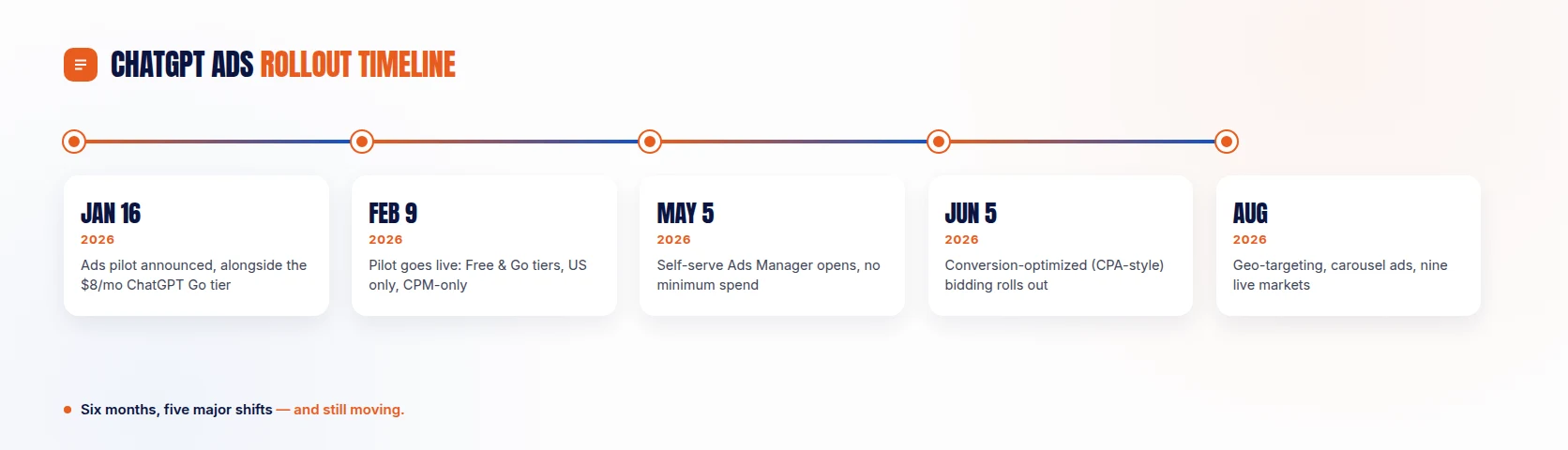
The rollout happened faster than most people tracking it expected, and the chronology matters because early coverage of “ChatGPT ads” is often describing a version of the product that no longer exists.
| Date | What Happened |
|---|---|
| January 16, 2026 | OpenAI announces it will begin testing ads, alongside the worldwide launch of the $8/month ChatGPT Go tier |
| February 9, 2026 | Ads go live for logged-in adult users on Free and Go tiers in the US, CPM-only, managed pilot with a $50,000–$200,000 monthly minimum |
| May 5, 2026 | Self-serve Ads Manager opens at ads.openai.com; minimum spend requirement removed; CPC bidding added alongside CPM |
| June 5, 2026 | Conversion-optimized (CPA-style) bidding begins rolling out for accounts with conversion tracking live |
| August 2026 | Automated “Maximize results” bidding becomes the default strategy; US state, DMA, and ZIP-level geo-targeting added; a multi-product carousel ad format ships for product feed campaigns; the platform expands to nine markets (US, UK, Canada, Australia, New Zealand, Japan, South Korea, Brazil, with Mexico announced); 31 European markets are listed as coming soon, opening first through agency and technology partners |
Treat that last row as a snapshot rather than a finish line. OpenAI has been shipping changes to this product roughly every few weeks since May, and the market list in particular has moved twice since August began.
Who Actually Sees These Ads
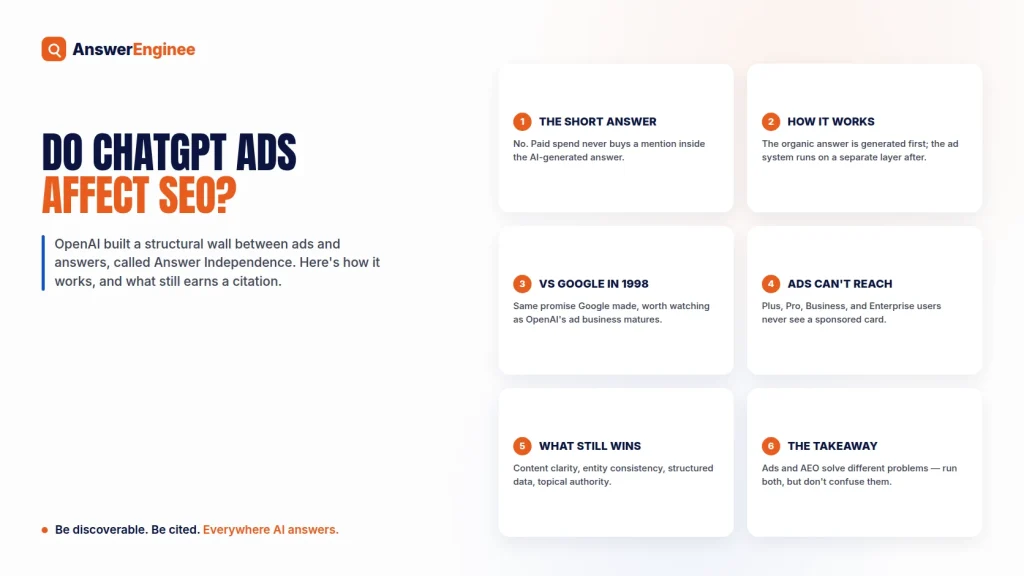
Ads only appear for logged-in users 18 and older on the Free tier or the ChatGPT Go plan, in a market where the program has launched. Plus, Pro, Business, Enterprise, and Education subscribers never see an ad, on any query, in any market. OpenAI has also excluded certain conversation categories from ad eligibility entirely, including politics, health, and mental health topics, regardless of which tier the user is on.
That exclusion of every paid tier is worth sitting with. It means the audience ChatGPT Ads can reach is structurally the free and lowest-cost users of the product, not the Plus and Enterprise subscribers who tend to use ChatGPT most heavily for work and carry more purchasing authority. Whatever a campaign is trying to accomplish, it’s reaching a specific slice of ChatGPT’s user base by design, not the whole thing.
What an Ad Actually Looks Like
The format is deliberately small. A ChatGPT ad is a single “Sponsored” card that appears below a relevant answer, containing a brand name, a favicon, a short title (16 to 24 characters), a short line of copy (32 to 48 characters), one square image, and a link to a landing page. As of August 2026, a multi-product carousel format is also available for product-feed campaigns, useful for ecommerce advertisers with a catalog to show rather than a single offer.
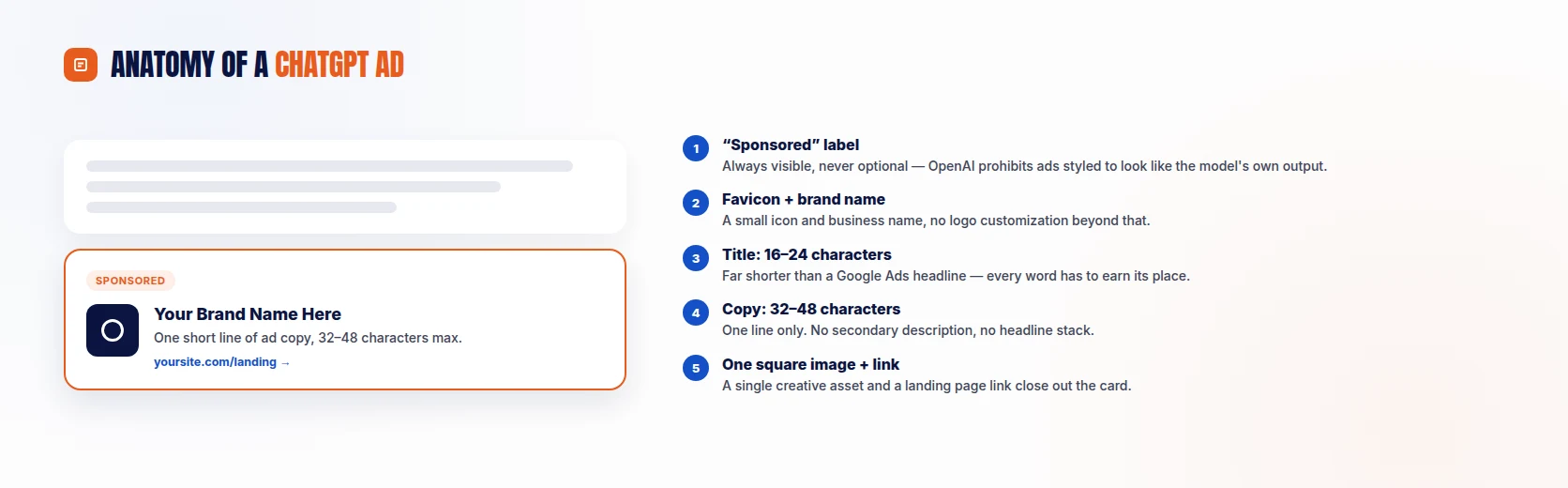
It’s a much smaller unit than a Google Ads text ad or a Meta feed placement. There’s no room for a headline stack, no secondary description line, no display URL customization beyond the favicon. Advertisers coming from mature ad platforms tend to underestimate how much that character limit narrows what a single ad can say, and it’s worth writing several versions before assuming the first draft fits the format’s constraints well.
How Targeting Works
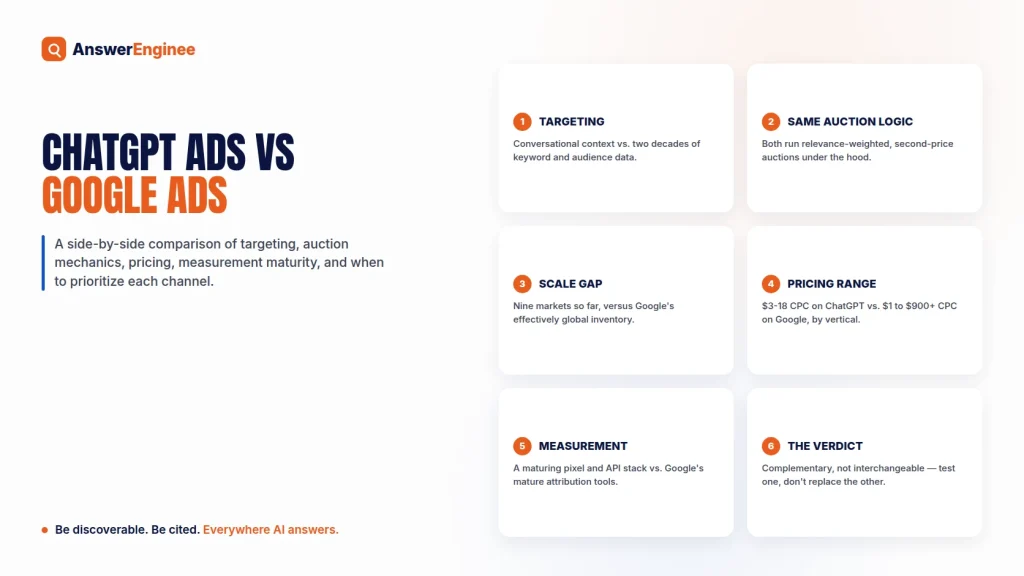
ChatGPT Ads doesn’t run on keyword bidding, and it doesn’t give advertisers access to a user’s chat transcripts. Instead, advertisers write plain-language “context hints” describing the kinds of conversations where an ad should be eligible to appear, and the system matches those hints against the live conversation’s topic in real time.
Targeting has expanded well beyond that base layer since the self-serve launch. As of August 2026, advertisers can add:
- Custom audiences built from uploaded email or phone lists, including hashed versions, for inclusion or exclusion
- US state, DMA, and ZIP-level geo-targeting, a meaningful upgrade from the country-only targeting available at self-serve launch
- Platform targeting, aiming campaigns at specific ChatGPT surfaces
- Automatic Advanced Matching, which uses hashed customer data collected through website forms to improve conversion match rates, and which became the default for new web pixels in August 2026
There’s still no interest or demographic layer in the way Meta or even Google’s audience targeting works. Relevance comes from the conversation itself and from first-party data an advertiser brings, not from an inferred profile of who the user is.
How the Auction and Pricing Work
Every eligible conversation triggers an auction across advertisers whose context hints match. OpenAI runs a relevance-weighted, second-price auction: an ad’s effective bid combines the advertiser’s max bid with a relevance score, the highest effective bid wins, and that advertiser pays one cent more than the second-highest effective bid. Anyone who has worked in Google Ads will recognize the shape of this immediately. It’s structurally close to how Quality Score interacts with bid amount in Google’s own auction.
Pricing has shifted since launch. The original managed pilot ran on a $60 CPM default. Self-serve access added CPC bidding, with a recommended starting max bid around $3 to $5 per click. Conversion-optimized bidding followed in June, and by August, an automated “Maximize results” strategy had become the default approach for new campaigns, meaning OpenAI’s own bidding algorithm handles bid adjustments rather than requiring a fixed manual max.
Setting Up a Campaign
Getting started requires an account at ads.openai.com, approved for a business registered in one of the currently supported markets. There’s no minimum spend on the self-serve tier. A campaign is built around three layers: the campaign itself (objective, budget, dates), an ad group (a theme with its context hints), and the ad creative (title, copy, image, landing page, favicon). Campaigns can be built through a guided workflow or uploaded in bulk with a schema template, and every campaign goes through review before it’s eligible to serve.
Measurement runs through a pixel and a server-side Conversions API, plus one-day view-through conversion reporting added in August. Several attribution and analytics platforms, including Triple Whale, Sonar Optimize, and Hightouch, now support integrations with ChatGPT Ads, which helps advertisers compare this channel’s performance against everything else in their stack rather than treating it as an isolated silo.
What’s Still Missing
For a platform six months old, ChatGPT Ads has moved quickly, but a few real gaps remain compared to Google Ads or Meta Ads Manager. There’s no interest or demographic targeting layer. Ad tech integration is still building out, with Adobe, Criteo, Kargo, Pacvue, and StackAdapt among the early partners rather than the deep, decades-old ecosystem Google Ads has. And the audience ceiling is structural: until paid ChatGPT tiers are reachable, which OpenAI has given no indication of changing, this remains a Free and Go tier channel only.
Frequently Asked Questions
When did ChatGPT ads officially launch?
OpenAI announced the ads pilot on January 16, 2026, and began showing ads to logged-in adult users on the Free and ChatGPT Go tiers in the US on February 9, 2026. Self-serve access opened May 5, 2026, and the platform has continued adding features and markets roughly every few weeks since.
Who can see ChatGPT ads?
Only logged-in users 18 and older on the Free tier or the ChatGPT Go plan, in a market where the program has launched. As of August 2026 that includes the US, UK, Canada, Australia, New Zealand, Japan, South Korea, and Brazil, with Mexico announced and 31 European markets listed as coming soon. Plus, Pro, Business, Enterprise, and Education subscribers do not see ads in any market.
Do ChatGPT ads use my chat history for targeting?
Targeting relies on contextual signals from the live conversation and advertiser-defined context hints, plus any first-party data an advertiser uploads directly, such as a hashed customer list. Reporting is aggregated at the campaign level and doesn’t expose conversation-level detail to advertisers.
Is there a minimum budget to advertise on ChatGPT?
No, not on the self-serve tier. The original managed pilot required a monthly minimum in the tens or hundreds of thousands of dollars; the self-serve Ads Manager launched May 5, 2026 removed that requirement, and reported starting points now sit around a $25 minimum daily budget with a $3 to $5 recommended max CPC.
Can I target ChatGPT ads by city or state?
Yes, as of the August 2026 update. State, DMA, and ZIP-level geo-targeting are now available in the US, an upgrade from the country-only targeting that existed when self-serve first launched in May.