The short answer is no. ChatGPT ads do not affect what ChatGPT recommends organically. OpenAI has built a structural wall between the ad system and the answer-generation system, and it’s given that wall a name: Answer Independence. It’s one of five advertising principles OpenAI has published, alongside mission alignment, conversation privacy, choice and control, and long-term value. In plain terms, it means a sponsored placement never buys a mention inside the actual AI response. It buys a separate, clearly labeled box that sits below it.
That’s the fact everyone searching this question wants confirmed. What’s more useful is understanding why that separation exists, how it compares to what happened on Google, and what actually still matters if you want ChatGPT to mention your brand for free.
What ChatGPT Ads Actually Are, in One Sentence
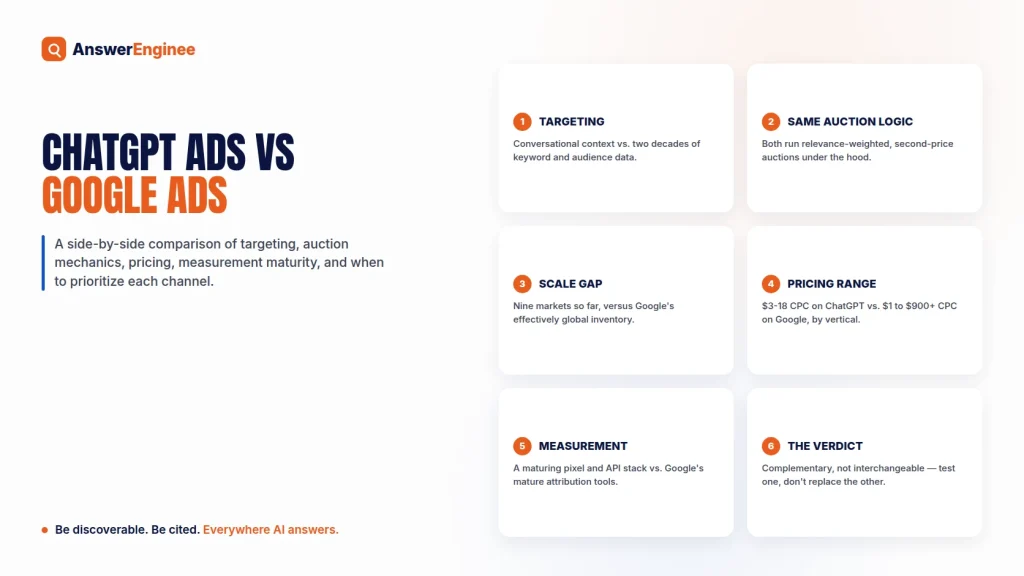
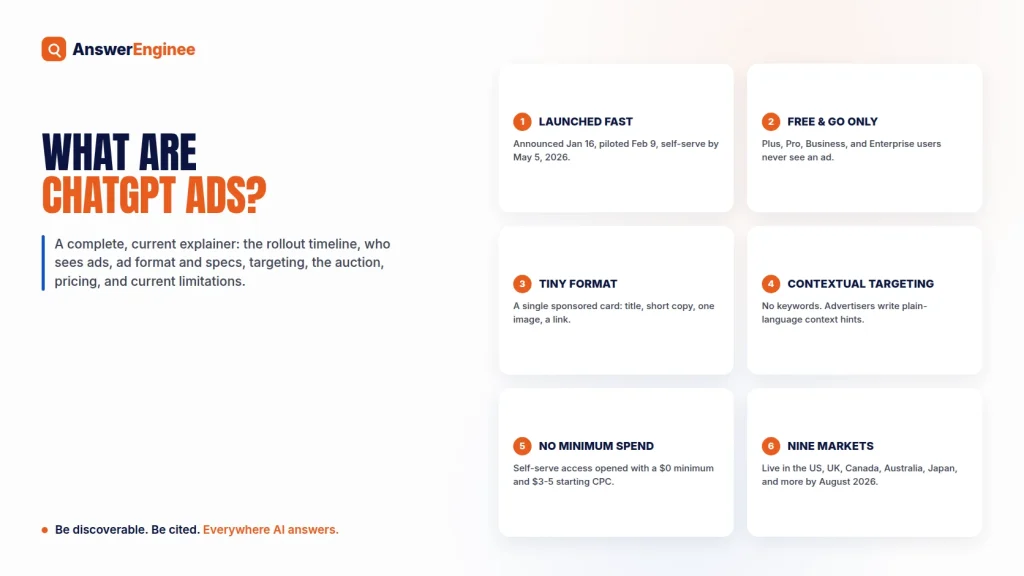
ChatGPT ads are sponsored, “Sponsored”-labeled cards that appear beneath a ChatGPT answer for logged-in adult users on the Free and ChatGPT Go tiers. OpenAI began testing them on February 9, 2026 for logged-in Free and Go users in the US, opened a self-serve Ads Manager to all US advertisers on May 5, 2026, and has since expanded the program well beyond that first market: Canada, Australia, and New Zealand by June 2026, the UK shortly after, then Mexico and Brazil, then dozens of European countries and additional markets like Japan and South Korea by August 2026, with the pace of expansion accelerating. If you want the full mechanics of how the ad auction and targeting work, that’s a separate topic worth its own read. This piece is about the one question that sits underneath all of it: does paying for one of these placements change what the model says when nobody’s paying?
The Mechanism Behind Answer Independence
The reason OpenAI can make that claim with a straight face isn’t goodwill. It’s architecture. The organic answer is generated first, by the same processes ChatGPT has always used: training data, web retrieval, and whatever synthesis logic produces a response to your question. The ad system runs on a separate layer that gets consulted afterward, purely to decide whether a relevant sponsored card should be attached to that answer. Advertisers write plain-language “context hints” describing the kinds of conversations where their ad should show up, and an auction picks a winner. None of that touches the model’s reasoning about what to actually tell you.
OpenAI’s advertiser policy goes further than most people expect here. It explicitly prohibits ad copy that implies ChatGPT has endorsed or recommended a product, and it prohibits ads styled to look like the model’s own output. Those aren’t small print. They’re the company protecting the one thing its whole ad business depends on: if users start suspecting the answers are for sale, the inventory becomes worthless, because nobody clicks a recommendation they don’t trust.
Where This Differs From What Happened to Google
It’s fair to be skeptical here, because this isn’t the first time a platform has promised to keep ads and organic results apart. Google made a similar promise in 1998 and, over two decades, the line between paid and organic on a results page got visibly thinner. Sponsored listings started looking more like organic ones. Shopping results, local packs, and ad units pushed the “ten blue links” further down the page even when nothing about the ranking algorithm itself changed.
So the honest version of this answer isn’t “trust OpenAI forever.” It’s “here’s the structural reason it’s true right now, and here’s what would have to change for that to stop being true.” ChatGPT’s ad format is a single labeled card, visually distinct from the conversational response above it. There’s no equivalent yet to how Google’s paid shopping carousel eventually looked almost indistinguishable from an organic product grid. Whether that stays true as OpenAI’s ad business matures and starts chasing more revenue is a fair thing to keep watching, not something to assume either way.
What Still Determines Organic AI Visibility
If ad spend doesn’t move the needle on organic citation, something else does. The same fundamentals that have always driven AEO performance are what determine whether ChatGPT mentions your brand for free:
Content clarity. ChatGPT tends to cite sources that answer a specific question directly and early, not sources that bury the answer under throat-clearing.
Entity consistency. If your business is described the same way, with the same facts, across your own site and the rest of the web, models have an easier time trusting and surfacing that information confidently.
Structured data. Schema markup doesn’t force a citation, but it helps the model parse who you are, what you do, and how your content is organized.
Topical authority. Consistent, genuinely useful coverage of a subject area builds the kind of signal that shows up across training data and retrieval results over time, not from a single optimized page.
None of that changes because ChatGPT now runs ads. If anything, it matters more, for a reason worth sitting with for a second.
The Audience Ads Can’t Reach
ChatGPT ads only show up for Free and ChatGPT Go users. Plus, Pro, Business, and Enterprise subscribers never see a sponsored card, on any query, in any market. Those paid tiers skew toward people who use ChatGPT constantly, often for work, often with real budget authority behind their decisions. No amount of ad spend reaches that audience. The only way to show up in front of a Plus or Enterprise user is to be the thing the model says organically.
That’s the practical stakes of this whole question. Ads and AEO aren’t competing for the same budget line so much as they’re covering different rooms. One reaches people on the free tier who are willing to see a sponsored card. The other reaches everyone, including the users advertising literally cannot touch.
What to Actually Do About It
Run both, if you have the resources, but understand what each one is for. Ads buy fast, guaranteed, measurable visibility for a specific slice of ChatGPT’s audience. AEO investment builds citation likelihood that compounds across every AI engine your customers use, not just ChatGPT, and reaches the subscribers who never see an ad at all. Treat a ChatGPT ad campaign as useful early signal on what messaging resonates, then feed anything you learn back into the organic content you’re building for citation. Neither one buys the other. That’s the whole point of the wall OpenAI built, and so far, the evidence says it’s holding.
Frequently Asked Questions
Can I pay to get my brand mentioned inside a ChatGPT answer?
No. OpenAI’s ad product places a labeled sponsored card in a separate slot below a response. It does not buy placement inside the AI-generated answer itself. Getting mentioned inside the actual answer still depends on unpaid factors: how clearly your content answers the question, how authoritative your site appears to the model, and whether your information is structured in a way the model can extract and cite with confidence.
Will ChatGPT ads make organic AEO less important?
If anything, the opposite. Ads only reach Free and ChatGPT Go users, a fraction of ChatGPT’s total usage, since Plus, Pro, Business, and Enterprise tiers stay ad-free. Anyone on a paid subscription only ever sees organic answers, so AEO remains the only lever for reaching that audience.
Is this similar to how Google Ads and organic SEO interact?
Structurally, yes. A paid slot sits alongside an unpaid result, and OpenAI has drawn a clear line between the two systems. The practical difference is format: a ChatGPT ad is a single sponsored card appended after a conversational answer, not a set of listings competing visually for the same space the way a Google results page works.
What is OpenAI’s Answer Independence principle?
It’s one of five advertising principles OpenAI has published for ChatGPT ads, alongside mission alignment, conversation privacy, choice and control, and long-term value. Answer Independence specifically commits that advertiser spend, identity, or campaign activity has no influence on the organic answers ChatGPT generates, because the ad system and the answer-generation system run on separate layers.
Should I still invest in AEO if I’m already running ChatGPT ads?
Yes. Ads and AEO solve different problems. Ads buy immediate visibility for a defined, ad-eligible audience. AEO builds the kind of citation likelihood that shows up across ChatGPT, Perplexity, Gemini, and Claude simultaneously, reaches ChatGPT’s paid-tier users that ads can never touch, and keeps working without ongoing spend once the underlying content and authority are in place.