That’s the summary. The rest of this comes down to where the two platforms actually differ in practice, because the differences aren’t cosmetic. They change what kind of campaign each one is good for.
Side by Side
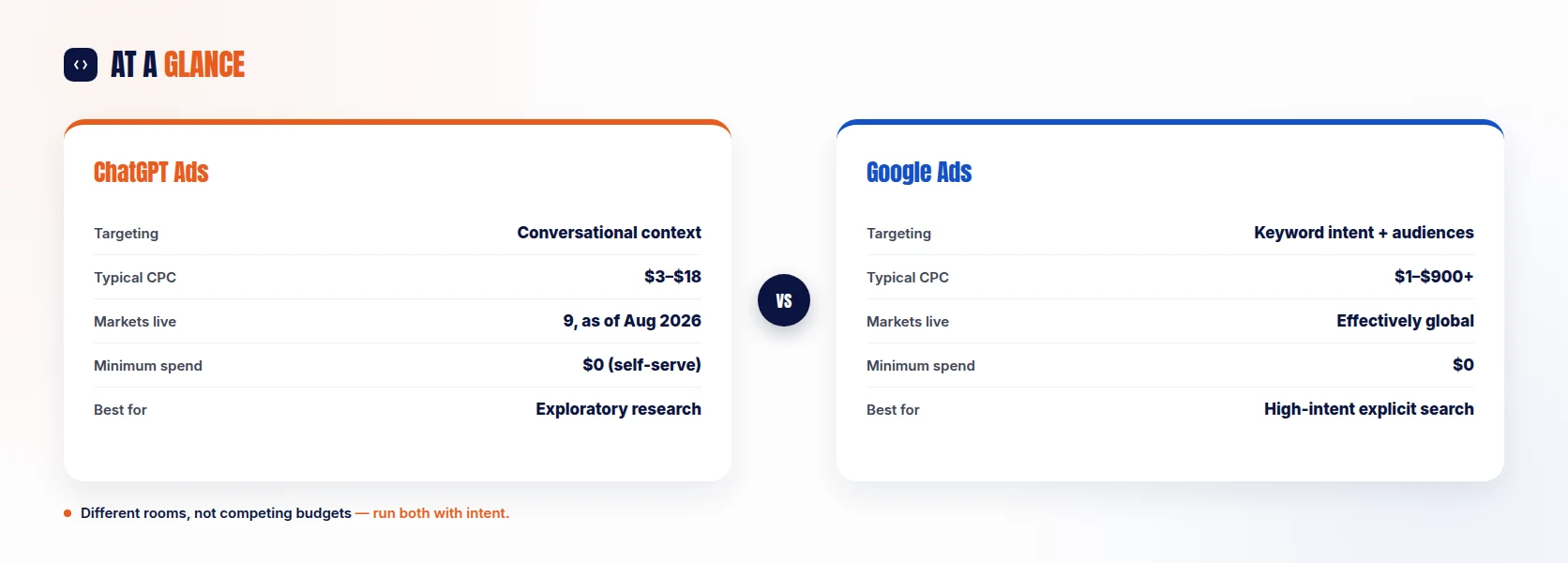
| ChatGPT Ads | Google Ads | |
|---|---|---|
| Targeting mechanism | Contextual match against conversation topic + advertiser “context hints” | Keyword intent, plus audience, remarketing, and demographic layers |
| Geo-targeting | US state, DMA, and ZIP-level as of August 2026; country-level elsewhere | Full local targeting: country, region, city, radius, in most markets |
| Pricing model | CPC ($3–5 typical start, $8–18 in competitive verticals) or CPM ($25–60) | CPC (roughly $1–2 average on Search, into the hundreds in competitive verticals) |
| Minimum spend | None on self-serve; ~$25/day minimum daily budget | None |
| Auction type | Relevance-weighted second-price | Quality Score-weighted second-price |
| Markets live | Nine, as of August 2026 (US, UK, Canada, Australia, New Zealand, Japan, South Korea, Brazil, Mexico) | Effectively global |
| Measurement | Pixel + Conversions API, aggregated reporting, ecosystem still building | GA4, Search Ads 360, Skai, deep native attribution |
| Ad tech integrations | Early-stage: Adobe, Criteo, Kargo, Pacvue, StackAdapt | Mature, decades-deep ecosystem |
| Best fit | Exploratory, comparison-stage research conversations | Bottom-funnel, high-intent explicit search |
Targeting: Keyword Intent vs. Conversational Context
Google Ads has spent twenty years building targeting around a search query. Someone types “best CRM for small business,” and an advertiser bids to appear against that exact phrase, refined by match type, negative keywords, audience layering, and remarketing lists built from past site visits.
ChatGPT doesn’t work off a query string the same way. It works off a conversation. An advertiser writes plain-language context hints describing the kinds of conversations where an ad should be eligible, and the system decides in real time whether the current exchange matches closely enough to trigger the auction. There’s no keyword list to build, no match type to choose, and no access to the user’s chat history beyond the live conversation itself.
The practical effect: ChatGPT Ads targeting is coarser and more topic-based, while Google Ads targeting is precise and query-based. A campaign built for Google’s granularity won’t translate directly. Context hints need to describe a topic area broadly enough to match real conversations, not a specific search phrase.
The Auction, and Why It’ll Feel Familiar
Anyone who understands how Quality Score interacts with bid amount in Google Ads already understands most of how ChatGPT’s auction works. Both platforms run a relevance-weighted, second-price auction: the winning bid isn’t necessarily the highest raw number, it’s the highest bid once relevance is factored in, and the winner pays just enough to clear the next-highest competitive bid rather than their own ceiling.
That parallel matters practically. A ChatGPT ad with strong relevance to the conversation it’s appearing in can outcompete a higher raw bid with weak relevance, the same way a high Quality Score keyword can win against a bigger spender with sloppy ad copy on Google. The lesson media buyers already know from Google Ads carries over directly: relevance is a lever, not just budget.
Scale: A Much Smaller Room Right Now
Google Ads inventory spans essentially every search Google processes, across nearly every market on earth, with mature remarketing pools built from years of site-visit data. ChatGPT Ads reaches logged-in adult users on the Free and ChatGPT Go tiers, in nine markets as of August 2026, and only within conversations that trigger an eligible context match. Plus, Pro, Business, and Enterprise subscribers never see an ad at all.
That’s a genuinely smaller surface. What it may lack in scale, some early advertiser data suggests it partly makes up in intent quality: a user mid-conversation, actively working through a decision, is a different kind of attention than a scrolled-past feed impression. Whether that intent premium holds up as the platform scales and more advertisers compete for the same inventory is still an open question, not a settled one.
Measurement: Mature vs. Maturing
Google Ads plugs into two decades of attribution infrastructure. GA4, Search Ads 360, Skai, and a long list of native and third-party tools all exist specifically to make Google Ads performance measurable down to a granular level.
ChatGPT Ads measurement is newer. A pixel and a server-side Conversions API cover the basics, reporting includes impressions, clicks, spend, CTR, average CPC/CPM, and conversions, and one-day view-through reporting was added in August 2026. Several attribution platforms, including Triple Whale, Sonar Optimize, and Hightouch, now support ChatGPT Ads integrations, which helps close the gap. But the ecosystem is still younger, and conversion tracking on the platform is, by most accounts, still maturing rather than fully settled.
Pricing: Not Directly Comparable, But Here’s the Range
Google Ads pricing varies enormously by vertical. Cross-industry average search CPC sits in the $5 range, but that number means little on its own: logistics and healthcare often run $20–40, home services $75–100, SaaS $250–300, and insurance can clear $900 or more per click.
ChatGPT Ads CPC generally runs $3–5 for general categories, climbing to $8–18 in competitive verticals like software and finance. CPM has settled well below its $60 launch-era default, with real-world clearing rates commonly reported in the $25–45 range as inventory has scaled.
Read those numbers as directional rather than fixed. Both platforms run live auctions, and the number that matters is what your specific vertical and creative actually clear at, not a published average.
When to Prioritize Which
Bottom-funnel, high-intent explicit search, someone who already knows what they want and is searching for where to buy it, still belongs on Google Ads. That’s the exact moment Google Ads was built to catch, and its targeting depth and measurement maturity make it the more reliable channel for that job today.
Exploratory, comparison-stage research, someone working through options in a conversation rather than typing a decided query, is where a ChatGPT Ads test budget makes the most sense right now. It’s a newer surface with less competition, a genuinely different kind of attention, and low enough cost to test without a large commitment.
How Much to Budget for a First Test
With no minimum spend requirement and a roughly $25 daily minimum, there’s little reason not to test ChatGPT Ads with a modest, defined budget rather than skip it entirely. A few thousand dollars over a month is enough to see real click and conversion data, learn whether your context hints and creative are working, and decide whether to scale before committing more. Treat it the way any new channel test should be treated: a bounded experiment with a clear read on performance, not a reallocation of an already-working Google Ads program.
Frequently Asked Questions
Is ChatGPT Ads cheaper than Google Ads?
It depends heavily on the vertical. ChatGPT’s $3–5 typical starting CPC sits below median Google Ads CPCs in many competitive B2B categories like SaaS or insurance, but above Google’s cheaper formats like Shopping or Display. ChatGPT’s CPM, in the $25–60 range, runs higher than typical display CPMs, closer to premium inventory like LinkedIn. Direct comparison is difficult because the platforms measure different things: a ChatGPT ad sits inside a single conversational moment, not a competitive results page.
Can I target ChatGPT ads by location the way I can with Google Ads?
Closer than before, but not to the same depth. As of August 2026, ChatGPT Ads Manager added US state, DMA, and ZIP-level geo-targeting, a real upgrade from the country-only targeting available at self-serve launch. Google Ads still offers more granular options, including radius targeting and availability across nearly every market globally, compared to ChatGPT’s nine live markets.
Should I move my Google Ads budget to ChatGPT Ads?
Most marketers are treating ChatGPT Ads as a supplementary test rather than a replacement. Google Ads still has far more inventory, targeting depth, and measurement maturity. ChatGPT Ads offers a newer surface with less competition and potentially higher-intent placement, which makes it worth testing with a modest, separate budget rather than reallocating spend from a channel that’s already working.
Does ChatGPT Ads use the same kind of auction as Google Ads?
Yes, structurally. Both run a relevance-weighted, second-price auction, where the winning bid combines the advertiser’s max bid with a relevance score, and the winner pays just enough to clear the next-highest competitive bid. Anyone familiar with how Quality Score interacts with bid amount on Google Ads will recognize the same underlying logic on ChatGPT.
What’s the biggest measurement gap between the two platforms?
Google Ads benefits from two decades of mature, granular attribution tooling, including native integrations with GA4, Search Ads 360, and Skai. ChatGPT Ads offers a pixel and server-side Conversions API with aggregated, campaign-level reporting, and while third-party integrations with platforms like Triple Whale and Hightouch are expanding the ecosystem, it remains newer and less battle-tested than Google’s measurement stack.