Quick Answer
OpenAI has not announced that Astra will power ChatGPT Search, so there is no confirmed “Astra ranking algorithm” or Astra-specific GEO strategy today.
What Astra does provide is an important signal about where frontier AI is heading.
OpenAI says Astra is its upcoming major model and has demonstrated significantly stronger autonomous cybersecurity capability than GPT-5.6 Sol, including more advanced vulnerability discovery, exploit development, and long-horizon task completion. These capabilities suggest that future AI systems could become better at breaking complex questions into smaller research tasks, examining multiple sources, testing competing claims, and forming conclusions from stronger evidence.
If Astra-class reasoning eventually reaches AI search products, GEO may shift further away from simply optimizing pages around queries and toward making information discoverable, understandable, verifiable, useful, and citation-worthy.
That would not make traditional SEO obsolete.
It would expand the optimization problem.
What Has OpenAI Actually Said About Astra and Search?
The first thing marketers need to understand is what OpenAI has not announced.
As of September 2, 2026:
- OpenAI has confirmed Astra as an upcoming model.
- OpenAI says Astra has reached its Critical cybersecurity capability threshold.
- OpenAI says Astra represents a significant capability increase over GPT-5.6 Sol in its disclosed cybersecurity evaluations.
- OpenAI plans to make Astra available soon.
But OpenAI has not announced:
- that Astra will power ChatGPT Search;
- that Astra changes ChatGPT Search ranking;
- an Astra search algorithm;
- Astra-specific ranking factors;
- Astra-specific citation factors;
- an Astra SEO or GEO framework.
OpenAI’s current Astra disclosures are focused primarily on cybersecurity capability, alignment, safeguards, and autonomous model behavior. For a closer look at how Astra’s disclosed benchmarks stack up against its predecessor, see OpenAI Astra vs GPT-5.6 Sol: what we know so far.
That means any discussion about Astra and GEO must be presented as scenario analysis, not as a confirmed product update.
This distinction matters because emerging AI topics quickly attract unsupported claims.
There is currently no legitimate basis for saying:
“Optimize for Astra by doing X.”
A more defensible question is:
“If the reasoning and autonomy demonstrated by Astra reach future AI search systems, what could that change about how information is discovered, evaluated, and cited?”
That is where the GEO implications become interesting.
How Does ChatGPT Search Work Today?
Before considering how Astra could change AI search, we need a baseline.
ChatGPT can search the web when a question requires current or external information. OpenAI says ChatGPT may search automatically, and search responses can contain inline citations linking users to supporting sources.
The search process is not necessarily a one-query-to-one-results-page interaction.
OpenAI says ChatGPT Search can rewrite a user’s request into one or more targeted search queries and may issue additional, more specific searches after evaluating initial results.
For example, a user might ask one broad question, while the system searches several narrower variations to gather enough information to answer it.
That already makes AI search structurally different from a conventional search session. A simplified version of the process looks like this:
- User question
- Query interpretation
- One or more searches
- Source retrieval
- Source evaluation
- Answer synthesis
- Citations
Traditional SEO often concentrates heavily on getting a page into a ranked result set.
GEO adds another problem:
Once the information is retrieved, is it useful enough to become part of the generated answer?
That is a different optimization challenge.
Why Astra Could Change That Process
Astra matters because its disclosed capabilities suggest stronger performance on problems requiring multiple stages of reasoning and autonomous action.
OpenAI says Astra can perform advanced cybersecurity work without a person directing each individual step and has demonstrated greater capability than GPT-5.6 Sol in vulnerability identification and exploit development.
Cybersecurity is not search.
But the underlying behavioral pattern is relevant. A system capable of:
- understanding a high-level objective;
- identifying intermediate problems;
- selecting what to investigate;
- using tools;
- evaluating results;
- changing strategies;
- continuing until it reaches an outcome
could potentially conduct much deeper search research than a system designed primarily to retrieve a few pages and summarize them. This kind of autonomous, multi-step behavior is also central to how Astra could reshape AI agents more broadly — see how OpenAI Astra could change AI agents and search.
If that capability reaches consumer AI search, the search process could begin to look more like:
- Question
- Decompose the problem
- Identify information gaps
- Run multiple searches
- Collect candidate sources
- Cross-check claims
- Investigate disagreements
- Evaluate source quality
- Synthesize the answer
- Choose supporting citations
That would have significant consequences for GEO.
Astra Could Make Query Decomposition More Important
One major change could be the number of hidden questions behind a visible query.
Consider this search: “What is the best CRM for a 30-person real estate company?”
A traditional SEO strategy might focus on ranking a page for best CRM for real estate.
But an advanced reasoning system may not treat that as one question. It could decompose it into:
- Which CRMs serve real estate companies?
- Which support 30-user teams?
- What are their current prices?
- Which have property-management integrations?
- Which support lead routing?
- Which have mobile apps?
- Which offer automation?
- What do existing users report?
- Are there implementation costs?
- Which options fit the likely budget?
- Which products have strong customer support?
- Which are best suited to the user’s region?
The final recommendation could be built from information retrieved across dozens of searches.
That changes the optimization target.
A company does not necessarily need one page ranking for the entire original query.
It may need to become a credible source for several of the underlying questions.
This is one reason topical depth could become more valuable in AI search environments.
Could Astra Change What Gets Cited?
Potentially.
But the important distinction is between retrieval and citation.
A page can be discovered without being cited.
A page can rank well in a conventional search engine without becoming the preferred source in an AI-generated answer.
OpenAI says ChatGPT Search uses multiple factors intended to help surface relevant and reliable information, while placement is not guaranteed.
That suggests marketers should think beyond visibility alone.
A source needs to contribute something useful to the answer.
A potentially useful framework is:
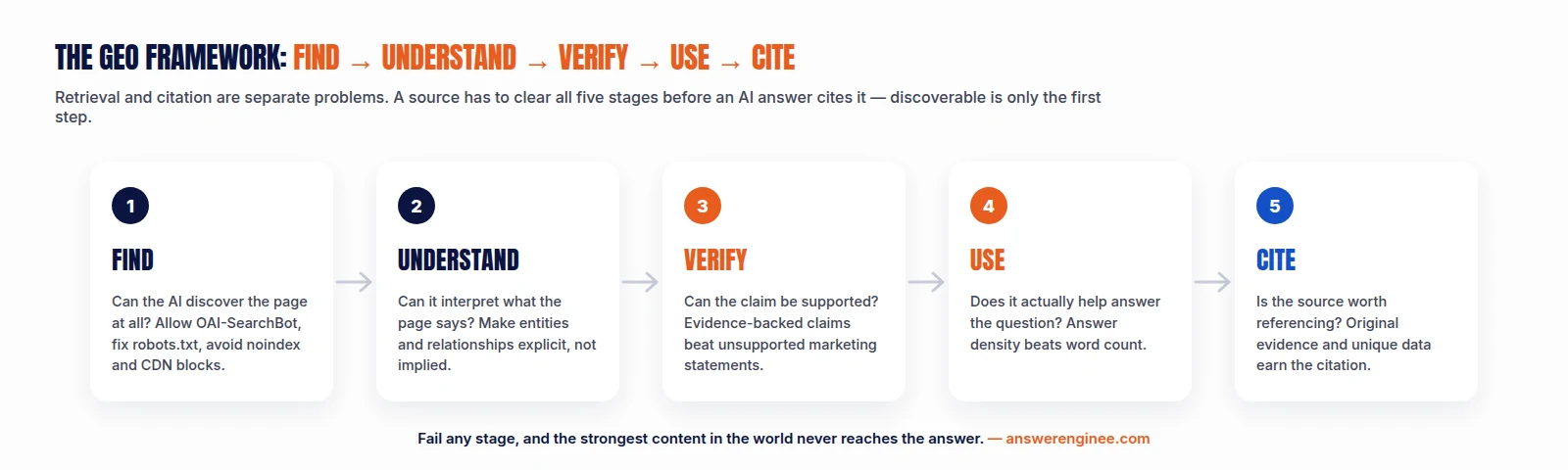
Find → Understand → Verify → Use → Cite
This provides a practical way to think about GEO.
1. Find: Can the AI Discover the Page?
Nothing else matters if the system cannot retrieve the content.
For ChatGPT Search specifically, OpenAI says sites that want their content eligible to appear in summaries and snippets should allow OAI-SearchBot to crawl the site.
OpenAI also recommends checking that hosting providers or CDNs are not blocking its published searchbot IP addresses.
Technical barriers can therefore eliminate a page from consideration before content quality is even evaluated. Common issues include:
- blocked crawlers;
- incorrect robots.txt directives;
- accidental noindex tags;
- server errors;
- CDN blocking;
- poor canonicalization;
- inaccessible rendering;
- broken internal links;
- orphaned pages.
GEO does not eliminate technical SEO.
It makes technical accessibility a prerequisite for participation in another discovery system — though being crawlable is only the starting line, not the finish; see why being crawlable isn’t enough for AI search.
2. Understand: Can the AI Interpret the Information?
Once a page is retrieved, machines need to understand what the page says.
This sounds obvious, but many websites make basic facts surprisingly difficult to identify.
For example, a SaaS homepage may use language such as:
“Unlock the future of connected customer transformation.”
That might sound impressive to a human marketing team.
It tells a retrieval system very little.
Compare it with:
“Acme is a customer-support platform for ecommerce companies that centralizes email, live chat, and social support.”
The second sentence provides explicit entities and relationships. It identifies:
- the company;
- the product category;
- the audience;
- the core functions.
That clarity can help both users and machines.
Strong GEO content tends to make important relationships explicit rather than forcing systems to infer them.
3. Verify: Can the Claim Be Supported?
This could become increasingly important as reasoning systems improve.
Suppose a company says: “We are the fastest-growing accounting platform in Europe.”
An advanced research system might ask:
- Fastest according to whom?
- Measured over what period?
- By customers?
- Revenue?
- Search interest?
- Employee count?
- Is there an independent source?
- Does another source contradict the claim?
If the system becomes better at corroborating information across the web, unsupported marketing statements may become less useful.
This creates an important distinction between claims and evidence-backed claims.
For GEO, the second category is much stronger.
4. Use: Does the Information Actually Help Answer the Question?
This is where many SEO pages fail.
A page can be technically optimized and factually correct but still contribute almost nothing useful.
Consider a search for: “Does schema markup improve AI citations?”
A weak page may spend 800 words explaining:
- what schema is;
- what SEO is;
- what AI is;
- why structured data matters;
- why digital marketing is changing.
But the user needs an answer to one specific question.
A more useful passage might say:
There is currently no evidence that schema markup directly guarantees an AI citation. Schema can help machines understand entities and relationships, but citation selection depends on additional factors such as retrieval, relevance, source quality, and usefulness.
That passage is more likely to support an answer because it directly resolves the question.
AI search increases the value of answer density.
The goal is not simply to create longer content.
It is to create more useful information per section.
5. Cite: Is the Source Worth Referencing?
Citation is the final stage.
An AI system might use a fact from a page without always displaying that page as the visible citation.
The sources most worth citing are often those that provide:
- original evidence;
- authoritative documentation;
- direct statements;
- unique data;
- precise definitions;
- transparent methodology;
- specific statistics;
- expert analysis;
- useful comparison data.
That means the strongest GEO strategy may increasingly resemble source creation rather than conventional content production.
Original Information Could Become the GEO Moat
This is one of the biggest strategic implications of more capable AI search.
Imagine 30 websites publish articles titled: “10 Ways AI Is Changing SEO.”
Most contain variations of the same points:
- use AI for content;
- focus on user intent;
- optimize for AI Overviews;
- improve E-E-A-T;
- use structured data;
- create quality content.
An advanced AI does not need all 30 pages.
Once the information becomes commoditized, there is little reason for the system to repeatedly cite rewritten versions of the same ideas.
Now imagine one publisher studies 10,000 AI-generated answers and discovers:
- which domains receive the most citations;
- which page types are cited;
- average citation age;
- the relationship between ranking position and AI citations;
- differences across ChatGPT, Gemini, and Perplexity.
That publisher has created information the others do not possess.
This is the stronger GEO moat.
The strategic principle is simple:
If AI can summarize everyone else’s information, become the source of information it cannot get elsewhere.
What Types of Content Could Become More Citation-Worthy?
There is no universal formula, but certain formats naturally produce evidence that other pages can reference.
Original research
Examples: surveys; experiments; industry datasets; benchmark studies; market analyses.
First-party data
Examples: customer behavior statistics; platform usage trends; aggregated anonymized data; internal performance data.
Technical documentation
Official documentation is often the best source for factual product information.
Definitions
Strong definitions answer a question precisely and establish the meaning of an entity or concept.
Comparison tables
Tables can help systems quickly identify meaningful differences between products, concepts, or strategies.
Case studies
Real examples provide evidence that a method produced a particular result.
Expert commentary
Specialist insight can add information unavailable in generic summaries.
Statistics with methodology
A number becomes considerably stronger when readers can understand where it came from and how it was calculated.
Could Astra Make GEO More Different From Traditional SEO?
Possibly.
Traditional SEO and GEO overlap significantly. Both benefit from:
- technical accessibility;
- relevance;
- authority;
- strong content;
- internal linking;
- clear site architecture;
- useful information.
But their optimization targets are not identical.
Traditional SEO often asks: Which page deserves to rank for this query?
GEO increasingly asks: Which information should an AI use when constructing this answer?
That distinction creates different incentives.
A conventional SERP rewards pages.
An AI answer may reward individual facts, passages, entities, statistics, or sources.
A page could rank highly but contribute nothing to an AI answer.
Another page could receive relatively little traditional search traffic but contain one highly useful dataset that gets repeatedly cited.
That creates a new dimension of organic visibility.
Could AI Search Move From Keyword Matching Toward Evidence Matching?
Keywords will not disappear.
AI systems still need to understand what information is relevant to a user’s question.
But relevance alone may be insufficient.
A more capable search system could increasingly ask: Which source provides the strongest evidence for the claim I need to make?
That creates an important shift.
Traditional content targeting: best project management software
Evidence-oriented content targeting:
- pricing comparison;
- implementation times;
- customer satisfaction data;
- integrations;
- uptime;
- security certifications;
- user counts;
- feature limitations;
- migration requirements.
The brand that supplies the strongest evidence across those subtopics could influence the final answer even without owning every top-ranking page.
This is why GEO should not be reduced to adding a “Quick Answer” box to existing SEO pages.
The underlying information architecture matters much more.
Entity Optimization Could Become More Important
AI systems also need to resolve entities accurately.
Consider a company that appears online under several variations: ABC Digital, ABC Digital LLC, ABC SEO, ABC Marketing Group.
If different directories, social profiles, review platforms, company pages, and schema markup use inconsistent information, systems may have more difficulty determining whether all references describe the same organization.
Entity consistency can help establish clearer relationships between:
- organizations;
- founders;
- products;
- services;
- locations;
- websites;
- social profiles;
- publications.
Businesses should keep important facts consistent wherever practical. Useful elements include:
- Organization schema;
- Product schema;
- LocalBusiness schema where appropriate;
- consistent names;
- consistent contact information;
- consistent founder or leadership information;
- descriptive About pages;
- clear service pages;
- official social profiles;
sameAsreferences where appropriate.
However: schema does not guarantee an AI citation.
Structured data helps machines interpret information.
It should not be marketed as a hidden switch that forces ChatGPT or another AI system to mention a website.
Technical GEO Could Become More Important, Not Less
There is a temptation to treat GEO as purely a content discipline.
That would be a mistake.
AI systems still depend on technical access.
For ChatGPT Search, OpenAI explicitly tells publishers to allow OAI-SearchBot if they want content eligible to be discovered, surfaced, and clearly cited.
That creates several technical GEO considerations.
Robots.txt
Make sure legitimate AI search crawlers are not blocked accidentally.
Noindex directives
Understand which pages you are deliberately excluding.
Server availability
A crawler cannot retrieve content from a page that repeatedly returns errors.
CDN and firewall rules
Security systems can accidentally block legitimate crawlers.
Internal linking
Important pages should be discoverable through clear site architecture.
Canonicals
Duplicate or conflicting canonical signals can confuse content selection.
Rendering
Critical information should not depend on brittle rendering behavior.
Semantic HTML
Clear headings, lists, tables, and page structure make information easier to interpret.
Technical SEO remains the foundation.
GEO adds another machine audience consuming the resulting information.
Should You Allow OAI-SearchBot?
If your goal is to become eligible for visibility in ChatGPT Search, generally yes.
OpenAI states that publishers should avoid blocking OAI-SearchBot if they want site content to appear in summaries and snippets in ChatGPT search results.
It is also important to distinguish OAI-SearchBot from GPTBot.
OpenAI’s publisher guidance says publishers can use GPTBot controls for content they want excluded from potential model training, while OAI-SearchBot controls search discovery.
This distinction is important for publishers that want search visibility without necessarily allowing the same content to be used for model training.
How Could Astra Affect AI Citation Selection?
Again, there is no confirmed Astra citation mechanism.
But stronger reasoning could make citation selection more demanding.
A future AI system might evaluate a source across dimensions such as:
Relevance
Does this passage answer the required subquestion?
Specificity
Does it provide concrete information or generic commentary?
Authority
Is the source well positioned to know this fact?
Corroboration
Can other trustworthy sources support the claim?
Originality
Is this the original source of the information?
Recency
Does freshness matter for this particular fact?
Consistency
Does the claim conflict with other information from the same entity?
Accessibility
Can the system retrieve and interpret it reliably?
The important point is not that Astra has these exact ranking factors.
It does not have any publicly announced search-ranking system.
The point is that deeper reasoning makes evaluating evidence increasingly feasible.
Marketers should prepare for that direction rather than attempting to reverse-engineer an imaginary Astra algorithm.
Could Backlinks Still Matter in an Astra-Era Search Environment?
Yes, but probably not in the simplistic sense that “more links equals more AI citations.”
Links perform several roles across the web. They can help with:
- discovery;
- authority;
- reputation;
- relationships between entities;
- identifying original sources;
- traditional rankings.
AI search systems may also receive search results from broader retrieval infrastructure where conventional authority signals still matter.
However, a highly linked page containing weak or irrelevant information may still be a poor source for a specific AI answer.
The stronger strategy is not: backlinks or content.
It is: authority + accessibility + evidence + relevance.
These reinforce one another.
Could Astra Reduce the Importance of Rankings?
It could reduce the importance of rankings as the only visibility metric.
That is different from making rankings irrelevant.
Traditional rankings remain valuable because:
- users still use search engines;
- AI systems can depend on web-search infrastructure;
- highly ranked pages can be easier to discover;
- rankings generate direct traffic.
But AI visibility introduces additional metrics.
Brands may increasingly need to track:
- AI mentions;
- AI citations;
- source inclusion;
- brand recommendations;
- competitor recommendation share;
- cited URLs;
- referral traffic from AI platforms;
- topic-level AI visibility.
A page can therefore perform well in one environment and poorly in another.
This makes organic search measurement more multidimensional.
How Should Marketers Measure GEO?
Traditional SEO metrics remain useful: rankings; impressions; clicks; organic traffic; conversions.
But GEO requires additional questions.
Is the brand mentioned?
A system may discuss your brand without linking to you.
Is the website cited?
Citation visibility is different from mention visibility.
Which pages receive citations?
The most frequently cited pages may not be the same pages attracting Google traffic.
For which topics does the brand appear?
A brand could have strong AI visibility in one topical area but none in another.
Which competitors appear more frequently?
Share of AI recommendation can reveal a different competitive landscape from SERP share.
Does AI visibility generate referral traffic?
OpenAI says publishers that allow OAI-SearchBot can track ChatGPT referral traffic because referral URLs include utm_source=chatgpt.com.
That creates at least one measurable bridge between AI citation visibility and website traffic.
What Could Happen to Zero-Click Search?
More sophisticated AI answers could increase zero-click behavior for some informational searches.
If an AI can research, compare, summarize, verify, and explain without requiring the user to open multiple websites, fewer informational searches may produce conventional clicks.
But that does not necessarily mean brands lose influence.
A user may receive a recommendation without visiting the recommended brand immediately.
This creates a distinction between traffic and influence.
Historically, SEO measurement has heavily emphasized visits.
AI search may force marketers to ask: Did our information influence the answer even if the user did not click?
That is a harder measurement problem, but an increasingly important one.
What Content Could Lose Value?
Stronger AI research could put pressure on several common content strategies.
Commodity definitions
If hundreds of websites publish nearly identical definitions, an AI system does not need all of them.
Rewritten listicles
Articles built primarily by summarizing existing rankings may struggle to provide unique value.
Artificially expanded content
Long sections created mainly to increase word count contribute little if they do not answer additional questions.
Unsupported thought leadership
Strong opinions without evidence may be difficult to distinguish from generic commentary.
Search-first content with weak user value
Pages engineered around keyword variations but lacking substantive information could become less competitive as source evaluation improves.
This does not mean informational content becomes useless.
It means information gain becomes more important.
What Content Could Gain Value?
The inverse is also true.
AI search can create more value for publishers that produce genuinely useful sources. Potential winners include:
- original research;
- official documentation;
- deep technical guides;
- proprietary datasets;
- transparent experiments;
- expert analysis;
- calculators and tools;
- strong comparison resources;
- unique case studies;
- firsthand reporting;
- frequently updated reference pages.
These resources offer information that an AI system has a reason to retrieve rather than merely paraphrase.
What Should Marketers Do Before Astra Arrives?
Marketers should not wait for an Astra search announcement before improving GEO fundamentals.
Most worthwhile changes are model-independent.
1. Check AI crawler accessibility
Review robots.txt and confirm important pages are accessible to relevant search crawlers. For ChatGPT Search eligibility specifically, verify OAI-SearchBot access.
2. Strengthen answer-first content
Important pages should answer the primary question quickly before expanding into detail.
3. Add evidence
Support important claims with data, sources, methodology, examples, and first-party observations.
4. Build citation-worthy assets
Create resources that other publishers and AI systems have a reason to reference.
5. Improve entity consistency
Standardize important brand and product information across authoritative surfaces.
6. Use clear semantic structure
Use meaningful headings, tables, lists, definitions, and descriptive language.
7. Publish original research
A proprietary dataset is much harder to replace than another generic article.
8. Improve internal linking
Connect related pages so crawlers and users can understand topical relationships.
9. Update stale information
Facts involving prices, software capabilities, laws, statistics, and product specifications should remain current.
10. Track AI visibility separately
Do not assume Google rankings accurately represent ChatGPT citation performance.
What Marketers Should Not Do
Emerging technologies create bad optimization advice almost as quickly as they create opportunities. Avoid the following.
Do not optimize for imaginary Astra ranking factors
None have been announced.
Do not rename ordinary SEO tactics “Astra SEO”
A new label does not create a new strategy.
Do not keyword-stuff “Astra”
Mentioning OpenAI Astra repeatedly will not make unrelated content more visible in future AI search.
Do not assume schema guarantees citations
Schema supports understanding. It does not force recommendation or citation.
Do not create hundreds of thin Astra pages
There are currently only a limited number of genuinely distinct Astra search intents.
Do not assume backlinks are irrelevant
AI search still exists within the broader web ecosystem.
Do not publish speculation as product documentation
Clearly label forecasts as forecasts. This is particularly important while Astra remains unreleased.
Could Astra Create a New Kind of Search Optimization?
Possibly, but the change would likely be evolutionary rather than a completely separate discipline.
A mature visibility strategy may increasingly combine several layers.
SEO
Can search engines discover and rank the website?
AEO
Can the content answer questions clearly?
GEO
Can generative systems retrieve, understand, and use the information?
Entity optimization
Can machines correctly identify the organization, products, people, and relationships?
Citation optimization
Does the site publish information worth referencing?
The strongest strategy is not to treat these as isolated tactics.
They are increasingly parts of the same machine-discovery ecosystem.
The Real GEO Shift: From Page Optimization to Information Optimization
This may be the most important takeaway from Astra’s potential impact on search.
SEO has traditionally been page-centric. Marketers optimize title tags, headings, content, links, URLs, schema, and page speed.
Those remain important.
But generative systems consume information, not simply pages.
A single AI answer might combine:
- a statistic from one website;
- a definition from another;
- pricing from an official product page;
- research findings from a study;
- customer sentiment from several reviews.
That suggests GEO will increasingly require marketers to think at the information level. Ask:
What facts do we uniquely own?
Which claims can we prove?
What questions can our content answer better than anyone else’s?
Which information should an AI system associate with our brand?
Which parts of our content are worth citing independently?
Those questions are more durable than chasing any single AI model.
Bottom Line
OpenAI Astra has not changed GEO yet. But it may show us where GEO is heading.
There is currently no Astra search algorithm, no confirmed Astra citation system, and no reason for marketers to chase Astra-specific optimization tactics.
What OpenAI has demonstrated is something more strategically important: frontier models are becoming better at operating across complex, multi-step tasks with less human guidance. Astra’s disclosed cybersecurity evaluations show a system capable of identifying problems, investigating them, using tools, adapting its approach, and continuing toward an outcome with substantially greater capability than GPT-5.6 Sol in the areas tested.
If those reasoning patterns eventually reach AI search, the implications for GEO could be significant. AI search may become better at:
- decomposing broad questions;
- running multiple targeted searches;
- comparing competing sources;
- verifying claims;
- identifying original evidence;
- resolving entities;
- choosing the most useful information for an answer.
That would push GEO further away from the idea that optimization means inserting the right phrases into a page.
The stronger competitive advantage would be: be discoverable; be understandable; be verifiable; be useful; be worth citing.
This is the shift marketers should prepare for.
Traditional SEO asks whether a page can be found and ranked.
The next generation of GEO increasingly asks something harder: when an AI system investigates a topic deeply enough to decide which information it trusts, does your brand provide evidence worth using?
If the answer is yes, Astra — or whatever frontier model eventually powers the next generation of AI search — becomes an opportunity rather than a threat.
FAQ
Will OpenAI Astra power ChatGPT Search?
OpenAI has not announced that Astra will power ChatGPT Search. Astra is an upcoming OpenAI model, but no Astra-specific search integration has been confirmed as of September 2, 2026.
What is OpenAI Astra GEO?
“OpenAI Astra GEO” is not an official OpenAI product or optimization framework. The phrase refers to the potential implications Astra’s stronger reasoning and autonomous capabilities could have for generative engine optimization if similar technology is eventually integrated into AI search.
Could Astra change SEO?
Potentially, but there is no confirmed Astra SEO update. The main strategic implication is that stronger AI reasoning could make source quality, evidence, entity clarity, and citation usefulness increasingly important.
Will Astra create new ranking factors?
No Astra-specific ranking factors have been announced. OpenAI has not said that Astra currently powers search ranking.
How do you optimize content for Astra?
There is currently no legitimate Astra-specific optimization method. Marketers should focus on durable GEO fundamentals such as crawler accessibility, useful answers, original evidence, entity consistency, technical quality, and citation-worthy information.
Does OpenAI crawl websites for ChatGPT Search?
Yes. OpenAI says publishers should allow OAI-SearchBot if they want their content eligible to be discovered, surfaced, and clearly cited in ChatGPT Search.
What is OAI-SearchBot?
OAI-SearchBot is OpenAI’s crawler associated with search discovery. OpenAI’s publisher guidance distinguishes it from GPTBot, which publishers can control separately for potential model-training use.
Does schema markup improve AI citations?
Schema can help machines understand entities and relationships, but there is no evidence that adding schema automatically earns AI citations. Citation selection depends on broader factors such as retrieval, relevance, evidence, authority, and usefulness.
Will keywords still matter in AI search?
Yes. AI systems still need to determine relevance. However, stronger reasoning could increase the importance of evidence and information usefulness beyond simple keyword matching.
Do backlinks matter for GEO?
Backlinks can contribute to discovery, authority, reputation, and traditional search visibility. However, links alone do not guarantee AI citations. A source still needs to contain information that is relevant and useful to the generated answer.
How can I get my website cited by ChatGPT?
There is no guaranteed method. For basic eligibility, OpenAI recommends allowing OAI-SearchBot and ensuring its crawler is not blocked. Beyond accessibility, publishers should create relevant, reliable, clearly structured, and genuinely useful information.
Can I track traffic from ChatGPT?
Yes. OpenAI says ChatGPT referral URLs include utm_source=chatgpt.com, which allows publishers to identify referral traffic in analytics platforms such as Google Analytics.