Quick Answer
A crawler may successfully access your page, receive a 200 OK response, render the content, and still never use that page in an AI-generated answer.
Why? Because AI search visibility involves several additional stages:
Accessible → Discoverable → Retrievable → Relevant → Understandable → Trustworthy → Useful → Selectable → Citable
Google explicitly says that meeting its technical requirements and following best practices does not guarantee that a page will be crawled, indexed, or served. Its generative AI Search features rely on core Search systems and retrieval techniques to select useful information from Google’s index.
OpenAI makes the same distinction. Allowing OAI-SearchBot is important for ChatGPT Search eligibility, but OpenAI says placement is not guaranteed and that its search systems use multiple factors intended to surface relevant and reliable information.
The practical principle is:
Crawlability earns eligibility. It does not earn selection.
Crawlability Is the Beginning of AI Visibility, Not the End
Technical GEO often begins with crawler access. That makes sense. If you’re new to the discipline, see what Technical GEO is and how it makes a website AI-ready for the foundation this article builds on.
If Googlebot cannot reach a page, Google cannot process it normally.
If OAI-SearchBot is unintentionally blocked, a publisher can limit its opportunity to appear in ChatGPT Search.
If a firewall returns 403 Forbidden to desired crawlers, content quality becomes irrelevant because the system cannot retrieve the page.
But once that technical barrier is removed, the competition has only begun.
Imagine 100 websites publish accessible pages about the same topic. All 100 may be:
- crawlable
- indexable
- technically valid
- mobile-friendly
- properly canonicalized
An AI answer does not need to cite all 100. It needs enough information to answer the user’s question well. That creates a second optimization problem: why should the system choose your information instead of everyone else’s?
That is where AI search visibility moves beyond crawler optimization. For a deeper look at what crawlers actually do once they reach your pages, see how AI crawlers understand your website.
The AI Search Visibility Funnel
A useful way to understand this is through the AI Search Visibility Funnel.
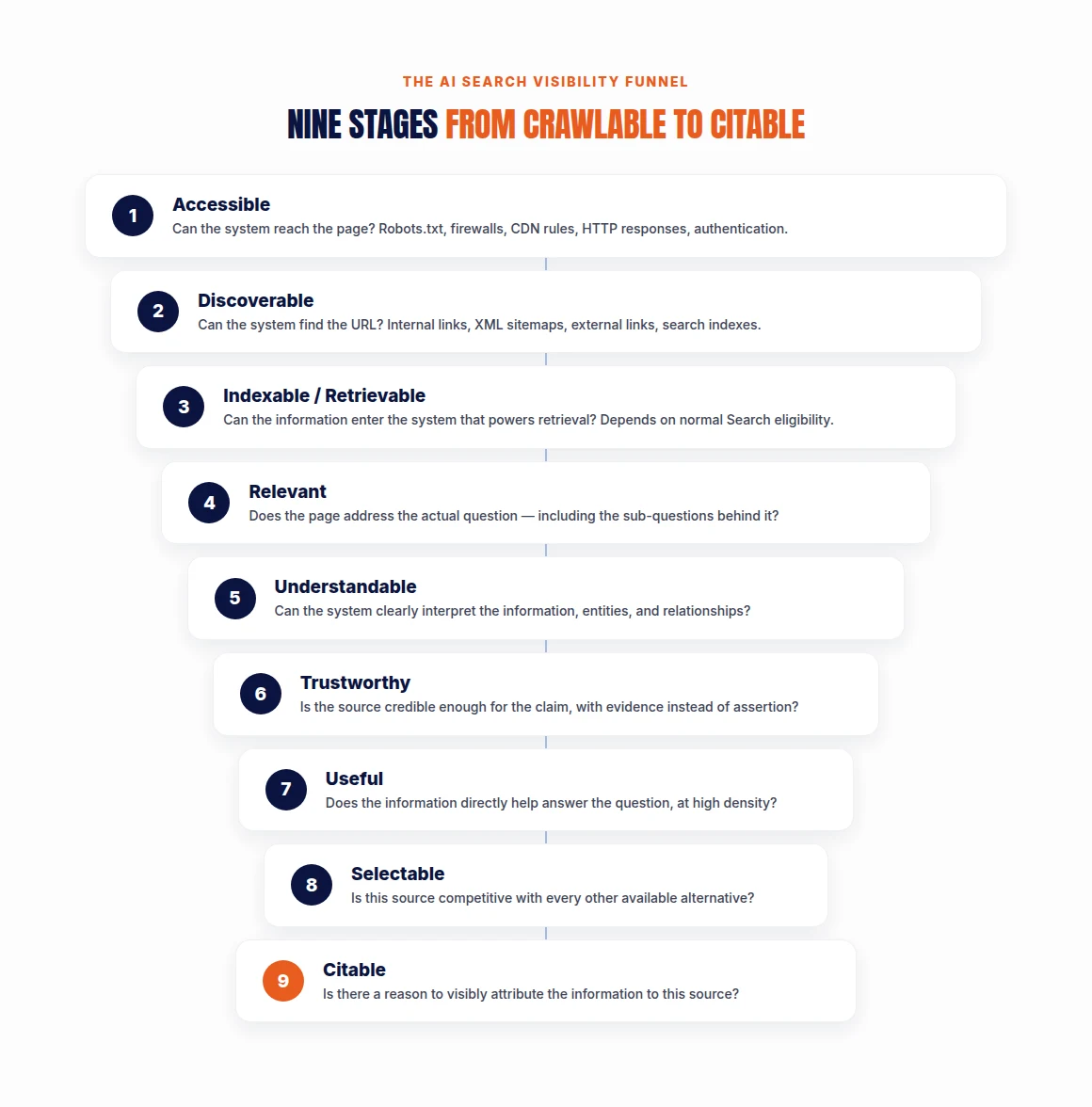
Stage 1: Accessible
Can the system reach the page? This includes:
- robots.txt
- firewall access
- CDN rules
- HTTP responses
- authentication
Failure here means the system may never retrieve the content.
Stage 2: Discoverable
Can the system find the URL? Discovery can depend on:
- internal links
- XML sitemaps
- external links
- search indexes
- previously discovered URLs
An accessible orphan page can still have poor discovery.
Stage 3: Indexable or Retrievable
Can the information enter the system that powers retrieval? For Google, generative AI Search depends heavily on Google’s existing Search infrastructure. Google says pages need normal Search eligibility to appear in its generative AI Search features.
Technical issues such as noindex, canonical conflicts, duplicate URLs, and poor rendering can therefore reduce eligibility.
Stage 4: Relevant
Does the page contain information relevant to the user’s actual question? A page can be technically perfect and still be irrelevant.
This sounds obvious, but relevance becomes more complicated in AI search because the visible query may not be the only query being evaluated. Generative systems can investigate multiple related questions. That makes relevance more granular.
Stage 5: Understandable
Can the system clearly interpret the information? Ambiguous content creates unnecessary uncertainty. Systems may need to understand:
- who the company is
- what the product does
- which price belongs to which plan
- where a business operates
- whether a statement is current
- which entity a pronoun refers to
Clear content structure, explicit relationships, consistent entities, and accurate structured data can help reduce ambiguity.
Stage 6: Trustworthy
Is the source credible enough for the claim being made? A company claiming:
“We are the most accurate analytics platform in the world.”
is different from a company publishing:
“In our benchmark of 5,000 test queries, the platform achieved 94.2% accuracy. Here is the methodology.”
The second statement provides evidence. AI systems capable of evaluating multiple sources have more opportunity to distinguish between assertions and supported information.
Stage 7: Useful
Does the information directly help answer the question? A page may contain 3,000 words about a topic but provide only one sentence useful to the actual user. Information density matters. Useful content often includes:
- direct answers
- definitions
- statistics
- comparisons
- limitations
- examples
- pricing
- specifications
- evidence
Stage 8: Selectable
Is this source competitive with alternatives? AI search is a selection environment. Your page does not compete against a technical standard. It competes against other information. A technically adequate page can lose to:
- official documentation
- original research
- better data
- stronger topical expertise
- more current information
- a clearer answer
Stage 9: Citable
Is there a reason to visibly attribute the information to your source? Some information is inherently more citation-worthy than other information. Original statistics are more likely to create attribution value than generic advice. Official documentation provides strong provenance. Original research creates a clear source relationship.
This is the final transition: crawlable → usable → citable.
Why AI Search Retrieval Is Different From Simple Crawling
Traditional crawler discussions often assume the process is: crawler finds page → page enters index → page appears for keyword.
Modern retrieval is more complicated. Google’s current generative AI Search guidance explains that its AI features use existing Search systems together with techniques such as retrieval-augmented generation. The system does not need to use every indexed page. It retrieves information relevant to a particular task.
That means indexing establishes potential availability. Retrieval determines whether the information is actually brought into the answer-generation process. These are different stages.
One User Question Can Create Many Retrieval Opportunities
One of the biggest differences in generative search is that a complex question may require several underlying investigations.
Suppose the user asks: “What is the best CRM for a 20-person roofing company?” A useful answer may require research into:
- CRM products for contractors
- pricing for 20 users
- lead-management functionality
- field-service integrations
- mobile access
- quote management
- QuickBooks integrations
- support quality
- customer reviews
Your page might never rank for the exact phrase best CRM for 20 person roofing company and still contribute useful evidence about CRM pricing for contractors or roofing CRM QuickBooks integrations.
This changes how marketers should think about visibility. The target is no longer only rank for the main keyword. It can also be become the strongest source for one of the questions the AI needs to resolve.
Why Generic Content Has a Selection Problem
This may be the biggest content problem in AI search. Consider 50 pages titled What Is Generative Engine Optimization? Most repeat similar ideas:
- GEO optimizes for AI search
- AI search is growing
- structured data can help
- content quality matters
- brands should build authority
If all 50 pages contain essentially the same information, the AI system has little reason to rely on every one.
Google’s 2026 generative AI optimization guidance specifically emphasizes creating non-commodity content—information that adds unique value rather than simply repeating what already exists. Google introduced this guidance as part of its recommendations for success in generative AI Search.
That should change how publishers think about AI visibility. The question becomes: what information exists on this page that would be difficult to replace with another source?
What Is Information Gain?
Information gain is the additional useful knowledge a source contributes beyond what is already readily available. It does not require discovering something scientifically groundbreaking. Information gain can come from:
- original data
- first-party experience
- expert interpretation
- new examples
- detailed testing
- clearer methodology
- real case studies
- updated information
- useful comparisons
For example:
Low Information Gain
AI Overviews can reduce organic clicks because users may get answers directly in Google.
Higher Information Gain
We compared 12,000 Search Console queries before and after AI Overview appearance and found that informational queries with AI Overviews had an average CTR decline of X%, while branded queries showed Y%.
The second example introduces information that other sites may want to reference. That creates citation potential.
Original Research Creates a Stronger Citation Reason
Suppose AnswerEnginee publishes Study: We Analyzed 50,000 ChatGPT Citations. The study contains methodology, dataset size, industries, citation frequency, ranking correlations, domain patterns, page-type findings, and limitations.
Now imagine another marketer publishes How to Get Cited by ChatGPT and summarizes AnswerEnginee’s findings. Which source has stronger attribution value? The original study.
AI systems capable of locating the original source may have a reason to reference it directly. This is why original research can become one of the strongest GEO assets.
First-Party Data Can Be a GEO Moat
Businesses often possess information competitors cannot reproduce. Examples include:
SaaS companies
- usage patterns
- feature adoption
- churn trends
- benchmark data
Ecommerce sites
- demand trends
- size preferences
- product-return patterns
Agencies
- campaign results
- audit findings
- conversion benchmarks
Publishers
- audience surveys
- market research
- original investigations
Local businesses
- service data
- local project patterns
- cost ranges
- customer questions
If this information can be published responsibly and accurately, it creates an informational moat. A competitor can rewrite your opinion. It cannot authentically recreate your first-party dataset.
Being Indexed Does Not Mean You Match the Retrieval Query
Another common misconception is: “The page is indexed, so why isn’t it showing in AI search?”
Because retrieval is query-dependent. A page can exist in an index yet fail to match the specific information need.
Consider a page titled Enterprise CRM Solutions. The page spends most of its content saying it will transform customer relationships, accelerate business growth, and create seamless experiences.
The AI system needs: does this CRM support Salesforce data migration?
The page may be indexed. It still doesn’t contain the answer. Technical eligibility cannot compensate for missing information.
Answer Density Matters More Than Word Count
AI search creates another reason to question simplistic content-length strategies. A 5,000-word page is not automatically more useful than a 1,500-word page. What matters is whether it contains information that helps resolve meaningful questions.
Compare:
Version A
800 words explaining why pricing matters.
Version B
A table showing:
| Plan | Price | Users | Limit |
|---|---|---|---|
| Basic | $29 | 5 | 10 projects |
| Pro | $79 | 20 | Unlimited |
| Enterprise | Custom | Unlimited | Unlimited |
Version B may be far more useful for a comparison query. The strategic concept is: maximize useful information, not arbitrary length. For tactical guidance on structuring passages this way, see how to optimize content for AI Overviews.
Entity Ambiguity Can Reduce AI Search Usefulness
Imagine an AI system finds several sources about Mercury. Does that mean the planet, the chemical element, the financial technology company, a car brand, or a record label?
Machines need context. The same applies to smaller brands. A business may create ambiguity when:
- company names vary
- product names change across pages
- addresses conflict
- founder information is inconsistent
- schema describes a different entity from visible content
Clear entities help machines determine who is this information about? Technical GEO helps expose those relationships. Content and brand consistency reinforce them.
Unsupported Claims Have Weak Citation Value
Marketing language frequently produces statements such as “industry-leading,” “best-in-class,” “number-one solution,” and “trusted by businesses everywhere.” These claims may be persuasive copy. They are weak evidence. A stronger source provides verifiable information.
Instead of:
We are the leading local SEO agency.
Consider:
We analyzed 2,400 local keyword campaigns between 2024 and 2026 and found that pages with X characteristic improved median map visibility by Y%.
The second statement gives an AI system something specific to use.
Freshness Can Affect Source Selection
Not every query needs fresh information. The definition of a canonical tag changes slowly. The price of a software subscription can change tomorrow. AI systems answering time-sensitive questions need current sources.
Publishers should therefore identify information where freshness matters:
- prices
- laws
- regulations
- product specifications
- software features
- statistics
- political leadership
- schedules
- inventory
- opening hours
An otherwise authoritative article can become less useful if its time-sensitive information is outdated.
Official Sources Have a Natural Advantage for Certain Facts
For some questions, the strongest source is obvious.
If the question is what does Google say about AI Overviews? Google’s own documentation is highly valuable.
If the question is what is GPTBot? OpenAI documentation has strong provenance.
If the question is what does this SaaS product cost? the official pricing page is often the most direct source.
This does not mean independent publishers cannot compete. It means they should avoid simply recreating documentation. Independent publishers create value through testing, comparison, interpretation, critique, research, and experience.
Citation-Worthy Content Is Different From Keyword-Optimized Content
Traditional keyword optimization asks: what phrases should this page target?
Citation optimization asks: what information on this page would another system need to attribute?
These can overlap. But they are not identical. A strong citation asset may include:
- proprietary statistics
- original methodology
- primary documentation
- expert commentary
- unique calculations
- industry benchmarks
- real-world testing
The page should still be discoverable through relevant terminology. But the citation opportunity comes from informational value.
Why Strong Rankings Still Matter
AI search does not make SEO rankings irrelevant. For Google especially, the two systems remain closely connected. Google says its generative AI Search features are grounded in its core Search ranking and quality systems.
That means strong SEO can improve the broader conditions for AI visibility through discovery, authority, index coverage, quality signals, and topical relevance.
But the relationship is not rank #1 = guaranteed AI citation. Generative systems can retrieve several sources and select information based on the task.
Think of rankings as an important discovery advantage—not a guaranteed citation contract. If you’re mapping out where technical SEO work ends and technical GEO work begins, see technical SEO vs technical GEO: what’s different.
Why Backlinks Are Not Enough Either
The same principle applies to links. Backlinks can contribute to authority, discovery, reputation, and rankings. But a highly linked page can still fail to answer the user’s question.
For GEO, the stronger model is: Authority × Relevance × Evidence × Accessibility.
If any component approaches zero, the source becomes weaker. A highly authoritative source with irrelevant content is not useful. A highly relevant page that cannot be accessed is not useful. A crawlable page with generic information is easily replaceable.
AI Search Visibility Is Competitive
Another reason crawlability is insufficient: your competitors are crawlable too.
Suppose ten accounting software companies all allow Googlebot and OAI-SearchBot. Crawler access does not differentiate them. The system may compare features, pricing, reviews, integrations, authority, documentation, and product fit.
Visibility therefore becomes competitive after access is solved. Technical SEO gets you onto the field. Information quality determines whether you win particular plays.
From Crawlable to Citable: An 8-Step Framework
Once crawler access is working, use this process.
1. Identify High-Value Questions
Look beyond broad keywords. Ask: what does the buyer need to know? What comparisons will an AI need to make? What facts determine the decision?
2. Map Supporting Questions
Turn one broad query into subquestions. Example: best project management software for architects could require pricing, collaboration, drawing support, integrations, mobile access, and client portals. Build content that answers those underlying questions.
3. Publish Direct Answers
Do not make the system search through five introductory paragraphs to find a simple fact. Use answer-first sections where appropriate.
4. Add Evidence
Support claims with citations, data, methodology, examples, and firsthand observations.
5. Create Original Information
Publish research, surveys, experiments, benchmarks, original datasets, and case studies. This is often the strongest differentiator.
6. Clarify Entities
Make clear who, what, where, when, which product, and which company. Avoid ambiguous references.
7. Keep Critical Facts Current
Prioritize freshness where the query requires it.
8. Measure AI Visibility
Do not assume improvements worked. Google now provides a dedicated Generative AI performance report in Search Console covering impressions in AI Overviews and AI Mode. The report can break visibility down by page, country, date, and device.
For ChatGPT, monitor referral traffic, citations, brand mentions, and cited URLs.
Measurement converts GEO from opinion into experimentation. If you want a structured checklist to run before you start measuring, see the AI readiness audit covering 27 technical signals.
How to Use Google’s Generative AI Performance Report
Google’s new Search Console report makes this problem more measurable. The report shows generative AI impressions for AI Overviews and AI Mode. You can analyze:
Pages
Which URLs appear most often?
Countries
Where is AI visibility occurring?
Dates
Is visibility increasing or declining?
Devices
Does visibility differ by device type?
This data can help identify an important distinction. Suppose Page A gets strong traditional organic impressions but almost no generative AI visibility, while Page B gets modest traditional Search traffic but significant generative AI impressions. That suggests AI source selection may value the pages differently. Those patterns deserve investigation.
Google’s AI Participation Control Adds Another Layer
As of August 31, 2026, Google has rolled out its Search generative AI control globally. Site owners can choose whether their site’s links and content are eligible for AI Overviews, AI Mode, and generative AI features in Discover.
This creates an important hierarchy. To gain Google generative AI visibility:
First: participate.
Second: meet technical Search requirements.
Third: become relevant enough to be retrieved and selected.
Participation is necessary. It is not sufficient.
Why ChatGPT May Crawl Your Site but Still Not Show It
OpenAI makes the same principle explicit. To make a website eligible for ChatGPT Search, publishers should allow OAI-SearchBot and ensure their hosting/CDN permits OpenAI’s published crawler IPs.
But OpenAI states that top placement cannot be guaranteed. Search results are ranked using multiple factors intended to surface relevant and reliable information.
So if ChatGPT is not citing your page, check two different problem categories.
Technical Eligibility
- Is OAI-SearchBot allowed?
- Is the firewall blocking it?
- Is the content public?
- Is the page accessible?
Selection Quality
- Does the page answer the question?
- Is the information unique?
- Is it trustworthy?
- Is another source better?
- Is the information current?
Do not keep changing robots.txt if the actual problem is content quality.
Common Reasons a Crawlable Site Still Has Weak AI Visibility
1. The Content Is Commodity
It says the same thing as hundreds of competing pages.
2. The Page Does Not Answer Specific Questions
It targets a broad keyword without useful supporting information.
3. The Information Is Outdated
Especially problematic for fast-changing topics.
4. Claims Lack Evidence
Marketing language replaces verifiable information.
5. Entity Relationships Are Unclear
Machines cannot easily determine who or what facts refer to.
6. Better Primary Sources Exist
You are summarizing information available directly from the original source.
7. The Page Has Weak Topical Context
It exists in isolation from related authoritative content.
8. Competitors Provide Better Information
Their source is simply more useful.
What Content Is More Likely to Create AI Visibility?
There is no guaranteed content format. But several categories naturally create stronger information value.
Original research
New information creates a reason to retrieve the source.
Definitive reference pages
Well-maintained resources can become useful recurring sources.
Primary documentation
Official product and policy facts carry strong provenance.
Expert analysis
Especially where interpretation adds value beyond documentation.
Comparison resources
Useful when they provide factual, structured differences.
Case studies
Real results and methodology add evidence.
Tools and calculators
They can provide outputs unavailable through generic prose.
Frequently updated data
Useful for time-sensitive queries.
What Should You Fix First: Crawling or Content?
Use a simple diagnostic rule.
If Crawlers Cannot Access the Page
Fix technical access first. No amount of content optimization can compensate.
If the Page Is Accessible but Never Selected
Investigate relevance, quality, evidence, information gain, authority, and freshness.
If the Page Appears but Gets No Clicks
Investigate intent, SERP/AI presentation, brand recognition, answer completeness, and conversion path.
Different stages require different solutions.
AI Visibility Should Be Audited in Layers
Instead of asking “Why isn’t ChatGPT citing us?” audit the funnel.
Layer 1 — Access
Can the system reach the site?
Layer 2 — Eligibility
Can the page enter the relevant search/retrieval environment?
Layer 3 — Retrieval
Does it match the information need?
Layer 4 — Quality
Is the information strong enough?
Layer 5 — Selection
Does it beat alternative sources?
Layer 6 — Citation
Is visible attribution useful?
Layer 7 — Traffic
Does the citation generate visits?
Layer 8 — Business Impact
Does AI visibility influence conversions or brand demand?
This prevents teams from treating every AI visibility problem as a crawler problem.
Bottom Line
Being crawlable is necessary for AI search visibility, but it is only the admission ticket.
A crawler reaching your website does not mean an AI system will retrieve it, trust it, use it, recommend it, or cite it. Those are separate decisions. The complete progression is:
- Accessible — Can machines reach the page?
- Discoverable — Can they find it?
- Eligible — Can it enter the relevant search or retrieval system?
- Relevant — Does it address the information need?
- Understandable — Can the system correctly interpret the information and entities?
- Trustworthy — Is there sufficient reason to rely on it?
- Useful — Does it materially improve the answer?
- Selectable — Is it stronger than competing sources?
- Citable — Is there value in visibly attributing the information?
That is the difference between AI crawler optimization and AI search visibility optimization. The first ensures that a machine can access your website. The second asks whether your website deserves to influence the answer. This distinction changes the GEO strategy.
Once technical blockers are removed, stop obsessing over whether another crawler directive or AI-specific file will magically create citations. Start asking harder questions: what information do we uniquely own? Which claims can we prove? What questions do we answer better than competing sources? What would an AI system lose if our website disappeared from the web tomorrow?
That final question is particularly useful. If the answer is:
“Not much—our content mostly summarizes information available elsewhere,”
then crawlability is not the real problem. The real problem is replaceability.
The strongest long-term GEO strategy is therefore not simply make your content crawlable. It is make your content difficult to replace.
Technical GEO gets the website into the retrieval ecosystem. Original information, evidence, relevance, authority, and usefulness give the system a reason to choose it. That is how a website moves from merely crawlable to genuinely citable.
FAQ
Why isn’t ChatGPT citing my website?
There can be technical or selection-related reasons. First confirm that OAI-SearchBot can access the site and that your CDN or host is not blocking OpenAI crawler traffic. If access is working, evaluate whether the page is relevant, reliable, current, and useful enough to compete with alternative sources. OpenAI says search placement is not guaranteed.
Can ChatGPT crawl my website without citing it?
Yes. Crawler access makes content eligible for discovery; it does not guarantee citation or placement.
Does being indexed guarantee Google AI Overview visibility?
No. Google says meeting technical requirements does not guarantee crawling, indexing, or serving. Generative AI visibility remains selective.
What makes content citation-worthy?
Citation-worthy content usually offers clear attribution value, such as original research, primary documentation, proprietary statistics, transparent methodology, expert analysis, or specific factual information.
Does authority matter for AI search?
Authority can matter because AI search systems aim to surface reliable information, but authority alone is not enough. The information must also be relevant and useful to the specific question.
Do backlinks guarantee AI citations?
No. Backlinks can support authority, discovery, and traditional rankings, but they do not guarantee AI citation selection.
Does word count affect AI citations?
There is no universal ideal word count for AI citation visibility. Information usefulness and relevance are more important than making a page arbitrarily long.
Is original research good for GEO?
Yes. Original research can create unique information that AI systems and other publishers have a reason to reference, making it one of the strongest potential GEO assets.
Can generic content appear in AI search?
Yes. Generic information can still be useful, especially when it comes from authoritative sources. However, commodity content faces more competition because many sources can provide equivalent information.
How can I measure Google AI search visibility?
Google provides a Generative AI performance report in Search Console for AI Overviews and AI Mode. It includes impression data and dimensions such as pages, countries, dates, and devices.
Does allowing OAI-SearchBot guarantee ChatGPT visibility?
No. OpenAI says allowing the crawler is important for eligibility but explicitly states that placement cannot be guaranteed.
Is crawlability still important for GEO?
Absolutely. Crawlability is foundational because systems cannot reliably use content they cannot access. The mistake is assuming crawlability alone produces visibility.