For Google specifically, the distinction is smaller than many marketers assume. Google says its generative AI features are rooted in its existing Search ranking and quality systems, use information from the Search index, and still depend on established SEO best practices. Google also explicitly says that, from its perspective, optimizing for GEO or AEO within Google Search is still SEO.
The additional value of Technical GEO appears when you look beyond conventional Google Search. A modern website may need to manage Googlebot for Search, OAI-SearchBot for ChatGPT Search, GPTBot policies, Google-Extended policies, generative AI participation settings, AI referral measurement, browser-agent accessibility, and machine-interpretable forms and controls.
So the simplest distinction is: Technical SEO asks whether search engines can discover, understand, index, and rank your website. Technical GEO asks whether the broader AI discovery ecosystem can access, retrieve, interpret, use, measure, and potentially interact with it.
This overlap and divergence is easier to see once you’ve mapped the technical signals themselves. If you haven’t run that inventory yet, the AI Readiness Audit covering 27 technical signals is a useful starting checklist before you decide how much of this article applies to your site.
Technical SEO vs Technical GEO at a Glance
| Area | Technical SEO | Technical GEO |
|---|---|---|
| Primary goal | Search visibility | AI + search visibility |
| Crawling | Core | Core |
| Indexability | Core | Core |
| Canonicalization | Core | Core |
| Rendering | Core | Core |
| Internal linking | Core | Core |
| XML sitemaps | Core | Core |
| Structured data | Search understanding/features | Search + machine understanding |
| Googlebot | Core | Core for Google AI Search |
| OAI-SearchBot | Usually outside traditional SEO | Relevant |
| GPTBot governance | Usually outside scope | Relevant |
| Google-Extended governance | Usually outside scope | Relevant |
| Search vs training controls | Rarely audited | Important |
| AI Search participation controls | Rarely audited | Important |
| AI referral measurement | Rarely primary | Important |
| AI citation visibility | Usually outside scope | Relevant |
| Agent accessibility | Usually accessibility/UX | Increasingly relevant |
| ARIA / accessibility tree | Secondary | Potentially agent-relevant |
llms.txt |
Not needed for Google | Platform-specific; not universally required |
| AI-specific schema | No | No universal requirement |
| Ranking guarantee | No | No |
| Citation guarantee | N/A | No |
The overlap is large. That is exactly why treating Technical GEO as a completely separate replacement for SEO is a mistake.
What Is Technical SEO?
Technical SEO is the work involved in making a website technically accessible, understandable, indexable, and usable by search engines.
It typically includes crawlability, indexability, HTTP status codes, robots.txt, canonicalization, redirects, XML sitemaps, internal linking, JavaScript rendering, site architecture, duplicate URL management, structured data, mobile usability, performance, and international targeting.
The basic technical SEO process can be simplified as: Discover → Crawl → Render → Index → Rank.
A page that fails early in that sequence can struggle no matter how good its content is. A brilliant article that returns a 500 error is not useful to a crawler. A perfect product page marked noindex may never become eligible for search. A page that canonicalizes to the wrong URL can send conflicting signals. Technical SEO removes those obstacles.
What Is Technical GEO?
Technical GEO is the technical layer of Generative Engine Optimization. It extends traditional technical SEO to account for generative search systems, AI crawlers, retrieval systems, and AI agents.
A Technical GEO audit may include traditional SEO checks, but it also asks whether OAI-SearchBot is intentionally allowed, whether GPTBot policy is intentional, whether Google-Extended policy is intentional, whether Search access and training access are controlled separately, whether Google generative AI participation is intentionally configured, whether AI-related referral traffic can be measured, whether browser agents can understand interactive elements, whether important entities are clear and machine-interpretable, whether an AI system can retrieve the information required to answer subqueries, and whether the site is technically prepared for agent interaction.
The Technical GEO process is therefore closer to: Access → Discover → Retrieve → Understand → Evaluate → Use → Cite or Recommend → Potentially Interact. This is a broader technical visibility model. For a fuller walkthrough of what this discipline covers end to end, see What Is Technical GEO? How to Make Your Website AI-Ready.
The Most Important Difference: Technical SEO Optimizes Search Infrastructure; Technical GEO Optimizes the Wider AI Discovery Layer
Traditional technical SEO primarily developed around web search engines. Technical GEO emerges because the machines using websites are becoming more diverse. A single website may now encounter several distinct categories of automated visitor.
Search crawlers. Example: Googlebot. Its job is connected to Google Search discovery and indexing.
AI search crawlers. Example: OAI-SearchBot. OpenAI says public sites can appear in ChatGPT Search and recommends allowing OAI-SearchBot if publishers want content to be discoverable, surfaced, cited, and linked in ChatGPT Search.
Training-related controls. Examples: GPTBot and Google-Extended. These involve a different governance question from ordinary search visibility.
User-triggered browser agents. These systems may need to interact with a website rather than simply crawl it. Google’s current guidance notes that browser agents may analyze rendered screenshots, inspect DOM structure, and interpret the accessibility tree when interacting with websites.
That diversity is what creates the practical case for Technical GEO. It’s also why understanding how AI crawlers actually parse your website is a separate skill from managing Googlebot alone.
Where Technical SEO and Technical GEO Are the Same
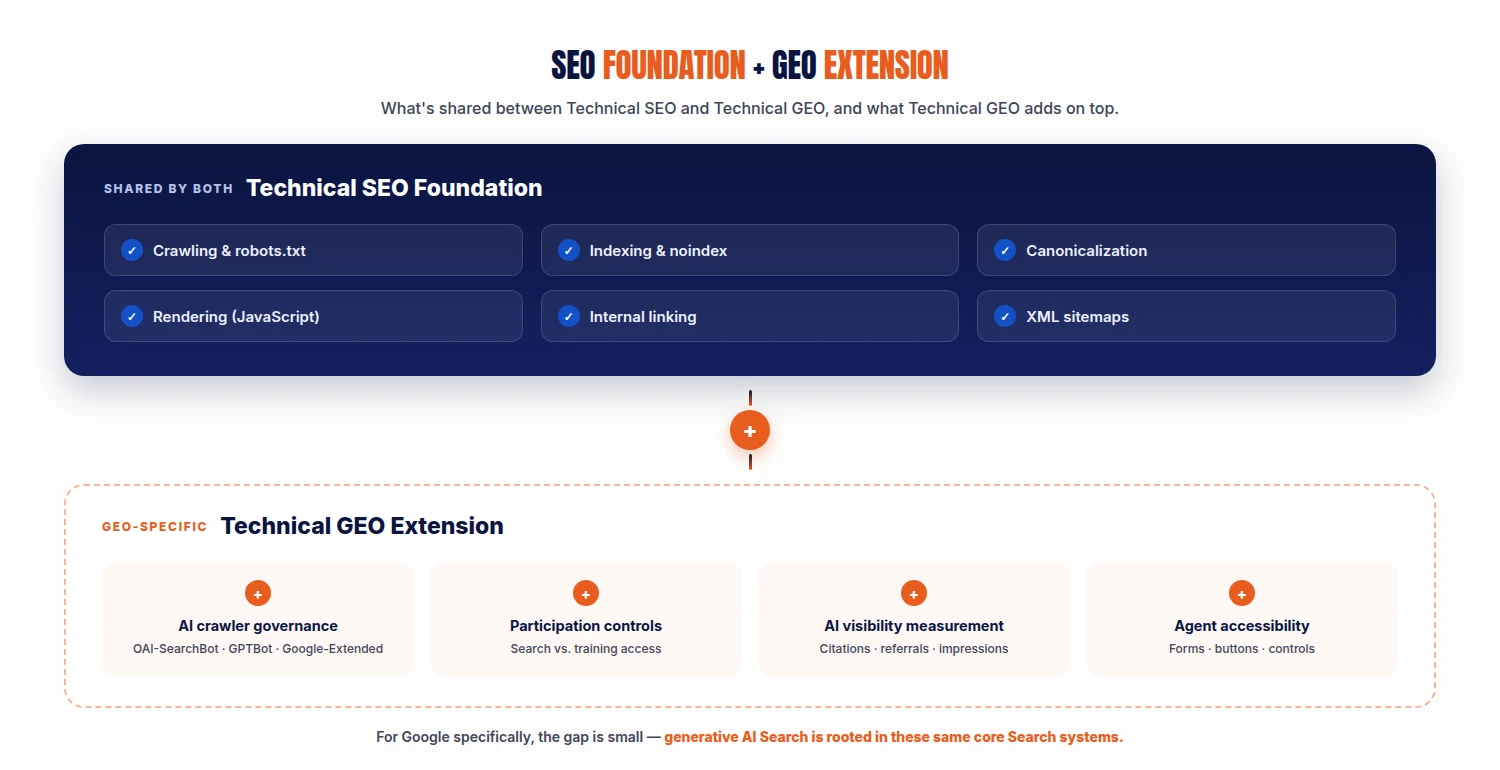
Before focusing on the differences, it is important to understand how much remains unchanged. For Google, the overlap is especially strong. Google says its generative AI features use core Search ranking and quality systems and retrieve relevant pages from the Search index through techniques such as retrieval-augmented generation. That means several Technical SEO fundamentals remain Technical GEO fundamentals.
1. Crawlability Matters to Both
If a desired crawler cannot access the page, the page cannot reliably participate in the system. Both Technical SEO and Technical GEO therefore care about robots.txt, network access, HTTP responses, firewalls, crawl permissions, and rate limits.
The difference is mainly which crawlers are being evaluated. Traditional SEO might audit Googlebot. Technical GEO may additionally audit OAI-SearchBot, GPTBot, Google-Extended controls, and other relevant AI systems.
2. Indexability Matters to Both
For Google, AI Overviews and AI Mode are still linked closely to normal Search eligibility. Google says a page must be indexed and eligible to appear in Search with a snippet to be eligible for generative AI Search features.
That makes standard SEO controls still important: noindex, canonical tags, status codes, duplicate management, and indexing eligibility. Technical GEO does not eliminate indexing. For Google, it depends on it.
3. Rendering Matters to Both
Modern websites frequently rely on JavaScript. Google says it can process JavaScript content as long as it is not blocked, while noting that SEO for JavaScript frameworks remains more technically complex than simpler implementations.
Both Technical SEO and GEO should therefore examine whether primary content renders, whether APIs fail, whether client-side routing works, whether critical data is delayed, and whether important information exists after rendering. The practical rule is unchanged: if machines cannot reliably access the information, they cannot reliably use it.
4. Canonicalization Matters to Both
Generative search does not remove duplicate URLs. If a website exposes the same content through tracking parameters, print versions, filters, HTTP and HTTPS, or multiple URL structures, the preferred source still needs to be clear. Canonicalization therefore remains a foundational technical problem.
5. Internal Linking Matters to Both
Search crawlers discover pages through links. AI retrieval systems can also benefit indirectly from clear site architecture because the underlying search infrastructure needs to discover and understand related content. Strong internal linking helps establish page relationships, topic clusters, hierarchy, priority, and discoverability.
So if your internal architecture is poor, calling the problem “GEO” does not change the solution. Fix the internal linking.
6. Structured Data Can Matter to Both
Structured data remains useful for explicit machine-readable relationships and supported Google Search features. But this is also one of the areas where GEO hype has created confusion.
Google explicitly says structured data is not required for generative AI Search, there is no special schema.org markup required for AI Overviews or AI Mode, and site owners should continue using structured data as part of a normal SEO strategy.
Therefore: structured data is useful. But “AI schema” is not a shortcut to GEO visibility.
Where Technical GEO Extends Technical SEO
This is where the practical differences begin.
Difference 1: Technical GEO Requires Multi-Crawler Governance
Traditional SEO crawler strategy is usually dominated by Googlebot and perhaps Bingbot. Technical GEO introduces additional decisions.
For example, a publisher might want Googlebot allowed because Google Search matters, OAI-SearchBot allowed because ChatGPT Search visibility matters, and GPTBot disallowed because the publisher does not want certain content available for potential training use.
That policy is technically coherent because OpenAI separates OAI-SearchBot search discovery from GPTBot-related training controls. Traditional technical SEO rarely needed this type of governance matrix. Technical GEO increasingly does.
Difference 2: Search Access and Training Access Become Separate Decisions
This is one of the most important Technical GEO concepts. “Should we allow AI crawlers?” is the wrong question. The better questions are: do we want to appear in AI search, do we want our content used for model training, and do we want user-triggered agents to interact with our site?
These are different use cases. For OpenAI, OAI-SearchBot relates to ChatGPT Search discovery and GPTBot relates to potential model-training use. For Google, Google-Extended similarly represents a different kind of content-use control from ordinary Googlebot Search crawling.
A technically mature site should make these decisions intentionally rather than with a blanket “block all AI bots” or “allow everything.”
Difference 3: Technical GEO Includes Generative AI Participation Controls
Traditional SEO generally asks: do we want this page in Search? The answer can be controlled through familiar mechanisms such as robots.txt, noindex, and canonicalization.
Generative Search is introducing additional participation layers. Google’s current generative AI guidance says a site must be included in Search generative AI features through Search Console to be eligible for Google’s generative AI Search experiences.
This creates a new governance layer: search visibility and generative AI visibility do not necessarily have to be managed identically. That is clearly within Technical GEO territory.
Difference 4: Technical GEO Thinks About Retrieval, Not Only Indexing
Traditional SEO often treats indexing as a major milestone: the page is indexed. For AI search, that is only part of the problem. An AI system still has to retrieve the page, or a useful part of it, for a particular task.
Google explicitly says its generative systems use RAG and query fan-out. Query fan-out can turn one user question into several related searches designed to gather additional information. For example, a user asking “Which CRM is best for a small construction company?” may trigger investigation into construction CRM pricing, field-service integrations, QuickBooks support, mobile apps, team size, and user reviews.
Technical GEO therefore asks whether relevant supporting information is accessible, linked, textually available, associated with the right page or entity, and retrievable through the underlying search system.
Difference 5: Technical GEO Adds AI Visibility Measurement
Traditional technical SEO monitoring commonly includes Google Search Console, crawling and indexing reports, organic impressions, organic clicks, rankings, and server logs. Technical GEO extends the measurement layer.
Google’s current generative AI guidance directs site owners to its Generative AI performance report in Search Console to understand visibility in generative Search features. OpenAI also says ChatGPT referral URLs include utm_source=chatgpt.com, which allows publishers to identify referrals from ChatGPT Search in analytics.
A Technical GEO measurement stack may therefore monitor generative AI impressions, AI citations, cited URLs, AI referrals, ChatGPT traffic, AI crawler requests, and AI-assisted conversions. That measurement layer is not normally central to a traditional technical SEO audit.
Difference 6: Technical GEO Includes Agent Accessibility
This may ultimately become the biggest technical difference. Search crawlers read websites. AI agents may need to use websites.
Google describes AI agents as autonomous systems that can perform tasks such as comparing product specifications or booking reservations. Its current guidance notes that browser agents can inspect screenshots, DOM structure, and accessibility trees while interacting with sites.
That introduces technical requirements that historically belonged more to accessibility, UX, and frontend engineering: properly labeled form fields, descriptive buttons, meaningful control states, accessible navigation, clear error messages, and predictable interactive workflows.
Traditional technical SEO asks: can Googlebot understand the page? Technical GEO increasingly asks: can an authorized AI agent understand what it can do on the page? This is also where crawlability alone stops being sufficient; see why being crawlable isn’t enough for AI search visibility for how that gap plays out in practice.
Technical SEO vs Technical GEO: Example
Consider a local HVAC company. Its website has clean 200-status pages, valid canonicals, an XML sitemap, strong internal links, LocalBusiness schema, and good mobile performance. From a technical SEO standpoint, the foundation looks strong.
Now perform a Technical GEO audit. You discover that OAI-SearchBot is blocked by the WAF, GPTBot policy is undocumented, the company has never reviewed Google-Extended, AI referrals are not measured, service-area information is inconsistent, quote-form fields rely entirely on placeholders, the “Request Estimate” control has no accessible name, and no one has checked generative AI participation settings.
The site can be technically strong for conventional SEO while still having AI-readiness gaps. That is the distinction Technical GEO is intended to expose.
Technical SEO vs GEO for Google: The Gap Is Smaller
This deserves emphasis because it prevents overengineering. For Google Search specifically, Technical GEO is largely an extension of good SEO.
Google’s official guidance says SEO remains relevant for generative AI Search, AI Overviews and AI Mode rely on core Search systems, normal technical structure matters, pages need normal Search eligibility, no llms.txt file is required, no special AI markup is required, and no content “chunking” strategy is required.
Google even says that, from its perspective, AEO and GEO work focused on Google generative Search is still SEO. So a site with poor technical SEO should not start by looking for exotic GEO tactics. Fix crawling, indexing, internal links, rendering, content quality, and duplication first.
Does Technical GEO Require Special AI Markup?
No universal AI markup exists. This is one of the clearest areas where marketers should resist unnecessary implementation.
For Google, the answer is explicit. Google says site owners do not need special AI text files, machine-readable AI files, AI markup, or Markdown versions to appear in Google Search’s generative AI features.
You should still use structured data where it serves a real purpose. But do not create imaginary properties such as AIOptimization, GEOScore, or AICitationReady and expect search engines to reward them.
Is llms.txt Part of Technical GEO?
It can be part of a platform-specific technical review, but it should not be treated as a universal requirement. For Google specifically: no. Google says Search ignores llms.txt, and maintaining the file neither improves nor harms Search visibility or rankings.
That means a Technical GEO audit should not deduct points because a website lacks llms.txt. The correct rule is: use platform-supported controls where platforms explicitly document them. Do not create technical busywork around unofficial conventions simply because the filename sounds AI-related.
Does Technical GEO Require Content Chunking?
Again, not for Google. Some GEO advice recommends dividing every page into tiny answer blocks to supposedly make information easier for language models to retrieve.
Google says there is no requirement to break content into tiny pieces for its AI Search systems and that its systems can understand multiple topics on a page and surface relevant portions.
This does not mean structure is irrelevant. Use clear headings, focused paragraphs, useful lists, tables, and definitions. But structure content for comprehension. Do not design arbitrary “AI chunks” because someone claims 50-word sections are a ranking factor.
Technical SEO vs Technical GEO Audit Checklist
Here is a practical way to decide where each check belongs.
| Technical Check | SEO | GEO |
|---|---|---|
| robots.txt | ✓ | ✓ |
| Googlebot access | ✓ | ✓ |
| HTTP status codes | ✓ | ✓ |
| noindex | ✓ | ✓ |
| canonical tags | ✓ | ✓ |
| XML sitemap | ✓ | ✓ |
| internal linking | ✓ | ✓ |
| JavaScript rendering | ✓ | ✓ |
| duplicate control | ✓ | ✓ |
| structured data | ✓ | ✓ |
| mobile usability | ✓ | ✓ |
| OAI-SearchBot | — | ✓ |
| GPTBot governance | — | ✓ |
| Google-Extended governance | — | ✓ |
| Search/training policy separation | — | ✓ |
| Google generative AI participation | — | ✓ |
| ChatGPT referral tracking | — | ✓ |
| AI citation monitoring | — | ✓ |
| agent accessibility | — | ✓ |
| accessible control states | — | ✓ |
This is why I would not recommend maintaining two completely disconnected audits. A better approach is one technical audit with an additional AI-readiness layer, which is the same principle behind a full 27-signal AI readiness audit.
Do You Need a Separate Technical GEO Audit?
For most websites: not as a completely independent audit. The more efficient model is a core technical SEO audit, followed by a Technical GEO extension.
The core audit covers crawlability, indexing, rendering, canonicals, sitemaps, internal architecture, duplicate management, structured data, and page experience. The extension then covers AI crawler access, training controls, generative AI participation, AI referral tracking, AI visibility measurement, and agent accessibility.
This avoids duplicate work. It also prevents teams from treating Technical GEO as a separate marketing project disconnected from the site’s actual technical health.
Which Should You Fix First: Technical SEO or Technical GEO?
If foundational SEO is broken, technical SEO first. For example, suppose a site has thousands of accidental noindex tags, redirect loops, incorrect canonicals, severe rendering failures, and orphan pages. It makes little sense to prioritize an llms.txt debate or AI-agent button labeling while those problems exist.
Use this order:
- Priority 1 — Search Infrastructure. Fix status codes, crawling, indexability, canonicals, rendering.
- Priority 2 — Site Discovery. Fix internal linking, sitemaps, architecture, duplicate URLs.
- Priority 3 — Machine Understanding. Improve entities, semantic structure, structured data.
- Priority 4 — AI Governance. Review OAI-SearchBot, GPTBot, Google-Extended, generative AI participation.
- Priority 5 — Agent Accessibility. Improve forms, buttons, controls, interface states.
- Priority 6 — AI Measurement. Track AI visibility, citations, referrals, AI-assisted conversions.
That order minimizes wasted effort.
Can Strong Technical SEO Automatically Produce GEO Visibility?
No. Strong technical SEO creates a powerful foundation. It does not guarantee that generative systems will choose your content.
Google explicitly says that meeting all technical requirements and best practices does not guarantee crawling, indexing, or serving. OpenAI similarly says ChatGPT Search ranks results using multiple factors intended to surface relevant and reliable information and that placement is not guaranteed.
A technically excellent page can still have generic content, weak relevance, no original evidence, poor authority, or outdated information. That is why Technical GEO should be paired with content GEO.
Technical GEO Does Not Guarantee AI Citations
This is another critical distinction. A technically optimized website can improve accessibility, eligibility, retrievability, and machine interpretation. It cannot force an AI system to cite the page.
Think of it this way: Technical GEO gets your content into the competition. Content quality, authority, relevance, and usefulness determine how competitive it is.
That is similar to traditional SEO. A perfect XML sitemap does not guarantee position #1. Likewise, a perfect OAI-SearchBot configuration does not guarantee a ChatGPT citation.
What About Backlinks?
Backlinks remain more closely associated with SEO and authority than with Technical GEO specifically. However, Technical GEO should not be treated as a reason to abandon traditional authority building.
Generative Search systems can rely on search infrastructure that already evaluates the broader web ecosystem. Google explicitly says its generative AI features are rooted in core Search ranking and quality systems.
Therefore, the strongest strategy remains integrated: technical health, useful content, authority, and machine accessibility, rather than trying to replace existing SEO fundamentals with GEO-specific hacks.
What About Page Speed and Core Web Vitals?
These remain relevant primarily as SEO, UX, and user-experience considerations. Technical GEO should not automatically relabel every performance metric as an “AI ranking factor.”
Instead, use a more disciplined standard: does performance prevent content from rendering, cause API failures, break interactive workflows, make browser-agent interaction unreliable, or degrade user experience? If yes, it has GEO implications too. If not, do not invent an unsupported direct AI ranking relationship.
Technical SEO vs GEO for Ecommerce
Ecommerce makes the distinction clearer. Technical SEO might focus on product crawlability, faceted navigation, canonicals, pagination, Product structured data, Merchant Center, and internal linking.
Technical GEO adds questions such as: can AI systems retrieve accurate price information, is availability understandable, are variants clear, can an AI agent interpret product selectors, is the Add to Cart action accessible, and are important transaction controls machine-interpretable?
Google’s current generative AI guidance specifically notes that product listings and product information can appear in generative AI responses and recommends maintaining Merchant Center and related product information.
So for ecommerce: SEO gets the product discovered. GEO increasingly considers whether AI systems can evaluate and potentially interact with it.
Technical SEO vs GEO for Local Businesses
Traditional Local SEO involves Google Business Profile, location pages, local schema, NAP consistency, local links, and reviews.
Technical GEO extends this by asking whether AI systems can reliably identify service areas, opening hours, exact services, locations, booking actions, and quote forms.
A local business may rank well but still provide vague machine-readable information about what it actually offers. That creates a GEO weakness even if traditional local rankings remain strong.
Technical SEO vs GEO for Publishers
Publishers face additional governance decisions. A publisher may need to decide separately whether Google should crawl the content, whether ChatGPT Search should discover it, whether GPTBot should access it, whether Google-Extended uses are acceptable, and whether generative AI Search participation fits its business model.
This makes Technical GEO partly a publisher policy discipline, not just a crawling discipline. That is a meaningful difference from traditional SEO.
A Practical Combined Audit Framework
For most websites, a three-layer technical audit works best.
Layer 1: Technical SEO Foundation. Check crawlability, HTTP, indexability, canonicals, rendering, sitemaps, duplicate URLs, and internal linking.
Layer 2: Technical GEO Readiness. Check AI search crawlers, AI-use permissions, generative Search eligibility, entities, retrieval accessibility, and AI measurement.
Layer 3: Agent Readiness. Check forms, buttons, menus, accessibility tree, interface states, and transactional workflows.
This combined audit is more useful than creating a disconnected checklist for every new industry acronym.
When Technical SEO Is Enough
There are situations where you may not need a major GEO-specific technical project. If a site already has excellent technical SEO, intentionally allows desired AI search systems, has documented crawler policies, does not depend on complex interactive workflows, and monitors AI visibility, then the biggest opportunities may no longer be technical.
The site may benefit more from stronger content, original research, clearer expertise, citation-worthy evidence, and entity authority. Do not keep inventing technical work after the technical bottleneck has been solved.
When Technical GEO Deserves Separate Attention
A deeper Technical GEO audit makes more sense when AI visibility is commercially important, ChatGPT referrals matter, publishers need crawler governance, ecommerce interfaces are highly interactive, AI agents may become part of the customer journey, multiple AI crawlers are being selectively controlled, or generative AI visibility is being measured as a distinct channel.
These businesses have technical requirements that a 2020-style SEO audit probably does not cover.
Bottom Line
Technical SEO and Technical GEO are not two competing roads to visibility. They are layers of the same technical problem.
Technical SEO established the foundation: can search engines find, crawl, render, index, understand, and rank the site? Technical GEO extends that foundation: can generative systems and AI agents access, retrieve, interpret, measure, and potentially use the site?
For Google, the overlap is especially large. Google’s official position is clear: generative AI Search remains rooted in its existing Search systems. Normal SEO best practices still matter. There is no special AI schema requirement, no required llms.txt, and no need to rewrite your entire technical stack for AI Overviews or AI Mode.
That means marketers should resist the false choice of “SEO or GEO?” The better model is: SEO foundation + GEO extension.
Use Technical SEO to solve crawling, indexing, rendering, canonicals, architecture, and duplication. Then use Technical GEO to solve AI crawler governance, Search vs training access, generative AI participation, AI visibility measurement, machine-readable entity consistency, and browser-agent accessibility.
The strategic difference can be summarized in one sentence: Technical SEO prepares your website to be searched. Technical GEO prepares it to participate in an AI-mediated web.
And there is one more important rule: do not label every old SEO best practice as a new GEO tactic simply because AI is involved. If the problem is a broken canonical, fix the canonical. If the problem is noindex, fix the noindex. If the problem is weak internal linking, improve internal linking. But if the problem is that ChatGPT Search is unintentionally blocked, your AI-use policies are undocumented, Google generative AI participation is misconfigured, or an agent cannot understand your checkout controls, then you are dealing with the new technical layer that Technical GEO is designed to address.
The strongest websites will not choose between SEO and GEO. They will build a technical foundation capable of serving search engines, generative systems, and increasingly agents, without compromising usability for the humans those systems ultimately serve.
FAQ
What is the difference between Technical SEO and Technical GEO?
Technical SEO focuses on making websites accessible, indexable, and optimized for traditional search engines. Technical GEO extends those foundations to AI search crawlers, generative retrieval systems, AI participation controls, AI visibility measurement, and agent accessibility.
Is Technical GEO replacing Technical SEO?
No. Technical GEO depends heavily on traditional Technical SEO. For Google specifically, generative AI Search features are rooted in core Search ranking and quality systems, and Google says existing SEO best practices remain foundational.
Does Google recognize GEO?
Google acknowledges that terms such as AEO and GEO are used by marketers, but says optimizing for its generative AI Search experiences is still SEO from Google’s perspective.
Do I need special technical changes for Google AI Overviews?
Usually not beyond good SEO fundamentals and intentional generative AI participation. Google says pages need normal Search eligibility and does not require special AI markup or files.
Do I need special schema for GEO?
No universal GEO schema exists. Google explicitly says there is no special schema.org markup required for its generative AI Search features.
Is llms.txt required for Technical GEO?
No. Google says Search ignores llms.txt, so it does not help or hurt Google Search visibility. Other services may have different policies, so implementation should be platform-specific.
Is OAI-SearchBot part of Technical SEO?
It is more accurately part of Technical GEO or AI-search readiness. OpenAI says allowing OAI-SearchBot helps make public content eligible for discovery and citation in ChatGPT Search.
Is GPTBot required for ChatGPT Search?
No. OpenAI distinguishes OAI-SearchBot for Search discovery from GPTBot-related training controls.
Does strong SEO guarantee AI visibility?
No. Strong SEO improves technical eligibility and can help underlying retrieval systems, but neither Google nor OpenAI guarantees generative placement simply because technical requirements are met.
Should I run separate Technical SEO and Technical GEO audits?
For most sites, one integrated audit is more efficient. Start with a normal technical SEO audit, then add AI-specific checks covering crawler governance, generative Search participation, AI visibility measurement, and agent accessibility.
Does Technical GEO include AI agents?
It increasingly can. Google notes that browser agents may inspect rendered pages, DOM structures, and accessibility trees while interacting with websites.
Should I prioritize SEO or GEO first?
Fix fundamental SEO failures first. Crawlability, HTTP errors, indexability, canonicalization, rendering, and internal linking should usually be addressed before advanced AI-specific optimization.