That range is wide on purpose. The honest answer is that trackers disagree with each other more than usual on this metric, and pretending otherwise would be less useful than explaining why. For the full study-by-study breakdown of the CTR side specifically, see do AI Overviews reduce organic click-through rates.
Why the coverage numbers don’t agree
BrightEdge’s commercial-vertical tracking put coverage at 48% by March 2026, up from 31% a year earlier. Similarweb’s panel data found 43%, up from 15% the year before. Advanced Web Ranking has reported figures as high as 60% for US queries at points in 2025 and 2026. Semrush’s broader keyword panel measured closer to 16%, and Pew Research’s real-user behavior data landed around 18%.
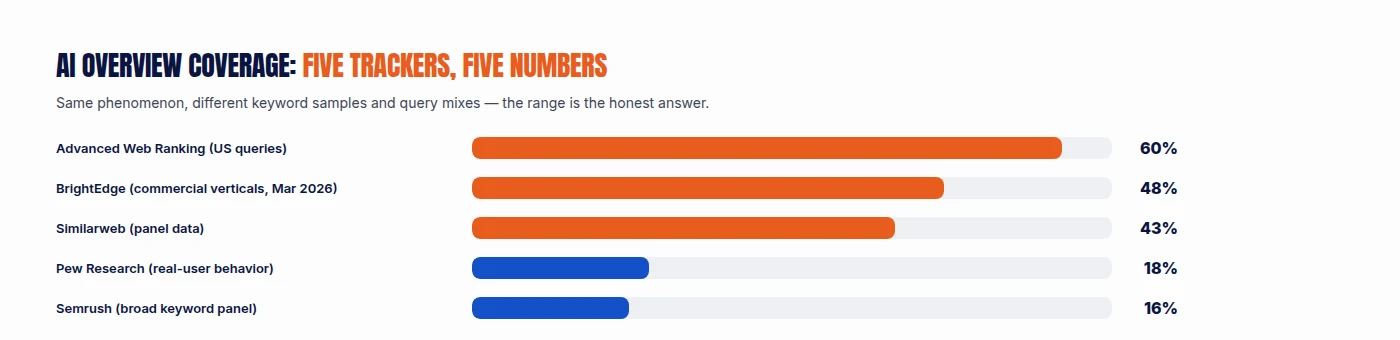
None of these trackers are wrong, exactly. They’re measuring different things: different keyword samples, different geographies, different query mixes, commercial versus informational skew. BrightEdge’s panel leans toward commercial verticals where AI Overviews trigger often; Semrush’s broader sample includes far more long-tail and transactional queries where they don’t.
What every tracker agrees on is the shape of the curve. Coverage has climbed sharply and consistently over the past year, whatever the exact starting and ending numbers. Treat any single percentage as directional, not as a hard fact to build a report around.
A relevant structural shift worth knowing
At Google I/O in May 2026, Google merged AI Overviews and AI Mode into a single, seamless flow, live globally as of May 19. A user can now start with a standard search, land on an AI Overview, and continue directly into a multi-turn AI Mode conversation without switching screens. Google’s VP of Search called this “AI search through and through,” a deliberate shift from earlier framing where AI features sat on top of a traditional results page. See AI Overviews vs. AI Mode for how the two surfaces still differ underneath that merged flow.
That doesn’t erase the distinction between the two experiences, but it does mean the two are now designed to flow into each other by default, which matters for how much of a session lives inside an AI-generated experience versus how much reaches a traditional results page at all.
The click-through data, by source
Seer Interactive’s longitudinal study is the most detailed public dataset here. Organic CTR on AI Overview-present queries fell to a low of 0.61% by September 2025, a roughly 65% collapse from its pre-AI-Overview baseline. It then partially recovered, reaching roughly 2.4% by February 2026, though CTR on non-AI-Overview queries rose over the same period too, preserving a persistent gap between the two.
Multiple independent studies converge on a similar range even with different methodologies. Reported CTR drops for the top-ranking organic result specifically, once an AI Overview is present, cluster between 34% and 61% depending on position and study. Pew Research’s real-user panel data found an 8% click-through rate when an AI Overview appears, against 15% when it doesn’t, a comparable gap measured a different way.
Where the impact varies most
Query type matters more than almost anything else here. Seer’s data found question-format queries trigger AI Overviews at nearly 86%, and review queries at a similar rate, while single-word queries trigger them only around 27% of the time. That’s roughly a sevenfold gap between the query types most likely and least likely to surface an AI Overview at all.
Industry matters just as much. Healthcare consistently shows among the highest trigger rates across every tracker, often cited above 60% and in some datasets above 80%. Education and B2B tech queries run high as well. E-commerce and highly transactional queries sit at the other end, often in the single digits, because Google has both a UX and a commercial reason to keep traditional results, and ads, in front of purchase-ready searchers.
The citation advantage
This is the part worth acting on. Being cited inside the AI Overview substantially offsets the traffic loss. Multiple studies, including Seer’s, find cited brands earn meaningfully more organic clicks than uncited brands on the same query, with some analyses putting the gap well above 100%.
That reframes the real risk. It’s not that AI Overviews exist on a given query. It’s being present in the search results but absent from the citation, which is the combination that captures the smallest possible share of a shrunk click pool.
What publishers are actually seeing
Real-world traffic declines at major publishers have been well documented across trade press over the past year, consistent with the CTR data above even without restating any single publisher’s specific numbers here. The pattern lines up: informational, question-heavy content categories, the same ones with the highest AI Overview trigger rates, are also where publishers have reported the steepest organic traffic pressure.
What to do about it
Prioritize being the cited source over simply ranking first. The data is consistent enough now that citation status matters more than ordinal position for how much traffic a query actually sends.
Structure content so a specific passage can be extracted and cited cleanly, answering the core question directly and early rather than building up to it. And track citation rate as a standing metric alongside traditional rankings, since ranking position alone increasingly fails to predict how much visibility, or traffic, a page is actually getting. For how to build citation tracking into your existing reporting, see how to track traffic from AI Overviews.
FAQ
What percentage of Google searches now show an AI Overview?
Estimates vary widely by tracking methodology, ranging from around 16% to over 60% depending on the dataset, query mix, and geography. What’s consistent across every tracker is the direction: coverage has grown sharply over the past year, whatever the exact starting number.
Does an AI Overview always reduce clicks to my site?
Not evenly. Being cited inside the AI Overview substantially offsets the loss, since cited brands see meaningfully higher organic CTR than uncited brands on the same query. The traffic risk is concentrated in being present in the search results but absent from the citation, not simply in the AI Overview existing.
Which industries are hit hardest by AI Overview expansion?
Healthcare, education, and B2B tech queries trigger AI Overviews at some of the highest rates across most trackers, in some datasets above 80%, while e-commerce and highly transactional queries see them far less often, often in the single digits.
Did Google’s AI Overviews and AI Mode merger change how this works?
As of May 2026, Google unified AI Overviews and AI Mode into a single flow, letting users move from a standard search into an AI Overview and then into a multi-turn AI Mode conversation without switching screens. The two remain distinct experiences, but they’re now designed to connect by default, which shapes how much of a search session stays inside an AI-generated experience.