The European Commission has explicitly said that Alphabet is responsible for ensuring that its deployment of AI Overviews in Google Search complies with the DMA, and that regulators are monitoring the integration, including under Article 6(5), which prohibits gatekeepers from treating their own services more favorably in ranking than comparable third-party services.
This does not mean AI Overviews have been ruled illegal.
It also does not mean Google’s €890 million DMA fine announced on July 23, 2026 was specifically an AI Overviews fine. The Commission fined Google €460 million for Search self-preferencing involving areas such as shopping, hotels, transport, and sports results, plus €430 million for separate Google Play anti-steering violations.
However, the same principles around self-preferencing, ranking fairness, source prominence, and access to Search data are increasingly relevant as Google Search becomes more AI-driven.
For SEOs, the key implication is: AI Search regulation is becoming part of search strategy.
You now need to monitor not just algorithms and rankings, but also:
- DMA enforcement
- AI Overview source treatment
- AI Mode interfaces
- publisher controls
- Search data access
- regional differences in European SERPs
- and potential remedies affecting how Google can prioritize its own AI experiences
What Is the Digital Markets Act?
The Digital Markets Act, or DMA, is an EU law designed to make digital markets more contestable and fair where a small number of very large platforms act as important gateways between businesses and users.
The law identifies certain companies as gatekeepers and applies specific obligations to designated core platform services.
The European Commission currently lists Alphabet as a gatekeeper for several services, including:
- Google Search
- Google Play
- Google Maps
- Google Shopping
- YouTube
- Android
- Chrome
- online advertising services
For SEOs, the important one is Google Search — Case DMA.100004.
Google Search’s designation means Alphabet cannot simply treat every Search product change as outside the DMA because the interface or technology evolves. The regulatory obligations remain attached to the designated core platform service.
Why Does the DMA Matter to SEO?
Traditional SEO assumes that Google largely controls crawling, indexing, ranking, SERP layouts, Search features, and source presentation. The DMA places legal constraints around some of those decisions.
That is significant because Article 6(5) of the DMA explicitly addresses not only ranking but also related indexing and crawling.
The law states that a gatekeeper must not treat its own services and products more favorably in ranking than similar third-party services and must apply transparent, fair, and non-discriminatory ranking conditions.
The accompanying DMA text explains that ranking can include multiple forms of relative prominence, such as display, linking, visual prominence, presentation of specialized results, and even situations where only a single result is communicated to the user.
That becomes highly relevant when Search changes from ten blue links to one synthesized AI answer supported by selected sources.
Why AI Overviews Create a DMA Question
AI Overviews change the architecture of the Search results page. Traditional Search runs Query → Ranked results → User chooses a website. An AI Overview instead runs Query → Google retrieves information → Google synthesizes an answer → Selected sources may appear around or within the response.
That creates new questions about prominence, ranking, source selection, linking, traffic distribution, Google’s own services, and competing publishers.
The European Commission has already acknowledged this. In its 2026 DMA review, the Commission said it is Alphabet’s responsibility to ensure the integration of AI Overviews into Google Search complies with the DMA. The Commission also acknowledged concerns from the media industry, including concerns about traffic losses, and said it is monitoring the integration through ongoing regulatory dialogue.
This makes AI Overviews more than a normal SERP feature from a regulatory perspective. For a closer look at how that traffic-loss debate specifically plays out for publishers, see EU investigates Google AI Search: what publishers need to know.
Article 6(5): The Most Important DMA Rule for AI Overviews
For SEOs, Article 6(5) is probably the most important DMA provision to understand. At a high level, it says gatekeepers must not favor their own products or services over comparable third-party services in ranking. They must apply transparent, fair, and non-discriminatory conditions.
Historically, this has applied to situations such as Google Shopping, Google Hotels, travel, transport, and sports results.
But the regulatory question now becomes: What happens when Google’s own AI-generated answer occupies the most prominent area of Google Search?
That question is not yet answered by a final AI Overviews-specific infringement decision. But the Commission is explicitly monitoring the issue under Article 6(5).
Why Self-Preferencing Matters for AI Search
Consider a traditional search query: “Best hotels in Paris.” Google might show organic travel publishers, booking sites, hotel pages, and Google’s own specialized travel interface. The DMA asks whether Google gives its own services unfair preferential treatment compared with comparable third parties.
Now imagine an AI Mode query: “Find me three boutique hotels in Paris under €300 per night near Le Marais.” Google AI could potentially interpret the request, retrieve information, compare options, display recommendations, link to sources, and incorporate Google-owned services.
The regulatory issue becomes more complex because ranking is no longer simply a linear list. It can involve which data is selected, which businesses are recommended, which links are visible, which Google services are embedded, and which third-party sources receive attribution.
The DMA was written broadly enough that these forms of prominence can still matter.
AI Overviews Do Not Escape the DMA Because They Use AI
This is a common misconception. A law does not necessarily need to mention “AI Overview” or “large language model” by name for existing obligations to apply.
The Commission has made clear that existing DMA rules continue to apply to AI services where relevant. Its 2026 review specifically states that AI-related changes integrated into designated core platform services remain subject to applicable DMA obligations.
This is important for the future of Search. Google cannot necessarily avoid an existing obligation simply by replacing a traditional interface with an AI-generated one.
Google Was Fined €890 Million in July 2026 — But Not Specifically for AI Overviews
This distinction needs to be extremely clear.
On July 23, 2026, the European Commission announced two DMA non-compliance decisions against Google. The total fines were €460 million for self-preferencing involving Google Search and €430 million for Google Play anti-steering restrictions, totaling €890 million.
The Search decision found that Google gave preferential treatment to its own services, including shopping, hotels, transport, and sports, through more prominent positioning, enhanced visuals, filters, and other presentation advantages.
That was a real DMA infringement decision. But it was not a decision finding AI Overviews themselves illegal.
Do not publish: “EU fines Google €890 million over AI Overviews.” That would be inaccurate.
Why the July 2026 Search Decision Still Matters to AI Overviews
Even though the fine was not specifically about AI Overviews, the legal principle matters. The Commission’s Search decision reinforces the idea that Google cannot use the Search results environment to systematically favor its own services over competitors in ways that violate Article 6(5).
AI Overviews and AI Mode dramatically reshape that environment. So SEOs should watch how the same concepts are interpreted when AI answers occupy more SERP space, source links become secondary, Google’s own services appear inside AI answers, and recommendations replace traditional rankings.
The question is no longer only where does a result rank. It increasingly becomes what gets included in the AI-mediated answer at all.
The DMA Definition of Ranking Is Broader Than Position #1
This is especially relevant for SEO professionals. The DMA does not treat ranking as only Position 1, Position 2, Position 3. Its recitals describe ranking broadly enough to include display prominence, rating, linking, voice results, specialized groups of results, and situations where a service presents only one result.
That is highly relevant to generative search. An AI answer may not look like a conventional ranked list, but there is still a selection process. Some information is included, emphasized, linked, or recommended. Other information is omitted.
From a regulatory perspective, relative prominence can still exist even when users do not see ten ordered links.
What Could Self-Preferencing Look Like in AI Search?
These examples are hypothetical, not findings by the Commission. Possible questions regulators may need to consider include:
Google Shopping. Does an AI shopping response disproportionately favor Google Shopping experiences over comparable third-party shopping services?
Google Hotels. Does an AI travel answer make Google’s own hotel tools more prominent than competing travel platforms?
Google Maps. Are Google’s local products given preferential treatment when AI answers local queries?
YouTube. Does Google preferentially surface YouTube videos compared with comparable content elsewhere?
Gemini or Other Google AI Services. Could Google use Search to steer users toward its own AI-related products?
Again: these are regulatory questions — not findings. SEOs should distinguish between what is legally established and what remains under review.
AI Overviews vs Publishers: The DMA Traffic Question
Publishers raise a different concern. An AI Overview can answer more of the query directly, which can potentially reduce the number of users who click through to news sites, informational publishers, blogs, and reference sites.
The European Commission’s DMA review explicitly acknowledges concerns from the media industry related to traffic losses resulting from AI Overviews.
This does not automatically mean Google has violated the DMA simply because CTR changes. Traffic reduction itself is not the entire legal test. But it becomes relevant when regulators examine ranking fairness, source prominence, publisher dependence, and Google’s role as both intermediary and provider of AI answers. If you’re weighing whether opting a site out of AI training and surfacing is worth the visibility trade-off, see Google AI opt-out vs GEO visibility: what do publishers lose?
Google’s New Publisher Opt-Out Changes the Debate
Google has now introduced a dedicated Search generative AI control. Publishers can exclude their links and content from covered generative AI experiences while remaining eligible for ordinary Search.
That directly addresses one major publisher complaint: previously, refusing AI use without sacrificing Search visibility was much harder.
However, the regulatory debate has not ended. As of September 1, 2026, EU antitrust regulators were actively consulting publishers about Google’s new opt-out and whether it meaningfully addresses their concerns.
This shows that regulators are interested not merely in whether a control exists, but whether the choice is meaningful in practice. For a deeper walkthrough of whether opting out actually makes sense for a given site, see should publishers opt out of Google AI Overviews and AI Mode?
DMA and Antitrust: Do Not Confuse Them
There are two separate legal tracks around Google AI Search.
DMA Monitoring. The Commission is monitoring whether AI Overviews comply with existing DMA obligations, including Article 6(5).
Traditional EU Antitrust Investigation. Separately, the Commission opened an antitrust investigation in December 2025 concerning Google’s use of publisher content for AI purposes. That investigation examines concerns including use of publisher content, appropriate compensation, and whether publishers could refuse AI-related use without losing Google Search access.
These proceedings interact conceptually. But they are not the same legal case. The DMA complements normal competition law rather than replacing it.
Why This Distinction Matters for SEOs
Imagine a headline says “EU Investigates Google AI Overviews.” That could refer to DMA compliance monitoring, the antitrust content-use investigation, publisher consultation, or broader Search self-preferencing enforcement.
Each has different legal standards, potential remedies, timelines, and consequences. SEO reporting should identify the specific proceeding rather than treating everything as one regulatory case — a distinction covered in more depth in EU investigates Google AI Search: what publishers need to know.
Article 6(11): The DMA Rule That Could Help AI Search Competitors
Another DMA provision may ultimately be just as important as Article 6(5).
Article 6(11) requires a gatekeeper operating an online search engine to provide eligible competing search engines access to certain anonymized search data on fair, reasonable, and non-discriminatory terms.
The relevant data can include ranking data, query data, click data, and view data. The purpose is competition: Google has accumulated enormous amounts of Search behavior data because of its scale, and that data can help improve relevance, ranking, query understanding, and search quality. New competitors do not automatically have the same data advantage.
AI Chatbots Can Qualify for Google Search Data Access
This became particularly important in 2026. The European Commission opened specification proceedings in January to define how Google’s Article 6(11) obligation should work in practice.
On July 16, 2026, the Commission reportedly adopted final binding measures under Article 6(11). According to reporting on those measures, eligible beneficiaries can include AI chatbots offering search functionality.
This could have major implications for AI search competition. A qualifying AI search provider may be able to access anonymized Google Search data under regulated conditions instead of trying to build equivalent behavioral datasets entirely from scratch.
What Search Data Must Google Share?
Article 6(11) covers categories including ranking data, query data, click data, and view data.
The Commission’s July 2026 measures reportedly define how Google must provide qualifying data under fair, reasonable, and non-discriminatory terms while addressing anonymization and security requirements.
The Commission’s objective is explicitly competitive. It wants third-party search engines to have better opportunities to improve their services and challenge Google Search’s entrenched position.
Why Search Data Matters to AI Search Engines
Imagine an AI search company building a new product. The model may be excellent at reasoning, summarization, and language generation. But search quality also depends on understanding what people search for, which results satisfy users, which links users choose, how queries change, and how different result types perform.
Google has accumulated these signals at enormous scale. The Commission says Google Search has held a market share above 90% for decades in Europe and has access to a uniquely large pool of user interaction data that can reinforce its position.
Article 6(11) attempts to reduce that data advantage.
Could the DMA Help ChatGPT, Perplexity, or Other AI Search Engines?
Potentially, but eligibility is not automatic. According to reporting on the Commission’s Article 6(11) measures, AI chatbots offering search functionality can qualify as beneficiaries under the framework. Whether a particular service qualifies depends on the regulatory criteria and process.
The broader strategic implication is clear: the DMA is not only regulating Google Search’s treatment of publishers. It is also trying to make the search market more contestable for competing AI-powered search services.
That could matter more to SEO over the long term than any single AI Overview interface change.
Article 6(7): AI Competition Extends Beyond Search
The DMA’s AI implications are not limited to Search. The Commission also adopted measures under Article 6(7) concerning interoperability between competing AI services and Android.
The Commission says Google must provide competing AI services with effective access to specified Android hardware and software functionality similar to what Google’s own services can access. This involves capabilities such as enabling competing assistants to execute tasks using users’ preferred applications.
Why should SEOs care? Because search discovery is moving toward AI assistant → research → action rather than query → SERP → website. If competing AI assistants gain stronger platform access, future discovery may become more fragmented across different AI interfaces.
The DMA Could Accelerate a Multi-Engine Search Market
Traditional SEO has largely been dominated by Google. AI search could create a more fragmented environment, with users increasingly discovering information through Google Search, Google AI Mode, ChatGPT, Perplexity, Gemini, browser agents, and operating-system assistants.
DMA interventions around search data access, interoperability, and self-preferencing could make it easier for competing systems to develop. If that happens, GEO becomes increasingly important because optimizing only for one ranked SERP becomes less sufficient.
Could AI Overview Rankings Be Regulated?
There is no separate published “AI Overview ranking law.” But existing DMA obligations around ranking can apply where relevant. Article 6(5) explicitly covers ranking and related indexing and crawling, and the DMA’s recitals describe ranking broadly, including various forms of prominence.
Therefore, regulators can evaluate whether Google’s implementation of AI Search respects those existing obligations. That does not mean regulators will dictate which website must rank in an AI Overview. The DMA is about competitive fairness — not SEO entitlement. Publishers do not gain a legal right to be cited simply because their content exists.
The DMA Does Not Guarantee Publisher Traffic
This is another important distinction. The DMA may constrain certain gatekeeper behavior. It does not guarantee organic CTR, traffic levels, ranking positions, AI citations, or publisher revenue.
Even a fully DMA-compliant AI Overview could potentially reduce clicks if users receive satisfactory answers directly. SEO teams should therefore not treat regulation as a strategy for restoring historic CTR. The Search environment itself is changing.
Could the EU Require More Links in AI Overviews?
Potentially, regulators could influence source presentation depending on how they interpret and enforce existing obligations. But as of September 2, 2026, there is no universal DMA rule stating “Google AI Overviews must contain X number of publisher links.”
Do not present speculative remedies as finalized requirements. Possible future areas of regulatory attention could include source prominence, attribution, comparable treatment, publisher controls, disclosure, and data access. But exact outcomes remain uncertain.
Could the DMA Force Google to Remove AI Overviews?
There is currently no basis to say that this is the expected outcome. The Commission is monitoring compliance. Regulation more commonly focuses on changing problematic behavior rather than necessarily eliminating an entire product.
Possible remedies could theoretically involve redesign, equal treatment, better controls, transparency, and source presentation. Removing AI Overviews entirely would be a much more extreme outcome and should not be predicted without evidence.
Could AI Search Look Different in the EU?
Yes. This is a realistic possibility. Google has already changed product behavior in Europe in response to DMA requirements. The Commission’s own public information notes that Google altered aspects of Search in 2024 as part of efforts to comply with Article 6(5), including changes involving Google Maps and Search presentation.
On August 28, 2026, Google also announced EEA-specific changes to its site reputation abuse enforcement following separate DMA scrutiny involving publishers.
The larger lesson is: regional SERP divergence is already real. SEOs operating internationally should not assume US Google equals EU Google, especially as regulation becomes more involved in Search product design.
What Could an EU-Specific AI Search Experience Mean for SEO?
If Google makes regulatory changes specifically for European users, SEOs may need to compare several dimensions: AI Overview frequency (does AI trigger at the same rate?), source diversity (are more competing services shown?), link prominence (are publisher links presented differently?), Google-owned services (are they integrated differently?), AI Mode functionality (does the European interface differ?), and product and local modules (do specialized Google services receive less prominence?).
This creates a new category of international SEO testing.
DMA Compliance Could Become a SERP Change Driver
Historically, SEOs monitored SERP changes caused by algorithm updates, product launches, UX testing, and monetization. Now there is another cause: regulatory compliance.
A SERP redesign in Europe may not reflect an algorithm experiment. It could reflect a Commission decision, DMA dialogue, antitrust remedy, or publisher negotiation. That distinction matters when diagnosing sudden performance changes.
SEO Monitoring Needs a Regulatory Layer
For European markets, sophisticated SEO teams should now monitor:
- Traditional Search updates — core updates, spam updates, ranking systems
- Google AI product updates — AI Overviews, AI Mode, Discover AI
- DMA enforcement — Commission decisions, specification proceedings, compliance changes
- Antitrust proceedings — especially publisher-content and AI cases
- Search Console controls — AI participation and reporting
This is increasingly part of technical competitive intelligence.
How the DMA Could Affect GEO Strategy
Generative Engine Optimization is about increasing visibility inside AI-mediated discovery. The DMA could influence GEO in several ways.
1. Source Diversity. Self-preferencing rules may encourage Google to ensure competing services receive fairer treatment. If source diversity improves, publishers may gain new opportunities.
2. Link Presentation. Changes to relative prominence could affect how visible third-party links become, which could change AI CTR, citation visibility, and source recognition.
3. Competitor Search Engines. Article 6(11) could strengthen competing AI search providers, which makes cross-platform GEO more important.
4. European Search Differences. SEO and GEO strategies may need region-specific measurement.
5. Publisher Controls. Google’s new AI Search opt-out already demonstrates how regulatory pressure can produce new publisher controls.
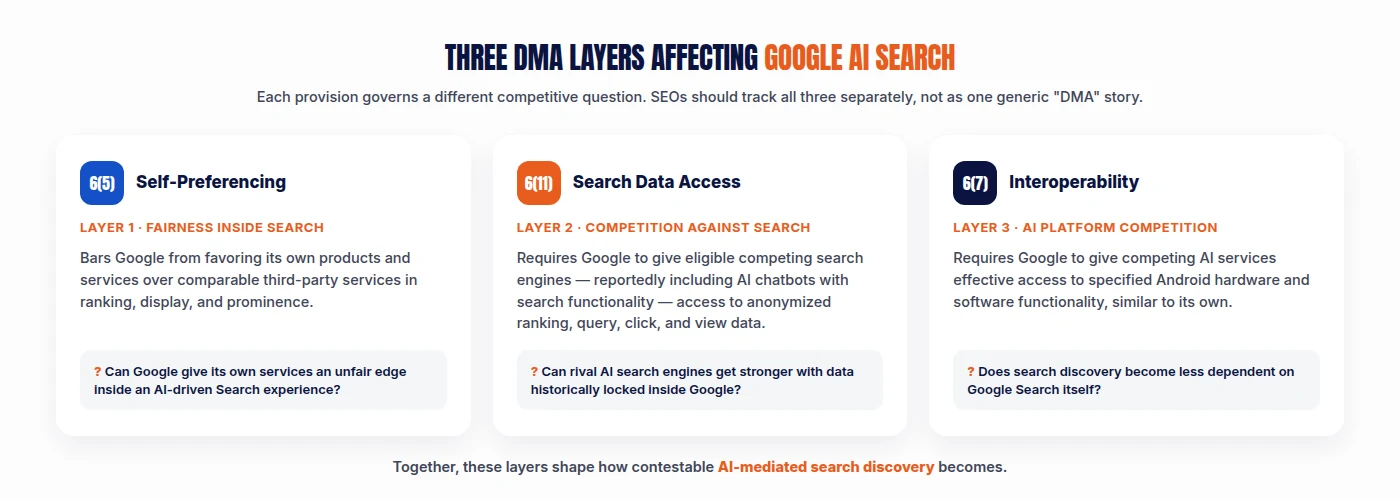
Article 6(5) vs Article 6(11): What SEOs Should Remember
| DMA Provision | Main Issue | Why SEOs Should Care |
|---|---|---|
| Article 6(5) | Self-preferencing | Could affect how Google-owned services compete for Search prominence |
| Article 6(11) | Search data access | Could strengthen competing search engines and AI search services |
| Article 6(7) | Interoperability | Could help competing AI assistants work more effectively on Android |
The first affects fairness inside Google Search. The second affects competition against Google Search. The third affects competition between AI assistants on Google’s mobile ecosystem. Together, they show how broad the DMA’s impact on AI discovery could become.
What SEOs Should Monitor Right Now
Use this practical checklist.
1. AI Overview Visibility in EU Markets. Track frequency, page types, and query categories. Compare with non-EU markets.
2. Source Presentation. Watch for changes in citation format, source cards, inline links, and link prominence.
3. Google-Owned Features. Monitor whether Shopping, Hotels, Maps, YouTube, and other Google services appear differently after compliance changes.
4. Search Console Generative AI Data. Track AI impressions separately. Changes can reveal whether Google product or regulatory updates alter visibility.
5. Publisher Opt-Out Behavior. If major publishers leave AI Search, eligible source competition may change.
6. Article 6(11) Beneficiaries. Watch which competing search/AI providers gain access to Google Search data. This could materially influence the competitiveness of alternative AI engines.
7. European Commission Decisions. Pay attention to exact case numbers and legal basis. Do not mix DMA, antitrust, DSA, copyright, and AI Act developments into one generic “EU AI regulation” category — a mistake worth avoiding when you’re also tracking parallel obligations like the EU AI Act’s rules for AI-generated content.
Does the DMA Make GEO More Important?
Potentially, yes. But not because the DMA creates a GEO ranking factor. It changes the competitive environment around AI search.
If more AI search providers become capable of competing effectively, brands may need visibility across Google and multiple AI engines, instead of focusing primarily on Google rankings. That moves search strategy toward multi-engine discoverability rather than single-SERP optimization.
SEO, AEO, GEO and the DMA
A useful strategic model is:
- SEO — optimize discovery and ranking within conventional search systems
- AEO — optimize information for direct-answer environments
- GEO — optimize brand/source visibility within generative systems
- Regulatory Monitoring — understand how laws change the interfaces and competitive conditions in which those systems operate
The fourth layer is becoming increasingly relevant for businesses targeting Europe.
The Biggest Mistake SEOs Can Make
The biggest mistake is treating every regulatory headline as an immediate ranking update. For example, “Google fined under DMA” does not automatically mean “AI Overview rankings changed today.”
Regulatory processes involve decisions, remedies, implementation, monitoring, appeals, and product changes. SEO teams should ask: What exactly must Google change? Which market does it affect? When does implementation begin? Which Search surface is involved? Only then should you infer SEO consequences.
What the DMA Does Not Mean for SEO
The DMA does not mean Google cannot use AI in Search, that AI Overviews are banned, that publishers are guaranteed clicks or citations, that Google must rank every competitor equally, that AI results must look like ten blue links, or that SEO becomes unnecessary.
The core objective is fair and contestable digital markets. SEO competition still exists within that environment.
FAQ
What is the Digital Markets Act?
The Digital Markets Act is an EU law regulating designated large digital platforms known as gatekeepers. It imposes specific obligations intended to make digital markets fairer and more contestable. Google Search is one of Alphabet’s designated core platform services.
Does the DMA apply to Google AI Overviews?
The European Commission says Alphabet is responsible for ensuring that AI Overviews integrated into Google Search comply with the DMA and is monitoring the feature under existing obligations including Article 6(5).
Is Google AI Mode covered by the DMA?
AI Mode is part of Google’s evolving Search ecosystem. The Commission has explicitly focused on AI Overviews and continues broader regulatory dialogue around Google’s Search evolution. Existing DMA obligations can apply to functionality integrated into designated Google Search where relevant.
What is DMA Article 6(5)?
Article 6(5) prevents gatekeepers from treating their own products or services more favorably in ranking than comparable third-party products or services and requires transparent, fair, and non-discriminatory ranking conditions.
What is DMA Article 6(11)?
Article 6(11) requires qualifying gatekeeper search engines to provide eligible competing online search engines access to anonymized ranking, query, click, and view data under fair, reasonable, and non-discriminatory terms.
Can AI chatbots access Google Search data under the DMA?
Potentially, yes. According to reporting on the European Commission’s July 2026 Article 6(11) measures, eligible beneficiaries can include AI chatbots offering search functionality.
Was Google fined for AI Overviews?
No. On July 23, 2026, the European Commission fined Google €460 million for Search self-preferencing and €430 million for separate Google Play anti-steering violations, totaling €890 million. The Search case was not an AI Overviews-specific infringement decision.
Has the EU declared AI Overviews illegal?
No. The Commission is monitoring AI Overview compliance and separately investigating certain AI-content practices, but AI Overviews have not been broadly declared illegal.
Why are publishers concerned about AI Overviews?
Publishers are concerned that AI-generated answers may use their information while reducing referral traffic and monetization opportunities. The Commission has acknowledged media-industry concerns related to traffic losses.
Could the DMA force Google to show more publisher links?
That is not currently a fixed DMA requirement. Future enforcement or compliance changes could affect source presentation, but SEOs should not assume a specific remedy before one is announced.
Can Google Search work differently in Europe because of the DMA?
Yes. Google has already implemented Europe-specific Search changes in response to regulatory requirements, so regional differences in Search and AI interfaces are possible.
Does the DMA guarantee publishers traffic?
No. DMA compliance does not guarantee rankings, AI citations, clicks, or traffic.
Why does Article 6(11) matter for GEO?
If competing AI search services gain access to useful anonymized Google Search data, competition in AI search could increase. Brands may therefore need to optimize visibility across more generative engines rather than concentrating only on Google.
Should SEOs track EU regulation?
Yes, especially for sites targeting European users. Regulatory decisions can change Search interfaces, source treatment, publisher controls, and competitive access to search data.
Bottom Line
Google AI Overviews are no longer just an SEO product feature. They are part of a much larger debate about how a dominant search platform can use AI while complying with European competition rules.
The Digital Markets Act matters because Google Search is already a designated core platform service. That means the transition from ranked links to AI-generated answers does not wipe away Google’s existing obligations. The European Commission has explicitly said it is monitoring AI Overviews under the DMA, including Article 6(5).
For SEOs, there are three regulatory layers worth remembering.
Layer 1 — Fairness Inside Google Search. Article 6(5) addresses self-preferencing. The question becomes: can Google give its own services unfair advantages inside an increasingly AI-driven Search experience?
Layer 2 — Competition Against Google Search. Article 6(11) requires Google to provide eligible competing search engines access to certain anonymized Search data under regulated terms. In 2026, the Commission reportedly confirmed that AI chatbots offering search functionality can potentially qualify. The question becomes: can competing AI search engines become stronger because they gain access to data historically concentrated inside Google?
Layer 3 — AI Platform Competition. DMA interoperability rules affecting Android could give competing AI assistants better access to device functionality. The question becomes: does search discovery become less dependent on Google Search itself?
Together, these developments point toward a broader change. The future of SEO may not be simply “how do we rank higher on Google?” It may increasingly become “how do we remain discoverable, retrievable, trusted, and selected across multiple AI-mediated interfaces?” That makes regulatory awareness increasingly relevant to GEO.
And there is one final distinction SEOs should keep clear: regulation can change the rules of the search marketplace. It does not eliminate the need to compete within it.
Even if the DMA creates more source diversity, fairer treatment, stronger competing AI engines, and better publisher controls, brands will still need crawlable websites, strong technical SEO, useful content, authority, original information, clear entities, and citation-worthy sources.
So the practical SEO response to the DMA is not to wait for regulators to restore the old search model. It is to prepare for a more fragmented one.
Track Google rankings. Track Google AI visibility. Track source citations. Track competing AI engines. Track EU-specific Search changes. And increasingly, track regulation as closely as you track algorithms.
Because when Search itself becomes AI-driven, the rules governing the platform can shape visibility almost as much as the systems ranking the content.