Quick Answer
The EU AI Act does not require every AI-assisted blog post to carry a visible “AI-generated” label.
Article 50, which began applying on August 2, 2026, creates different transparency obligations for different actors. Under Article 50(2), providers of generative AI systems generally have obligations to make qualifying AI-generated text, images, audio, and video machine-readable and detectable as AI-generated or manipulated. Under Article 50(4), deployers—such as businesses professionally using AI systems—have a separate disclosure obligation for certain AI-generated or manipulated text published to inform the public about matters of public interest.
Crucially for publishers and SEO teams, the European Commission says qualifying text that undergoes substantive human review or editorial control, with a person or organization holding editorial responsibility for publication, does not need to be labelled under that text-disclosure requirement. Simple spell-checking or grammatical correction is not enough to qualify as substantive human review — that distinction is worth understanding in detail before assuming a light proofreading pass is sufficient. If you’re comparing this to how AI providers signal content provenance in the first place, see our breakdown of Claude watermark vs AI content detection.
For SEO, the EU AI Act and Google Search policy should be treated as separate systems. The AI Act concerns legal transparency obligations. Google’s Search guidance focuses on quality, relevance, accuracy, usefulness, and scaled content abuse. Google has not announced that an Article 50 AI label or machine-readable watermark automatically harms rankings — a question worth its own look at whether AI-watermarked content affects Google rankings.
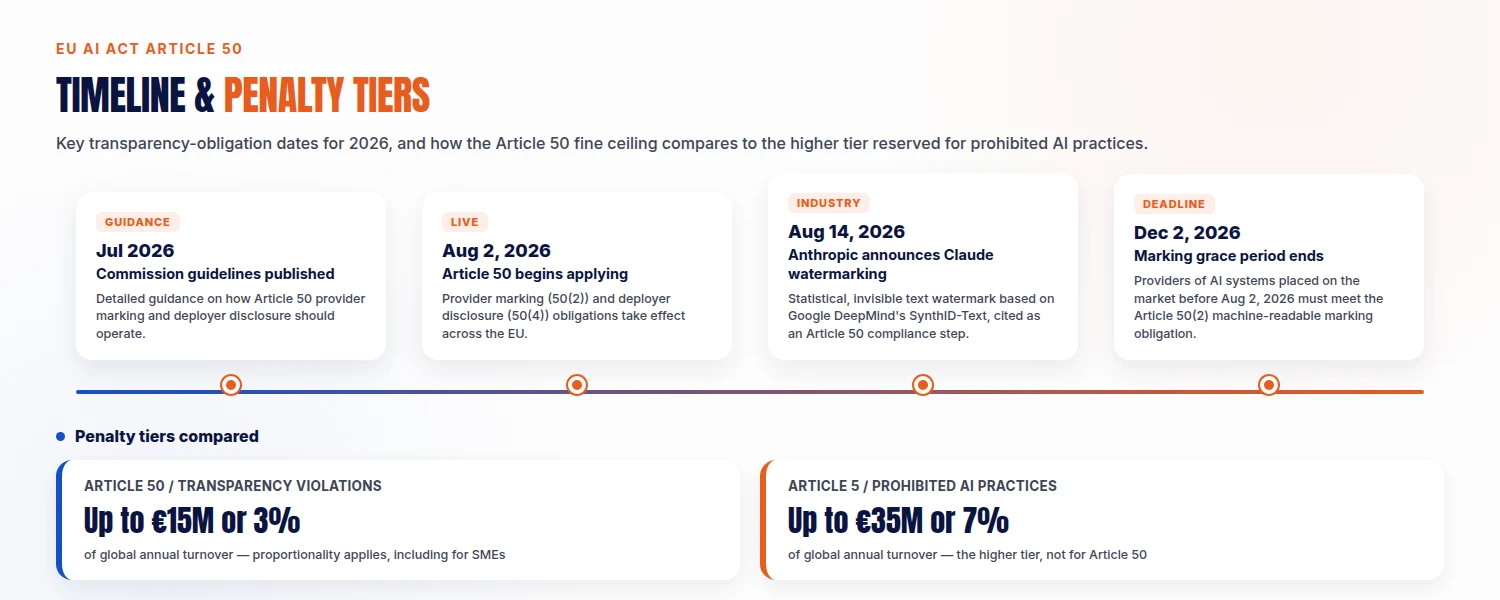
Current status — September 2026: Article 50 transparency requirements have been applicable since August 2, 2026. A limited transition until December 2, 2026 applies to the machine-readable marking obligation for AI systems placed on the market before August 2, 2026. Content generated before August 2, 2026 does not need retroactive labelling under these provisions, although the Commission encourages voluntary transparency where possible.
Does the EU AI Act Affect SEO?
Yes, potentially—but not because the law introduces an “SEO penalty.”
The EU AI Act affects the broader process through which some AI-generated content is created, marked, reviewed, disclosed, and published.
That makes it relevant to:
- SEO agencies
- publishers
- news organizations
- content marketing teams
- freelance content professionals
- ecommerce companies
- affiliate publishers
- brands using generative AI
- AI content platforms
- companies building their own AI tools
- organizations publishing material about public-interest topics
The precise obligation depends on factors including what AI system is being used, who controls that use, what the organization’s role is under the Act, what kind of content is produced, whether it concerns a matter of public interest, and what human editorial processes occur before publication.
That complexity is exactly why the simplistic claim—
“The EU AI Act says every AI article must have an AI label.”
—is wrong.
What Is Article 50 of the EU AI Act?
Article 50 is the part of the EU AI Act dealing with certain transparency obligations.
Its purpose is to help people understand when they are interacting with AI or when content has been artificially generated or manipulated.
The European Commission published detailed guidelines in July 2026 explaining how Article 50 should operate. The transparency obligations began applying on August 2, 2026.
For content and SEO teams, two provisions are particularly important:
Article 50(2): Provider marking
Providers of generative AI systems generally need to ensure qualifying AI-generated or manipulated text, images, audio, and video are:
machine-readable
and
detectable as artificially generated or manipulated.
This is the regulatory layer behind technologies such as AI text watermarks. Anthropic’s own approach is a useful real-world case study — see how Claude AI watermarking works and what it means for SEO.
Article 50(4): Deployer disclosure
Organizations professionally using AI systems can face a separate requirement to disclose certain AI-generated or manipulated material.
For text, this requirement applies specifically to text published for the purpose of informing the public on matters of public interest, subject to important exceptions including substantive human review or editorial control.
These two provisions should not be confused.
Machine-readable marking and visible disclosure are different obligations aimed at different actors.
Provider vs Deployer: The Most Important Distinction for SEOs
Before deciding what the EU AI Act means for an SEO workflow, determine which role the organization is performing.
What Is an AI Provider?
Under the Act, a provider is generally an individual or organization that develops an AI system—or has one developed—and places it on the market or puts it into service under its own name or trademark.
Think conceptually of companies that make generative AI systems available to users.
The Commission confirms that providers can be located inside or outside the EU. Providers outside the EU can still fall within the Act where relevant conditions are met, including where outputs of their systems are used in the Union.
Provider obligations are where machine-readable AI marking becomes especially important.
What Is an AI Deployer?
A deployer is generally an individual or organization using an AI system under its authority for professional purposes.
That category is likely to be more relevant to a typical:
- SEO agency
- publisher
- ecommerce business
- marketing department
- professional content creator
- consultancy
using Claude, ChatGPT, Gemini, or another AI system as part of its workflow.
The Commission specifically explains that where a company controls the use of an AI system, individual employees such as content creators, journalists, web designers, or digital staff are generally not separate deployers. The legal organization remains the deployer even where contractors or freelancers operate the system on its behalf and under its control.
A freelancer using an AI system independently for professional work, however, can potentially be a deployer in their own right.
That distinction matters for agencies.
If an agency uses AI under its authority to produce client content, it should not assume that responsibility disappears because an employee or contractor clicked the “generate” button.
Does Every AI-Generated Article Need an AI Label?
No.
This is probably the most important misconception SEO teams need to correct.
Under the Commission’s Article 50 guidance, the specific deployer disclosure requirement for AI-generated or manipulated text applies when three criteria are met.
The text must be:
- Published
- Informative to the public
- About a matter of public interest
That is much narrower than:
“Any text created using AI.”
What Counts as a Matter of Public Interest?
The European Commission provides examples of topics that can fall within matters of public interest.
These include areas such as:
- politics and democratic processes
- public administration and services
- administration of justice and law enforcement
- fundamental rights
- public security
- public health
- environmental protection
- consumer safety
- economic developments
- financial developments
- scientific developments
- cultural developments relevant to public debate
For SEOs, this means context matters enormously.
Consider two examples.
Example 1: AI-Generated Product Category Description
An ecommerce store uses AI to draft a category description for blue running shoes.
That is not automatically equivalent to publishing AI-generated public-interest journalism.
Example 2: AI-Generated Public Health Article
A publisher uses AI to create an article explaining a new national health-policy change.
That is much more likely to raise Article 50(4) considerations because it is published to inform the public about a public-interest matter.
The practical mistake would be treating all commercial webpages and all public-interest information as legally identical.
They are not.
Human Review Can Change the Disclosure Requirement
This is the part of Article 50 that matters most for professional content teams.
The European Commission states that published AI-generated text that has undergone qualifying human review or editorial control does not need to be labelled under this particular text-disclosure requirement, provided the required editorial responsibility is also present.
But “a human looked at it” is not necessarily enough.
The Commission gives substance to what human review means.
What Counts as Human Review?
Human review involves deliberate examination of the substance of the content by one or more people with relevant knowledge and professional judgment.
That can include professional validation or expert review.
For a content team, meaningful review could involve:
- checking factual accuracy
- challenging unsupported claims
- verifying statistics
- opening and evaluating sources
- identifying misleading interpretations
- correcting material errors
- adding necessary context
- rejecting weak sections
- assessing whether conclusions follow from the evidence
What Counts as Editorial Control?
Editorial control means a responsible editorial person or organization genuinely has authority over the substance of the publication.
The Commission specifically refers to authority to:
- approve content
- alter content
- reject content
- fact-check information
- evaluate the trustworthiness of sources
That is significantly more meaningful than clicking “approve” after quickly scanning an AI draft.
What Does NOT Count as Sufficient Human Review?
The European Commission makes this especially clear:
Superficial, formal, or procedural checks are not enough.
It specifically gives examples such as:
- spell-checking
- grammatical correction
as insufficient by themselves.
This creates an important compliance distinction for AI publishing.
Consider these workflows.
Weak Editorial Workflow
Claude → Grammarly → publish
The presence of minor proofreading does not suddenly turn the process into substantive human review.
Stronger Editorial Workflow
Research → AI draft → expert review → source verification → substantive editing → editorial approval → publish
That is much closer to the type of human review and editorial control described by the Commission.
For SEO agencies, this is another reason to avoid fully automated AI publishing.
The benefits of real human review extend well beyond SEO quality.
They can also matter to regulatory transparency.
What Is Editorial Responsibility?
Human review alone is not the entire concept.
The Commission says editorial responsibility means a person must hold the ultimate legal responsibility for publication, including the relevant review or editorial control.
That means a mature AI content operation should be able to identify:
Who ultimately approved this publication?
For an organization, that could be part of a broader editorial governance structure.
The key point is accountability.
AI should not become a mechanism through which nobody takes responsibility for what gets published.
Provider Watermarks and Publisher Labels Are Not the Same Thing
This is another area where confusion is likely.
Suppose Claude places a machine-readable watermark inside AI-generated text.
Does that automatically satisfy every disclosure obligation of the publisher using Claude?
No.
The Commission expressly distinguishes machine-readable provider marking from human-perceivable deployer disclosure.
For relevant disclosure obligations, information needs to be understandable and perceivable by people. The Commission says deployers cannot simply rely on an invisible machine-readable mark embedded by the provider where a clear disclosure obligation applies.
Think of the difference this way:
| Provider Marking | Deployer Disclosure |
|---|---|
| Primarily machine-readable | Human-perceivable |
| Helps technical detection | Helps readers understand AI involvement |
| Usually implemented by AI provider | Implemented by organization publishing/deploying relevant content |
| Article 50(2) | Article 50(4)/(5) |
| May involve watermarking/provenance technology | May involve label, disclosure, or other clear notification |
The presence of one does not automatically eliminate the need for the other where the other independently applies. This is also why the question of whether a search engine can even see a machine-readable mark is a separate one — see whether Google can detect Claude-written content through AI watermarks.
Why Claude Introduced AI Text Watermarking
Claude provides a useful real-world example of Article 50 influencing AI technology.
On August 14, 2026, Anthropic announced that future Claude models would generate text containing a statistical watermark.
Anthropic explicitly says it and other major AI providers are implementing these changes to comply with the EU AI Act.
Claude’s implementation uses a version of Google DeepMind’s SynthID-Text approach.
Instead of placing hidden characters into text, the system creates a statistical pattern through token-selection choices.
Anthropic says the watermark:
- is invisible to readers
- does not add hidden characters
- does not identify the user
- does not identify an organization or chat
- has no practical impact on content quality
Anthropic has also said it is working to enable qualified third parties to detect the watermark and will share further detail in forthcoming technical documentation, though as of September 2026 no confirmed program or eligibility list has been published.
For publishers, this illustrates how Article 50 can influence AI-generated content even before a publisher makes any disclosure decision.
The provenance signal can originate at the model-provider layer.
Does the EU AI Act Require Claude to Watermark Every Output?
The legal requirement is more nuanced than that.
Article 50(2) generally requires providers of AI systems generating synthetic text, images, audio, or video to make qualifying outputs machine-readable and detectable.
But the regulation and Commission guidance include exceptions and limitations.
For example, the Commission says certain categories can fall outside the marking obligation, including:
- source code
- short sequences of numbers, symbols, or letters
- certain machine-to-machine outputs
- certain closed-loop industrial or development uses
The marking obligation also does not apply where an AI system performs an assistive function for standard editing or does not substantially alter the input or its meaning.
This aligns with Anthropic’s explanation that simple proofreading can present little opportunity for its text watermark to appear.
Does Using AI for Editing Trigger the Same Rules as Full AI Generation?
Not necessarily.
Article 50 itself distinguishes situations where AI merely performs an assistive standard-editing function.
For content teams, this means there can be a meaningful difference between asking AI to:
Fix three spelling mistakes
and asking AI to:
Completely rewrite this 2,500-word article.
The first leaves the underlying substance and wording overwhelmingly human-created.
The second can materially transform the publication.
This should also influence internal AI governance.
Instead of recording AI usage as a binary:
AI used: yes/no
a more mature workflow can record the role AI played.
For example:
Level 1 — Mechanical assistance
Spelling, punctuation, formatting.
Level 2 — Editorial assistance
Suggestions, restructuring, headline ideas.
Level 3 — Partial generation
Sections or substantial rewrites.
Level 4 — Full generation
Most or all of the initial draft generated by AI.
That distinction can make future compliance, auditing, and editorial review significantly easier.
Does Human Editing Automatically Make AI Content “Human-Written”?
That is not a useful legal or editorial framing.
If AI generated the first draft and a human then substantially reviewed and edited it, AI was still involved in its creation.
Human review can be highly relevant to whether a specific Article 50 disclosure requirement applies.
But that does not mean the history of the content disappears.
A better description might be:
AI-assisted content with substantive human editorial review
rather than attempting to force every piece of content into one of two categories:
100% AI
or
100% human.
Modern content production is increasingly mixed.
The regulation reflects some of that complexity.
Does the EU AI Act Apply to SEO Agencies?
Potentially, yes.
An SEO agency using generative AI professionally can qualify as a deployer depending on the circumstances.
The Commission says a deployer is generally a person or organization using an AI system under its authority in a professional context.
An agency could therefore encounter relevant considerations when using AI to create:
- client blog articles
- public-information content
- financial content
- health content
- political or policy content
- scientific articles
- public-facing reports
- consumer-safety information
The answer will still depend on the specific use, audience, subject, editorial process, contractual arrangement, and jurisdiction.
The safest operational approach isn’t to assume:
“We are only the SEO agency, so the regulation is the client’s problem.”
Instead, establish who controls the AI workflow, who publishes the content, who performs human review, and who holds editorial responsibility.
What About Freelance SEO Writers?
Professional freelancers can also fall within the concept of a deployer where they use AI systems under their own authority for business or freelance activities.
The Commission contrasts this with purely personal, non-professional AI use, which is outside this deployer definition.
That means an independent writer using AI for paid professional publishing should not assume Article 50 is irrelevant merely because they are not incorporated as a large company.
Again, the actual obligations depend on what is being produced and how it is used.
Does the EU AI Act Apply Outside the EU?
Potentially.
The AI Act has an extraterritorial dimension.
Article 2 says the regulation applies to providers placing AI systems or general-purpose AI models on the Union market regardless of whether those providers are located in the EU or a third country.
It can also apply to providers and deployers located outside the EU where the output produced by the AI system is used in the Union.
The Commission similarly states that providers outside the EU can be subject to the Act where outputs are used in the EU.
That does not mean every website anywhere in the world automatically falls under every AI Act requirement simply because someone in Europe can load the webpage.
Territorial applicability can become legally complex.
Companies outside Europe with substantial EU customers, operations, audiences, or AI deployments should assess their actual exposure rather than assuming either:
“EU law can never affect us.”
or:
“Every globally accessible webpage automatically has to follow every Article 50 requirement.”
What About AI Content Published Before August 2, 2026?
The Commission says content generated before August 2, 2026 does not need to be labelled retroactively under these Article 50 provisions.
Voluntary labelling is still encouraged where practical because it supports the transparency objectives of the regulation.
This is important for websites with large archives.
A publisher should not read the new Article 50 rules and immediately assume:
We need to audit and label every AI-assisted article we published during 2024 and 2025.
The Commission’s guidance does not impose that retroactive requirement under Article 50.
Other laws or policies may still matter depending on the content, but that is a separate question.
What Is the December 2, 2026 Grace Period?
There is a narrow transition period, and it is easy to misinterpret.
Article 50 generally began applying on August 2, 2026.
However, the Commission says AI systems placed on the market before that date receive a limited grace period specifically for the Article 50(2) machine-readable marking and detection obligation.
Providers of those older systems must comply with that requirement from December 2, 2026.
This is not a blanket four-month delay for every Article 50 obligation.
That distinction matters.
Publishers shouldn’t conclude:
“Nothing in Article 50 matters until December.”
The transition is narrower than that.
How Should AI-Generated Text Be Labelled When Disclosure Is Required?
Article 50 requires relevant information to be provided in a clear and distinguishable manner.
The European Commission has also introduced optional EU icons for AI-generated content. These can be used alongside text labels.
However, use of the EU icon is optional, and the Commission explicitly warns that using an icon alone does not automatically establish legal compliance. The deployer remains responsible for ensuring that the disclosure satisfies Article 50.
For a publisher, that means transparency should be designed for the reader rather than treated as a decorative badge.
A disclosure should not be:
- intentionally hidden
- buried where readers are unlikely to see it
- dependent on specialized software to decode
- written so ambiguously that ordinary readers cannot understand it
Where disclosure is legally required, the objective is meaningful transparency.
Machine-Readable AI Mark vs Visible AI Label
This distinction deserves repeating because it is central to Article 50.
Machine-Readable Mark
Designed primarily for technical detection.
Examples can include statistical text watermarking or other provenance mechanisms.
Visible or Perceivable Disclosure
Designed for the person consuming the content.
Examples could include an appropriate:
- label
- disclosure
- icon
- explanatory notice
depending on the content and applicable rules.
A website publisher shouldn’t assume that because Claude or another model embeds a machine-readable provenance marker, the publisher has automatically met a separate human-facing disclosure obligation.
The Commission expressly says machine-readable provider marking cannot simply substitute for relevant deployer disclosure requirements.
What Is the EU Code of Practice on Transparency of AI-Generated Content?
The European Commission has also developed a Code of Practice on Transparency of AI-Generated Content, finalized on June 10, 2026 with roughly 190 signatories.
The code is designed to help providers and deployers demonstrate compliance with the Article 50 marking and labelling requirements.
It addresses:
- machine-readable marking
- detection of AI-generated content
- deepfake labelling
- AI-generated public-interest text
- presentation of labels and disclosures
Signing the Code is voluntary.
Organizations don’t necessarily have to sign it to comply with Article 50.
But the Commission says signatories can benefit from greater predictability and legal certainty because they can rely on an approved compliance framework. Organizations that don’t follow the Code need to demonstrate compliance through alternative adequate means.
For large publishers or AI platforms, that may become operationally significant.
EU AI Act vs Google Search Rules
SEOs should keep these two systems completely separate.
The EU AI Act is legislation.
Google Search guidelines are platform policies governing Search eligibility, spam, and performance.
They solve different problems.
| EU AI Act | Google Search |
|---|---|
| Legal/regulatory framework | Search platform policies and ranking systems |
| Focus includes AI transparency | Focus includes quality, relevance and spam |
| Article 50 creates marking/disclosure obligations | No general requirement that every AI article be visibly labelled for SEO |
| Machine-readable AI provenance can be required | No public AI-watermark ranking penalty |
| Public-interest AI text can require disclosure | AI-generated content itself is not automatically prohibited |
| Human review can affect Article 50 text-disclosure obligations | Human review can improve quality but is not a magical ranking factor |
| Violations can result in legal enforcement | Violations can affect Search eligibility or visibility |
Google says generative AI can be useful for research and adding structure to original content.
Its primary warning is against using generative AI or other tools to create many pages without adding value for users, which can violate Google’s scaled content abuse policy.
Therefore:
EU-required AI disclosure ≠ Google penalty.
Likewise:
No Google penalty ≠ EU legal compliance.
A page could perform perfectly well in Google Search and still have a regulatory transparency issue.
Or it could comply perfectly with an AI disclosure requirement while still being low-quality SEO content.
Will an “AI-Generated” Disclosure Hurt Google Rankings?
Google has not published a Search policy stating that an Article 50 disclosure label causes a ranking reduction.
There is also no public Google guidance telling publishers to hide AI involvement in order to rank.
Google’s current guidance focuses on the resulting content.
The main questions remain:
- Is it useful?
- Is it accurate?
- Is it original?
- Does it satisfy the user?
- Does it comply with Search Essentials?
- Is automation being used primarily to manipulate rankings?
That means SEO teams shouldn’t resist legally required transparency out of an unsupported fear that adding an AI disclosure automatically damages rankings.
If disclosure is legally required, compliance is the priority.
Does the EU AI Act Require Google to Detect AI Content?
Article 50 creates transparency and detection obligations for relevant AI-system providers and deployers.
That is different from saying:
Google Search must scan every indexed article and identify whether Claude wrote it.
The law’s requirements should not be converted into imaginary Search-ranking mechanisms.
AI systems may increasingly produce machine-readable provenance.
Platforms may increasingly consume provenance data.
But whether a search engine uses that data—and for what purpose—is a separate technical and policy decision.
This is why the existence of Claude’s watermark does not automatically mean Google Search is penalizing Claude-generated articles.
What Are the Penalties for Violating Article 50?
Potential penalties can be significant.
The European Commission says fines for Article 50 transparency non-compliance can reach €15 million or 3% of total worldwide annual turnover for the preceding financial year, while proportionality is taken into account, including for SMEs and small mid-cap companies. This sits at a lower tier than the up to €35 million or 7% of global turnover reserved for prohibited AI practices under Article 5 — the two should not be conflated.
That figure needs context.
It does not mean:
A small blogger forgets one disclosure and automatically receives a €15 million fine.
Enforcement considers the applicable legal framework, circumstances, proportionality, responsible authority, and nature of the infringement.
The maximum figure should therefore not be used as clickbait.
The appropriate conclusion is simpler:
Article 50 is a real compliance obligation, not merely a voluntary SEO best practice.
Who Enforces Article 50?
The European Commission says enforcement will primarily involve national competent market-surveillance authorities.
The AI Office has particular responsibilities within its scope, while the European Data Protection Supervisor has enforcement responsibilities concerning AI systems used by EU institutions, bodies, and agencies.
This again demonstrates why Article 50 should not be confused with Google’s Search policies.
The enforcement bodies are regulatory authorities, not search-ranking teams.
A Practical EU AI Act Workflow for SEO Teams
SEO agencies and publishers should move away from the workflow:
Keyword → AI generation → proofreading → publish
A stronger workflow would look like this:
Step 1: Record Which AI System Is Used
Maintain a basic record of whether content was assisted by:
- Claude
- ChatGPT
- Gemini
- another generative system
- multiple AI tools
You don’t necessarily need a bureaucratic system for every comma correction, but organizations should understand their material AI usage.
Step 2: Record the Role AI Played
Was AI used for:
- spelling
- editing
- research
- outlining
- partial generation
- rewriting
- translation
- full drafting
This provides far more useful information than a simple yes/no field.
Step 3: Identify the Nature of the Content
Ask:
Is this publication intended to inform the public about a matter of public interest?
If yes, apply greater scrutiny.
Step 4: Conduct Substantive Human Review
Don’t merely fix grammar.
Verify:
- claims
- statistics
- interpretations
- sources
- dates
- conclusions
- potentially misleading statements
Step 5: Establish Editorial Responsibility
Someone should have authority to:
- approve
- change
- reject
- or delay publication
That person or organization should take responsibility for the finished content.
Step 6: Determine Whether Disclosure Is Required
Evaluate the Article 50 rules against the actual circumstances.
Where the situation is legally significant or uncertain, involve qualified counsel rather than guessing.
Step 7: Add a Clear Disclosure Where Required
Don’t rely solely on an invisible provider watermark where human-facing disclosure applies.
Step 8: Optimize the Finished Page for SEO and AEO
Legal compliance does not make a page valuable.
The content still needs:
- strong search-intent alignment
- factual accuracy
- useful organization
- original contribution
- credible sources
- clear entities
- direct answers
- internal links
- accessible presentation
Step 9: Keep an Editorial Record
For higher-risk content, retain enough information to show that substantive review occurred.
This could include:
- editor
- review date
- sources checked
- major revisions
- approval status
This is useful for governance even beyond Article 50.
An AI Content Compliance Matrix for SEO Teams
| Workflow | Article 50 Concern | Recommended Approach |
|---|---|---|
| Human article + AI spelling correction | Lower | Normal editorial process |
| Human article + AI formatting | Lower | Document material use where appropriate |
| Human draft + substantial AI rewrite | Higher AI involvement | Conduct substantive review |
| Fully AI-generated commercial article | Depends on context | Human review + evaluate applicable rules |
| Fully AI-generated public-health explainer | Potentially significant | Expert review + assess disclosure |
| AI-generated financial/public-interest article with no human review | High concern | Assess Article 50(4) disclosure |
| AI public-interest article substantively expert-reviewed with editorial responsibility | May qualify for text-label exemption | Maintain evidence of review |
| AI-generated article published before August 2, 2026 | No Article 50 retroactive label requirement | Voluntary transparency possible |
| Claude article carrying machine-readable watermark | Provider provenance exists | Still assess separate deployer obligations |
The purpose of this table isn’t to provide a legal verdict for every case.
It is to show why AI use alone is not enough information.
How Should SEO Agencies Change Their AI Content Process?
The EU AI Act provides another reason to formalize AI-assisted publishing.
Agencies should consider creating a simple internal policy covering:
Allowed AI uses
Define where AI can assist.
Prohibited workflows
For example, no automatic publication of unverified public-interest content.
Required human review
Define what substantive review means.
Source verification
Require primary-source checking for important claims.
Editorial ownership
Identify who approves publication.
Disclosure assessment
Create a trigger for public-interest content or other higher-risk use cases.
Record keeping
Keep proportionate evidence of meaningful review.
The important point is that the process should be operational.
A 50-page AI policy nobody follows is less useful than a short editorial procedure consistently applied.
What Should SEOs Tell Clients About AI Disclosure?
Avoid making either of these blanket statements:
“You must label every AI-generated article.”
or:
“You never need to disclose AI because Google doesn’t care.”
Both collapse different issues into one.
A more accurate client explanation is:
AI disclosure requirements depend on the content, use case, jurisdiction, role of the organization, and degree of substantive human editorial review. Google Search policy is a separate issue from EU AI transparency law.
That answer is less sensational.
It is also much more defensible.
Does AI Content Need an Author Name Under the EU AI Act?
Article 50’s text transparency rules should not be confused with Google’s authorship practices or an automatic requirement to assign an individual author to every AI-assisted page.
The central Article 50 concepts for relevant text include:
- AI-generated or manipulated content
- publication
- public-interest purpose
- disclosure
- human review/editorial control
- editorial responsibility
An SEO byline strategy is a separate editorial decision.
However, clearly communicating who is responsible for content can still support:
- accountability
- reader trust
- expert positioning
- editorial transparency
especially in high-trust subject areas.
What Does the EU AI Act Mean for AEO and GEO?
The immediate impact is compliance rather than ranking.
But there is a broader strategic implication.
The web is moving toward stronger content provenance.
That means future AI visibility may increasingly exist alongside information about:
- who created content
- whether AI participated
- which system generated it
- whether it was reviewed
- where claims originated
- whether media has been manipulated
For Answer Engine Optimization and Generative Engine Optimization, that reinforces the value of publishing content with:
- precise claims
- clear sourcing
- named entities
- evidence
- editorial accountability
- unique information
- trustworthy authorship
- first-party expertise
The goal shouldn’t be to make AI involvement undetectable.
The goal should be to make the content reliable enough that provenance transparency does not undermine its value.
What Should Publishers Do Right Now?
For most professional publishing teams, the practical priority is not to label everything immediately.
It is to understand the workflow.
Start by identifying where generative AI materially participates in publishing.
Then determine:
- whether the content is public-interest information
- whether AI generated or materially manipulated it
- whether meaningful human review took place
- whether editorial responsibility is clearly assigned
- whether applicable transparency obligations are satisfied
- whether records exist to support that process
This is a governance problem before it is a label-design problem.
The Bottom Line
The EU AI Act changes AI content publishing, but not in the simplistic way many headlines suggest.
Article 50 does not say every webpage touched by AI must visibly display an “AI-generated” warning.
Instead, it creates different responsibilities across the AI-content chain.
Providers of generative AI systems generally need mechanisms that make qualifying synthetic content machine-readable and detectable.
Professional deployers have separate disclosure obligations in circumstances including certain AI-generated or manipulated text published to inform the public on matters of public interest.
For SEO teams, one of the most significant provisions is the human-review exception.
The Commission says public-interest AI text that undergoes substantive human review or editorial control, with appropriate editorial responsibility, does not need the relevant Article 50 text label. But superficial spell-checking and grammatical correction do not qualify as substantive review.
That creates a clear strategic direction for publishers:
Don’t build AI publishing around one-click generation. Build it around accountable editorial review.
The ideal workflow isn’t:
AI → publish.
It is:
AI assistance → expertise → verification → substantive editorial review → accountability → publish.
That approach is stronger for compliance.
It is also stronger for SEO, AEO, GEO, and reader trust.
And perhaps most importantly, it prepares publishers for a web where AI-generated content becomes increasingly transparent rather than increasingly hidden.
FAQ
Does the EU AI Act apply to SEO?
Potentially. SEO agencies, publishers, professional content creators, and businesses using AI systems can qualify as deployers depending on how they use AI. The specific Article 50 obligations depend on the content, context, organizational role, and other factors.
Does every AI-generated article need to be labelled?
No. The Article 50 deployer obligation for text specifically concerns AI-generated or manipulated text published to inform the public on matters of public interest. Qualifying substantive human review or editorial control with editorial responsibility can also remove that particular labelling requirement.
When did Article 50 of the EU AI Act take effect?
Article 50’s transparency obligations began applying on August 2, 2026.
Do old AI-generated articles need to be labelled?
The European Commission says content generated before August 2, 2026 does not need retroactive labelling under Article 50, although voluntary transparency is encouraged where possible.
What is the December 2, 2026 AI Act deadline?
AI systems placed on the market before August 2, 2026 receive a limited transition until December 2, 2026 for the Article 50(2) machine-readable marking and detection obligation. It is not a general postponement of all Article 50 requirements.
Does human-edited AI content need an AI disclosure?
It depends on the applicable obligation and the nature of the review. For Article 50’s public-interest text labelling rule, the Commission says qualifying substantive human review or editorial control can exempt the publication from that labelling obligation when editorial responsibility is present. Simple grammar or spelling corrections do not qualify as substantive review.
What qualifies as human review under the EU AI Act?
The Commission describes human review as deliberate examination of the substance of content by people with relevant knowledge and professional judgment. Editorial control can include authority to approve, alter, reject, fact-check, and assess the trustworthiness of sources.
Does the EU AI Act require AI watermarks?
Article 50(2) requires relevant providers of generative AI systems to ensure qualifying synthetic content is marked in a machine-readable format and detectable as artificially generated or manipulated, subject to applicable exceptions and technical considerations. A statistical text watermark is one possible implementation approach.
Is an AI watermark the same as an AI disclosure?
No. A machine-readable watermark is primarily designed for technical detection. A deployer disclosure is designed to inform people. Where a human-facing disclosure obligation applies, the Commission says deployers cannot simply rely on the provider’s machine-readable mark.
Does the EU AI Act apply outside Europe?
It can. Article 2 includes certain providers and deployers located in third countries, including circumstances where AI-system output is used in the Union. Territorial application can be complex, so organizations outside the EU with significant European exposure should assess their specific circumstances.
Does the EU AI Act require Google to penalize AI content?
No. Article 50 establishes legal transparency requirements; it does not instruct Google to reduce organic rankings for AI-generated content. Google Search policy is separate.
Does Google penalize AI content with an EU AI label?
Google has not published a policy saying an AI disclosure required under the EU AI Act automatically harms rankings. Google’s guidance focuses on quality, accuracy, relevance, usefulness, and preventing scaled content abuse.
What topics count as matters of public interest?
European Commission guidance gives examples including politics, democratic processes, public administration, justice, fundamental rights, public security, public health, environmental protection, consumer safety, and economic, financial, scientific, political, or cultural developments relevant to public debate.
What are the penalties for breaking Article 50?
The European Commission says fines can reach up to €15 million or 3% of worldwide annual turnover for the preceding financial year, with proportionality considerations including for SMEs and small mid-cap companies. This is a maximum framework, not an automatic fine for every violation, and it sits below the higher up-to-€35 million/7% tier reserved for prohibited AI practices under Article 5.
Is the EU AI Transparency Code mandatory?
The Code of Practice on Transparency of AI-Generated Content is a voluntary mechanism, finalized June 10, 2026 with roughly 190 signatories, designed to help providers and deployers demonstrate compliance. Organizations can use alternative adequate means instead, although Commission guidance says Code signatories can gain greater predictability and legal certainty.
Should SEO agencies stop using AI because of the EU AI Act?
No. The Act does not prohibit normal professional use of generative AI for SEO content. Agencies should instead build clear processes around substantive human review, source verification, editorial responsibility, appropriate transparency, and compliance assessment for relevant content.