Claude’s watermark is an intentionally created statistical pattern embedded during text generation. Anthropic’s official detector looks for that specific pattern using a watermarking key.
Traditional AI content detectors usually don’t have Anthropic’s key. Instead, they analyze the finished text for linguistic, statistical, or stylistic characteristics associated with AI-generated writing.
The simplest distinction is:
Claude watermark detection asks: “Does this text contain the statistical pattern Claude intentionally generated?”
Traditional AI detection asks: “Does this text look like it was probably written by AI?”
Neither method should automatically be interpreted as proof that an entire article was written by AI. Anthropic says its watermark can indicate that Claude was likely involved in producing or substantially processing text, but it cannot distinguish between Claude writing the whole piece and Claude heavily editing human-written content. This distinction matters a great deal for whether AI-watermarked content affects Google rankings, since a watermark alone says nothing about quality or originality.
Current status — September 2026: Anthropic has not published a public, broadly available Claude watermark detection tool. According to Anthropic’s own Help Center and primary documentation, the company says it is working to enable third-party watermark detection and will share further details in forthcoming technical documentation. There is no confirmed “private preview” program with a specific published eligibility list as of this writing — claims describing a formal private-preview rollout with named eligible categories should be treated as unconfirmed until Anthropic publishes that documentation itself.
What Is Claude Watermark Detection?
Claude watermark detection is a method for estimating whether Claude was involved in generating a piece of text by looking for an intentionally created statistical signal.
The watermark itself isn’t something readers can see.
Claude doesn’t insert:
- hidden text,
- zero-width characters,
- unusual punctuation,
- an HTML tag,
- a visible label,
- or identifying information about the user.
Instead, the watermark emerges from how Claude selects words and tokens while generating its response.
Anthropic says Claude’s implementation is based on a version of Google DeepMind’s SynthID-Text approach, which it announced on August 14, 2026. For background on how this fits into the broader compliance picture, see how the EU AI Act treats AI-generated content.
To understand why this differs from normal AI detection, it helps to understand how large language models generate text.
How Claude Creates a Text Watermark
Large language models generate text one token at a time.
Imagine Claude is writing:
The campaign produced stronger results because the messaging was more…
Several possible next words might be equally reasonable:
- focused
- relevant
- persuasive
- targeted
- specific
Claude assigns probabilities to possible next tokens.
Without watermarking, randomness helps determine which acceptable token gets selected.
Claude’s watermarking system changes the source of that randomness.
Anthropic explains that the watermarking key and the preceding context help determine which acceptable token gets chosen. Across a sufficiently long passage, those choices create a statistical pattern that can later be tested using the corresponding key.
Google DeepMind’s SynthID-Text uses the same fundamental idea: it adjusts token selection during generation so that a statistical signal becomes part of the resulting sequence without visibly changing the text.
The watermark therefore exists because of which words Claude chose, not because Anthropic inserted a separate piece of data after generation. For a deeper walkthrough of the mechanism itself, see how Claude AI watermarking works and what it means for SEO.
What Is Traditional AI Content Detection?
Traditional AI detectors usually work from the opposite direction.
They receive a completed piece of text and attempt to determine whether its characteristics resemble AI-generated writing.
They may evaluate patterns involving areas such as:
- word choice,
- sentence structure,
- predictability,
- variation,
- repetition,
- statistical characteristics,
- stylistic consistency,
- and other features associated with machine-generated text.
Different AI detectors use different techniques and models, so their results can vary significantly.
One detector might classify a passage as:
90% likely AI
while another might rate the same passage much lower.
Anthropic explicitly distinguishes these services from its watermark detector. It says third-party AI detection companies don’t have Anthropic’s watermark key and therefore use other characteristics of the text to estimate AI involvement.
Google DeepMind has also warned that classifier-based AI detectors can perform inconsistently when used across different types of content and platforms, potentially causing text to be incorrectly labeled as AI-generated.
That is why a traditional AI detector score and an official watermark detection result should not be treated as interchangeable.
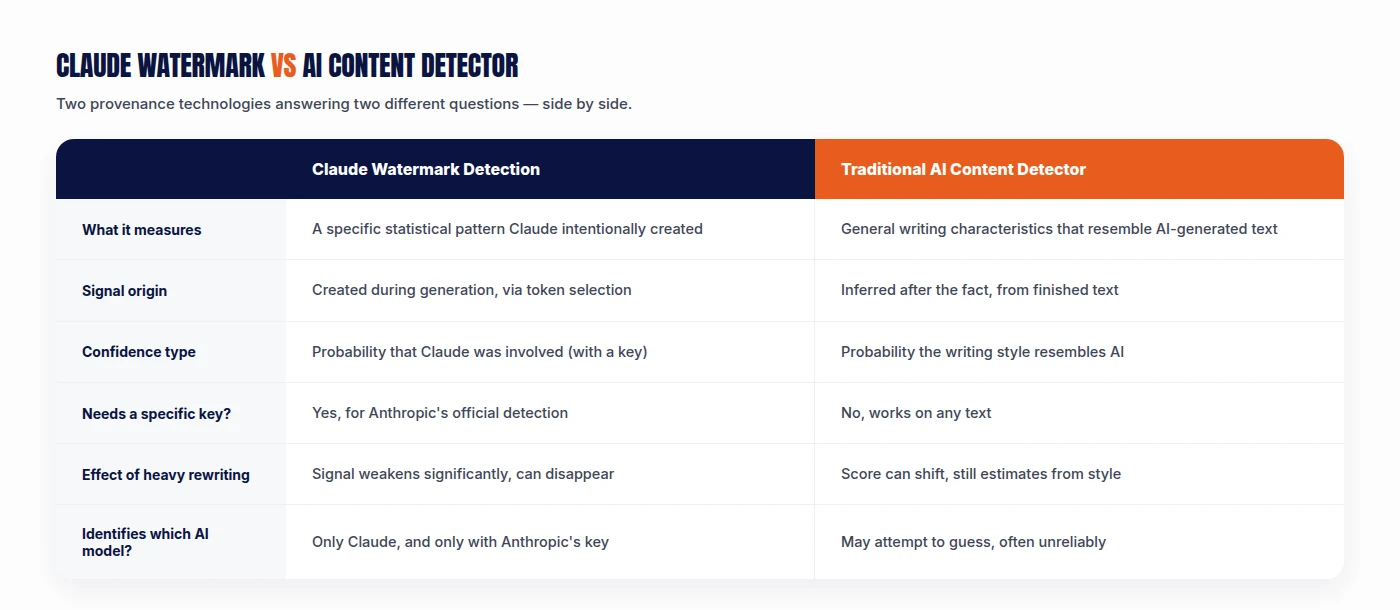
Claude Watermark vs AI Detector: The Key Differences
| Feature | Claude Watermark Detection | Traditional AI Content Detection |
|---|---|---|
| Signal intentionally created? | Yes | No |
| Created during generation? | Yes | No |
| Looks for a provider-specific pattern? | Yes | Usually no |
| Requires knowledge of the watermark system/key? | Yes for Claude’s official detection | Usually no |
| Analyzes general writing characteristics? | Not primarily | Yes |
| Can identify arbitrary AI models? | No | May attempt to |
| Works better with longer text? | Yes | Often |
| Can struggle with short samples? | Yes | Yes |
| Can be affected by rewriting? | Yes | Yes |
| Identifies the person who generated the text? | No | No |
| Proves the entire article was AI-written? | No | No |
| Is it an SEO ranking score? | No | No |
This distinction is essential because the term AI detection is often used as though every detector is looking for the same thing.
They aren’t.
The Simplest Way to Understand the Difference
Think of a watermark detector as searching for a specific signal.
A normal AI detector searches for circumstantial evidence.
Consider an analogy.
Suppose investigators want to know whether a document came from a particular printer.
Watermark-style detection
The printer deliberately places an invisible machine-readable pattern into every page.
Investigators know the pattern and specifically look for it.
Classifier-style detection
There is no intentional marker.
Instead, investigators look at:
- ink distribution,
- letter shapes,
- spacing,
- printing artifacts,
- and other characteristics
and estimate which printer probably produced it.
Both approaches can provide useful information.
But they are fundamentally different forms of evidence.
Claude watermark detection is much closer to the first.
Traditional AI text detection is closer to the second.
What Does the Claude Watermarking Key Do?
The watermarking key is one of the most important differences between Claude watermark detection and generic AI classifiers.
Anthropic says the watermark key helps determine the random token choices that form Claude’s statistical pattern.
When detection happens, the sequence of text can be compared with the pattern expected if Claude had generated it using that key.
Using Anthropic’s key can therefore help answer a narrow question:
How likely is it that Claude was involved in producing this text?
It cannot answer:
- Was this written by ChatGPT?
- Was this written by Gemini?
- Was this written entirely by a human?
- Which person generated it?
- Which Claude account generated it?
- What prompt produced it?
Anthropic specifically notes that another AI provider using watermarking would have a different key and could even use a completely different watermarking method.
That means there isn’t necessarily one universal AI watermark detector that can identify every AI model’s official watermark.
Can Traditional AI Detectors Detect Claude’s Official Watermark?
Not necessarily.
A traditional detector might correctly predict that Claude-generated text appears AI-written.
But that doesn’t mean the detector discovered Anthropic’s official watermark.
This distinction is subtle but important.
Suppose a third-party tool says:
AI probability: 96%
That could mean the tool’s classifier detected linguistic patterns it associates with AI.
It does not automatically mean:
Anthropic’s watermark was successfully detected.
Anthropic explicitly says third-party AI detection software uses a different method because those providers don’t have its watermark key.
Therefore, website owners should be cautious when a tool markets itself as a Claude detector. This question comes up constantly around whether search engines themselves can spot Claude output — see whether Google can actually detect the Claude watermark for how that plays out in practice.
The relevant question is:
Is this detecting Anthropic’s actual watermark, or is it simply classifying the writing as likely AI-generated?
Those are not the same capability.
Does Claude’s Watermark Use Hidden Characters?
No.
This misconception is likely to become widespread.
Claude’s text watermark isn’t based on:
- zero-width spaces,
- Unicode tricks,
- invisible symbols,
- hidden HTML,
- metadata,
- punctuation sequences,
- or strange formatting.
Anthropic explicitly says nothing is added to the text and there are no hidden characters.
This means opening a Claude-generated article in a plain-text editor will not reveal a secret watermark string.
Likewise, simply pasting Claude text into:
- WordPress,
- Google Docs,
- Microsoft Word,
- a text editor,
- or another CMS
doesn’t inherently remove the watermark.
If the wording remains the same, the sequence of token choices that carries the statistical pattern remains largely intact.
Is Claude Watermark Detection 100% Accurate?
No watermark detector should be assumed to provide perfect results across every piece of text.
Anthropic describes detection probabilistically.
Its system attempts to determine the likelihood that Claude was involved rather than issuing an infallible statement of authorship.
Google DeepMind’s SynthID research also evaluates detection using concepts such as:
- true-positive rates,
- false-positive rates,
- confidence,
- and selective abstention when a detector lacks enough evidence.
This matters because AI provenance shouldn’t be reduced to:
Detected = definitely AI
Not detected = definitely human
Neither conclusion necessarily follows.
A watermark can be difficult to detect because:
- the sample is too short,
- Claude generated only a small portion,
- the content is highly factual,
- the text contains code,
- the passage was substantially edited,
- or there simply isn’t enough statistical evidence.
Why Is Short Text Harder to Detect?
Watermarking depends on repeated token-selection opportunities.
Long text gives Claude many chances to make choices between equally reasonable words.
Short text gives it far fewer.
Imagine Claude generates:
Thank you. I’ll review this tomorrow.
There aren’t many token decisions available to establish a strong statistical pattern.
Compare that with a 2,000-word essay.
Claude makes thousands of generation decisions.
The detector has much more information to evaluate.
Anthropic says watermark detection does not work well on small samples and that confidence increases as passages become longer.
Google DeepMind similarly says SynthID-Text works best with longer responses.
This creates an important interpretation rule:
Failure to detect a watermark in a short passage does not prove that Claude wasn’t involved.
There may simply not be enough statistical evidence.
Why Are Factual Passages Harder to Watermark?
Watermarking works best when several different token choices would produce equally good text.
Factual writing sometimes removes that freedom.
Consider:
The capital of France is…
The correct continuation is:
Paris.
Claude cannot reasonably select:
- Rome,
- Madrid,
- Brussels,
- or Berlin
just because one of those tokens would strengthen a watermark.
Accuracy has to win.
Anthropic therefore says watermarking is sparser in factual passages where fewer alternative choices can be made without decreasing correctness.
Google DeepMind reports the same limitation for SynthID-Text, noting weaker effectiveness for prompts where factual accuracy leaves little variation in possible responses.
This has practical implications for content detection.
A long creative essay may contain many watermarking opportunities.
A short list of:
- dates,
- formulas,
- product specifications,
- statistics,
- names,
- legal citations,
- or factual answers
may contain substantially fewer.
Why Is Code Harder to Watermark?
Code has a similar constraint.
Many programming tokens cannot be arbitrarily changed without altering functionality or causing errors.
For example:
if user_logged_in:
Changing required syntax simply to strengthen a watermark could break the program.
Anthropic says code generally contains less watermarking because exactness restricts the model’s choices.
However, not every part of code is equally constrained.
Areas such as:
- comments,
- variable names in some contexts,
- documentation,
- explanatory text,
- and other unconstrained language
can still provide opportunities for watermarking.
So the correct conclusion isn’t:
Claude code contains no watermark.
It is:
Code generally provides fewer opportunities for watermarking than unconstrained prose.
What Happens When Claude Proofreads Human Content?
Proofreading presents another important edge case.
Suppose a human writes a 2,000-word article and asks Claude:
Correct grammar and punctuation only. Don’t rewrite anything.
Claude may alter only 30 words.
The remaining 1,970 words were selected by the human.
Because Claude’s watermark only applies to words it actually chooses, the final article may contain too little watermarked material to reliably register.
Anthropic explicitly notes that light proofreading may create too few watermark-bearing changes for detection.
Compare that with telling Claude:
Rewrite this entire article to improve clarity and flow.
Now Claude selects most or all of the wording.
That provides much more room for the watermark.
A useful way to think about it is:
| Claude’s Role | Likely Watermark Opportunity |
|---|---|
| Spell check only | Very low |
| Grammar corrections | Low |
| Light copy editing | Low to moderate |
| Rewrite several sections | Moderate |
| Rewrite entire article | High |
| Generate article from scratch | Highest opportunity |
This does not mean detection becomes guaranteed at any particular level.
It shows why the amount of Claude-generated text matters.
Does a Claude Watermark Prove Claude Wrote the Entire Article?
No.
This is one of the most important limitations of Claude watermark detection.
Anthropic says a successful watermark result can indicate that Claude was likely involved with the text.
But it cannot distinguish:
Claude wrote the entire article
from:
A human wrote it and Claude heavily edited it.
That’s a crucial distinction between:
AI involvement
and:
AI authorship.
Consider a workflow:
- A journalist conducts an interview.
- The journalist writes the first draft.
- Claude restructures the draft.
- The journalist rewrites several sections.
- An editor fact-checks and approves it.
Claude was involved.
But saying:
Claude wrote the article
would oversimplify the production process.
Watermark detection can’t reconstruct that editorial history.
Can Claude’s Watermark Identify the User?
No.
Anthropic says the watermark contains no identifying information about:
- the individual user,
- the user’s organization,
- the Claude account,
- the conversation,
- or the prompt.
The watermark helps test Claude’s involvement.
It does not function like a tracking code tied to someone’s account.
This means a detected watermark cannot answer:
Who generated this?
It can only contribute evidence toward:
Was Claude likely involved?
Can Editing Remove Claude Watermark Detection?
Editing can weaken the signal.
But the degree of editing matters.
Anthropic says light editing probably will not completely remove Claude’s watermark, while a complete rewrite in which every word is replaced will remove the original signal.
Google DeepMind reports that SynthID-Text can remain detectable through some transformations, including:
- cropping portions of text,
- modifying some words,
- and mild paraphrasing.
However, detection confidence can decline substantially when text is thoroughly rewritten.
This makes sense.
The watermark exists in patterns created by the original sequence of token selections.
As those token choices are replaced, less of the original statistical pattern remains.
Editing Effect on Claude Watermark Detection
| Modification | Likely Effect |
|---|---|
| Copy and paste | Little inherent effect |
| Formatting changes | Little inherent effect |
| Correcting punctuation | Limited effect |
| Changing several words | Signal may remain |
| Light paraphrasing | Detection may remain possible |
| Heavy rewriting | Detection confidence may decline significantly |
| Complete rewrite | Original watermark can disappear |
These should be understood as general technical tendencies rather than guarantees for every passage.
What Happens if Claude Translates the Text?
Translation creates an interesting distinction.
If someone takes existing Claude-generated English text and independently translates it using another process, the original English token sequence no longer exists.
Google DeepMind notes that translating watermarked text into another language can significantly reduce detection confidence for the original watermark.
But if Claude itself performs the translation, Anthropic says the translated output carries Claude’s watermark because Claude chooses all of the words in the new version.
Those situations are different.
Scenario A
Claude generates English → another system translates it.
The original Claude watermark may become difficult to detect.
Scenario B
A human writes English → Claude translates it into Spanish.
Claude is generating the Spanish output, so Claude’s watermark can be present in the translated text.
What About False Positives?
This is where careful language matters.
Any detection system that makes probabilistic classifications needs to account for incorrect classifications.
A false positive occurs when a detector indicates that content contains the target signal even though it doesn’t.
A false negative occurs when the detector fails to identify content that actually does contain the signal.
Google DeepMind’s published SynthID-Text research explicitly evaluates performance using both true-positive and false-positive rates. The researchers also describe an abstention mechanism that can avoid making a classification when there isn’t enough confidence.
This is a healthier model for interpreting AI detection.
Sometimes the correct answer should be:
There isn’t enough evidence to tell.
That is more defensible than forcing every piece of writing into one of two categories.
Why Traditional AI Detectors Can Produce False Positives
Traditional classifiers face an especially difficult problem.
They are trying to infer a text’s origin from patterns rather than checking a provider-specific intentional signal.
Some human writing can look statistically predictable.
For example:
- academic writing,
- technical documentation,
- formulaic business communication,
- writing by non-native speakers,
- standardized school assignments,
- repetitive instructional content,
- and highly structured professional documents
can potentially share characteristics that an AI classifier associates with model-generated writing.
Google DeepMind warns that traditional classifier-based AI detectors can perform inconsistently across different types of content, creating the possibility that human text is incorrectly labeled as AI-generated.
That is why an AI detector score should not automatically be treated as proof of misconduct, plagiarism, or authorship.
Is Watermark Detection More Reliable Than Traditional AI Detection?
For the narrow task it was designed for, provider-specific watermarking has an important advantage:
The model intentionally creates a signal that the detector knows how to find.
Traditional classifiers don’t have that advantage.
They must infer AI involvement indirectly.
Google DeepMind’s SynthID-Text research demonstrates that deliberate watermarking can achieve strong detectability while preserving text quality in tested settings. The researchers validated the approach across multiple models and also tested it in production with roughly 20 million Gemini responses.
But watermarking has limitations too.
It becomes less useful when:
- text is short,
- text is heavily transformed,
- the output is highly factual,
- Claude only performs minor editing,
- or the detector doesn’t have the correct key.
So the better conclusion is not:
Watermarking solves AI detection.
It is:
Watermarking provides stronger provider-specific provenance evidence in situations where enough of the original signal remains.
Can One Claude Detector Identify Content From ChatGPT, Gemini, and Other Models?
Not through Claude’s watermark key alone.
Anthropic says its key can help estimate whether Claude was involved.
It can’t tell whether a different AI generated the text. Another AI provider may use:
- another watermark key,
- another watermarking method,
- or no compatible text watermark at all.
This points toward a fragmented future for AI provenance.
There may be:
- Claude-specific watermark detection,
- Gemini/SynthID detection,
- other provider-specific watermarks,
- C2PA provenance credentials,
- traditional AI classifiers,
- and other provenance standards.
The phrase “AI detector” will therefore become increasingly inadequate.
Users will need to ask exactly what type of signal the tool is detecting.
Is There a Public Claude Watermark Detector?
Not yet, based on what Anthropic has published so far.
As of September 2026, Anthropic has not released a broadly available, public-facing watermark detection tool for Claude text. According to Anthropic’s own Help Center documentation, the company says it is working to enable approved third-party watermark detection and will publish further details in forthcoming technical documentation once that access model is finalized.
Reporting and commentary elsewhere have speculated about which kinds of organizations might eventually be prioritized for that access — categories such as regulators, researchers, journalists, or organizations facing AI-content compliance obligations are the sort of groups commonly discussed in this context. That framing is illustrative rather than confirmed: Anthropic has not published a specific, named eligibility list, and no formal “private preview” label with defined criteria currently appears in Anthropic’s own primary documentation.
This distinction matters because websites may begin claiming that they offer a Claude watermark checker.
Before trusting such a claim, ask:
- Does the tool actually have access to Anthropic’s official watermark detection system?
- Is it detecting Anthropic’s watermark or merely running a general AI classifier?
- Does it provide confidence levels?
- Does it explain limitations involving short or edited text?
- Does it distinguish Claude involvement from complete Claude authorship?
A tool that can’t answer these questions should not be treated as definitive evidence of Claude watermark detection.
Can GPTZero or Similar Tools Detect Claude’s Watermark?
A conventional AI detector may classify Claude-generated writing as likely AI-generated.
That does not mean it detected Anthropic’s official watermark.
Anthropic specifically explains that third-party AI detection services use other characteristics of the text because they don’t have its watermark key.
Therefore, there are two different claims:
“This tool thinks the text resembles AI-generated writing.”
and:
“This tool detected Anthropic’s official Claude watermark.”
The second is much more specific and should require evidence that the detector has access to the relevant watermark mechanism.
Claude Watermark Detection vs C2PA
There is another provenance technology worth separating from text watermarking: C2PA Content Credentials.
Anthropic says supported files created or processed through Claude, such as certain PNG, JPG, and SVG files, can contain cryptographically signed provenance information in their metadata using the C2PA standard.
That works differently from Claude’s text watermark.
Claude Text Watermark
The signal is embedded statistically through token choices.
C2PA Content Credential
Information is stored as cryptographically signed provenance metadata associated with a file.
The difference matters.
Removing file metadata is not equivalent to removing a statistical text watermark.
Similarly, checking text for Claude’s watermark tells you nothing about whether an image contains C2PA provenance metadata.
Does Claude Watermark Detection Matter for SEO?
Not directly as a ranking metric based on current public evidence.
Watermark detectors and AI classifiers are provenance tools, not SEO scoring systems.
They are designed to help answer questions about how content may have been produced.
SEO systems answer different questions:
- Is the content relevant?
- Is it useful?
- Does it satisfy the query?
- Is it original?
- Is the information trustworthy?
- Does the page comply with search policies?
A detector saying that Claude likely participated in writing an article does not answer any of those questions by itself. If you want the fuller picture on ranking impact specifically, see whether AI watermarks affect Google rankings.
This is why publishers shouldn’t confuse:
AI detection
with:
Google ranking evaluation.
A Claude-generated article may be useful.
A human-generated article may be poor.
The production method and final content quality are related, but they are not identical.
Why This Matters for Publishers and Content Teams
AI watermarking changes the conversation around AI-generated content.
Until now, much of the industry has focused on trying to infer AI authorship through style.
Provider-specific watermarking introduces something different:
intentional provenance signals.
That means publishers should increasingly distinguish four concepts:
1. AI Involvement
Did AI participate somewhere in the workflow?
2. AI Authorship
How much of the finished content did AI actually generate?
3. AI Detection
Does a classifier believe the text resembles AI-generated writing?
4. AI Watermark Detection
Does the text contain a specific signal intentionally created by a particular AI provider?
Those four concepts should not be treated as synonyms.
A Better Framework for Interpreting AI Detection Results
When evaluating any AI detection result, ask five questions.
1. What is being detected?
Is the tool checking:
- linguistic characteristics,
- a statistical watermark,
- provenance metadata,
- or something else?
2. Which model can it identify?
Can it identify Claude specifically?
Or does it simply classify generic AI-style writing?
3. How long is the sample?
Very short text may provide weak evidence.
4. Has the text been edited?
Heavy transformation can affect both watermark detection and traditional classifier results.
5. What exactly does the result prove?
A detector may indicate probable AI involvement.
That does not necessarily prove:
- complete AI authorship,
- plagiarism,
- misconduct,
- lack of human review,
- poor content quality,
- or an SEO violation.
That final distinction may be the most important.
The Bottom Line
Claude watermark detection and traditional AI content detection attempt to answer related questions through fundamentally different methods.
Claude’s watermark is deliberately created during generation. Anthropic uses a version of Google DeepMind’s SynthID-Text approach in which token-selection decisions create a statistical pattern that can later be evaluated using a watermarking key.
Traditional AI detectors usually don’t possess that key.
Instead, they analyze finished writing for characteristics associated with AI-generated text. Anthropic explicitly says these services use different methods from official Claude watermark detection.
That leads to the most important distinction:
A tool predicting that text looks AI-generated is not necessarily detecting Claude’s watermark.
And even Anthropic’s official watermark does not prove that Claude wrote an entire article from scratch.
It can indicate that Claude was likely involved.
Detection becomes stronger when Claude generates longer passages and weaker when:
- samples are short,
- writing is highly factual,
- Claude performs only minor proofreading,
- code requires exact tokens,
- or the original text is heavily rewritten.
For SEOs, publishers, educators, and content teams, the future of AI detection will therefore require more precision. See our companion piece on whether Google can detect the Claude watermark for how search engines specifically fit into this picture.
Don’t ask only:
Was this detected as AI?
Ask:
What signal was detected, by which system, with what confidence, and what does that result actually prove?
Those are very different questions.
FAQ
What is Claude watermark detection?
Claude watermark detection looks for a statistical pattern intentionally created through Claude’s token-selection process. Anthropic’s official detector uses a watermarking key to estimate the likelihood that Claude was involved in producing the text.
Is Claude watermark detection the same as an AI detector?
No. Traditional AI detectors generally analyze linguistic or statistical characteristics that resemble AI-generated writing. Claude watermark detection checks for an intentionally generated provider-specific signal.
Does Claude use hidden characters for its watermark?
No. Anthropic says Claude’s text watermark does not insert hidden characters or additional text. The watermark exists through patterns created by Claude’s word-selection decisions.
Can an AI detector identify Claude’s official watermark?
A conventional AI detector may identify Claude-generated writing as likely AI content, but that doesn’t mean it detected Anthropic’s official watermark. Anthropic says third-party AI detection services use different methods because they don’t have its watermark key.
Can Claude’s watermark identify who generated the text?
No. Anthropic says the watermark contains no information identifying a user, organization, chat, or prompt.
Does a Claude watermark prove Claude wrote the entire article?
No. Anthropic says its watermark can indicate likely Claude involvement but cannot distinguish between Claude writing an entire piece and Claude heavily editing human-written content.
Can editing remove Claude watermark detection?
Light editing may leave much of the watermark detectable, while extensive rewriting can significantly weaken the signal. Anthropic says a complete rewrite can remove the original watermark.
Does copying and pasting remove Claude’s watermark?
Simply copying the same words into another application does not inherently change the statistical sequence carrying the watermark. Formatting changes alone are therefore different from rewriting the underlying text.
Why is short Claude-generated text harder to detect?
Short passages contain fewer token-selection decisions, giving the detector less statistical evidence. Anthropic says detection confidence generally increases as passage length grows.
Is Claude-generated code watermarked?
It can be, but Anthropic says code generally provides fewer watermarking opportunities because exact syntax limits the model’s freedom to choose between alternative tokens. Natural-language comments and other less constrained areas may provide more opportunities.
Does Claude watermark translated text?
If Claude performs the translation, yes. Anthropic says Claude-generated translations carry a watermark because Claude selects the words in the translated output.
Can AI detectors produce false positives?
Yes, classifier-based detection can misclassify text. Google DeepMind notes that classifier performance can be inconsistent across different types of content and platforms, potentially causing human-written text to be incorrectly identified as AI-generated.
Is there an official public Claude watermark detector?
Not yet as a broadly available public tool. Anthropic’s own Help Center documentation says the company is working to enable third-party watermark detection and will share further details in forthcoming technical documentation. No confirmed “private preview” program with a specific published eligibility list currently exists in Anthropic’s own primary sources.
Does Claude watermark detection affect Google rankings?
There is no publicly documented Google Search policy saying that Claude watermark detection itself affects rankings. Watermark detection establishes potential AI provenance; it is not inherently a Search quality or ranking score.