Anthropic says its approach is based on Google DeepMind’s SynthID-Text technology and is being implemented primarily to comply with transparency requirements under the EU AI Act. The watermark does not identify the user, organization, prompt, or conversation behind the content. There is also no public evidence that Google Search currently penalizes a page simply because Claude-generated text contains an AI watermark — a question worth separating out on its own, which we cover in more depth in whether AI-watermarked content affects Google rankings.
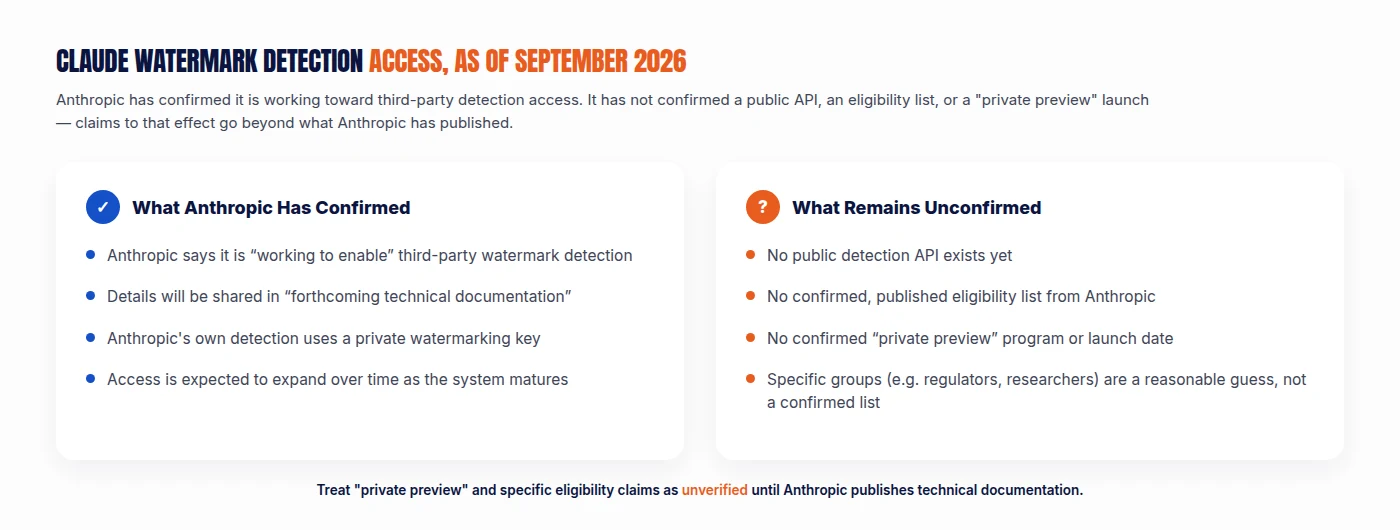
Current status — September 2026: Anthropic announced Claude text watermarking on August 14, 2026. Older Claude models are subject to a transition period, so it would be inaccurate to assume that every piece of Claude-generated text currently contains a detectable watermark. Anthropic has also said it is working to enable third-party detection of the watermark and will share details in forthcoming technical documentation — a public detection API is not yet available.
What Is Claude AI Watermarking?
Claude AI watermarking is a technique Anthropic uses to place an invisible statistical signal into AI-generated text.
The word “watermark” can be misleading if you imagine a logo placed over an image or hidden text inserted into a document. Claude’s text watermark works very differently.
According to Anthropic:
- No hidden characters are inserted into the text.
- Nothing extra is added to the response.
- The watermark is invisible to readers.
- It does not contain personal or organizational information.
- It does not require extra output tokens.
- Anthropic says it has no practical impact on the quality or readability of Claude’s response.
The signal instead comes from how Claude chooses words while generating a response.
That distinction matters because many discussions about Claude watermarking incorrectly treat it as something that can simply be found in HTML, stripped from metadata, or removed by deleting an invisible Unicode character. That is not how this watermark works, and it’s also what separates it from conventional detection software — a distinction we unpack fully in Claude watermark vs AI content detection.
Why Is Anthropic Watermarking Claude Content?
The immediate reason is regulatory compliance.
Article 50 of the European Union’s AI Act includes transparency requirements for providers of generative AI systems. Providers generating synthetic text, images, video, or audio generally need mechanisms that make qualifying AI-generated or manipulated outputs machine-readable and detectable.
Those Article 50 transparency provisions began applying on August 2, 2026.
Anthropic says it signed the EU Code of Practice on Transparency of AI-Generated Content and is implementing text watermarking as part of its response to these requirements. For the broader regulatory picture beyond Claude specifically, see the EU AI Act and AI-generated content: what SEOs need to know.
Interestingly, Anthropic is not initially restricting the watermark to European users. It says watermarking is being applied globally because the company does not yet have a durable way to reliably scope the system by region.
This is important for SEOs, publishers, agencies, and content teams outside Europe. Even if your company is not based in the EU, content generated with future Claude models may still contain the same watermark.
How Does Claude’s Text Watermark Actually Work?
To understand Claude watermarking, you first need to understand one basic feature of large language models.
Claude generates text one token at a time. A token might represent:
- a word,
- part of a word,
- punctuation,
- or another small unit of text.
At each step, the model evaluates possible tokens that could logically come next. Consider:
The weather this morning was cold and…
Several words might make sense: cloudy, grey, windy, wet, overcast. Claude assigns probabilities to possible choices and then selects one. In many situations, several different choices would produce an equally useful sentence.
Watermarking takes advantage of those choices.
The watermark comes from token selection
Rather than adding a separate marker after the content is generated, Claude’s watermark influences the source of randomness involved in choosing among acceptable tokens.
Over a sufficiently long passage, those choices create a statistical pattern. Someone with access to the appropriate watermark key can then analyze the sequence of text and estimate whether the pattern is consistent with text produced by watermarked Claude generation.
Anthropic describes its system as a version of the SynthID-Text approach developed by Google DeepMind. Google DeepMind explains SynthID-Text similarly: the technology modifies token probabilities during generation so an imperceptible signal becomes part of the resulting sequence of text.
The key idea is: the watermark is created through Claude’s generation decisions rather than being pasted into the completed text afterward.
Is the Claude AI Watermark Visible?
No. A normal reader cannot look at an article and see whether the Claude watermark is present. It isn’t:
- a visible label,
- an HTML tag,
- a line of metadata,
- a string of hidden characters,
- a series of zero-width spaces,
- or a watermark like the one placed over a stock photograph.
Anthropic says watermarked and unwatermarked Claude text should be indistinguishable to readers. Its internal testing found no meaningful effect on readability, creativity, or content quality.
Google DeepMind has similarly described SynthID-Text watermarks as imperceptible to humans and designed not to compromise the quality, accuracy, creativity, or generation speed of the text.
This also means that trying to inspect a webpage’s source code for a “Claude watermark” misunderstands the technology.
Is Every Claude Response Watermarked?
No — at least not automatically as of September 2026. This is one of the most important details for publishers to understand.
Anthropic’s announcement says future Claude models will generate text containing the watermark. Models launched before the EU AI Act’s August 2, 2026 deadline have a transition period, and Anthropic says it is working to add watermarking to those models over the coming months.
European Commission guidance also provides a limited transition period for qualifying AI systems that were already on the market before August 2, 2026, with the relevant marking and detection requirements applying from December 2, 2026 in those cases.
Therefore, statements such as:
“All Claude content is now watermarked.”
are too broad. The more accurate position is:
Anthropic has begun implementing text watermarking across Claude in response to the EU AI Act, with older models transitioning into the system.
That distinction matters when evaluating content generated before or during the rollout.
Does Claude Watermark Content That It Only Proofreads?
Not necessarily in a detectable way. This is where Claude’s watermarking system becomes particularly interesting for content teams.
Remember that the watermark depends on choices Claude makes while generating words. If you give Claude a 2,000-word human-written article and ask:
Fix punctuation and spelling mistakes only.
Claude might change only a handful of words. Most of the article remains the human writer’s original text. Anthropic says there may therefore be too little watermarked material for its detection system to confidently identify Claude’s involvement.
Compare that with asking Claude:
Rewrite this entire article in a more professional style.
Claude now needs to make thousands of generation decisions. There is far more opportunity for the watermarking pattern to appear.
The practical relationship is roughly:
| Claude’s involvement | Potential watermark signal |
|---|---|
| Basic proofreading | Very limited |
| Small grammar edits | Limited |
| Partial rewriting | Increasing |
| Heavy rewriting | Stronger potential signal |
| Full article generation | Greatest opportunity for detection |
This doesn’t mean every fully generated article can be identified with perfect certainty. Watermark detection remains probabilistic. But the more original text Claude generates, the more data the detection system has to evaluate.
Why Is Short Claude-Generated Text Harder to Detect?
Watermark detection needs enough generation decisions to identify a pattern. A two-sentence response contains relatively few token choices. A 2,000-word article contains many more.
Anthropic therefore says watermark detection works less effectively on small samples and becomes more confident as passage length increases.
This is an important limitation. A watermark detector should not be interpreted like a binary file property where the answer is always watermark = yes or watermark = no. Instead, the detector evaluates statistical evidence and estimates the likelihood that Claude was involved.
What About Facts, Numbers, and Code?
Watermarks work best where the model has multiple acceptable ways to express something. They become weaker when there is only one clearly correct answer. For example:
2 + 2 = 4
Claude cannot reasonably select another number merely to strengthen a watermark. The same issue appears in factual statements where accuracy substantially limits the model’s possible next words.
Anthropic therefore says factual passages generally contain fewer watermarking opportunities. Code can also contain less watermarking because changing a token arbitrarily may break the code.
However, natural-language comments inside code or other areas where multiple wording choices are possible can still provide opportunities for watermarking.
This reinforces an important point: a Claude watermark is a statistical provenance signal, not a hidden identification tag attached equally to every sentence.
Can a Claude Watermark Identify Who Generated the Content?
No. Anthropic explicitly says the watermark does not contain information identifying:
- the Claude user,
- an individual,
- a business,
- an organization,
- a specific chat,
- or the prompt used to create the response.
A successful detection result is therefore closer to:
Claude was likely involved in producing this text.
It is not:
This article was generated by John Smith using account X on September 1.
That distinction matters for privacy and for understanding what AI provenance systems can actually establish.
Does a Claude Watermark Prove Claude Wrote the Entire Article?
No. A detected watermark indicates likely Claude involvement. It does not necessarily establish whether Claude:
- wrote the whole article,
- rewrote several paragraphs,
- translated the text,
- substantially edited a human draft,
- or participated somewhere else in the production process.
Anthropic specifically says watermark detection cannot distinguish between situations such as Claude completely writing something and Claude heavily editing it.
For publishers, this is a useful distinction between AI involvement and AI authorship. Those aren’t always the same thing.
Does Claude Watermark Translated Content?
Yes, according to Anthropic. When Claude translates a document, Claude chooses the words that form the translated version. That creates numerous opportunities for the watermarking mechanism to operate, even though the underlying ideas came from another text.
Translation is therefore different from minor proofreading.
Can Editing Remove a Claude AI Watermark?
Editing can weaken a watermark, but the effect depends on how extensively the text changes.
Anthropic says light editing probably will not completely remove the signal, while a complete rewrite in which essentially every word changes can remove it.
This makes sense technically. If the watermark exists across patterns created by Claude’s token choices, replacing more of those choices gradually destroys the original statistical pattern.
But there is an important strategic point for publishers here. The SEO objective should not become:
How do I remove Claude’s watermark before publishing?
That solves the wrong problem. If a content team’s workflow revolves around disguising where text came from rather than improving its accuracy, originality, experience, evidence, and usefulness, the watermark is not the real SEO risk. The content production model is.
How Can a Claude Watermark Be Detected?
Detection requires knowledge of the watermarking pattern.
Anthropic explains that its system uses a key. Someone with access to that key can compare the statistical patterns in a passage with the patterns expected from watermarked Claude output.
That differs substantially from conventional AI-content detection software. Traditional AI detectors usually don’t possess Anthropic’s watermark key. Instead, they attempt to infer AI involvement by examining linguistic characteristics or patterns associated with model-generated writing.
As of this writing, Anthropic has not published a public detection API or a confirmed eligibility list for third-party access. Anthropic’s own guidance says the company is working to enable third-party detection of the watermark and will share details in forthcoming technical documentation. Organizations that might eventually need this kind of access likely include categories such as regulators, journalists, researchers, and platforms with relevant compliance obligations — but that’s a reasonable inference about who watermark detection is meant to serve, not a confirmed program with published eligibility rules.
Anthropic says it intends to expand access over time as the system matures.
So, at the moment, you should be skeptical of any website claiming it can definitively identify Anthropic’s official Claude watermark, or claiming it already has access to a specific private-preview program with eligibility criteria Anthropic itself has not confirmed.
Claude Watermarking vs Traditional AI Content Detection
These technologies answer similar questions but use fundamentally different methods. We go deeper on this comparison in Claude watermark vs AI content detection: what’s the difference, but the core distinctions are below.
| Claude watermark detection | Traditional AI detection |
|---|---|
| Looks for an intentionally generated statistical signal | Looks for patterns associated with AI writing |
| Signal is created during text generation | Analysis happens after the text exists |
| Uses knowledge of a watermark key | Usually doesn’t have the provider’s watermark key |
| Designed to identify likely Claude involvement | May attempt to identify AI writing generally |
| More text generally improves watermark confidence | Reliability varies by detector and content |
| Does not identify a specific user | Does not reliably establish authorship |
A useful way to think about it is: traditional AI detectors ask, “Does this writing look like AI?” Watermark detection asks, “Does this text contain the statistical pattern our system intentionally generated?”
That is a much more important difference than the shared word “detection” suggests.
Claude Text Watermarks vs C2PA Content Credentials
Claude’s approach to generated files adds another layer that can easily cause confusion.
Anthropic says supported files such as PNG, JPG, and SVG files can receive C2PA Content Credentials. C2PA is an industry provenance standard that can store cryptographically signed information in file metadata indicating that a file was created or processed using Claude.
That is not the same technology as Claude’s text watermark.
Text watermark
The signal is statistically embedded through generation choices.
C2PA Content Credential
Provenance information exists in signed file metadata.
The two approaches serve related transparency goals but work differently. Publishers should not assume that removing image metadata, for example, tells us anything about a statistical watermark embedded in generated text.
What Does Claude AI Watermarking Mean for SEO?
At the moment, there is no publicly documented Google Search policy stating that the presence of an AI watermark is a negative ranking factor.
Google’s current guidance is much more focused on the resulting content than on whether AI participated in producing it. Google advises publishers using generative AI to focus on:
- accuracy,
- quality,
- relevance,
- usefulness,
- originality,
- and compliance with its spam policies.
Google also warns that generating many pages with AI or other automation without adding value for users can violate its scaled content abuse policies.
That’s a crucial distinction.
AI-generated does not automatically mean low quality
Claude could help a subject-matter expert organize original research, improve article structure, analyze data, summarize notes, refine explanations, or turn firsthand expertise into a clearer article. The resulting content could be extremely useful.
Human-written does not automatically mean high quality
A person can also produce thin articles, inaccurate claims, recycled information, keyword-stuffed pages, or hundreds of low-value search pages. Google’s systems ultimately need to evaluate the usefulness and quality of the content users encounter. The existence of an AI watermark doesn’t change that fundamental problem. For a deeper look specifically at ranking impact, see will AI-watermarked content affect Google rankings.
Could Google Detect Claude Watermarks?
This requires careful wording.
Claude’s watermarking technique is based on Google DeepMind’s SynthID-Text research. Google therefore clearly understands and operates watermark-detection technology.
But that does not establish that Google Search:
- possesses Anthropic’s specific Claude watermark key,
- scans indexed webpages for Claude watermarks,
- stores that information as a Search signal,
- or changes rankings based on it.
Anthropic explains that different AI systems can use different watermark keys, and its key only helps answer whether Claude was likely involved.
There is currently no publicly documented Google Search policy saying Claude watermark detection is part of organic ranking. We break down what’s confirmed versus speculative on this exact question in can Google detect Claude-written content through AI watermarks.
The safest conclusion is therefore: Google may have extensive technical capabilities for detecting AI-generated material, but there is no public evidence that the Claude watermark itself is a Google Search ranking factor.
That question deserves to be separated from the broader question of whether Google can identify low-value AI content. Google does not need a Claude watermark to recognize patterns associated with spam, duplication, mass production, or pages that provide little original value.
Will Claude-Watermarked Content Still Be Able to Rank?
There is no reason based on Google’s current published guidance to assume that a watermark alone prevents a page from ranking.
Google’s 2026 guidance for appearing in its generative AI Search experiences goes even further in emphasizing unique, non-commodity content. Google recommends providing original perspectives, firsthand experience, useful organization, high-quality supporting media, and information that goes beyond simply recycling what already exists online.
That leads to a more useful SEO question. Instead of asking:
Did AI write this?
Ask:
What does this page contribute that another page — or an AI model itself — cannot easily reproduce?
That may include firsthand experience, original testing, proprietary data, screenshots, expert analysis, real-world examples, unique comparisons, customer evidence, original frameworks, or a genuinely useful point of view. Those qualities matter whether Claude helped create the first draft or not.
Should SEOs Stop Using Claude for Content?
No. Claude watermarking isn’t, by itself, a reason for SEO teams to stop using Claude.
What should change is the assumption that the ideal AI content workflow is:
keyword → prompt → article → publish
That workflow was already weak before watermarking. A stronger model is:
Research → AI Assistance → Human Expertise → Evidence → Editorial Review → Publish
1. Research the search intent
Understand the problem the user is actually trying to solve rather than generating an article solely around a keyword.
2. Use AI as an accelerator
Claude can organize research, surface questions, develop structures, analyze information, and help improve explanations.
3. Add something proprietary
Bring information Claude could not independently generate from generic knowledge. Examples include your experience, experiments, opinions, data, examples, screenshots, processes, customer observations, or original frameworks.
4. Verify factual claims
Check important claims against primary sources rather than trusting a model-generated citation or explanation.
5. Apply editorial judgment
A knowledgeable person should decide what is correct, useful, unnecessary, misleading, or missing.
6. Optimize for humans and search systems
Make answers easy to understand and extract without reducing the article to robotic keyword targeting.
This approach produces stronger SEO content regardless of whether watermark detection becomes more widespread.
Does Claude AI Watermarking Change AEO or GEO Strategy?
Not fundamentally.
Answer Engine Optimization and Generative Engine Optimization still depend heavily on creating content that systems can understand, trust, retrieve, and use when answering questions. AI provenance does not automatically eliminate those characteristics.
For AI visibility, publishers should continue emphasizing clear answers, strong entity relationships, factual precision, trustworthy sourcing, original information, consistent brand/entity signals, concise definitions, logical heading structures, evidence supporting important claims, and regularly updated information.
Google’s 2026 AI Search guidance similarly emphasizes unique and useful material rather than producing large numbers of pages for every possible query variation.
Claude watermarking changes the transparency layer around AI-generated content. It does not replace the fundamentals of producing material worth ranking, citing, or recommending.
What Should Content Teams Do Now?
For most SEO teams and website owners, there is no reason to panic. There is, however, a strong reason to improve AI governance.
A practical policy would be:
- Document which AI systems your team uses.
- Avoid publishing unreviewed AI output.
- Verify factual and statistical claims.
- Add original experience or evidence whenever possible.
- Maintain human editorial responsibility.
- Understand applicable AI-transparency regulations, including how the EU AI Act affects AI-generated content.
- Don’t build workflows around bypassing provenance mechanisms.
- Monitor changes to Claude’s watermark rollout and detection access.
- Monitor Google’s Search policies separately from AI-regulation developments.
- Treat AI as part of the production process rather than a replacement for editorial judgment.
The distinction in point nine is particularly important. AI transparency regulation and Google Search ranking policy are two separate systems. Something can be required for regulatory transparency without becoming a negative SEO signal.
The Bottom Line
Claude AI watermarking represents a significant shift in how AI-generated text may be identified, but it does not suddenly make Claude unusable for SEO.
The watermark is an invisible statistical signal created through Claude’s token-selection process. It contains no hidden characters and no information identifying the user who generated the content. Detection becomes easier when Claude generates longer passages and more difficult when its involvement is limited to light editing, highly constrained factual material, or certain types of code.
Anthropic’s primary reason for introducing the technology is compliance with the EU AI Act’s transparency requirements, not SEO enforcement.
For publishers, the bigger lesson is not to become obsessed with hiding AI usage. Google continues to emphasize useful, accurate, original, people-first content and warns against using generative AI to produce large amounts of content without adding value.
Claude’s watermark may make AI involvement more transparent. It doesn’t determine whether the content deserves to rank. That still depends much more on what the content actually gives the reader.
FAQ
Does Claude watermark AI-generated text?
Anthropic is introducing text watermarking for Claude models as part of its compliance with EU AI Act transparency requirements. Future Claude models will produce watermarked text, while models introduced before August 2, 2026 are being transitioned into the system over time.
Is the Claude AI watermark visible?
No. Claude’s text watermark is invisible to readers. Anthropic says it does not add visible labels, hidden characters, or extra text. The signal comes from statistical patterns created by Claude’s word and token choices.
Does copying and pasting Claude text remove the watermark?
Simply copying and pasting the same text would not inherently eliminate a statistical pattern created by Claude’s word choices. Editing the actual wording can gradually weaken the signal, particularly if the text is extensively rewritten.
Can editing remove Claude’s watermark?
Light editing may leave much of the watermark intact, while extensive rewriting can weaken it significantly. Anthropic says a complete rewrite in which the original wording is replaced can remove the original watermark signal.
Does Claude watermark proofreading?
Claude can only watermark words or tokens it actually chooses. If Claude merely corrects a few punctuation or grammar issues in mostly human-written content, there may not be enough Claude-generated material for its involvement to be reliably detected.
Does the Claude watermark identify the user?
No. Anthropic says its watermark contains no information identifying a user, company, organization, conversation, or prompt.
Can anyone detect Claude’s watermark?
Not yet, and not directly. Anthropic’s official detection system relies on its watermarking key, which is not publicly available. Anthropic has said it is working to enable third-party detection and will share details in forthcoming technical documentation, but as of this writing there is no confirmed public detection API or published eligibility list for who will get access.
Does Claude watermark code?
Code may contain less watermarking than normal prose because many programming tokens need to be exact. Where Claude has several equally valid wording choices, such as comments, watermarking may still occur.
Does Google penalize Claude-written content?
Google has not published a policy saying Claude-generated or watermarked content is automatically penalized. Google’s guidance focuses on content quality, originality, accuracy, usefulness, and whether automation is being used to create large amounts of content without providing additional value.
Will Claude-watermarked content rank on Google?
A Claude watermark does not automatically prevent content from ranking based on Google’s currently published policies. A page still needs to demonstrate relevance, usefulness, originality, quality, and other characteristics Google’s systems seek to reward.
Is Claude AI watermarking the same as an AI content detector?
No. Claude watermark detection searches for a statistical signal intentionally created during text generation. Traditional AI detectors typically analyze linguistic patterns and estimate whether writing resembles machine-generated text. They are fundamentally different approaches.
Why is Anthropic watermarking Claude?
Anthropic says it is implementing text watermarking to comply with EU AI Act transparency requirements. Article 50 requires qualifying generative AI providers to make AI-generated content machine-readable and detectable as artificially generated or manipulated.