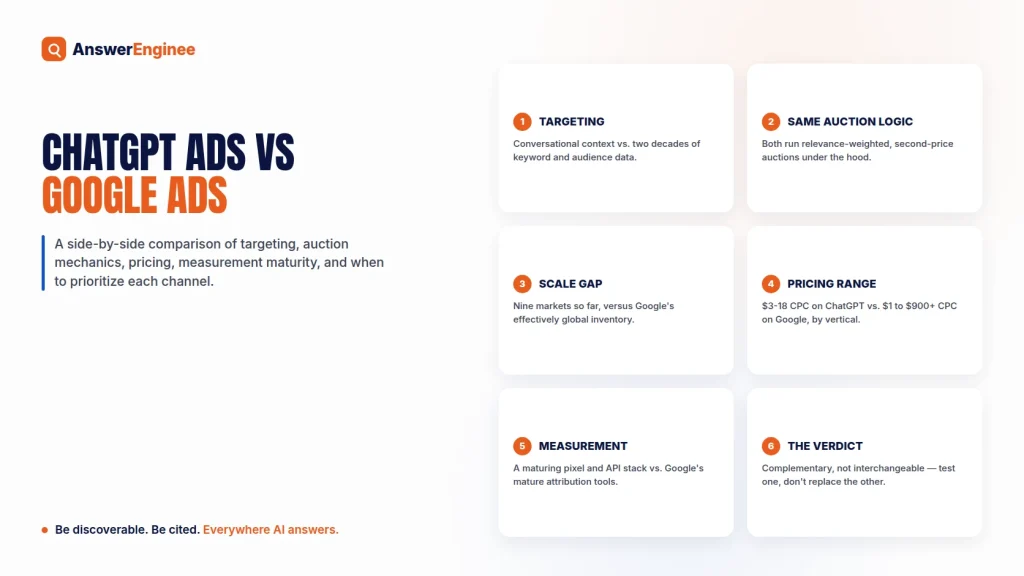
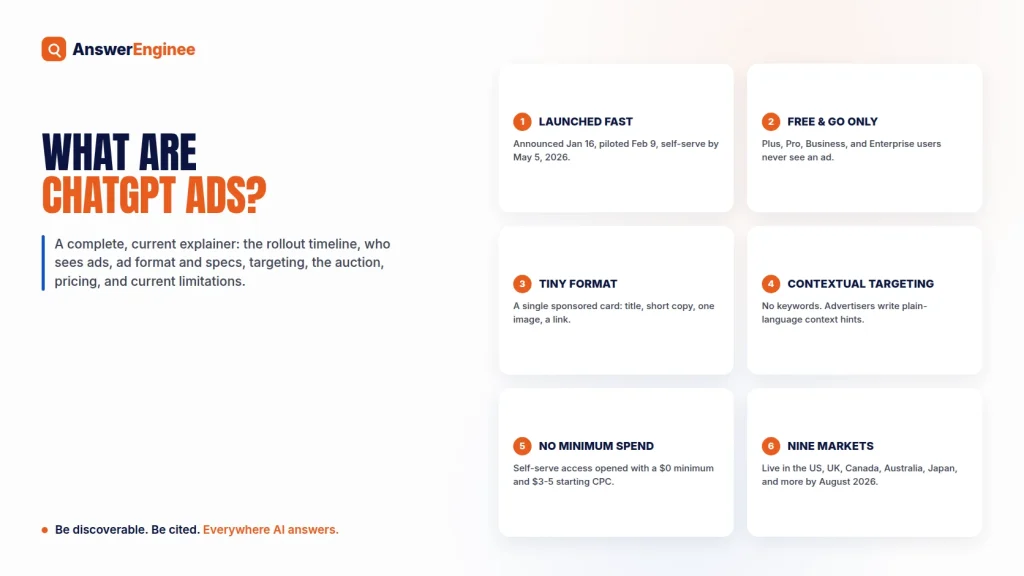
Whether it becomes the next Google Ads depends on whether targeting granularity, measurement infrastructure, and advertiser trust mature fast enough to match user growth. None of that is guaranteed. But the trajectory since the February 2026 launch has been unusually fast, and it’s worth looking honestly at both the case for and against.
The bull case
The platform has matured quickly by any standard. CPM-only bidding gave way to CPC within three months, and conversion-optimized bidding followed within six. An automated “Maximize results” strategy became the default by August. That’s a fast sequence for any ad platform.
The minimum spend barrier is gone entirely. What started as a $200,000 monthly commitment at launch dropped to zero by May, opening the door to any eligible business rather than only enterprise budgets, a shift covered in more detail in can small businesses advertise on ChatGPT.
Major brands are already spending here. Best Buy, Lowe’s, Target, and VistaPrint are among the advertisers who’ve been running live campaigns, which signals real confidence from marketers with plenty of other places to put budget.
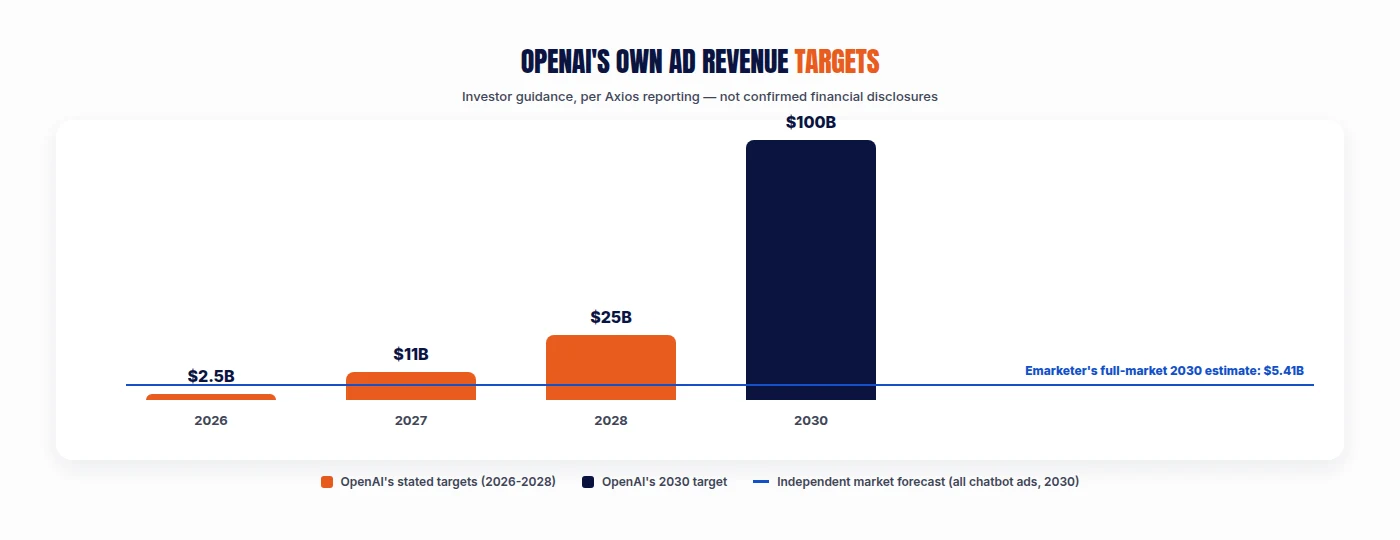
The revenue trajectory, if OpenAI’s own numbers hold, is aggressive by design. The company has told investors to expect $2.5 billion in 2026, climbing to $11 billion in 2027, $25 billion in 2028, and $100 billion by 2030. OpenAI’s ad pilot reportedly crossed $100 million in annualized revenue within six weeks of launch, and the business passed the $1 billion annualized mark within its first year, a genuinely fast climb for any ad product.
And the audience underneath it all is large. ChatGPT has approached a billion weekly active users, the overwhelming majority on the free tier where ads actually show up.
The constraints
Targeting still lags well behind Google. State, DMA, and ZIP-level geo-targeting arrived in the US in May 2026, a real improvement, but there’s still no interest or demographic layer, and most non-US markets remain country-level only.
Ad tech integration is early. Adobe, Criteo, Kargo, Pacvue, and StackAdapt are among the partners so far, a meaningful start but nowhere close to Google’s decades-deep relationships with Search Ads 360, Skai, and thousands of smaller platforms built specifically around its ad infrastructure.
Category exclusions genuinely cap the addressable market. Political advertising, gambling, alcohol and tobacco, and adult content are fully prohibited. Healthcare and financial services opened to gated, case-by-case approval in April 2026, and legal advertising access remains narrower and less clearly defined, a slower, more limited path than the open access those industries have on Google.
And AI Mode complicates the picture further. If more search shifts toward agent-driven, multi-step interactions rather than a single conversational answer, it’s not yet clear that the current ad model, a single sponsored card below a response, translates cleanly into that kind of flow. See how AI Overviews and AI Mode actually differ for more on that shift.
The skeptical read on OpenAI’s own numbers
It’s worth sitting with how large a gap exists between OpenAI’s stated ambition and independent forecasts. Emarketer estimates the entire US standalone chatbot ad market, covering ChatGPT, Copilot, Google AI Mode, and Amazon’s shopping assistant combined, will reach roughly $5.41 billion by 2030. OpenAI’s own target for ChatGPT ads alone is nearly twenty times that.
One analyst put it plainly: even if OpenAI captured 100% of the entire projected chatbot ad market five years from now, it would still miss its own $100 billion target by about 90%. Hitting that number requires growth across total audience, revenue per user, and the ad products themselves, all at once, which is a lot of variables to land simultaneously.
That doesn’t mean the number is wrong. Forecasts miss in both directions, and a genuinely new ad category is hard to model from a standing start. But it’s a fair reason to treat OpenAI’s own projections as an ambitious internal target, the kind companies set ahead of an IPO, rather than a settled forecast.
What other AI platforms are doing
The picture across the rest of the category is mixed, not uniformly moving toward more ads. Perplexity ran its own ad experiment starting in late 2024 and abandoned it entirely in February 2026, citing user trust concerns and pivoting to a subscription-only model instead. Microsoft Copilot serves ads, but by extending existing Microsoft Advertising campaigns automatically rather than building a standalone chatbot ad product. Google has been testing its own AI-era ad formats within AI Mode and AI Overviews, backed by the existing Google Ads infrastructure rather than a new system. Anthropic’s Claude has no ad program.
Check current status before relying on any of this, since this list has already shifted more than once in the past year.
What history suggests, as a comparison point
Meta took roughly seventeen years, from 2004 to 2021, to build its ad business into a $100 billion annual run rate. OpenAI’s own target compresses a comparable climb into about four years from ChatGPT’s ad launch.
That’s not a prediction that OpenAI will or won’t get there. It’s a reminder that ad businesses at this scale have historically taken a long time to mature, and a compressed timeline, if it happens, would be unusual by any historical comparison.
What marketers should do regardless of the outcome
Test now, while competition for inventory and CPCs are both still relatively low. Whether or not OpenAI hits its own revenue targets, ChatGPT Ads is a real, working channel today, and early movers get cheaper learning than advertisers who wait for the platform to mature.
Don’t over-commit budget to an unproven platform in the process. A bounded test, a few thousand dollars over a month, tells you what you need to know without betting a meaningful share of a working budget on a channel that’s still finding its footing. Set up real ROI measurement from day one so that test actually tells you something.
Where this leaves things
There’s genuine uncertainty here, and the honest answer resists a confident forecast in either direction. The platform has moved faster than most ad products in its first six months. The gap between OpenAI’s stated ambition and independent market estimates is also real and large. Both things can be true at once, and the next year or two of advertiser adoption, targeting maturity, and consumer trust will likely say more than any projection can right now.
FAQ
How much ad revenue is OpenAI currently targeting from ChatGPT Ads?
OpenAI has told investors to expect $2.5 billion in ad revenue in 2026, climbing to $11 billion in 2027, $25 billion in 2028, and $100 billion by 2030, according to Axios and other reporting. These figures come from investor presentations rather than public financial disclosures, so they should be treated as an internal target rather than a confirmed outcome.
What’s the biggest obstacle to ChatGPT Ads reaching Google Ads-level scale?
Targeting maturity is one of the clearest gaps. ChatGPT Ads Manager added US state, DMA, and ZIP-level targeting in May 2026, but most markets outside the US remain country-level only, with no interest or demographic layer anywhere yet, compared to Google’s decades of targeting infrastructure. Ad tech integration and category access for regulated industries also remain more limited.
Are other AI platforms besides ChatGPT building ad products?
The picture is mixed. Microsoft Copilot serves ads through existing Microsoft Advertising campaigns, and Google is testing new formats within AI Mode and AI Overviews. Perplexity abandoned advertising entirely in February 2026 over trust concerns, and Anthropic’s Claude has no ad program. Confirm current status before relying on any of this, since it’s changed more than once in the past year.
Is OpenAI’s $100 billion ad revenue target realistic?
Independent analysts are skeptical. Emarketer estimates the entire US standalone chatbot ad market will reach only about $5.41 billion by 2030, meaning OpenAI’s target for ChatGPT ads alone is nearly twenty times that estimate. The company’s own projections should be read as an ambitious internal goal rather than a settled forecast.