If you’ve already launched a test campaign, following the setup steps here, here’s how to actually measure whether it’s working, not just whether it’s spending.
What native reporting shows you
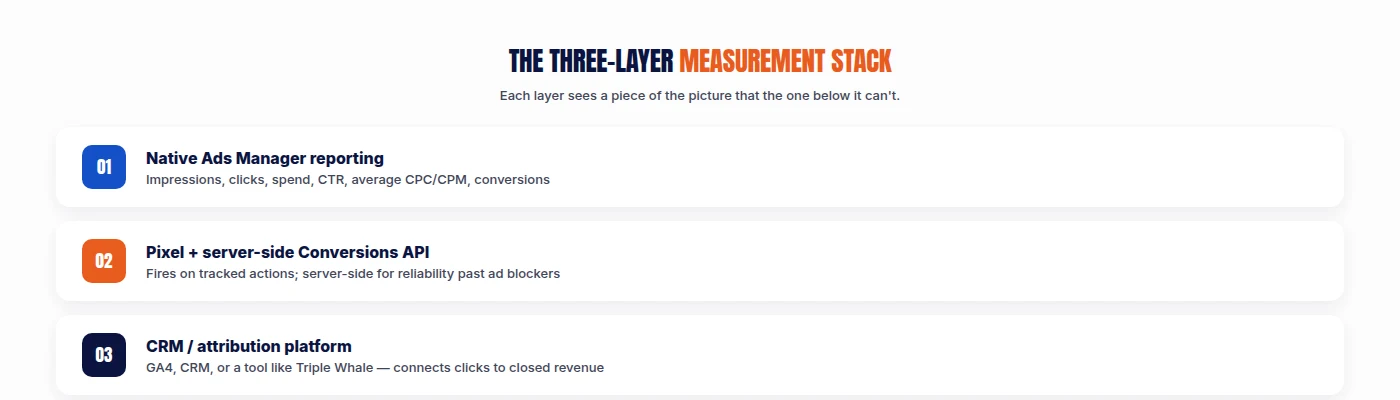
Ads Manager reports the basics you’d expect: impressions, clicks, spend, click-through rate, average CPC or CPM, and conversions once tracking is connected. One-day view-through conversion reporting was added in August 2026, giving some visibility into conversions that happen shortly after an impression without a click.
That’s useful, but it’s also where the native dashboard stops. There’s no conversation-level detail and no granular audience breakdown. OpenAI aggregates reporting by design, to protect the privacy of the conversations ads appear inside.
That gap is exactly why most advertisers don’t stop at the native dashboard.
Setting up the pixel and Conversions API
The pixel sits on your website and fires when a visitor from a ChatGPT ad completes a tracked action, a purchase, a form fill, a signup. It’s the same basic idea as a Meta or Google Ads pixel, adapted for a chat-based referral source rather than a click from a results page.
The Conversions API sends that same conversion data server-side, which tends to be more reliable than browser-based pixel tracking alone, especially as ad blockers and privacy settings interfere with client-side scripts. Automatic Advanced Matching, which uses hashed customer data from your own website forms to improve match rates, became the default for new web pixels earlier in 2026 and extended to existing pixels in August 2026.
Set both up before your first campaign goes live. Retrofitting measurement after you’ve already spent budget means you’ve lost the ability to learn from that early spend.
Connecting to your existing attribution
Native ChatGPT Ads reporting tells you what happened on the platform. It won’t tell you whether that click became a closed deal three weeks later. That’s where connecting to GA4, your CRM, or a marketing attribution platform matters.
Route conversion events from the Conversions API into whatever system already tracks your other channels. Several third-party platforms, including Triple Whale, Hightouch, and others, now support direct ChatGPT Ads integrations, which shortcuts a lot of this setup work.
The goal is a single view where a ChatGPT ad click sits next to a Google Ads click and a Meta click, all measured against the same downstream outcome. Comparing platforms on their own separate dashboards makes it too easy to draw the wrong conclusion.
The metrics that matter most right now
CTR and CPC or CPA trends over time matter more than any single week’s numbers, since the auction and available inventory are both still stabilizing. A cost that looks high in week one might normalize as more advertisers and more inventory enter the platform.
Landing page conversion rate, isolated for ChatGPT ad traffic specifically, helps separate ad quality from platform quality. If the click-through rate is healthy but conversion rate lags well behind your other channels, the problem is likely the landing page experience, not the ad or the platform.
Incremental lift, where you can measure it, is the most honest signal available. Comparing outcomes for customers exposed to a ChatGPT ad against a similar group that wasn’t tells you whether the ad actually changed behavior, rather than just claiming credit for a purchase that would have happened anyway.
Setting realistic ROI benchmarks
Resist the urge to hold ChatGPT Ads to the same benchmark as a channel with two decades of optimization behind it. Early-platform CPMs and CPCs reflect a still-maturing auction, not a settled, steady-state price.
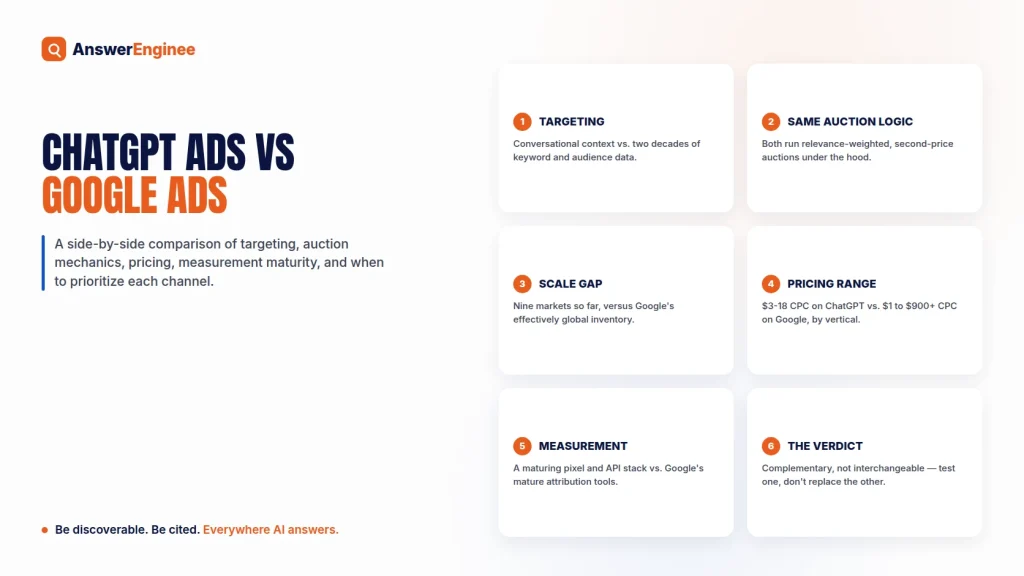
Comparing directly against mature Google Ads ROAS benchmarks can mislead more than it informs, at least for now. A more useful comparison is your own ChatGPT Ads performance against itself over time, watching whether efficiency improves as you refine targeting and creative. For a fuller sense of how the platform compares structurally, see ChatGPT Ads vs. GEO and ChatGPT Ads vs. Google Ads.
A simple ROI tracking framework
Set this up before or alongside your first real campaign:
- Install the pixel and Conversions API and confirm test events are firing correctly before spending real budget.
- Connect conversion events to your CRM or attribution platform so a click can be traced to pipeline or revenue, not just a landing page visit.
- Track CTR and CPC or CPA weekly, watching the trend rather than any single week in isolation.
- Track landing page conversion rate for ChatGPT traffic specifically, comparing it against your other channels’ baseline.
- Revisit after four weeks with enough data to judge trend direction, not day-one performance.
When to pause or scale
Pause and rework the campaign if CTR sits well below your other channels after a couple of weeks, or if landing page conversion rate is meaningfully worse for this traffic than for your baseline. Both point to a fixable problem in targeting, creative, or the landing experience rather than a reason to abandon the channel entirely.
Scale spend once you have several consecutive weeks of stable or improving CPC and conversion data. Early volatility is normal on a platform this new. A consistent trend across multiple weeks is a better signal to act on than any single strong or weak day.
FAQ
Does ChatGPT Ads Manager show which specific conversations led to a conversion?
No. Reporting is aggregated at the campaign level to protect conversation privacy, so advertisers see performance metrics like impressions, clicks, and conversions but not the underlying conversation content or transcript-level detail.
What’s the best way to track ROI without native conversation-level data?
Install both the OpenAI pixel and the server-side Conversions API, then connect conversion events to your CRM or attribution platform so a ChatGPT ad click can be traced through to a closed deal, not just a landing page visit. Comparing landing page conversion rate for ChatGPT ad traffic against your other channels also helps isolate ad quality from platform-level noise.
Should I expect the same ROAS from ChatGPT Ads as from Google Ads?
Not necessarily, at least not yet. The auction, inventory, and targeting tools are all newer and still maturing, so early performance benchmarks are less stable than a channel with decades of optimization data behind it. Most advertisers are treating early results directionally rather than as a fixed expectation.
How long should I run a test before judging whether ChatGPT Ads is working?
Around four weeks is a reasonable minimum, enough time to see past early volatility and judge trend direction in CTR, cost, and conversion rate rather than reacting to a single strong or weak day.