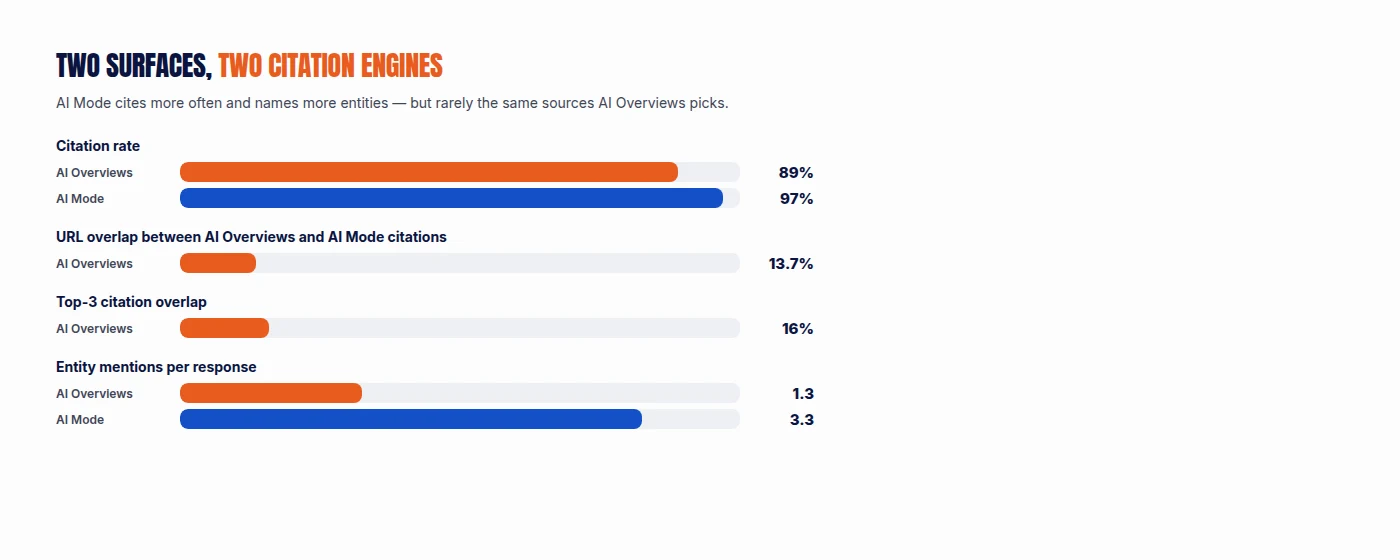
The number that matters most for anyone doing SEO or AEO work: Ahrefs found the two cite the same URL only 13.7% of the time for matched queries. Citation in one doesn’t imply citation in the other, so both surfaces need to be optimized for separately. For the traffic implications of that shift more broadly, see how expanded AI Overviews affect organic search traffic.
What’s actually different
| AI Overviews | AI Mode | |
|---|---|---|
| Trigger | Automatic, appears inline on eligible queries | Increasingly reachable directly from an AI Overview, or via a dedicated entry point |
| Query handling | Single query | Fans out into multiple sub-queries per question |
| Response length | Short, summary-style | Roughly 4x longer on average, per Ahrefs |
| Organic results shown | Yes, alongside the summary | No traditional ranked list |
| Citation rate | Cites sources in 89% of responses | Cites sources in 97% of responses |
| Entity mentions | Averages 1.3 per response | Averages 3.3 per response, about 2.5x more |
| Interactivity | Read-only summary | Conversational, supports follow-up |
Why the citation patterns diverge so much
Google has said the two systems may use different models and techniques, and the data backs that up. Ahrefs’ analysis of over 540,000 matched query pairs found AI Overviews and AI Mode agree on substance far more than they agree on sources: an 86% average semantic similarity score, with 9 out of 10 response pairs landing above 0.8 on a 1.0 scale. But word-level overlap sits at just 16%, and the two share an identical opening sentence only about 2.5% of the time.
Put simply, the two systems tend to reach the same conclusion and explain it in their own way, using largely different sources to get there. That’s a genuinely different failure mode for SEO than a typical ranking discrepancy, where two tools disagreeing usually points to a methodology difference. Here, both Google products are looking at the same query and landing on different citations almost nine times out of ten.
The overlap data, in detail
Ahrefs’ most-cited figure is 13.7% URL overlap between AI Overviews and AI Mode citations for the same query. Looking only at each response’s top three citations, that overlap rises modestly to around 16%, still meaning the large majority of citations differ even at the most prominent positions.
A separate SE Ranking study, using its own methodology, found comparable divergence: roughly 10.7% URL overlap and 16% domain-level overlap. Different tools, similar conclusion.
Source preferences differ too, not just which specific URLs get cited. Wikipedia shows up in roughly 29% of AI Mode citations versus about 18% of AI Overview citations. AI Mode cites Quora at more than three times the rate AI Overviews does, and cites health-related sites at roughly double the rate. None of this looks like the same system drawing from a slightly different sample. It looks like two systems with meaningfully different citation logic.
There’s one meaningful bright spot for brand visibility, though. When a brand or entity gets mentioned in an AI Overview, Ahrefs found roughly a 61% chance it also gets mentioned somewhere in the corresponding AI Mode response, even when the specific citations differ. Entity-level presence carries over more reliably than exact source citation does, a point worth pairing with how to get brand mentions in AI search engines.
The May 2026 merger, and what it does and doesn’t change
At Google I/O in May 2026, Google unified AI Overviews and AI Mode into a single, connected flow, live globally as of May 19. A user can now start with a standard search, see an AI Overview, and continue directly into an AI Mode conversation without switching tabs or re-typing their question.
That’s a real change in how much of a search session stays inside an AI-generated experience. It is not evidence that the two systems now share a citation engine. The underlying divergence Ahrefs measured predates the interface merger, and nothing in Google’s announcement suggests the two are pulling from a unified source-selection process now. Treat the merger as a shift in user flow and session structure, not as a reason to stop optimizing for both surfaces separately.
Rollout status varies independently
Availability for the two products hasn’t tracked together historically, and that’s worth checking rather than assuming. AI Mode has expanded broadly, into roughly 200 countries and territories and dozens of languages per Google’s own figures, while AI Overviews has rolled out more unevenly market by market, with some launches, like France’s, arriving later than expected. Account type and region can also affect what a specific user sees. Verify current availability in your own market rather than assuming parity between the two.
What this means for SEO strategy
For AI Overviews, the extractability fundamentals still apply: answer the core question directly and early, in a passage that could be lifted cleanly on its own, since the format favors short, quotable summaries pulled from a single strong source.
For AI Mode, the fan-out behavior changes the target. Since a single question can generate multiple sub-queries behind the scenes, content that comprehensively covers a topic’s full question family, not just the primary question but the natural follow-ups a reader would ask next, has more surface area to get pulled into a longer, multi-source response.
Practically, that means building both a tight, directly-answering passage near the top of a page for AI Overview extraction, and broader topical coverage further down for AI Mode’s fan-out queries to catch. Neither structure fully substitutes for the other.
A dual-optimization checklist
Lead with a clear, self-contained answer to the primary question, structured for clean extraction. Follow it with genuinely comprehensive coverage of the topic’s adjacent and follow-up questions, since AI Mode’s fan-out behavior rewards breadth a single-answer page won’t have. Track citation separately for each surface rather than assuming one number represents both, since the 13.7% overlap means strong AI Overview citation tells you very little about AI Mode performance. And check availability and rollout status for your specific market before drawing conclusions from aggregate global figures.
FAQ
If my page is cited in Google AI Overviews, will it also be cited in AI Mode?
Not reliably. Ahrefs’ analysis found only around 13.7% overlap between URLs cited in AI Overviews versus AI Mode for the same queries, meaning the two surfaces largely draw from different sources even when answering similar questions and reaching the same conclusion.
Is AI Mode available everywhere AI Overviews are?
No. Availability varies independently by country, language, and even account type. AI Mode has expanded to roughly 200 countries and territories, while AI Overviews has rolled out more unevenly by market, so it’s worth checking current availability in a specific market rather than assuming parity.
Does AI Mode show traditional blue-link search results?
No. AI Mode replaces the traditional results list with a conversational, multi-query response that cites sources within the answer itself, rather than displaying organic rankings alongside an AI summary the way AI Overviews do.
Did Google merge AI Overviews and AI Mode into the same system?
Not at the citation level. As of May 2026, Google connected the two into a single user flow, letting someone move from an AI Overview directly into an AI Mode conversation. But the underlying citation behavior remains distinct, with the two systems still pulling from largely different sources for the same query.