Quick Answer
Traditional Shopping ranking is primarily built around relevance to the user’s search terms, Google activity, and personalization. AI Mode can add a conversational reasoning layer: it interprets a longer request, performs query fan-out, researches multiple product considerations, uses Shopping Graph data, evaluates attributes, and may then surface a much smaller set of products that fit the synthesized intent.
Google has not published a standalone list of “AI Mode shopping ranking factors,” so SEOs should avoid pretending there is a known formula.
What Google has confirmed is that AI-powered shopping uses the Shopping Graph, conversational queries, product attributes, reviews, prices, availability, personalization, and AI-generated research. Merchant Center now even reports AI-specific metrics such as share of voice, products showing, shopping stage, popular terms, and missing product attributes.
Third-party 2026 studies have also observed meaningful differences between AI Mode and standard Search. One July analysis of more than 2 million product listings found AI Mode returned roughly 95% fewer product listings for the tracked product-centric queries. A later August study from the same company found that when the same product appeared in both environments, the listing shown in AI Mode was 21.6% more expensive on average.
These findings do not prove that AI Mode universally prefers expensive products or intentionally suppresses listings. They do show that ecommerce SEOs should stop assuming that strong Google Shopping visibility automatically translates into strong AI Mode product visibility.
Google AI Mode Is Not Just Another Shopping SERP
For years, ecommerce SEO has been built around relatively familiar surfaces:
- standard organic search;
- Shopping results;
- free product listings;
- Shopping ads;
- Popular Products;
- product knowledge panels;
- Merchant Center.
AI Mode changes the interface.
Instead of asking:
waterproof hiking shoes
a shopper can ask:
I need lightweight waterproof hiking shoes for a seven-day trip to Iceland in October. I have wide feet, prefer less than 12 ounces per shoe, and want something comfortable enough for city walking too.
That is not one keyword.
It contains:
- waterproofing;
- weight;
- climate;
- foot width;
- hiking suitability;
- travel use;
- urban comfort;
- seasonality.
Google’s AI shopping experience can reason across those requirements and generate additional searches to investigate them.
This is where traditional “ranking position” begins to break down.
How Regular Google Shopping Ranking Works
Google’s current Shopping documentation says products are ranked based on relevance, including the user’s search terms and other Google activity. Personalization can also be influenced by searches, views, browsing activity, and saved shopping preferences.
For AI-supported shopping recommendations, Google says “Top recommendations” can be selected using signals such as:
- relevance;
- ratings;
- price;
- product features.
Source: Google Shopping Help
That gives us an important baseline.
Traditional Shopping can already be personalized and relevance-driven.
So the difference is not:
Regular Shopping is simple and AI Mode is intelligent.
Regular Shopping is already heavily algorithmic.
The bigger difference is the query interpretation and synthesis process AI Mode can add before products are surfaced.
How AI Mode Shopping Works Differently
Google says AI Mode shopping combines Gemini capabilities with the Shopping Graph.
The Shopping Graph contains tens of billions of product listings with information such as:
- prices;
- reviews;
- color options;
- availability;
- merchant data;
- product attributes.
Google also says AI Mode can use query fan-out.
In Google’s own example, a user looking for a travel bag for Portland in May triggers multiple searches around weather, journey requirements, waterproofing, and accessibility before AI Mode suggests suitable products.
Source: Google Shopping AI Mode
That creates a different selection problem.
Traditional query:
travel bag
AI Mode may effectively research:
- waterproof travel bags;
- travel bags for rainy climates;
- easy-access travel bags;
- bags suitable for long journeys;
- lightweight travel bags;
- carry-on requirements;
- style preferences.
The final product set can therefore be shaped by multiple hidden subqueries rather than only the phrase the shopper typed.
Query Fan-Out Is the Biggest Ranking Difference
Query fan-out is one of the most important concepts ecommerce SEOs need to understand.
In standard SEO, you usually optimize around a visible query.
In AI Mode, one visible query can create multiple secondary searches.
The product may need to qualify across several dimensions.
Example
User:
Best office chair for a tall person with lower-back pain who works 10 hours a day and wants something under $800.
Potential research dimensions could include:
- office chairs for tall users;
- lumbar support;
- long-duration comfort;
- seat depth;
- weight capacity;
- ergonomic certifications;
- chairs under $800;
- customer reviews;
- warranty.
A product that ranks highly for:
ergonomic office chair
may not be selected if Google’s data does not clearly establish:
- maximum height suitability;
- seat depth;
- lumbar adjustment;
- price;
- warranty;
- long-session comfort.
AI Mode therefore makes attribute completeness much more important.
Google Now Measures AI Shopping Visibility Separately
One of the strongest signals that AI Mode should be treated as a distinct ecommerce visibility layer is Google’s own Merchant Center reporting.
Google’s AI performance insights report measures visibility for conversational shopping queries across AI Mode and AI Overviews.
Metrics include:
Share of Voice
Your AI impressions divided by the total impressions across your defined competitor set.
Products Showing
How many of your products appear for relevant:
- terms;
- attributes;
- search intents.
Shopping Stage
Google classifies conversational shopping queries into:
- Discovery;
- Evaluation;
- Purchase.
Top Terms
Words and concepts shoppers prioritize in conversational searches.
Popular Attributes
Structured specifications such as:
- size;
- color;
- material.
Top Search Intents
The broader purpose behind the conversation.
Source: Google Merchant Center AI Performance Insights
This is a major shift.
Traditional ecommerce reporting asks:
Which keywords generated impressions and clicks?
AI reporting increasingly asks:
Which shopping intents and attributes cause our products to appear in conversational journeys?
That is a fundamentally different optimization lens.
AI Mode Can Show Far Fewer Products Than Standard Search
A July 2026 Productrise study compared standard Google results with AI Mode for the same product-centric queries.
The company tracked:
- more than 2 million product listings;
- more than 100,000 SERPs and AI Mode responses;
- 21 days of data.
Its headline finding:
AI Mode returned roughly 95% fewer product listings than standard Search for the tracked queries.
Source: Productrise
This is third-party observational research.
Google has not confirmed that AI Mode is designed to show “95% fewer products.”
The result may also be influenced by:
- the query sample;
- product categories;
- interface layout;
- geography;
- device;
- data collection methodology;
- changes in AI Mode.
But the directional implication matters.
If AI Mode surfaces a smaller candidate set, then being eligible is not enough. This is the shift we describe in more detail in Google AI Mode vs Popular Products: a narrower results panel changes what “competing” even means.
Competition may shift from:
How do I rank higher among many listings?
to:
How do I become one of the few products AI Mode decides is relevant enough to show?
That is a much tougher visibility problem.
AI Mode May Produce a Different Price Mix
Productrise published a second study on September 1, 2026.
Across more than 2 million listings and 100,000+ standard and AI Mode responses collected between August 9 and August 31, the company found:
- when the same product appeared in both surfaces, the AI Mode listing price was 21.6% higher on average;
- across all products shown, AI Mode listings sat 49% higher than traditional Search listings.
Source: Productrise
This does not prove:
AI Mode has a ranking factor that rewards higher prices.
There are several possible explanations.
For example, AI Mode may be selecting:
- premium variants;
- products with stronger feature matches;
- products with higher ratings;
- products that satisfy more attributes;
- retailers with different offers;
- products better suited to complex conversational intent.
Google itself says AI-supported top recommendations can consider relevance, ratings, price, and product features.
That means price exists inside a multi-factor selection system.
The correct interpretation is:
AI Mode can produce a materially different product and price distribution from standard Shopping.
Do not turn a correlation into a ranking rule.
AI Mode Shopping Rankings Are Probably Not a Single Ranking System
Marketers often ask:
What are the AI Mode ranking factors?
That framing may be too simplistic.
AI Mode can involve multiple layers:
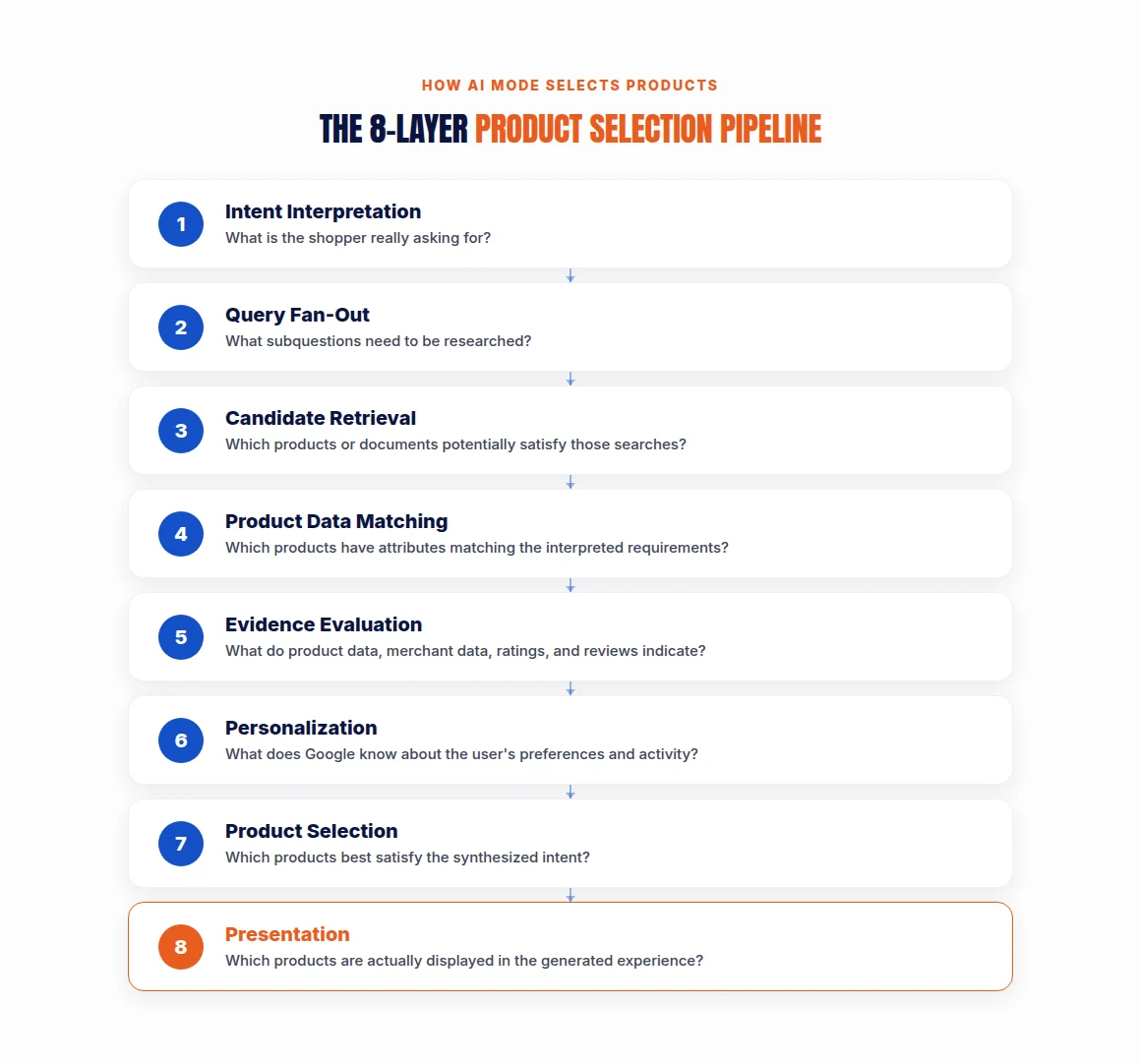
1. Intent Interpretation
What is the shopper really asking for?
2. Query Fan-Out
What subquestions need to be researched?
3. Candidate Retrieval
Which products or documents potentially satisfy those searches?
4. Product Data Matching
Which products have attributes matching the interpreted requirements?
5. Evidence Evaluation
What do product data, merchant data, ratings, reviews, and other sources indicate?
6. Personalization
What does Google know about the user’s preferences and activity?
7. Product Selection
Which products best satisfy the synthesized intent?
8. Presentation
Which products are actually displayed in the generated experience?
There may not be one simple linear ranking list.
That changes how ecommerce teams should measure performance.
Ranking Position Becomes a Weaker KPI
Traditional SEO often asks:
Are we position 1, 2, 3, or 4?
AI Mode may not produce a stable ten-blue-links-style list.
The user may receive:
- a generated recommendation;
- a visual product panel;
- a few products;
- follow-up options;
- personalized refinement.
The more useful KPIs become:
- share of voice;
- product inclusion;
- products showing;
- citation/source visibility;
- attribute coverage;
- buyer-stage visibility;
- frequency by intent;
- competitor presence.
Google is effectively validating this measurement model through Merchant Center.
Product Eligibility Is Not the Same as AI Selection
This distinction is critical.
Merchant Center can tell you whether a product is:
- approved;
- limited;
- not approved;
- visible.
But approval means the product is eligible to appear across relevant Google surfaces.
It does not mean it will appear for every AI Mode request.
Google’s visibility documentation also recommends keeping product data updated, noting that stale product data can reduce visibility or eventually lead to removal from Merchant Center.
Source: Google Merchant Center
Think of the process as:
Eligibility → Retrieval → Matching → Selection → Display
Ecommerce SEOs have traditionally spent a lot of time on the first part.
AI shopping pushes attention toward the middle.
Product Attributes Are Becoming a Core AI Ranking Input
Google’s AI performance reporting explicitly shows merchants which attributes shoppers are asking for.
Examples include:
- size;
- color;
- material;
- product specifications.
Google recommends adding missing attributes identified in the AI report.
That recommendation is strategically significant.
It tells merchants:
If shoppers are asking about an attribute and your feed does not contain it, improve the product data.
This is not generic SEO advice.
It is direct AI shopping optimization guidance from Google.
Conversational Attributes Push This Even Further
Google has also introduced optional conversational Merchant Center attributes designed to help AI systems understand products in greater detail.
Current attributes include:
question_and_answer;document_link;related_product;item_group_title;variant_option;popularity_rank.
Google explicitly says conversational attributes are designed to help customers discover product information across AI-driven surfaces such as AI Mode.
Source: Google Merchant Center Conversational Attributes
This is one of the clearest examples of how AI Mode optimization differs from old-school product feed optimization.
Traditional feeds focus heavily on:
- title;
- description;
- GTIN;
- price;
- availability;
- brand.
Conversational product data can now expose:
- frequently asked questions;
- product documents;
- relationships between products;
- variant information;
- popularity context.
AI shopping is pushing product feeds toward richer product knowledge representation.
The question_and_answer Attribute Is Especially Important
Google says the Merchant Center question_and_answer attribute is primarily intended for conversational experiences such as AI Mode in Search.
It can provide merchant-, manufacturer-, or user-authored questions and answers.
Example use cases:
- Does this laptop support Thunderbolt?
- Is this shoe suitable for wide feet?
- Can this camera record 4K at 120fps?
- Is this fabric machine washable?
- Does this product contain latex?
Source: Google Merchant Center
That creates a new opportunity.
Instead of hoping Google infers answers from long product descriptions, merchants can provide structured answers to recurring product questions.
Do not use this to spam keywords.
Use it to clarify legitimate buyer questions.
The Shopping Graph Means Product Data Can Matter Beyond Your Landing Page
Google describes the Shopping Graph as a dynamic product-information repository.
Brands and retailers send data through systems such as:
- Merchant Center;
- Manufacturer Center.
Google says this information can support:
- Search;
- Ads;
- YouTube;
- generative AI features;
- recommendations;
- review summaries;
- buying guidance.
Source: Google Shopping Help
This means ecommerce SEO is no longer purely page-level optimization.
The product entity exists across:
- website;
- Merchant Center;
- structured data;
- manufacturer data;
- reviews;
- retailer listings;
- external content.
AI Mode can synthesize across that ecosystem.
Why Strong Organic Rankings May Not Transfer to AI Mode
Imagine a retailer ranks #1 organically for:
best running shoes for flat feet
That page may be successful because of:
- backlinks;
- topical authority;
- content depth;
- internal linking;
- traditional ranking signals.
But AI Mode may interpret a specific shopper request as:
lightweight stability running shoes for flat feet, men’s size 12 wide, under $160, suitable for marathon training.
The retailer’s article might rank strongly.
But the actual product chosen by AI Mode may depend on:
- width availability;
- price;
- cushioning;
- stability;
- current inventory;
- ratings;
- product attributes;
- merchant data.
Traditional ranking success does not automatically prove product-level suitability.
Why Strong Google Shopping Visibility May Not Transfer Either
Even if a product consistently appears in Shopping, AI Mode may narrow the candidate set differently.
Potential reasons include:
- missing attributes;
- weak conversational relevance;
- insufficient variant data;
- price mismatch;
- review differences;
- personalization;
- query fan-out criteria;
- stale availability;
- incomplete product descriptions;
- stronger competitor product data.
This is why Google’s AI performance report is so valuable.
It can reveal:
- terms where demand is high but your share of voice is low;
- attributes shoppers care about that are missing;
- stages of the funnel where visibility is weak.
Traditional Shopping reporting alone cannot show that. For the bigger picture of how this affects retailers overall, see our guide to Google AI Mode and ecommerce.
The AI Mode Shopping Optimization Framework
Ecommerce SEOs should add an AI-specific layer to existing product optimization. This complements the broader tactics covered in AI shopping SEO for Google AI Mode.
1. Maintain Merchant Center Eligibility
Start with the basics:
- approved products;
- valid feeds;
- accurate availability;
- accurate price;
- correct landing pages;
- shipping data;
- policy compliance.
AI optimization cannot rescue disapproved product data.
2. Improve Title Relevance
Google’s product-data specification recommends clear product titles that accurately identify the product.
Include important differentiating attributes where appropriate.
For example:
Weak:
Trail Pro
Stronger:
Trail Pro Men’s Waterproof Wide-Fit Hiking Shoe – Black
Do not stuff irrelevant terms.
3. Strengthen Descriptions
Descriptions should clearly communicate:
- product type;
- material;
- intended use;
- major features;
- specifications;
- visual attributes;
- compatibility.
Google’s product data documentation explicitly recommends including relevant product attributes and technical specifications.
4. Complete Structured Attributes
Review:
- size;
- color;
- material;
- pattern;
- gender;
- age group;
- product type;
- GTIN;
- brand;
- variant details.
Then use Merchant Center AI insights to identify missing attributes tied to conversational demand.
5. Add Product Highlights and Details
Product highlights can communicate key selling points.
Product details can expose technical specifications.
These may help Google better match products to detailed conversational needs.
6. Use Conversational Attributes Where Appropriate
Especially:
- question and answer;
- document link;
- related product;
- variant option.
These attributes should improve product understanding, not repeat data already submitted elsewhere.
7. Improve Landing Page Consistency
Feed data and landing-page information should agree.
Align:
- title;
- price;
- availability;
- variants;
- technical details;
- images;
- product claims.
Conflicting information creates uncertainty.
8. Build External Product Evidence
AI shopping research may draw from:
- reviews;
- publisher content;
- retailer data;
- brand information;
- other content providers.
Strengthen:
- authentic reviews;
- expert coverage;
- reputable product comparisons;
- manufacturer information;
- detailed customer feedback.
9. Monitor AI Performance Separately
Use Merchant Center’s AI performance reporting where available.
Track:
- share of voice;
- competitors;
- products showing;
- discovery;
- evaluation;
- purchase;
- popular terms;
- popular attributes.
10. Test Conversational Queries
Create prompts based on realistic shopper constraints.
Do not test only:
running shoes
Test:
Best lightweight stability running shoes for a 200-pound runner with flat feet who needs a wide toe box under $170.
This is closer to how AI shopping changes product discovery.
Traditional Shopping SEO vs AI Mode Shopping SEO
| Area | Traditional Shopping | AI Mode Shopping |
|---|---|---|
| Query | Often shorter keyword | Longer conversational intent |
| Matching | Query/product relevance | Query + fan-out + attribute fit |
| Product set | Often larger | Can be much narrower |
| Measurement | Impressions, clicks, rank | Share of voice, products showing, intent stage |
| Attributes | Important | Increasingly critical |
| Product Q&A | Usually unstructured | Can be submitted conversationally |
| Personalization | Present | Potentially deeper in conversational flow |
| Buyer journey | Search-result interaction | Multi-step exploration and refinement |
| KPI | Visibility/clicks | Inclusion + share + stage visibility |
| Data layer | Feed + page | Feed + page + conversational attributes + evidence |
The systems overlap heavily.
AI Mode does not replace Merchant Center optimization.
It makes the data layer more important.
What Ecommerce SEOs Should Stop Doing
Stop Assuming Rank = AI Visibility
A top Shopping position does not guarantee AI Mode inclusion.
Stop Optimizing Only Titles
Titles matter, but conversational prompts often require attributes buried elsewhere.
Stop Treating Product Feeds as a PPC Task
Product data now affects organic and generative discovery.
SEO teams need to care about Merchant Center.
Stop Ignoring Missing Attributes
If Google tells you shoppers frequently ask for a product attribute and your catalog lacks it, that is a visibility problem.
Stop Publishing Generic Product Copy
AI Mode needs specific facts.
Stop Turning Third-Party Studies Into Google Ranking Factors
A study showing higher-priced products in AI Mode does not prove Google rewards high prices.
A Practical AI Mode Shopping Audit
Use this checklist.
Merchant Center
- Products approved.
- Price accurate.
- Availability current.
- GTIN and brand complete.
- Variants structured correctly.
- Product category accurate.
- Titles descriptive.
- Descriptions detailed.
- Images high quality.
- Shipping information current.
Attribute Depth
- Size.
- Color.
- Material.
- Pattern.
- Technical specifications.
- Product highlights.
- Product details.
- Variant options.
Conversational Data
- Relevant Q&A submitted where useful.
- Supporting documents available.
- Related products identified where appropriate.
- Variant relationships clear.
Landing Page
- Feed and page agree.
- Important specs visible as text.
- Reviews accessible.
- Structured data valid.
- Price and availability match.
AI Measurement
- AI share of voice reviewed.
- Products showing tracked.
- Discovery-stage visibility checked.
- Evaluation-stage visibility checked.
- Purchase-stage visibility checked.
- Top terms reviewed.
- Popular attributes reviewed.
- Missing attribute opportunities prioritized.
What We Still Do Not Know About AI Mode Shopping Rankings
This is important.
Google has not published:
- exact ranking weights;
- a universal AI Mode product score;
- the weight of reviews vs price;
- the weight of Merchant Center attributes;
- the weight of organic rankings;
- the exact role of backlinks;
- the exact role of product-page SEO;
- the exact role of third-party reviews;
- a fixed relationship between Shopping rank and AI Mode position.
Anyone presenting those as known facts is overclaiming.
What we do know is enough to act intelligently:
- AI Mode uses Gemini and the Shopping Graph.
- It can perform query fan-out.
- Shopping recommendations can consider relevance, ratings, price, and product features.
- Product data and attributes feed AI experiences.
- Merchant Center now measures AI-specific visibility.
- Google recommends improving titles, descriptions, and missing attributes based on AI insights.
- Conversational attributes are designed specifically to improve product understanding in AI-driven surfaces.
That is a strong optimization foundation without inventing a secret algorithm.
FAQ
Are Google AI Mode shopping rankings different from regular Google Shopping?
They can be. AI Mode can interpret complex conversational intent, perform query fan-out, and use product attributes and Shopping Graph data to narrow products differently from standard Shopping results.
Does ranking highly in Google Shopping guarantee AI Mode visibility?
No. Eligibility and strong traditional Shopping visibility do not guarantee that the product will be selected for a specific AI Mode conversation.
Does Google AI Mode prefer expensive products?
Google has not stated that AI Mode rewards higher prices. A September 2026 third-party study observed that AI Mode displayed a higher-priced product mix in its dataset, but that does not establish price as a positive ranking factor.
Why does AI Mode show fewer products?
Google has not stated that AI Mode always shows fewer products. A July 2026 third-party study observed roughly 95% fewer product listings for the product-centric queries it tracked. AI Mode’s conversational interface and synthesized selection process may naturally result in smaller visible product sets, but the exact reason has not been confirmed by Google.
What is query fan-out in AI Mode shopping?
Query fan-out is the process where AI Mode runs multiple related searches to investigate different aspects of the user’s request before synthesizing an answer or product recommendation.
Which product attributes matter for AI Mode?
Relevant attributes depend on the product category. Google Merchant Center’s AI performance report can show popular product attributes such as size, color, material, and other specifications that shoppers are asking about.
What are Merchant Center conversational attributes?
They are optional product-data fields designed to help AI systems understand product nuances. Current examples include question and answer, document link, related product, item group title, variant option, and popularity rank.
Should SEO teams manage Merchant Center for AI Mode?
At minimum, SEO and ecommerce teams should collaborate closely on product data. AI Mode makes Merchant Center titles, descriptions, attributes, product details, variants, and landing-page consistency increasingly relevant to organic product discovery.
How should ecommerce brands measure AI Mode visibility?
Use Merchant Center AI performance insights where available to monitor share of voice, products showing, shopping stage, top terms, top intents, competitor visibility, and missing product attributes.
Is AI Mode replacing traditional Google Shopping?
Not currently. AI Mode is another shopping and discovery surface within Google’s broader commerce ecosystem. Ecommerce brands should optimize for both rather than assuming one replaces the other.
Bottom Line
Google AI Mode shopping should not be treated as a new tab showing the same products in a slightly different design. It introduces a different discovery process: conversational intent, query fan-out, Shopping Graph research, product attributes, personalization, and a synthesized product-selection layer can all change which products are surfaced.
That is why a product that performs well in ordinary Search or Shopping can underperform in AI Mode. The traditional ranking may prove that Google understands and trusts the product for a broad query, while AI Mode still decides that another product better satisfies a more complex combination of attributes.
The strategic response is not to hunt for a secret “AI Mode ranking factor.” Google has not published one. Instead, ecommerce teams should make product data more complete, keep Merchant Center accurate, strengthen titles and descriptions, expose detailed attributes, use conversational product data where appropriate, maintain landing-page consistency, build authentic external evidence, and measure AI visibility separately from traditional Shopping performance.
The shift is from ranking for the keyword to qualifying for the entire shopping intent. Ecommerce brands that understand that distinction will be much better prepared for AI-driven product discovery.