The goal is not to make a page “sound like AI content.” The goal is to make it easy for AI systems such as ChatGPT, Gemini, Perplexity, and Google AI search experiences to discover, interpret, verify, and potentially cite the page when a prospective buyer asks a commercial question.
For B2B companies, agencies, consultants, law firms, accountants, managed-service providers, and other professional-service businesses, GEO should therefore extend beyond blog content. Your service pages are part of the information layer AI systems may use when deciding what your company does, who it serves, and whether it belongs in a buyer’s consideration set. This builds on the broader principles covered in AI citation optimization for commercial pages.
What Is B2B GEO?
B2B GEO, or B2B Generative Engine Optimization, is the process of improving a business’s visibility and representation in AI-generated answers used during business research and buying decisions.
Traditional B2B SEO asks: Can this page rank for the target keyword? Does it satisfy search intent? Is it technically crawlable? Does it earn organic traffic? Does it generate leads?
B2B GEO adds another set of questions: Can an AI system identify the company and service correctly? Can it understand who the service is designed for? Can it extract a direct answer from the page? Can it distinguish this company from competitors? Can it verify important service claims? Does the page answer the detailed questions buyers ask conversationally? Is there enough evidence for the company to be mentioned or cited confidently?
This does not make SEO obsolete. In fact, much of the infrastructure overlaps. Search engines and AI systems still need pages that are accessible, understandable, relevant, and trustworthy.
The difference is that a traditional search engine can rank a page and let the user interpret it. A generative system may need to interpret the page on the user’s behalf. That raises the importance of explicitness.
Why Service Pages Matter More in AI-Assisted B2B Buying
B2B buyers rarely move from awareness to purchase in one query. A typical journey might include questions such as: What is technical SEO consulting? Then: What does a technical SEO consultant actually do? Then: Which technical SEO agencies work with enterprise ecommerce sites? Then: Does Agency A handle JavaScript rendering and international SEO? Then: Agency A vs Agency B, which one is better for a Shopify Plus migration? Then: How much does enterprise technical SEO consulting usually cost? Then: What questions should I ask before hiring an SEO agency?
Different pages may support different stages of that journey. Educational articles can explain the topic. Comparison pages can frame alternatives. Directories and review platforms can validate reputation.
But the service page has a unique job: it is the company’s primary first-party source for what the service actually includes.
If the page does not clearly explain the service, third-party sites may end up defining the company instead. That is a weak position in both SEO and GEO.
Do Service Pages Actually Get Cited by AI?
There is no credible universal benchmark saying that service pages receive a fixed percentage of AI citations. Current research actually points in the opposite direction: citation patterns vary sharply by intent and industry.
A 2026 DeltaV Digital study analyzed more than 25,000 citations across ChatGPT, Perplexity, Gemini, Google AI Overviews, and Google AI Mode. It found no single page type dominated all industries. For example, listicles captured 61% of citations in the B2B technology-services segment they measured, while homepages captured 55% for one local-services brand.
A separate Wix Studio AI Search Lab study covering 75,000 AI answers and more than one million citations similarly found that query intent was a stronger predictor of cited content format than simply the industry or AI model.
The practical conclusion is not: build a service page because AI always prefers service pages. It is: build a service page strong enough to become the best first-party source when the query requires authoritative information about your service. That distinction matters.
What Questions Should a Citation-Ready Service Page Answer?
A conventional service page often answers one question: why should you hire us? A citation-ready service page should answer many more.
Service Definition
- What exactly is this service?
- What category does it belong to?
- What does the provider actually do?
Audience
- Who is this service for?
- Which company sizes are a good fit?
- Which industries does the provider specialize in?
Problems
- What problems does the service solve?
- What situations trigger the need for it?
Deliverables
- What is included?
- What does the client receive?
- What is not included?
Process
- How is the work performed?
- What happens after engagement?
- How long does the process typically take?
Expertise
- Why is this provider qualified?
- Which credentials, experience, or specialization support the claim?
Commercial Fit
- What kinds of clients are a good fit?
- When might another solution be better?
- Is pricing available?
- Is there a minimum engagement?
Location
- Where does the business operate?
- Is the service local, national, or international?
- Are there jurisdiction or territory limitations?
Evidence
- Are there case studies?
- Are there measurable outcomes?
- Are there named clients?
- Are there certifications or partnerships?
If an AI assistant is asked to compare providers, many of these details can become relevant.
The Biggest B2B Service Page Problem: Marketing Without Information
Consider this service-page copy: “Strategic solutions built to accelerate your growth.” It sounds professional. But what service is being sold?
Now compare it with: “We provide technical SEO consulting for enterprise ecommerce companies, including crawl diagnostics, JavaScript rendering audits, indexation analysis, site-migration planning, international SEO, and technical implementation support.”
The second version immediately communicates service category, target audience, core deliverables, and areas of specialization. That is valuable to both a human buyer and an AI system.
The principle is simple: persuasion should sit on top of clarity, not replace it. A service page can still have strong branding, design, storytelling, and conversion elements. But the underlying information must be explicit. This same tension between marketing language and machine-readable clarity shows up on product pages built for GEO as well.
The Citation-Ready B2B Service Page Framework
A strong B2B service page can be organized around ten information layers.
1. Start With a Precise Service Definition
Within the opening section, state what the company provides. A useful formula is: [Company] provides [service] for [target audience], helping them [primary outcome] through [main approach or deliverables].
Example: “Northline provides fractional CFO services for venture-backed SaaS companies, helping finance teams improve forecasting, cash-flow planning, board reporting, and fundraising readiness without hiring a full-time CFO.”
This is stronger than: “Strategic finance for ambitious companies.” The second sentence can still be used as a brand line. It should not be the only explanation.
The Opening 100-Word Test
A buyer or AI system should be able to determine within roughly the first 100 words: what service is offered, who it is for, what problem it solves, how it is delivered, and what makes the provider relevant. If not, the page is unnecessarily ambiguous.
2. Make the Ideal Client Explicit
Service providers often resist narrowing their audience because they fear excluding prospects. That can weaken positioning.
Compare: “We work with businesses of all sizes,” with: “Our enterprise SEO engagements are designed primarily for ecommerce brands with large inventories, complex technical stacks, multiple international markets, or active site-migration projects.”
The second version creates useful classification information. It tells a buyer: this may be for me. It also tells an AI system: this provider is relevant to this specific scenario.
Include relevant dimensions such as company size, industry, business model, technology stack, geography, maturity, budget level, and problem complexity. You do not have to publish every commercial qualification criterion. But the page should make fit understandable.
3. Explain the Problems You Solve
Do not assume the buyer connects your service title with the problem they are experiencing. For example, a company may not search for “conversion architecture consulting.” They may ask: “Why are users dropping off between pricing and signup?”
Build service pages around real problem language. A technical SEO page might address crawling problems, index bloat, JavaScript rendering, duplicate content, faceted navigation, site migrations, internationalization, Core Web Vitals, orphan pages, and schema errors. A B2B demand-generation service might address low qualified pipeline, weak lead quality, poor paid media efficiency, unclear ICP, long sales cycles, and low demo conversion.
The service name identifies the category. The problem set helps AI retrieval systems connect the service to conversational intent.
4. Turn Deliverables Into Explicit Service Facts
One of the strongest opportunities on B2B service pages is to clearly state what the buyer receives.
Weak: “A comprehensive strategy tailored to your goals.” Stronger: “Each engagement includes a technical crawl, indexation analysis, rendering review, internal-link audit, structured-data review, prioritized implementation backlog, and a 90-day technical SEO roadmap.”
This gives an AI system concrete information. A useful deliverables section can include:
| Deliverable | What It Includes | When It Is Used |
|---|---|---|
| Technical audit | Crawl, rendering, indexation and architecture review | Initial diagnosis |
| Implementation backlog | Prioritized technical fixes by impact and effort | Engineering handoff |
| Migration QA | Staging and launch validation | Site migrations |
| Reporting | KPI and issue tracking | Ongoing engagement |
Tables are useful when they genuinely clarify information. Do not create tables solely because someone claims AI systems prefer them. The purpose is structured comprehension.
5. Explain How the Service Works
Professional services are intangible. That makes process clarity especially important.
A buyer evaluating two providers may want to know: What happens first? Who participates? How often do we meet? Does your team implement changes? Do you only advise? How long does an engagement last? What access do you require? What happens after the audit?
Create a clear process. For example:
Step 1: Discovery and Access. We review business goals, analytics, search performance, technical architecture, and current constraints.
Step 2: Diagnosis. We identify the technical issues most likely to affect crawling, indexation, ranking, and search visibility.
Step 3: Prioritization. Recommendations are scored by expected impact, implementation difficulty, and dependency.
Step 4: Implementation Support. Our team works with internal developers or provides implementation guidance.
Step 5: Validation. Changes are recrawled and monitored to confirm that issues were resolved.
That process can answer many buyer questions without requiring a separate call.
6. Add Evidence, Not Just Claims
Every B2B service website says some version of experienced, trusted, expert, results-driven, strategic, and data-driven. These are claims. Citation-ready pages need evidence.
Useful evidence can include case studies showing the starting problem, intervention, outcome, timeframe, and relevant constraints; named clients where permission exists; and quantified results such as organic traffic increase, conversion improvement, cost reduction, issue resolution, pipeline generated, or revenue influenced. Do not invent precision. If attribution is complex, say so.
Also include credentials such as professional qualifications, certifications, licenses, years of experience, industry memberships, and platform partnerships; original research if your company publishes proprietary data, benchmarks, surveys, or industry analysis connected to the relevant service; and expert attribution identifying who leads or contributes to the service.
Perplexity’s August 2026 source-label documentation is notable here. Its domain-level review process considers factors including whether sites identify authors and maintain correction practices when assigning some source labels. A label is not a page-level endorsement, but the feature reinforces the broader importance of transparent publishing practices and domain credibility.
7. Make Claims Self-Contained and Verifiable
A strong service page should include statements an AI system can safely reuse.
Weak: “We deliver world-class outcomes.” Stronger: “Our technical SEO audits cover crawling, rendering, indexation, canonicalization, internal linking, structured data, page templates, international SEO, and site-performance issues.” The second statement is factual. It can be verified by inspecting the service.
Use Citation-Grade Statements
A citation-grade statement is specific, understandable without surrounding marketing copy, factually supportable, current, and relevant to a buyer question.
For example: “Our standard enterprise technical SEO audit takes four to six weeks and includes two stakeholder workshops, a full technical crawl, template-level analysis, and a prioritized implementation backlog.” That statement can help answer: How long does an enterprise technical SEO audit take? The more directly your page answers real buyer questions, the more useful it becomes as a retrieval source.
8. Clarify Geography and Service Availability
Location is especially important for law firms, accountants, consultants, contractors, medical practices, financial advisors, professional services subject to jurisdiction, and regionally delivered B2B services.
Make it clear whether the service is local, regional, nationwide, international, remote, or limited by jurisdiction.
A vague service page might say: “Serving businesses everywhere.” A stronger page might say: “We provide remote SEO consulting to companies across the United States, Canada, and the United Kingdom, with local SEO engagements currently focused on U.S.-based multi-location businesses.” This reduces ambiguity.
For local businesses, maintain consistent company name, address, phone, office information, service areas, and business categories. Entity consistency matters beyond the service page itself.
9. Build Entity Clarity Across the Website
A service page does not exist in isolation. AI systems may encounter information about your company from your homepage, About page, service pages, employee profiles, LinkedIn, directories, review sites, industry associations, news coverage, partner websites, and case studies.
These sources should not contradict one another. If your homepage says “enterprise cybersecurity consultancy,” your LinkedIn says “IT support company,” and a directory categorizes you as “software developer,” the company’s category becomes harder to interpret.
Core Entity Signals to Align
Keep the following consistent: company name, service categories, locations, leadership, founding information, areas of specialization, customer types, website URL, contact information, and professional credentials.
Google’s current Organization structured-data documentation explicitly states that organization markup can help Google understand administrative details and disambiguate an organization. That does not mean Organization schema directly creates AI citations. It means machine-readable entity clarity has a legitimate role in search understanding.
10. Support the Service Page With a Commercial Content Ecosystem
One service page cannot answer every buyer question. Build supporting pages around recurring intent.
For a B2B SEO agency, that might include a core service page (/technical-seo-services/); specialized services such as /technical-seo-audits/, /enterprise-seo/, /seo-migrations/, and /international-seo/; industry pages such as /seo-for-saas/, /seo-for-ecommerce/, and /seo-for-marketplaces/; comparison content such as in-house SEO vs agency; problem pages such as why pages are not indexing; evidence such as case studies and original research; and FAQs and guides covering cost, timelines, process, prerequisites, and implementation.
This creates multiple retrieval surfaces around the service entity. The goal is not to manufacture hundreds of thin pages. Each page should satisfy a distinct, useful buyer need.
How AI Retrieval Changes Service Page Titles
Page titles have always mattered for SEO. Current ChatGPT citation research suggests they may also play an important role in retrieval selection.
Ahrefs analyzed 1.4 million ChatGPT prompts and found cited pages had stronger semantic alignment between their titles and ChatGPT’s generated fan-out queries than non-cited candidates. Their study also found that ChatGPT may evaluate retrieval information such as title, URL, and snippet before deciding which candidates to open and cite.
For a B2B service page, that means vague branded titles can be a disadvantage.
Weak: “Growth Services | Acme.” Stronger: “B2B Demand Generation Services for SaaS Companies | Acme.” Weak: “Advisory | Northline.” Stronger: “Fractional CFO Services for Venture-Backed SaaS Companies | Northline.”
This does not mean stuffing every title with keywords. It means making the service entity and audience obvious.
Why Generic Service Pages Can Lose to Specialized Pages
A broad page may mention SEO, PPC, social media, web design, branding, email marketing, and content. It is relevant to many things. But it may be the strongest answer to none of them.
Ahrefs’ 2026 analysis of retrieval-augmented generation makes a similar point: broad pages can score adequately across multiple intents, while specialized pages can win when the query requires depth around a specific entity or problem.
That suggests a useful architecture: a homepage explaining what the company does overall, a category service page for the main service area, a specialized service page for a specific capability, an industry page applying the service to a vertical, and a use-case or problem page applying the service to a particular need.
The key is to avoid creating near-duplicate doorway pages. Each page needs a meaningful reason to exist.
Service Page GEO vs Traditional Conversion Optimization
A common concern is that adding more detail will hurt conversion. That is not necessarily true. The real conflict is usually between clarity and vague persuasion, not between GEO and CRO.
Consider CRO-only copy: “Unlock transformational growth with our proven methodology.” And GEO-only copy: “We provide digital marketing services.” Neither is strong enough.
A combined version could be: “We provide B2B demand-generation strategy and campaign execution for SaaS companies, covering paid acquisition, content, landing pages, lifecycle campaigns, and pipeline reporting. Engagements are built around qualified pipeline rather than lead volume alone.” This is clear, differentiating, commercial, and extractable. The best service-page copy works for both humans and machines.
The Role of Structured Data in B2B Service Page GEO
Schema is useful, but it should be treated carefully. There is a recurring GEO myth: add more schema and AI engines will cite you. Current evidence does not justify that claim.
One 2026 cross-platform study of schema and AI citation found no simple positive independent relationship between schema presence and citation probability across its commercial-query dataset.
That should not be interpreted as “schema is useless.” Instead: schema helps classification and machine understanding, but schema alone does not make weak content citation-worthy.
For B2B businesses, relevant structured data may include Organization, LocalBusiness where appropriate, Person for team or professional profiles, BreadcrumbList, Article for editorial content, and other valid types that accurately describe the page. Service also exists in Schema.org, but marketers should not confuse schema availability with a Google rich-result guarantee.
Use structured data to describe real information. Do not invent attributes or add markup simply to make a page look more “GEO optimized.”
The Role of External Authority
A service provider declaring itself excellent is not enough. AI systems and buyers may look for corroboration elsewhere.
External authority can come from industry publications, partner directories, professional associations, client websites, review platforms, conference profiles, podcasts, interviews, research citations, awards with meaningful criteria, and local business profiles.
The important word is corroboration. If your service page says “we specialize in enterprise Shopify SEO,” it becomes stronger when the surrounding web also contains evidence such as Shopify case studies, ecommerce client testimonials, relevant conference appearances, partner ecosystem references, and independent articles discussing your work.
GEO therefore extends beyond on-page copy. It includes the broader entity footprint around the business. That footprint matters just as much when buyers are comparing offerings, which is why product pages competing against Reddit for AI citations face a similar corroboration challenge.
How to Make Service FAQs Actually Useful
FAQ sections can be valuable. But generic FAQs often add little.
Weak: “Why choose us? Because we care about our clients.” Better: “Do you implement technical SEO recommendations or only provide the audit? Our enterprise engagements can include implementation support. We typically work with the client’s development team, provide ticket-ready recommendations, review staging changes, and validate fixes after deployment.” That answer is useful because it resolves a real commercial uncertainty.
Strong B2B Service FAQ Topics
Consider questions about pricing, engagement length, minimum contract, implementation, onboarding, deliverables, industries, team structure, geography, technology platforms, reporting, qualifications, limitations, and timelines. Do not add FAQs merely to increase word count.
Technical GEO Checks for Service Pages
A strong service page cannot be cited if it is difficult to discover or process. Review the following.
Indexability
Check that there is no accidental noindex, canonical points correctly, the page is included in internal linking, and it appears in the XML sitemap where appropriate.
Crawlability
Ensure the page is not unintentionally blocked by robots.txt, authentication, broken routing, or inaccessible scripts.
Rendering
Important service information should be available in rendered content. Avoid placing essential facts exclusively inside images, videos, interactive widgets, client-side elements that fail to render, or gated PDFs.
Internal Linking
Relevant articles should link back to the commercial page. For example, an article about ecommerce crawl-budget problems should naturally link to your enterprise technical SEO service if the service solves that problem.
Page Performance
Core performance still matters for users and search engines. GEO does not excuse poor technical SEO.
The B2B Service Page Citation Readiness Score
Use this 100-point framework to audit a service page. It is a diagnostic model, not a ranking formula.
1. Service Clarity — 20 Points
4 points each: service clearly defined; target audience identified; problems solved are explicit; major deliverables explained; geography/availability clarified.
Score interpretation: 0–7 highly ambiguous; 8–13 understandable but generic; 14–17 strong; 18–20 highly explicit.
2. Buyer Question Coverage — 20 Points
4 points each: process explained; timelines addressed; commercial fit explained; common objections answered; comparison/suitability context provided.
3. Evidence and Trust — 20 Points
4 points each: case studies or measurable proof; credentials or expertise; named experts/team; client/customer validation; major claims are verifiable.
4. Entity and Information Architecture — 20 Points
4 points each: company/service categories consistent; specialized supporting pages exist; internal links connect evidence; external profiles corroborate identity; appropriate structured data is accurate.
5. Technical and Retrieval Readiness — 20 Points
4 points each: descriptive title; logical headings; crawlable/indexable content; essential information available as text; page is current and maintained.
Overall Score
| Score | Assessment |
|---|---|
| 0–39 | Poor citation readiness |
| 40–59 | Basic |
| 60–74 | Competitive |
| 75–89 | Strong |
| 90–100 | Excellent information asset |
A score of 95 does not guarantee a citation. A score of 45 does not mean citation is impossible. The framework helps identify weaknesses you can control.
Example: Turning a Weak Service Page Into a Citation-Ready Page
Imagine a cybersecurity consultancy.
Before
Headline: “Security Without Compromise”
Copy: “We protect ambitious organizations with next-generation cyber solutions tailored to your needs.” That is almost all branding.
After
Headline: “Managed Cybersecurity Services for Mid-Market Financial and Professional-Service Firms”
Opening: “NorthSecure provides managed cybersecurity services for U.S. companies with 100–2,000 employees. Services include 24/7 security monitoring, managed detection and response, vulnerability management, incident response planning, Microsoft 365 security, employee security training, and compliance support for frameworks including SOC 2 and HIPAA where applicable.”
Then build sections for who it is for, services included, monitoring process, response times, technology, compliance support, implementation, case studies, certifications, pricing approach, and FAQs.
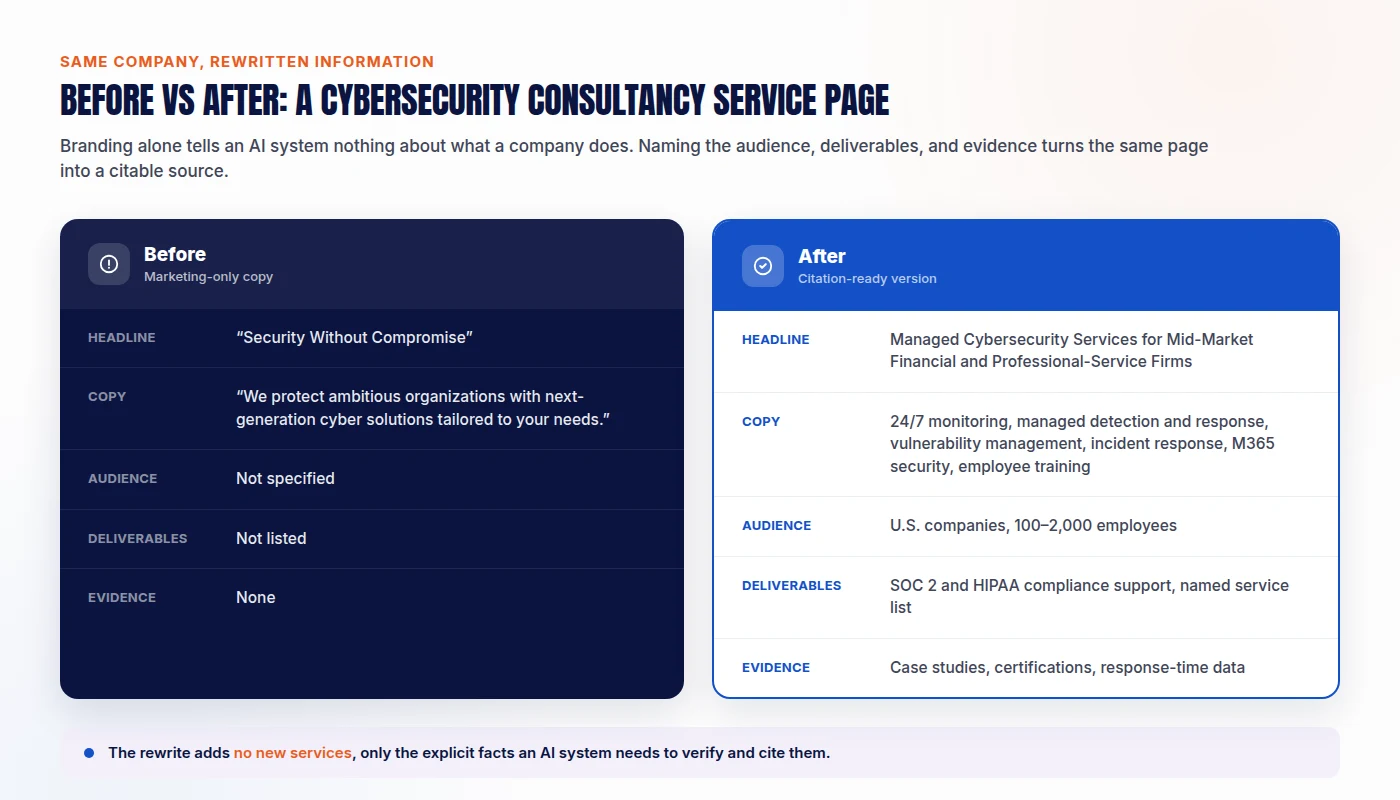
The second page is far easier to understand and compare. That is the practical core of B2B GEO.
How to Test Whether Your Service Page Appears in AI Buying Journeys
Do not test only “What does Company X do?” That is a branded query. Your real opportunity is unbranded commercial discovery.
Build prompts around category discovery (“Best enterprise technical SEO agencies,” “Top cybersecurity consultants for financial firms,” “Fractional CFO firms for SaaS companies”); problem discovery (“Who can fix JavaScript SEO issues on a large ecommerce site?”); fit (“Best SEO agency for a Shopify Plus migration”); comparison (“Agency A vs Agency B”); and commercial questions (“How much does enterprise technical SEO cost?”).
Test representative prompts across relevant AI systems. Record whether your company appears, which competitors appear, whether your service page is cited, which third-party sources are cited, what attributes are used to describe competitors, and what information about your business is incorrect or missing. Then improve the appropriate information source. This same testing discipline applies directly to product pages competing for B2B AI search citations.
Why Citation Counts Alone Are Not Enough
GEO measurement is still developing. A 2026 academic framework distinguished between citation selection and citation absorption. A page can be cited but contribute very little to the final answer. Another page may strongly influence the generated response.
The study found that high-influence pages tended to be more structured, semantically aligned, and rich in extractable evidence such as definitions, numerical facts, comparisons, and procedural steps.
For service businesses, this suggests a useful KPI hierarchy: Level 1, Retrieval — does the page appear in the candidate/source environment? Level 2, Citation — is the page visibly cited? Level 3, Mention — does the AI answer name the company? Level 4, Accurate Representation — does it describe the service correctly? Level 5, Recommendation — does the company enter the shortlist? Level 6, Commercial Impact — does visibility contribute to branded searches, direct visits, inquiries, leads, pipeline, and revenue?
A GEO program that celebrates citation counts while ignoring commercial outcomes is incomplete.
Common B2B Service Page GEO Mistakes
Mistake 1: Writing Only for Keywords
A page optimized around “B2B SEO agency” can still fail to explain what the agency actually does.
Mistake 2: Hiding Expertise
If your consultants have relevant credentials, experience, or specializations, make that information discoverable.
Mistake 3: Using Generic Proof
“Trusted by leading companies.” Who? Where possible, provide evidence.
Mistake 4: Publishing Thin Location Pages
Do not create 100 near-identical city pages simply to target AI search. Location pages need genuine local relevance.
Mistake 5: Treating Schema as the Strategy
Schema supports interpretation. It cannot replace content quality, authority, evidence, or relevance.
Mistake 6: Optimizing Only the Blog
Commercial pages need factual depth too.
Mistake 7: Ignoring Third-Party Information
If external sources consistently misclassify your company, on-site improvements alone may not solve the problem.
Mistake 8: Measuring Only Branded Prompts
If the prompt includes your company name, you are testing recognition. You also need to test discovery.
A Practical B2B GEO Service Page Template
A strong service page does not have to follow one rigid design. But this structure is a useful starting point.
Hero: clear service name, target audience, primary outcome, direct CTA.
Quick Service Definition: 40–100 words explaining what the service is.
Problems We Solve: list the recurring problems that trigger demand.
Who This Is For: define ideal clients and scenarios.
What Is Included: explain deliverables.
How It Works: show the process.
Specialized Capabilities: break out distinct service components.
Industries / Use Cases: explain where expertise applies.
Evidence: use case studies, results, certifications, and customer proof.
Why Choose the Provider: use verifiable differentiators rather than generic claims.
Pricing / Engagement Model: explain what can reasonably be disclosed.
FAQs: answer genuine buying questions.
CTA: make the next step clear.
This structure works because it mirrors the questions buyers ask. That is also what makes it useful for generative retrieval.
B2B GEO Does Not Mean Turning Every Page Into an Encyclopedia
There is a risk of overcorrection. Once companies hear that AI systems need facts, they may try to put 8,000 words on every service page. That is unnecessary.
Citation readiness is not a word-count contest. A concise page can be excellent if it answers the important questions clearly. The objective is information completeness relative to the buyer’s task.
Ask: what would a serious prospect need to know before deciding whether this provider belongs on the shortlist? Provide that information. Then create supporting pages for deeper questions.
FAQ
What is B2B GEO?
B2B GEO is the optimization of a company’s digital information so AI search and generative answer systems can accurately discover, understand, mention, and potentially cite the business during B2B research and buying journeys.
Can service pages be cited by ChatGPT?
Yes. ChatGPT can cite commercial service pages when they are relevant to the questions it is answering. There is no guarantee that a service page will be cited, and citation behavior varies by prompt, industry, platform, and retrieval process.
How do I make a B2B service page citation-ready?
Clearly define the service, identify the target audience, explain problems solved, list deliverables, describe the process, publish evidence, identify relevant experts, clarify geographic availability, strengthen entity consistency, and ensure the page is technically crawlable and discoverable.
Should service pages include prices for GEO?
Publish pricing when it makes commercial sense. If exact pricing cannot be disclosed, explain the pricing model, typical engagement structure, minimums, or the factors that influence cost. Avoid inventing pricing solely to create an AI-friendly answer.
Does Service schema improve AI citations?
There is no evidence that adding Service schema by itself guarantees or directly causes AI citations. Structured data can improve machine-readable understanding, but the underlying page still needs relevance, useful information, credibility, and technical accessibility.
Should every service have its own page?
Only when the service represents a distinct user intent or meaningful offering. Creating separate thin pages for minor keyword variations can create duplication and poor user experience.
Are FAQs important for B2B GEO?
They can be useful when they answer genuine evaluation questions such as pricing, process, timelines, implementation, qualifications, geography, and suitability. Generic FAQs added solely for optimization are unlikely to improve the page meaningfully.
How long should a B2B service page be?
There is no fixed length. The page should contain enough information for a qualified buyer to understand the service and determine whether the provider is relevant. Complex professional services usually require more explanation than simple standardized services.
Is GEO replacing B2B SEO?
No. B2B GEO builds on many SEO fundamentals, including crawlability, relevance, information architecture, authority, and content quality. GEO adds a focus on how generative systems interpret, synthesize, and cite business information.
How should I measure service-page GEO performance?
Track unbranded and branded AI prompts, mentions, citations, cited URLs, competitor visibility, accuracy of service descriptions, sentiment, and eventual commercial outcomes such as branded search demand, inquiries, qualified leads, pipeline, and revenue.
Bottom Line
B2B GEO should change how companies think about service pages. A service page is no longer only a landing page designed to persuade someone who has already found the company. It can also become a primary information source used before the prospect ever visits the website. That means vague positioning, hidden deliverables, generic claims, weak evidence, and inconsistent entity information now create a larger strategic problem.
The strongest service pages do not chase AI algorithms. They make the business easy to understand and easy to verify. They state what the service is, who it is for, what it includes, how it works, what evidence supports it, and where the provider genuinely has expertise. Then they connect that page to supporting content, credible third-party signals, and a technically sound site architecture.
There is no universal formula that guarantees ChatGPT, Gemini, Perplexity, Google AI Mode, or another generative system will cite a service page. Citation behavior varies too much by query and platform for that promise to be credible. But there is a durable principle: when a buyer asks an AI system a high-intent question about your category, your website should contain the clearest, most specific, and most verifiable first-party answer available. That is the foundation of citation-ready B2B GEO.