Quick Answer
A September 2026 Ten Speed study analyzing 7,387 citation appearances across 170 B2B evaluation-stage prompts found that product pages accounted for 24.1% of citations, more than any other page type in the dataset. Articles accounted for 17.4%, comparison pages 13.3%, and community-driven sources such as Reddit, YouTube, and forums collectively represented just 4.2%.
But this does not mean product pages universally outperform blogs, Reddit, YouTube, or third-party sites in AI search. The study focused on mid- and bottom-of-funnel B2B queries. The stronger conclusion is that page type increasingly needs to match buyer intent. For a full framework on getting a product page ready for this shift, see our guide to product page GEO.
For B2B companies, this changes the role of the product page. It is no longer only a conversion page. It can also be a major AI retrieval and citation surface.
Why Product Pages Are Suddenly Important for AI Search
For years, B2B SEO strategies have concentrated heavily on informational content.
Companies built articles targeting queries such as:
- What is CRM software?
- How does sales automation work?
- What is cloud security?
- What is revenue management software?
- How can businesses automate customer support?
That strategy still matters.
But AI search changes what happens farther down the buying journey.
Instead of only searching Google for broad information, buyers can now ask ChatGPT, Gemini, Claude, Perplexity, and other AI systems questions such as:
- What CRM is best for a 15-person sales team?
- Does Product X integrate with Salesforce?
- Product X vs Product Y: which is better for enterprise teams?
- Does this software support SOC 2 compliance?
- Which platform offers the strongest API capabilities?
- What are the limitations of Product X?
- Is Product X suitable for financial services companies?
These are fundamentally different questions.
The buyer is no longer trying to understand the category.
They are evaluating products.
And once the question becomes product-specific, the information AI systems need often exists on product, solution, integration, pricing, documentation, and comparison pages rather than general educational articles.
That is where the product page becomes strategically important.
What the Latest B2B AI Citation Research Found
Ten Speed examined citation data collected through Peec AI across B2B SaaS and professional-services companies.
The prompts were designed around mid- and bottom-of-funnel buying behavior and included product comparisons, alternatives, feature questions, integrations, buying-intent queries, and product-specific use cases.
Across 7,387 citation appearances from 170 evaluation-stage prompts, product pages generated the largest citation share.
| Page Type | Share of AI Citations |
|---|---|
| Product pages | 24.1% |
| Articles | 17.4% |
| Comparison pages | 13.3% |
| Listicles | 13.2% |
| How-to guides | 8.9% |
| Homepages | 7.8% |
| Profiles/directories | 7.2% |
| Discussion pages | 3.7% |
| Alternative pages | 2.4% |
| Category pages | 1.2% |
| Video | 0.5% |
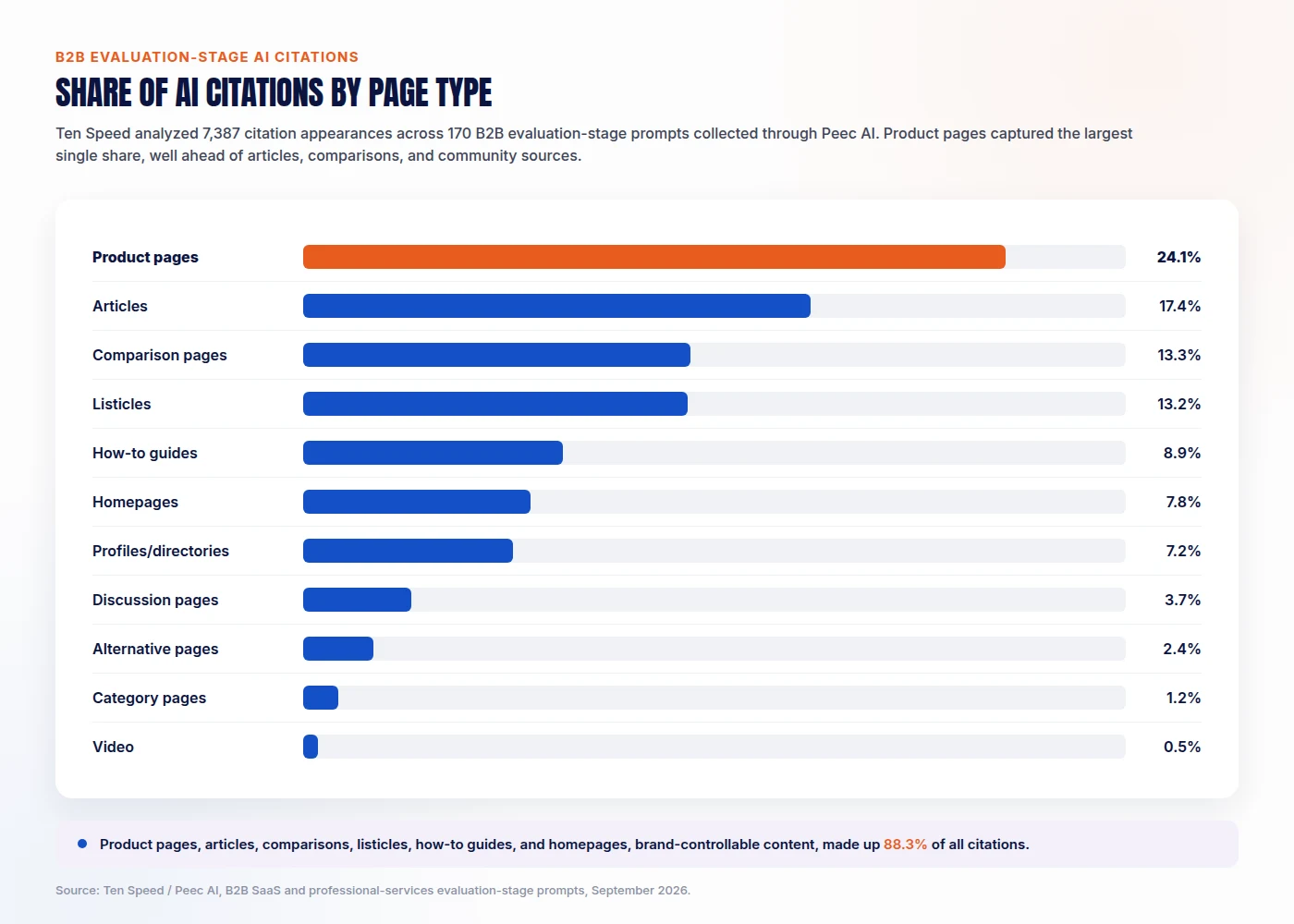
The pattern is significant because product pages were not simply participating in AI answers. They represented roughly one-quarter of all citation appearances in this specific dataset.
Ten Speed also grouped product pages, articles, comparisons, listicles, how-to guides, and homepages as brand-controllable content. Together, these accounted for 88.3% of citation volume in the evaluation-stage dataset. Community-driven sources represented 4.2%.
That should get the attention of B2B marketing teams.
But it should not lead to the simplistic conclusion that owned content always beats third-party content.
The buyer stage matters enormously.
Why Product Pages Can Perform So Well in B2B AI Search
The most useful way to understand the finding is to look at what an AI system is trying to accomplish.
Imagine someone asks:
Which CRM supports automated lead routing, Salesforce integration, SOC 2 compliance, and advanced reporting for a 50-person sales organization?
The AI system needs facts.
It may need to determine:
- what each product does;
- which features exist;
- whether an integration is supported;
- who the product is designed for;
- what industries it serves;
- what security certifications it has;
- what pricing model it uses;
- how products differ.
Where is the strongest first-party source for many of those facts?
Often, it is the vendor’s own commercial pages.
Product Pages Contain First-Party Product Facts
A good product page can establish:
Product identity
What the product actually is.
Category
CRM, cybersecurity platform, analytics software, marketing automation platform, etc.
Target audience
SMBs, enterprises, healthcare organizations, agencies, ecommerce companies, developers, or another clearly defined audience.
Capabilities
What the product actually does.
Features
Specific functionality rather than generic benefits.
Integrations
Which platforms and technologies it works with.
Use cases
The problems and scenarios the product supports.
Differentiators
How the product differs from alternatives.
That information is extremely useful when an AI system needs to construct an answer about a specific product.
AI Search Rewards Specificity More Than Marketing Ambiguity
Many B2B websites have a serious problem.
Their product pages were written almost entirely for persuasion.
Consider this type of headline:
Transform Your Business With Intelligent Innovation
It may sound impressive to a marketing team.
But it communicates almost nothing.
What is the product?
Who uses it?
What does it actually do?
Now compare it with:
Acme is an AI customer support platform for SaaS companies that automatically answers customer questions using company documentation and integrates with Zendesk, Intercom, and Salesforce.
The second statement gives both humans and machines considerably more information.
It identifies:
- the entity;
- the product category;
- the audience;
- the primary capability;
- the data source;
- the integrations.
This is one of the central principles of Generative Engine Optimization.
Clarity increases machine interpretability.
That does not mean every product page should become robotic or sacrifice conversion optimization.
It means branding cannot substitute for factual information.
The strongest product pages can do both.
They persuade the buyer while also making the product unmistakably understandable.
Product Pages and Blog Articles Have Different Jobs
The product-page citation data does not mean companies should stop investing in blogs.
That would be the wrong conclusion.
Different content types satisfy different information needs.
| Buyer Question | Strong Potential Source |
|---|---|
| What is sales automation? | Educational article |
| How does CRM software work? | Educational guide |
| What are the best CRMs for startups? | Listicle/comparison |
| Product A vs Product B | Comparison page |
| Does Product A integrate with Salesforce? | Product/integration page |
| Does Product A support SOC 2? | Product/security documentation |
| What does Product A cost? | Pricing/product page |
| What do actual customers dislike about Product A? | Reviews/community sources |
| What does Product A do? | Product page/homepage |
This is why thinking about “the best content type for AI citations” is usually the wrong question.
The better question is:
Which content type provides the strongest answer for this particular buyer intent?
That is a much more durable GEO strategy.
The Buyer Journey Changes the Citation Landscape
An important limitation of the Ten Speed research is also one of its most valuable lessons.
The study intentionally excluded broad top-of-funnel informational queries.
That matters.
Someone asking:
What is endpoint security?
may trigger a completely different source mix from someone asking:
CrowdStrike vs SentinelOne for a 1,000-employee financial company.
The first query requires education.
The second requires evaluation.
At the awareness stage, AI systems may benefit more from:
- editorial articles;
- Wikipedia;
- Reddit discussions;
- YouTube;
- expert commentary;
- educational guides.
At the evaluation stage, they may increasingly require:
- product pages;
- comparison pages;
- pricing pages;
- integration pages;
- security documentation;
- case studies;
- review platforms.
This may explain why studies looking at broader AI citation behavior sometimes report much greater influence from community and user-generated sources.
The apparent contradiction is actually useful.
AI citation behavior is highly dependent on intent, industry, platform, and stage of the customer journey.
Comparison Pages May Be Another Major B2B GEO Opportunity
Product pages were not the only notable result.
Comparison-format prompts represented about 20% of the analyzed prompt set but generated approximately 26.7% of the citations.
Ten Speed calculated that comparison prompts generated about 1.33 times the citation volume their share of prompts would predict.
That suggests B2B companies may be underinvesting in pages such as:
- Product A vs Product B
- Product A alternatives
- Product A vs category leader
- Product A for enterprise vs Product B
- Best alternatives to Product B
Historically, some companies have avoided these pages because they dislike mentioning competitors.
AI-driven product research makes that reluctance increasingly questionable.
If buyers are explicitly asking AI systems to compare vendors, somebody’s content will provide the comparison context. This is the same broader principle behind optimizing commercial pages for AI citations: the strategic question becomes whether your brand contributes factual information to that conversation or leaves competitors and third-party publishers to define you.
Your Homepage May Be an AI Entity Page Too
Another interesting finding is that homepages represented 7.8% of citations in the Ten Speed dataset.
For traditional SEO, companies often think of the homepage mainly as:
- a branded ranking page;
- a navigation hub;
- a conversion page.
AI search adds another function.
Your homepage may help an AI system answer:
- What does this company do?
- What category is it in?
- Who is the company for?
- What products does it sell?
- What problems does it solve?
That makes vague homepage messaging increasingly risky.
A visitor might understand a clever slogan after looking around the website.
An AI retrieval system may not give your brand that much interpretive generosity.
B2B companies should make the core entity definition obvious.
Why Reddit Still Matters
It would be a mistake to interpret the study as evidence that Reddit is irrelevant to GEO.
Discussion pages accounted for only a small portion of this evaluation-stage dataset, but community content can answer questions vendor pages cannot answer credibly.
For example:
- What are real users complaining about?
- Is the product difficult to implement?
- What is customer support actually like?
- Which product do practitioners prefer?
- What unexpected limitations exist?
- Did switching from Product A to Product B help?
A company product page is naturally biased toward its own product.
Community conversations provide another kind of evidence. For a closer look at how these two source types actually compare in the data, see product pages vs Reddit in AI citations.
The correct strategy is therefore not:
Product pages instead of Reddit.
It is:
Use the right information surface for the right part of the decision journey.
What the Study Does Not Prove
This section is crucial because AI-search statistics are often repeated far beyond what the original research supports.
The Ten Speed findings do not prove that product pages receive 24.1% of all AI citations.
They do not.
The research reflects a specific B2B SaaS and professional-services client base and a specific set of mid- to bottom-of-funnel prompts.
The study also does not tell us whether product-page citation rates were identical across:
- ChatGPT;
- Gemini;
- Claude;
- Perplexity.
Nor does a citation automatically mean:
- a click;
- a lead;
- a demo;
- a sale;
- increased revenue.
Citation visibility and business impact are separate metrics.
The study therefore provides an important strategic signal, not a universal ranking formula.
How to Make B2B Product Pages More Citation-Ready
If product pages are becoming an important AI citation surface, B2B companies should review them differently. The steps below build on the broader product page GEO framework.
1. Clearly Define the Product
Within the opening section, explain:
- what the product is;
- what category it belongs to;
- who it is for;
- what problem it solves.
Do not make AI systems reverse-engineer this information from slogans.
2. Describe Features Specifically
Avoid:
Powerful automation designed for modern teams.
Prefer:
Automatically assigns inbound leads based on territory, company size, industry, and sales-representative availability.
Specific statements are more useful to both buyers and machines.
3. Publish Integration Information
If buyers frequently ask whether your product integrates with another platform, that information should have a clear indexable location.
Consider dedicated integration pages where appropriate.
4. Explain Use Cases
Do not list features without explaining when they matter.
Connect capabilities to actual scenarios.
5. Answer Evaluation Questions
Product pages should help answer questions buyers might otherwise ask an AI assistant:
- Who is this best for?
- What teams use it?
- What does implementation involve?
- Which integrations are available?
- What security standards are supported?
- What differentiates it from alternatives?
6. Support Claims With Evidence
Strong evidence may include:
- benchmarks;
- customer results;
- named case studies;
- certifications;
- product documentation;
- original research;
- transparent specifications.
Avoid unsupported superlatives such as “best,” “leading,” or “most advanced” unless they can be substantiated.
7. Build Supporting Commercial Content
A single product page cannot answer every evaluation question.
Build a connected content ecosystem that may include:
- comparison pages;
- alternative pages;
- integrations;
- industry solution pages;
- use-case pages;
- pricing information;
- security documentation;
- case studies.
The same logic applies to service-based B2B businesses, not just software vendors; see how it plays out for B2B GEO on service pages. This creates more possible retrieval surfaces around your product entity.
The Bigger Lesson: GEO Is Moving Down the Funnel
Much of the early GEO conversation focused on getting blog posts cited.
That was understandable because informational AI answers were the easiest place to observe citations.
But commercial AI usage is expanding.
Buyers are increasingly able to use AI assistants not only to learn but also to:
- build shortlists;
- compare vendors;
- analyze features;
- investigate pricing;
- evaluate integrations;
- assess suitability;
- research alternatives.
That moves GEO closer to revenue-generating pages.
For B2B brands, product pages should therefore be evaluated across three dimensions:
Conversion readiness
Can the page persuade a qualified buyer?
SEO readiness
Can search engines crawl, understand, index, and rank the page?
AI citation readiness
Can an AI system confidently extract the factual information necessary to describe, compare, or recommend the product?
The strongest commercial pages will increasingly need to accomplish all three.
Product Pages Are Becoming Search Assets, Not Just Sales Assets
The most important takeaway from the recent data is not the 24.1% figure itself.
Statistics will change.
Platforms will change.
Citation behavior will change.
The more durable insight is that AI search is expanding the role of commercial content.
A product page used to primarily answer the person who had already reached your website.
Now that same page may help an AI system formulate an answer before the buyer ever visits your website.
That fundamentally changes its strategic value.
B2B companies that fill product pages with vague positioning while putting all factual, useful information into blog posts may be creating an information gap precisely where AI-assisted buyers are evaluating vendors.
The better strategy is to treat product pages as authoritative product records: clear enough for machines to understand, detailed enough for buyers to evaluate, and persuasive enough to convert.
Product pages are not replacing blogs, Reddit, review sites, or comparison content.
They are becoming another critical layer of the AI-search ecosystem.
And for B2B evaluation queries, the evidence suggests they may be one of the most important layers of all.
FAQ
Do AI search engines cite product pages?
Yes. AI systems such as ChatGPT, Gemini, Claude, and Perplexity can surface product pages as sources when those pages contain information relevant to the user’s question. Recent B2B evaluation-stage research found product pages represented 24.1% of citation appearances in the analyzed dataset.
Why would ChatGPT or another AI engine cite a product page?
Product pages often contain first-party facts about features, integrations, use cases, product categories, target customers, security capabilities, and other details necessary for answering product-evaluation questions.
Are product pages better than blog posts for GEO?
Not universally. Product pages are particularly relevant for commercial and evaluation-stage questions, while educational articles may be more suitable for informational queries. GEO strategy should match content format to search and buyer intent.
Do product pages receive more AI citations than Reddit?
In Ten Speed’s B2B evaluation-stage dataset, product pages accounted for 24.1% of citations, while community-driven sources including Reddit, YouTube, forums, and discussion pages accounted for approximately 4.2%. The findings should not be generalized to all industries or all types of AI prompts.
How can B2B companies optimize product pages for AI citations?
Start by clearly explaining what the product is, who it serves, what it does, which features and integrations it offers, and which use cases it supports. Add factual evidence, clear headings, detailed product information, and supporting comparison, integration, and use-case pages. Avoid relying solely on vague marketing language.
Does getting cited by AI guarantee more traffic or sales?
No. An AI citation indicates visibility within an AI-generated response, but it does not guarantee a click, lead, conversion, or revenue. Citation visibility should be measured alongside branded demand, referral traffic, qualified leads, assisted conversions, and other business outcomes.