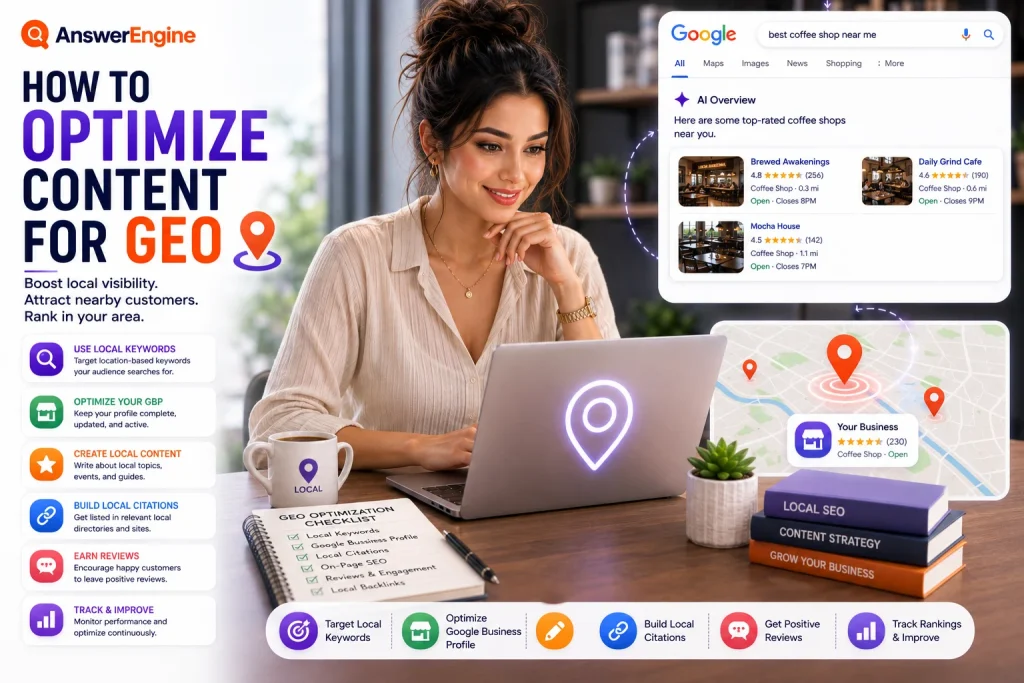
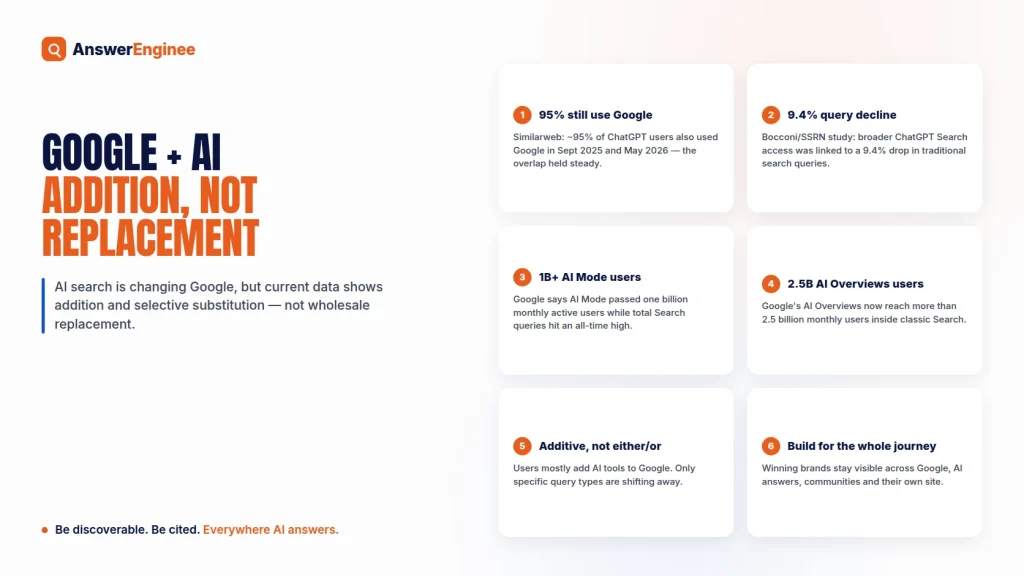
Commercial AI visibility is therefore an information-architecture problem as much as a copywriting problem.
What Is AI Citation Optimization?
AI citation optimization is the practice of improving a web page and its surrounding information ecosystem so generative systems are more likely to identify it as a useful source for a specific question. That can include systems such as ChatGPT, Gemini, Google AI Mode, Google AI Overviews, Perplexity, Claude, Copilot, and other retrieval-enabled AI systems.
Traditional SEO generally focuses on crawling, indexing, rankings, clicks, organic traffic, and conversions. AI citation optimization adds another layer: retrieval, source selection, citation, brand mention, answer inclusion, recommendation, and accurate representation.
These outcomes overlap with SEO, but they are not identical. A page can rank in Google without being cited by an AI system. A page can be cited in an AI answer without ranking first for the user’s obvious keyword. And a brand can be mentioned without its own website receiving the citation. That is why commercial-page GEO needs its own measurement framework.
Why Commercial Pages Need a Different GEO Strategy
Most early GEO advice focused on articles. That made sense. AI systems were frequently observed answering informational questions such as “What is programmatic SEO?”, “How does cloud storage work?”, “What causes crawl-budget problems?”, and “What is revenue attribution?” Articles are natural sources for those questions.
But buyers do not stay informational forever. They eventually ask which provider offers a service, whether a product supports a specific feature, what something costs, which plan includes SSO, what alternatives exist, whether a provider is suitable for their industry, how Product A compares to Product B, whether a vendor can deliver in their location, and which model is available in a given size.
Those questions require commercial information. The pages that answer them are often product pages, service pages, pricing pages, category pages, solution pages, comparison pages, integration pages, and documentation. The commercial website is therefore becoming part of the AI research layer.
The Most Important Principle: Intent Determines the Best Citation Source
There is no single page type that AI systems always prefer. The Wix Studio AI Search Lab analyzed 75,000 AI answers containing 1,056,727 citations across ChatGPT, Google AI Mode, and Perplexity.
Across the full dataset, the three most-cited formats were listicles (21.9%), articles (16.7%), and product pages (13.7%). Together, those formats accounted for more than half of citations. But the averages hide the more important finding: citation formats changed dramatically by intent.
| Content Type | Informational | Navigational / Local | Transactional | Commercial |
|---|---|---|---|---|
| Articles | 45.48% | 3.54% | 5.58% | 6.15% |
| Product pages | 3.45% | 21.95% | 24.88% | 7.14% |
| Category pages | 1.74% | 18.31% | 14.97% | 12.42% |
| Listicles | 21.68% | 5.36% | 16.87% | 40.86% |
| Discussions | 4.42% | 8.03% | 6.68% | 11.44% |
| Comparison pages | 2.55% | 0.29% | 1.50% | 4.08% |
Source: Wix Studio AI Search Lab
This changes how commercial-page GEO should be approached. If the user asks “Where can I buy Product X?” a product page is a natural source. If the user asks “What are the best products for X?” a third-party listicle may be more useful. If the user asks “Product A vs Product B?” a comparison page, product pages, discussions, reviews, or multiple sources may all contribute. AI citation optimization therefore starts with intent architecture, not schema. For a deeper look at how this plays out specifically for B2B product pages, see how product pages earn AI citations in B2B search.
The Six Commercial Page Types That Matter Most
For most brands, commercial-page GEO should focus on six core page types.
1. Product Pages
Primary job: establish what a product is and what it does.
Strong for questions involving features, specifications, compatibility, availability, use cases, product identity, plans, and integrations. A strong product page should function as the primary first-party record of the product. See our product page GEO framework for a page-level breakdown of this work.
2. Service Pages
Primary job: define what a company provides, who it serves, and how the service works.
Strong for questions involving provider capabilities, deliverables, industries, service areas, process, expertise, and commercial fit. For a B2B-specific treatment of this page type, see making B2B service pages citation-ready.
3. Pricing Pages
Primary job: explain what the buyer pays and what is included.
Strong for plan comparisons, package eligibility, feature availability, minimums, billing models, and price-sensitive recommendations. A vague “contact sales” page may provide very little useful information when the buyer explicitly asks about cost. That does not mean every company must publish exact enterprise pricing. But if exact prices cannot be disclosed, explain the pricing model where appropriate.
4. Category Pages
Primary job: help users understand and navigate a set of related products or services.
For ecommerce, category pages can become particularly important because users often ask AI systems for products matching multiple attributes — for example, waterproof trail shoes for wide feet, modular sofas under $3,000, or commercial espresso machines for small cafés. A strong category page can help connect a product set to the attributes behind the query.
5. Solution Pages
Primary job: connect products or services to a specific problem, industry, role, or use case.
Examples include cybersecurity for law firms, SEO for marketplaces, CRM for recruitment agencies, and analytics for finance teams. Solution pages can provide the contextual layer a generic product page lacks.
6. Comparison Pages
Primary job: help buyers evaluate alternatives.
Examples include Product A vs Product B, managed service vs in-house team, Product A alternatives, and plan comparisons. Comparison pages should be useful rather than disguised attack ads. A credible comparison acknowledges where each option is stronger, meaningful tradeoffs, different ideal users, and limitations. If your product “wins” every row in every table, the page looks promotional rather than analytical.
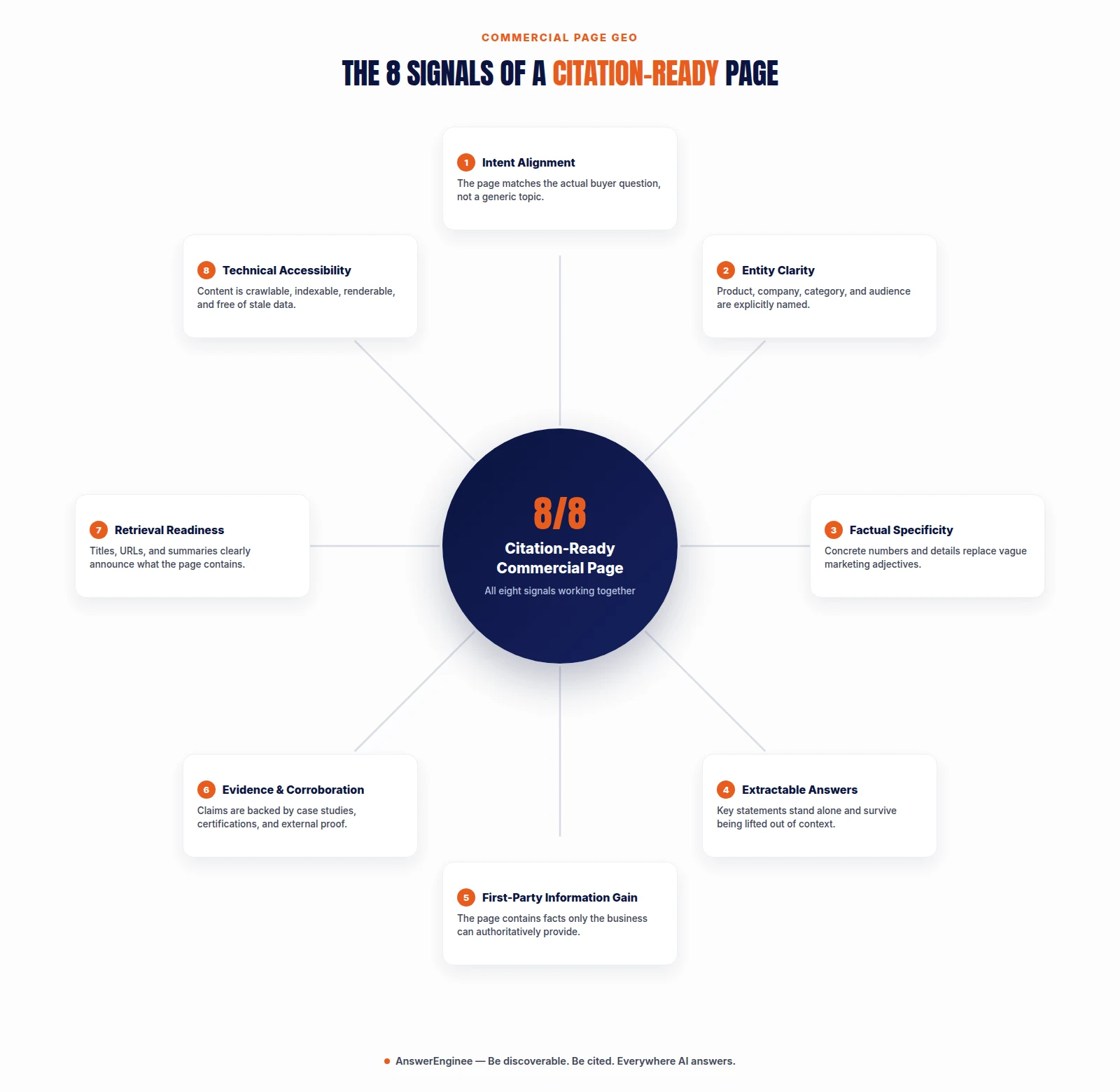
The 8 Signals of a Citation-Ready Commercial Page
Commercial pages become stronger AI sources when eight conditions align.
Signal 1: Intent Alignment
The page must match the actual question. This sounds obvious, but it is one of the most common failures. A company may want its homepage cited for “best enterprise CRM with Salesforce integration and EU data residency,” but the homepage may contain none of those details. The correct source may be an enterprise product page, integration page, security page, or regional data-hosting documentation.
Build a Prompt-to-Page Map
For every important commercial prompt, identify the best source page.
| Prompt | Best Owned Page |
|---|---|
| What does Product X do? | Product page |
| Does Product X integrate with Salesforce? | Integration page |
| Product X pricing | Pricing page |
| Product X vs Product Y | Comparison page |
| Is Product X suitable for healthcare? | Healthcare solution page |
| Is Product X SOC 2 compliant? | Security page |
| Product X API capabilities | Developer documentation |
If you cannot identify a strong owned source, you have an information gap.
Signal 2: Entity Clarity
AI systems need to know what the page is about. A commercial page should make key entities explicit. For a software product, that includes product name, company, category, audience, features, integrations, industries, plans, and certifications. For a service business, that includes provider, service, geography, customer type, expertise, deliverables, and credentials.
Compare “Work smarter with Nova” with “Nova is an inventory forecasting platform for multi-location retailers that predicts SKU-level demand and integrates with Shopify, NetSuite, and Amazon.” The second sentence gives the system actual entities and relationships.
Avoid Category Drift
Entity clarity weakens when the business describes itself differently across platforms. For example: the website says “B2B demand generation agency,” LinkedIn says “full-service digital agency,” a directory says “web design company,” and a press bio says “AI marketing consultancy.” Some evolution is normal, but uncontrolled category drift makes machine interpretation harder.
Signal 3: Factual Specificity
Commercial pages frequently contain language that is persuasive but non-informational — words like revolutionary, seamless, powerful, transformative, world-class, and cutting-edge. These terms can support brand voice. They should not replace facts.
Weak: “Seamlessly connect your business tools.” Stronger: “Connect the platform with Salesforce, HubSpot, Slack, Microsoft Teams, Zapier, and more than 40 supported integrations.”
Weak: “Fast implementation.” Stronger: “Standard implementations typically take two to four weeks and include data migration, admin configuration, two training sessions, and launch support.” Specificity creates extractable information.
Signal 4: Extractable Answers
An AI system may need one sentence from your page, not the whole page. Important commercial facts should therefore be easy to isolate. Useful structures include descriptive headings, direct definitions, concise paragraphs, feature blocks, specification tables, comparison tables, process steps, and clearly labeled FAQs.
Do not confuse “extractable” with “short.” A complex page can be detailed. The important point is that key statements should make sense when removed from surrounding marketing copy.
The Self-Contained Statement Test
Ask: if an AI system extracted this sentence alone, would it still be accurate and understandable? Weak: “It includes everything you need.” Strong: “The Enterprise plan includes SAML SSO, SCIM provisioning, audit logs, custom data-retention policies, and priority support.” The second sentence survives extraction.
Signal 5: First-Party Information Gain
Why should an AI system cite your commercial page rather than a generic third-party article? The strongest answer is because your page contains information only you can authoritatively provide — current features, technical specifications, pricing, availability, integration details, service deliverables, implementation process, original benchmarks, company policies, product limitations, methodology, and proprietary research. This is first-party information gain. A commercial page that merely repeats category-level marketing claims adds very little to the information ecosystem.
Publish the Facts Others Need to Cite
If journalists, reviewers, comparison sites, analysts, and AI systems repeatedly need the same fact, make it easy to find — founding year, service locations, customer count, pricing, supported integrations, security certifications, product dimensions, plan differences, and methodology.
Signal 6: Evidence and Corroboration
Being the primary source does not make every claim equally credible. Consider: “Our platform is the easiest CRM on the market.” The company is not an independent judge of that claim. AI systems may look for external support, such as case studies, named customer results, research methodology, certifications, technical documentation, public benchmarks, customer reviews, reputable awards, independent testing, and partner directories.
Separate Facts From Evaluations
First-party sources are often strongest for “What does the product do?” Third-party sources may be stronger for “Is the product good?” A healthy GEO ecosystem includes both.
Signal 7: Retrieval Readiness
A page cannot be cited if it does not survive retrieval. Ahrefs analyzed 1.4 million ChatGPT prompts and found that ChatGPT retrieved many URLs but cited only part of them. Its study found stronger semantic similarity between fan-out queries and the titles of cited pages than non-cited candidates. The study reported a user-prompt-to-cited-URL-title similarity of 0.602, a user-prompt-to-non-cited-URL-title similarity of 0.484, and a fan-out-query-to-cited-URL-title similarity of 0.656.
Source: Ahrefs
This does not reveal a universal ChatGPT ranking formula. But it reinforces a practical principle: the page should clearly announce what information it contains before the system opens it.
Retrieval-Ready Titles
Weak: “Solutions | Acme.” Stronger: “Enterprise Cybersecurity Consulting for Financial Services | Acme.” Weak: “Nova Pro.” Stronger: “Nova Pro Inventory Forecasting Software for Multi-Location Retailers.”
Descriptive URLs and Useful Snippets
Use URLs that remain stable and understandable. Opening copy and metadata should clearly describe the page.
Specialized Pages
Ahrefs’ broader RAG research makes another useful point: generic pages may score reasonably across many topics, but specialized pages can win when a fan-out query needs depth around a specific entity. This supports building dedicated commercial pages where genuine intent exists.
Signal 8: Technical Accessibility and Data Consistency
Content quality cannot compensate for broken access. Review robots directives, indexability, canonicalization, rendering, internal linking, site performance, JavaScript dependencies, stale data, and feed inconsistencies. Important commercial information should not exist only inside screenshots, videos, hidden interfaces, gated files, or inaccessible JavaScript widgets.
Ecommerce Requires an Additional Data Layer
For ecommerce, the website is only part of the product information system. Google Merchant Center says structured product data helps Google and other platforms understand product information reliably. Google has also announced AI performance insights designed to show how products are discovered across AI Mode, AI Overviews, and Gemini. The reporting includes AI share of voice, discovery/evaluation/purchase visibility, product terms, product attribute insights, and attribute completeness.
Source: Google Merchant Center
This means ecommerce citation optimization increasingly includes website content, structured data, Merchant Center, product feeds, attributes, identifiers, price, and availability. Commercial GEO is becoming a data-quality discipline.
AI Citation Optimization by Page Type
The eight signals apply broadly, but each commercial page requires a different emphasis.
Product Page Optimization
Prioritize clear product definition, category, target audience, feature details, specifications, integrations, use cases, plan availability, evidence, and current product status. Product pages should be strongest for product facts.
Service Page Optimization
Prioritize service definition, ideal client, problems solved, deliverables, process, geography, expertise, engagement model, evidence, and FAQs. Service pages should reduce ambiguity about what the company actually does.
Pricing Page Optimization
Prioritize plan names, prices, billing period, feature differences, limits, eligibility, add-ons, contract terms, trials, and enterprise pricing explanation. Pricing pages often fail because companies optimize the visual comparison table but provide almost no explanatory text. Make important plan differences explicit.
Category Page Optimization
Prioritize category definition, filtering attributes, product relationships, category-specific buying guidance, product inventory, availability, variants, and structured product information. Category pages should help an AI system understand which products belong in which use case.
Solution Page Optimization
Prioritize audience or industry, specific problem, relevant capabilities, workflow, proof, compliance, integration, and case studies. A solution page should not be a product page with the industry name swapped into the headline. It needs scenario-specific information.
Comparison Page Optimization
Prioritize comparison criteria, exact feature differences, pricing, ideal users, limitations, tradeoffs, sources, and update date. Avoid comparison pages where your own brand magically wins every category. Credibility is more valuable than promotional scoring.
Citation Optimization vs Conversion Optimization
One of the most important commercial-page questions is whether GEO conflicts with CRO. Sometimes it can. Conversion teams often want minimal copy, emotional messaging, short forms, strong CTAs, and reduced friction. Citation optimization often benefits from detailed facts, comparisons, specifications, explanatory text, and supporting evidence.
The solution is not to choose one. Build information hierarchy.
For example, the hero might read “Enterprise Technical SEO for Complex Ecommerce Websites,” with a subheading such as “We help large ecommerce teams diagnose crawling, rendering, indexation, site architecture, international SEO, and migration problems,” followed by a CTA to “Request an Audit.” That section remains conversion-focused. Below it, provide problems solved, deliverables, process, proof, case studies, and FAQs. The page can convert quickly while still offering depth.
Why “AI-Friendly Copy” Is the Wrong Goal
There is an emerging temptation to rewrite pages in a strange style because marketers believe AI systems prefer it. Common advice includes using very short sentences, answering every heading in exactly 40 words, adding dozens of FAQs, turning everything into tables, and mentioning the entity repeatedly. This can produce terrible pages.
AI citation optimization should improve information quality, not make content robotic. Use paragraphs when explanation is needed, tables when comparing structured values, lists when enumerating items, FAQs when users genuinely ask those questions, and prose when nuance matters. The content format should follow the information task.
Structured Data: Useful, but Not a Citation Button
Schema markup is useful because it gives machines an additional structured representation of page information. But the claim that adding schema will get you cited by ChatGPT is unsupported.
Use appropriate structured data when it truthfully describes visible content — examples may include Product, Offer, Organization, LocalBusiness, Person, BreadcrumbList, and Article. For ecommerce, Google explicitly uses product structured data to read fields such as price and availability and to support Merchant Center functions.
Source: Google Merchant Center
The correct interpretation is that structured data improves machine readability and ecosystem consistency. It does not guarantee AI visibility.
External Citations Can Matter More Than Your Own Commercial Page
This is the part brands often dislike. Sometimes the strongest answer to a commercial query is not your website. The Wix study found that listicles accounted for 40.86% of citations for the commercial-intent queries in its dataset.
Why? A query such as “Best CRM for small agencies” requires comparison. Your own website has a conflict of interest. A credible third-party listicle can compare multiple providers. This means commercial GEO includes earned inclusion. You may need to appear in third-party listicles, review sites, industry directories, partner marketplaces, analyst coverage, customer case studies, and expert comparisons — including forums such as Reddit, which increasingly surface in AI answers alongside owned product pages. See our analysis of how product pages compare with Reddit threads for AI citations for more on this dynamic.
The objective is not always to get your own page cited. Sometimes the strategic win is that your brand appears in the answer because a credible third party recommends it.
Owned Citation vs Earned Citation
Commercial AI visibility can be divided into two systems.
Owned Citation
Your website is cited. Examples include a product page, service page, documentation, pricing, and case study. Best for product facts, company facts, service definitions, specifications, and first-party evidence.
Earned Citation
A third-party page is cited and mentions your brand. Examples include a review, listicle, article, directory, customer story, analyst page, and Reddit discussion. Best for recommendations, comparisons, reputation, reviews, and social proof.
A complete GEO strategy needs both.
Commercial Page Information Gain: What Can Only You Publish?
This is one of the strongest ways to improve a money page. Ask: what information can our company publish that no generic SEO article can reproduce authentically?
For SaaS: integration specifics, roadmap status, API limits, implementation timeline, customer benchmarks, and plan differences.
For professional services: audit methodology, deliverables, staffing model, process, pricing structure, specialization, and case-study results.
For ecommerce: dimensions, materials, product compatibility, care instructions, manufacturing details, fit, variant data, and inventory.
For manufacturers: tolerances, certifications, technical drawings, capacity, lead times, and compatible systems.
The more original first-party information the page contains, the harder it is for a generic competitor page to substitute for it.
How to Measure AI Citation Optimization
Do not reduce GEO measurement to “did ChatGPT cite us?” Build a broader scorecard across these ten dimensions.
1. Prompt Coverage
Track important prompts by buyer stage: discovery, evaluation, transaction, and validation.
2. Brand Mention Rate
How often does the brand appear?
3. Citation Rate
How often is your domain cited?
4. Cited URL Mix
Which pages are being selected — homepage, blog, product, service, comparison, or documentation?
5. Competitor Share of Voice
Which competitors appear more frequently?
6. Source Share
Which third-party sites are shaping answers?
7. Accuracy
Is the AI describing products, prices, services, locations, and features correctly?
8. Sentiment and Recommendation
Is the brand recommended, neutrally mentioned, excluded, or criticized?
9. Search and Traffic Effects
Track AI referrals, branded search, direct traffic, organic traffic, and assisted conversions.
10. Commercial Outcomes
Ultimately track leads, demos, purchases, pipeline, and revenue. A citation that never affects a business outcome may still have awareness value, but commercial GEO eventually needs commercial measurement.
The 100-Point Commercial Page AI Citation Audit
Use this framework to audit an individual commercial page. This is a diagnostic model, not an AI ranking formula.
1. Intent Alignment — 15 Points
- Page maps to a real commercial prompt: 3
- Search/buyer intent is unambiguous: 3
- Page type matches the task: 3
- Supporting intent pages exist: 3
- No major cannibalization/duplication: 3
2. Entity Clarity — 15 Points
- Product/service clearly named: 3
- Category explicit: 3
- Audience explicit: 3
- Key related entities identified: 3
- Entity description consistent elsewhere: 3
3. Factual Depth — 15 Points
- Features/deliverables explicit: 3
- Specifications/attributes clear: 3
- Process/use cases explained: 3
- Important limitations addressed: 3
- Information is current: 3
4. Evidence — 15 Points
- Claims are verifiable: 3
- Case studies/customer evidence: 3
- Credentials/certifications where relevant: 3
- Original first-party information: 3
- External corroboration exists: 3
5. Extractability — 10 Points
- Clear headings: 2
- Direct definitions: 2
- Self-contained factual statements: 2
- Tables/lists used where useful: 2
- FAQs answer genuine questions: 2
6. Retrieval Readiness — 10 Points
- Descriptive title: 2
- Descriptive URL: 2
- Strong opening summary: 2
- Internal links: 2
- Specialized page depth: 2
7. Technical Accessibility — 10 Points
- Indexable: 2
- Crawlable: 2
- Correct canonical: 2
- Critical content renderable: 2
- Reasonable performance/accessibility: 2
8. Machine-Readable Data — 10 Points
- Appropriate structured data: 2
- Markup matches visible content: 2
- Product/feed data consistent where relevant: 2
- Price/availability current: 2
- Business/entity data consistent: 2
Score Interpretation
| Score | Assessment |
|---|---|
| 0–39 | Weak commercial information source |
| 40–59 | Basic citation readiness |
| 60–74 | Competitive foundation |
| 75–89 | Strong commercial source |
| 90–100 | Excellent citation-ready information asset |
Do not market a score of 90 as a guarantee. No one controls the final source-selection systems of ChatGPT, Gemini, Google, Perplexity, or other AI engines. Use the score to decide what to improve.
Common AI Citation Optimization Mistakes
Mistake 1: Optimizing Only Blogs
Informational content is only one layer of AI visibility. Money pages need information too.
Mistake 2: Treating Every Query as Commercial
Some queries need education. Others need comparison. Others need transactions. Match format to intent.
Mistake 3: Adding Huge FAQ Sections
Twenty generic questions do not automatically make a page citable. Answer the questions buyers actually ask.
Mistake 4: Inventing “AI Ranking Factors”
Be cautious with claims such as “AI loves tables,” “schema increases ChatGPT rankings,” “200-word answers get more citations,” or “repeating your brand increases LLM visibility.” Unless evidence supports the claim, treat it as a hypothesis.
Mistake 5: Ignoring External Sources
A buyer asking “best X” may never trigger your product page. Third-party recommendation ecosystems matter.
Mistake 6: Hiding Critical Information
Pricing, specifications, integrations, and service details hidden in inaccessible formats reduce information utility.
Mistake 7: Publishing Fake Evidence
Do not create fake reviews, fake benchmarks, fabricated statistics, or fake customer quotes. Citation optimization without credibility is self-defeating.
Mistake 8: Measuring One Prompt
AI outputs vary. Track prompt sets over time.
Mistake 9: Measuring Only One Model
ChatGPT, Google AI Mode, Gemini, and Perplexity use different retrieval and citation environments.
Mistake 10: Forgetting Conversion
A commercial page still needs to sell. Citation optimization should strengthen the buyer experience, not destroy it.
A Practical Commercial GEO Workflow
Use this process for each important commercial topic.
Step 1: Identify the Buyer Decision
What is the buyer trying to decide?
Step 2: Collect Real Prompts
Build prompts from sales calls, Search Console, site search, customer support, Reddit, reviews, AI testing, People Also Ask, and keyword research.
Step 3: Classify Intent
Label each prompt as informational, commercial research, navigational, transactional, or validation.
Step 4: Map Each Prompt to the Best Page
Identify the existing source, missing source, or third-party source needed.
Step 5: Improve Owned Pages
Fix clarity, facts, evidence, titles, structure, and technical accessibility.
Step 6: Strengthen Earned Visibility
Target relevant reviews, directories, listicles, partner ecosystems, and editorial coverage.
Step 7: Test Across AI Platforms
Monitor mentions, citations, competitors, source mix, and accuracy.
Step 8: Measure Business Impact
Connect visibility to branded demand, traffic, conversions, pipeline, and sales. Then repeat. AI visibility is not a one-time optimization project.
What Google Merchant Center’s 2026 AI Reporting Signals for Commercial GEO
Google’s 2026 Merchant Center announcement is strategically important beyond ecommerce. Google is introducing AI performance reporting around share of voice, shopping funnel stage, conversational product terms, product attributes, and attribute completeness.
The exact reporting is commerce-specific. But the broader shift matters: AI visibility is moving from an experimental brand metric toward structured commercial measurement.
For ecommerce SEOs, that means feed optimization, product data, attributes, and landing pages should increasingly be managed as one system. For B2B marketers, the lesson is to build similar internal measurement across discovery prompts, evaluation prompts, purchase prompts, brand share, citation share, and source gaps. The AI buyer journey should become measurable.
AI Citation Optimization Is Not About Owning Every Citation
This may be the most important strategic shift. A brand does not need its own domain to receive every citation.
Imagine a user asks: “Best payroll software for a 100-person company with international contractors.” A strong AI answer may cite a third-party roundup, a review site, and several vendor product pages.
Your goal may be achieved if your brand makes the shortlist, your product facts are correct, the recommendation is favorable, and credible sources support the claim. That is why AI visibility should be measured at the brand level and the URL level. Owned citations matter. Earned citations matter too.
FAQ
What is AI citation optimization?
AI citation optimization is the process of improving web content and the surrounding information ecosystem so generative AI systems can more easily discover, interpret, verify, and potentially cite the information when answering user questions.
Can commercial pages get cited by ChatGPT?
Yes. Product, service, pricing, category, comparison, and other commercial pages can be cited when they provide information relevant to the prompt. Citation likelihood varies by intent, platform, topic, retrieval process, and source competition.
Which commercial pages are most likely to get AI citations?
There is no universal winner. Current research shows product pages perform strongly for transactional and navigational intent, while category pages can also perform well. Broader commercial-comparison prompts often favor third-party listicles and discussions.
Do product pages get more AI citations than blog posts?
It depends on intent. In the Wix Studio AI Search Lab dataset, articles dominated informational queries, while product pages were far stronger for transactional and navigational/local queries. Comparing total citation counts without controlling for intent can therefore be misleading.
How can I optimize a service page for AI citations?
Clearly define the service, audience, problems solved, deliverables, process, geography, expertise, commercial fit, and evidence. Use descriptive titles and headings and ensure the page is crawlable, current, and connected to supporting content.
Does schema markup improve AI citations?
Structured data can improve machine readability and help platforms understand commercial information, especially in ecosystems such as Google Merchant Center. However, schema markup does not guarantee that ChatGPT, Gemini, Perplexity, Google AI Mode, or another system will cite a page.
Are comparison pages good for GEO?
They can be when they answer genuine comparison intent with factual criteria, meaningful tradeoffs, transparent sourcing, and balanced recommendations. Promotional comparison pages that distort competitor information may be less credible to both users and retrieval systems.
Is ranking in Google required for AI citations?
Not universally. Search visibility can support retrieval in some AI systems, but citation processes differ by platform. A page should maintain strong SEO fundamentals while also optimizing information quality and relevance for generative retrieval.
Should commercial pages be longer for GEO?
Not automatically. They should contain enough information to answer serious buyer questions. A complex enterprise software page may require substantial detail, while a simple product may not. Information completeness matters more than arbitrary word count.
How do I measure AI citation optimization?
Track representative prompts, brand mentions, citations, cited URLs, competitor share of voice, third-party source visibility, answer accuracy, sentiment, AI referrals, branded demand, leads, conversions, and revenue where attribution is possible.
Bottom Line
AI citation optimization for commercial pages is not a new layer of keyword stuffing and it is not a race to add more schema, FAQs, tables, or AI-generated copy. It is the discipline of turning commercial pages into reliable decision-making sources.
The strongest strategy starts with intent. Product pages should own product facts. Service pages should define services and expertise. Pricing pages should clarify commercial terms. Category pages should organize product choices. Solution pages should connect offerings to real scenarios. Comparison pages should help buyers evaluate alternatives honestly. At the same time, third-party listicles, reviews, directories, discussions, and editorial coverage should validate what your own website claims.
Current research makes one point especially clear: AI engines do not cite one page format uniformly. The content type changes with the user’s task. That means the durable advantage is not finding a universal “AI citation formula.” It is building an information architecture where the right source exists for every important buyer question, the facts are specific and verifiable, the pages are technically accessible, and credible external sources reinforce the brand.
That is what commercial GEO should optimize for: not citations in isolation, but accurate inclusion in the decisions AI-assisted buyers are already making.