Quick Answer
The reason is simple: traditional Shopping visibility and AI Mode visibility are related, but they are not the same selection problem.
Google AI Mode can interpret longer conversational queries, run query fan-out, evaluate multiple product attributes, use Shopping Graph data, and narrow products according to the full intent behind the user’s request. Google now measures this AI-specific visibility separately in Merchant Center using metrics such as:
- share of voice;
- products showing;
- shopping stage;
- top terms;
- popular attributes;
- search intent.
That reporting would be unnecessary if traditional Shopping rankings fully predicted AI visibility.
Third-party 2026 tracking reinforces the difference. Productrise analyzed more than two million product listings across 100,000+ standard Search and AI Mode responses and found that only a small fraction of products visible in standard Search also appeared in AI Mode for the same query on the same day.
The practical takeaway is:
Google Shopping success proves your product can compete in Google’s commerce ecosystem. It does not prove that the product satisfies the more complex intent AI Mode constructs for a specific conversation.
Ecommerce teams need to optimize for both. If you’re still mapping how AI shopping SEO works inside Google AI Mode, that’s a useful primer before working through the diagnostic below.
Why This Problem Matters
For years, ecommerce teams have used familiar performance signals:
- Shopping impressions;
- free listing visibility;
- Shopping ad performance;
- organic product rankings;
- click-through rate;
- Merchant Center eligibility.
These metrics still matter.
But AI Mode adds another layer.
A product can be:
- approved in Merchant Center;
- visible in free listings;
- strong in standard Search;
- commercially successful;
and still appear rarely in AI Mode.
This creates a new diagnostic problem.
The old question was:
Why is this product not ranking?
The new question is:
Why is this product visible in Shopping but not being selected for AI-assisted shopping journeys?
Those are not identical questions.
Traditional Shopping Visibility and AI Mode Visibility Solve Different Tasks
Traditional Shopping often responds to relatively compact search intent.
Example:
waterproof hiking boots
Google can evaluate products based on relevance, product data, price, ratings, availability, personalization, and other signals.
Now consider AI Mode:
I need waterproof hiking boots for a week in Iceland in October. I have wide feet, walk 10–15 miles a day, want something under $200, and prefer a lightweight boot.
That request includes:
- waterproofing;
- climate;
- fit;
- distance;
- weight;
- budget;
- use case.
Google says AI Mode can perform query fan-out, running multiple searches to investigate different aspects of the user’s request before narrowing products.
Source: Google
This means a product that is highly relevant to:
waterproof hiking boots
may not be sufficiently qualified for the richer conversational request.
Ranking Is Not the Same as Qualification
This is the most useful way to think about the difference.
Traditional Shopping asks:
Which products are relevant enough to rank for this query?
AI Mode may effectively ask:
Which products satisfy the combined constraints inferred from this entire conversation?
That moves ecommerce SEO from keyword relevance toward attribute qualification.
A product may rank well because Google understands that it is a waterproof hiking boot.
But if Google does not clearly understand:
- whether it comes in wide widths;
- how much it weighs;
- whether it is suitable for long-distance hiking;
- the current price;
- relevant materials;
- availability;
it may lose to another product with richer data.
The product is relevant.
It is simply not sufficiently qualified.
Google Now Measures AI Product Visibility Separately
Google’s Merchant Center AI performance insights are one of the clearest signs that AI shopping visibility requires its own measurement layer.
The report covers conversational shopping queries across AI Mode and AI Overviews.
Google currently reports metrics including:
Your Share of Voice
The percentage of AI impressions captured by your brand or products relative to your defined competitor set.
Competitor Average Share
A benchmark against competitors in Merchant Center.
Frequency
How popular certain terms, intents, or attributes are.
Products Showing
The number of your products appearing for:
- top terms;
- popular attributes;
- search intents.
Source: Google Merchant Center
This reporting separates AI visibility from traditional rank tracking.
If Shopping rank alone predicted AI Mode inclusion, there would be little need for a separate “products showing” metric.
AI Mode Also Breaks Visibility Down by Buyer Stage
Google classifies conversational shopping behavior into three stages.
Discovery
The shopper is exploring options.
Examples:
- best backpacks for business travel;
- comfortable office chairs for long workdays;
- good running shoes for beginners.
Evaluation
The shopper is comparing products or researching specifications.
Examples:
- Product A vs Product B;
- lightweight laptops with 32GB RAM;
- best standing desks for tall users.
Purchase
The shopper is close to a transaction.
Examples:
- Product A size 10 in stock;
- buy Product B under $150;
- Product C available nearby.
A product can perform differently at each stage.
That means a single overall Shopping ranking cannot tell you the full story. This is closely related to how Google AI Mode differs from the Popular Products carousel — both surfaces pull from the same commerce data but select very differently.
A Product Can Be Strong Late in the Funnel but Weak Early
Imagine a well-known shoe brand.
Merchant Center AI performance:
| Shopping Stage | Share of Voice |
|---|---|
| Discovery | 7% |
| Evaluation | 18% |
| Purchase | 36% |
This pattern suggests:
- buyers who already know what they want can find the product;
- Google understands the product entity;
- transactional relevance is strong;
- broad conversational discovery is weak.
Traditional rank reports may not reveal this.
The optimization problem is not necessarily:
Improve product ranking.
It may be:
Improve product attribute coverage and discovery relevance.
Third-Party Data Shows the Product Sets Can Be Very Different
Productrise published a July 2026 study comparing standard Google Search and AI Mode on identical product-centric queries.
The company analyzed:
- more than 2 million product listings;
- more than 100,000 SERPs and AI Mode responses;
- 21 days of data.
It reported:
- standard Search showed products on about 88% of tracked queries;
- AI Mode showed products on about 23%;
- when products appeared, standard Search displayed about 22.5 products on average;
- AI Mode displayed about 4.3;
- AI Mode therefore surfaced roughly 95% fewer product listings overall.
Source: Productrise
The study also found very little overlap between the products shown in standard Search and those shown in AI Mode.
This is observational research.
It does not establish a permanent Google rule.
The results could vary by:
- category;
- market;
- device;
- query;
- interface;
- time;
- methodology.
But the difference is large enough that ecommerce teams should not assume the two surfaces rank products identically.
Why Standard Shopping Success May Fail to Transfer
There are several plausible reasons.
1. AI Mode May Use More Attributes
A normal query:
office chair
may require only broad product classification.
A conversational query:
office chair for a 6’4″ person with adjustable lumbar support and a seat depth above 20 inches under $700
requires detailed attributes.
If competitor products expose:
- seat depth;
- maximum height;
- lumbar range;
- price;
and yours does not, they are easier to match.
2. Query Fan-Out Can Change the Candidate Set
Google AI Mode can research multiple subtopics.
The system may investigate:
- ergonomic standards;
- dimensions;
- reviews;
- warranty;
- suitability for tall users.
Your Shopping visibility for one keyword does not prove your product performs across every subquery.
3. Product Data May Be Incomplete
Merchant Center explicitly recommends improving missing attributes identified in AI performance reporting.
Examples:
- material;
- size;
- color;
- product specifications.
If the attribute exists in reality but not in your data, Google has less structured evidence for the match.
4. Product Variant Data May Be Weak
A product may rank broadly while the exact relevant variant is unclear.
Examples:
- wide width;
- larger size;
- specific color;
- storage capacity;
- regional version.
AI Mode may need a specific variant rather than the base product entity.
5. The Landing Page May Not Confirm the Feed
Suppose Merchant Center says:
waterproof
but the landing page barely mentions waterproofing.
Or the page says:
32GB RAM
while the structured data describes 16GB.
Conflicting information creates uncertainty.
6. External Evidence May Differ
Google’s Shopping Graph can contain:
- ratings;
- reviews;
- prices;
- merchant offers;
- other product information.
Two products with similar feed data may have very different external evidence.
7. Personalization Can Change the Result
Google says Shopping recommendations can use personalization based on activity and shopping preferences.
A product that appears for one shopper may not appear identically for another.
This makes stable rank tracking harder.
8. AI Mode May Show Fewer Products
If standard Search displays 20+ products while AI Mode displays only four or five, being “good enough to rank” is not enough.
The product needs to make a much smaller shortlist.
Merchant Center Approval Is Only the First Gate
Many merchants confuse eligibility with visibility.
An approved product has cleared an important requirement.
But think of the funnel as:
Approved → Eligible → Retrieved → Matched → Selected → Displayed
Merchant Center approval mainly helps with the beginning.
AI Mode visibility depends on later stages.
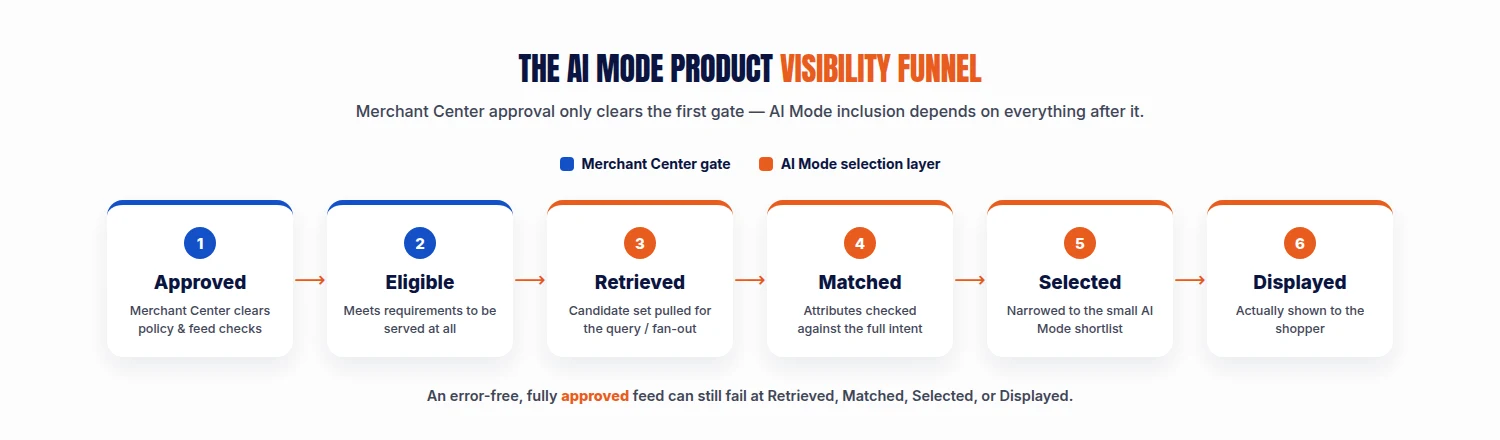
This distinction matters because teams often respond to low AI visibility by checking only:
- disapprovals;
- feed errors.
Those are important.
But an error-free feed can still have weak attribute depth. For a broader look at how this funnel plays out across a whole catalog, see how Google AI Mode is reshaping ecommerce visibility.
The Most Common AI Mode Product Visibility Gaps
Gap 1: Keyword-Rich Title, Attribute-Poor Product
Example title:
Best Ergonomic Office Chair for Back Pain
But the product data does not specify:
- lumbar adjustment;
- seat dimensions;
- recline;
- user height;
- weight capacity.
The title cannot substitute for specifications.
Gap 2: Strong Feed, Weak Landing Page
The Merchant Center feed contains detailed product data.
The landing page contains:
- images;
- a short description;
- price;
- Add to Cart.
Important specifications may not be visible.
That weakens corroboration.
Gap 3: Strong Product Page, Weak Merchant Center Data
The reverse can happen.
The landing page explains everything.
But Merchant Center has:
- generic title;
- generic description;
- missing attributes;
- incomplete identifiers.
The AI shopping ecosystem does not automatically treat your landing page as a replacement for poor feed quality.
Gap 4: Missing Conversational Attributes
Google now supports optional Merchant Center conversational attributes such as:
- question and answer;
- document link;
- related product;
- item group title;
- variant option;
- popularity rank.
These are designed to help AI systems understand product nuances.
Source: Google Merchant Center
Ignoring them may mean leaving useful product context unstructured.
Gap 5: No Product Q&A
Google says the question_and_answer attribute is primarily intended for conversational experiences such as AI Mode.
This can help answer questions like:
- Is it machine washable?
- Does it support Thunderbolt?
- Is it suitable for wide feet?
- Is this accessory included?
If buyers repeatedly ask these questions, explicit answers may improve product understanding.
Gap 6: Weak Category and Product-Type Classification
Product categorization helps Google understand where an item belongs.
Inaccurate categories create noisy matching.
A technically correct title cannot always compensate for poor classification.
Gap 7: Stale Availability or Price
AI shopping is closer to a purchase decision than many informational searches.
If Google lacks confidence in:
- price;
- stock;
- merchant offer;
it may avoid showing the product.
Gap 8: Strong Branded Demand, Weak Unbranded Discovery
Some products appear easily for:
Brand X Model Y
but not:
best lightweight laptop for video editing under $2,000
This means Google understands the entity but may not strongly associate it with the category attributes driving discovery.
How to Diagnose an AI Mode Visibility Gap
Use a structured workflow.
Step 1: Confirm Merchant Center Eligibility
Check:
- disapprovals;
- limitations;
- missing identifiers;
- price;
- availability;
- landing page;
- images;
- variants.
If the product is not eligible, solve that first.
Step 2: Compare Traditional Visibility With AI Visibility
Identify products that:
- perform strongly in Shopping;
- have weak AI share of voice;
- show rarely in AI performance.
This is your highest-value diagnostic set.
Step 3: Review Shopping Stage Performance
Check:
- Discovery;
- Evaluation;
- Purchase.
Different weaknesses imply different fixes.
Weak Discovery
Focus on:
- product categories;
- product types;
- attributes;
- broader use cases;
- descriptive content.
Weak Evaluation
Focus on:
- specifications;
- comparisons;
- reviews;
- Q&A;
- product details;
- variants.
Weak Purchase
Focus on:
- availability;
- price;
- offers;
- accurate transactional data;
- merchant eligibility.
Step 4: Review Top Terms
Merchant Center shows terms users prioritize in conversational searches.
Example:
maximum cushioning
If your running shoe actually has maximum cushioning but the term is missing from:
- title;
- description;
- product details;
you have an information gap.
Google explicitly recommends adding relevant top terms to titles and descriptions.
Step 5: Review Popular Attributes
Popular attributes may include:
- size;
- color;
- material;
- specifications.
Look for:
- high frequency;
- low share of voice;
- missing values.
Then update only attributes that are factually true.
Step 6: Review Products Showing
The “products showing” metric tells you how many products are actually surfacing for:
- terms;
- attributes;
- intents.
This is more useful than assuming all eligible products participate equally.
Step 7: Compare Competitors
Ask:
- Which competitor products appear?
- Which attributes do they document?
- Are their titles more specific?
- Are their landing pages more complete?
- Do they have more reviews?
- Are variants clearer?
- Is their product data more consistent?
The goal is not to copy competitors blindly.
It is to identify information gaps.
Step 8: Test the Same Query in Both Surfaces
Run a controlled comparison.
Example:
best lightweight hiking boots for wide feet
Check:
Standard Search
- Which products appear?
- Which merchants?
- How many products?
AI Mode
- Which products appear?
- Which attributes are emphasized?
- Which products disappear?
- Which new products appear?
This can reveal the qualities AI Mode is prioritizing for that conversation.
Do not infer a universal ranking factor from one result.
Look for patterns across many prompts.
Step 9: Build a Conversational Prompt Set
Create 30–100 queries based on real buyer constraints.
Categories:
Feature
laptop with OLED screen and 32GB RAM
Compatibility
docking station that works with MacBook Air and two 4K monitors
Fit
running shoes for flat feet and wide toes
Budget
ergonomic office chair under $600
Use Case
carry-on backpack for a two-week Europe trip
Evaluation
Product A vs Product B for video editing
Track results over time.
Step 10: Fix the Product Information Layer
Depending on the diagnosis, improve:
- title;
- description;
- identifiers;
- product type;
- Google product category;
- specifications;
- variants;
- highlights;
- product details;
- Q&A;
- documents;
- related products;
- landing page;
- structured data.
Then monitor whether AI share of voice changes.
Why Product Attributes Are Becoming the New Long-Tail Keywords
Traditional SEO spent years optimizing long-tail queries.
Example:
waterproof hiking boots for wide feet
AI Mode turns long-tail intent into structured product constraints.
The old long-tail keyword:
wide fit waterproof boots
becomes attributes:
- waterproof = yes;
- width = wide;
- category = hiking boots;
- use case = hiking.
This is a useful mental model.
AI shopping optimization increasingly requires converting buyer language into accurate product attributes. This same shift is reshaping how Google evaluates product rankings inside AI Mode more broadly, not just for individual queries.
Ranking in Popular Products Is Not the Same Either
Google has multiple commerce surfaces.
A product may appear in:
- standard Shopping;
- free listings;
- Popular Products;
- organic results;
- AI Mode.
These experiences share underlying commerce data but can present and select products differently.
Do not build one “Google Shopping rank” metric and assume it represents all product discovery.
Modern ecommerce visibility should be surface-specific.
Why Traditional Rank Tracking Is Becoming Less Reliable
AI Mode can be:
- conversational;
- personalized;
- iterative.
The user can say:
Show me cheaper options.
Then:
Only black.
Then:
I need it by Friday.
The product set can change at every turn.
Traditional rank tracking assumes a relatively stable result set.
AI shopping behaves more like a dynamic recommendation system.
That does not eliminate measurement.
It changes the metrics.
Better KPIs for AI Mode Product Visibility
Track:
AI Share of Voice
How often your products appear compared with competitors.
Products Showing
How much of the catalog participates.
Stage Visibility
Discovery vs Evaluation vs Purchase.
Attribute Coverage
Which high-demand specifications are complete.
Term Coverage
Which conversational product terms align with your catalog.
Competitor Inclusion
Which competitors consistently appear.
Product Inclusion Rate
Across your prompt set:
How often does this product appear?
Accuracy
Are:
- price;
- variant;
- availability;
- specifications;
correct?
Commercial Impact
Where possible, connect AI visibility with:
- product views;
- conversions;
- branded search;
- revenue.
What Not to Do When AI Mode Visibility Is Low
Don’t Add Fake Attributes
If the product is not waterproof, do not label it waterproof.
Don’t Stuff Conversational Terms
Merchant Center guidance to use relevant terms does not mean repeating every popular phrase.
Don’t Inflate Specifications
Incorrect product data can damage eligibility and user trust.
Don’t Assume Price Is the Ranking Problem
Recent third-party research observed a more expensive product mix in AI Mode.
That does not prove increasing price improves visibility.
Don’t Ignore Shopping Fundamentals
AI Mode optimization still sits on top of:
- clean Merchant Center data;
- eligibility;
- correct product pages.
Don’t Treat One Prompt as Evidence
AI outputs vary.
Use a meaningful prompt set.
A Practical 100-Point AI Mode Visibility Audit
Use this diagnostic score.
It is not a Google ranking formula.
| Category | Checklist Item | Points |
|---|---|---|
| Merchant Center Foundation — 20 Points | Product approved | 4 |
| Accurate price | 4 | |
| Accurate availability | 4 | |
| Correct identifiers | 4 | |
| Valid product category/type | 4 | |
| Attribute Completeness — 20 Points | Core category attributes complete | 5 |
| Variants complete | 5 | |
| Product details complete | 5 | |
| Popular AI attributes populated | 5 | |
| Conversational Readiness — 20 Points | Descriptions answer major needs | 5 |
| Product highlights useful | 5 | |
| Q&A implemented where relevant | 5 | |
| Product relationships/documents clear | 5 | |
| Landing Page Consistency — 20 Points | Feed and page agree | 5 |
| Structured data agrees | 5 | |
| Specifications visible | 5 | |
| Price/availability confirmed | 5 | |
| AI Performance — 20 Points | Share of voice tracked | 4 |
| Products showing tracked | 4 | |
| Stage visibility reviewed | 4 | |
| Top terms reviewed | 4 | |
| Competitor visibility reviewed | 4 |
Score Interpretation
| Score | Assessment |
|---|---|
| 0–39 | Weak AI product readiness |
| 40–59 | Basic |
| 60–74 | Competitive |
| 75–89 | Strong |
| 90–100 | Excellent product-information foundation |
Again, this is a management tool.
A 95 does not guarantee AI Mode visibility.
Bottom Line
Ranking in Google Shopping is still valuable, but it is no longer enough to describe your full product visibility on Google.
Traditional Shopping tells you that a product is eligible, relevant and competitive in a familiar product-results environment. AI Mode introduces a different problem: Google may need to understand whether that product satisfies a much richer combination of needs, attributes, constraints and buyer-stage intent before it earns one of a much smaller number of visible slots.
That is why strong Shopping performance can coexist with weak AI Mode share of voice. The product may be relevant to the keyword but poorly qualified for the conversation.
The solution is not to abandon traditional Shopping optimization. It is to extend it. Maintain clean Merchant Center data, strengthen attributes and variants, improve product descriptions and highlights, add conversational information where useful, keep landing pages and structured data consistent, and use Google’s own AI performance insights to identify where products disappear from Discovery, Evaluation or Purchase journeys.
The new ecommerce question is no longer only “Where does my product rank?”
It is “For which shopping intents does Google understand my product well enough to include it?”
That is the visibility gap AI Mode makes impossible to ignore.
FAQ
Does ranking in Google Shopping guarantee AI Mode visibility?
No. Traditional Shopping and AI Mode use overlapping commerce data, but AI Mode can interpret conversational intent, perform query fan-out, evaluate detailed product attributes and surface a different set of products.
Can a product rank #1 in Shopping and not appear in AI Mode?
Yes. A strong traditional ranking does not guarantee inclusion in AI Mode for the same or a related query.
Why does AI Mode show different products from Google Shopping?
Potential reasons include query fan-out, attribute matching, product specifications, personalization, reviews, price, availability, variant data and the narrower product set displayed by AI Mode.
Does Merchant Center have separate AI Mode reporting?
Google now provides AI performance insights for conversational shopping queries across AI Mode and AI Overviews. Metrics include share of voice, products showing, shopping stages, top terms, popular attributes and search intents.
What does “products showing” mean in Merchant Center?
It is the number of your products appearing for relevant top terms, popular attributes and search intents in the AI performance report.
What should I do if Shopping visibility is high but AI share of voice is low?
Review product attributes, titles, descriptions, variants, landing-page consistency, product highlights, Q&A, popular terms and missing attributes shown in Merchant Center AI performance insights.
Are product attributes more important for AI Mode?
They are particularly important because conversational queries can include multiple specific requirements. Complete attributes give Google structured information to match the product to those requirements.
Does AI Mode always show fewer products?
Google has not stated that it always does. A July 2026 Productrise study observed far fewer product listings in AI Mode for the product-centric queries it tracked, but results may vary by category, query and interface.
Is higher price a ranking factor in AI Mode?
Google has not confirmed that. Third-party research observed a higher-priced product mix in AI Mode, but that does not prove that higher prices improve ranking.
How should I measure AI Mode product visibility?
Track Merchant Center AI share of voice, products showing, Discovery/Evaluation/Purchase performance, top terms, popular attributes, competitor visibility and a controlled set of conversational product prompts.