Quick Answer
Google does not publish a simple list of AI Mode shopping ranking factors.
What Google has confirmed is that its AI shopping experiences combine Gemini capabilities with the Shopping Graph, can use query fan-out to research multiple aspects of a shopping request, and rely on product information aggregated from brands, merchants, stores, reviews and other content providers.
Google also says AI-supported “Top recommendations” can be selected using signals including:
- relevance;
- ratings;
- price;
- product features.
Merchant Center now goes further by showing merchants AI-specific performance data such as:
- share of voice;
- products showing;
- Discovery, Evaluation and Purchase visibility;
- popular terms;
- product attributes;
- attribute completeness.
The most useful way to think about AI shopping SEO is therefore:
Google first tries to understand the shopper’s real intent, then retrieves and compares candidate products using its commerce data, product attributes and supporting evidence before deciding which products deserve to be shown.
For ecommerce brands, this means success increasingly depends on the quality of the entire product-information system—not just the keyword in the product title.
What Is AI Shopping SEO?
AI shopping SEO is the process of optimizing product information so ecommerce products can be more accurately discovered, understood, compared and surfaced in AI-assisted shopping experiences.
This includes surfaces such as:
- Google AI Mode;
- AI Overviews with shopping intent;
- Gemini shopping experiences;
- other Google generative commerce interfaces.
Traditional ecommerce SEO often focuses on:
- product-page rankings;
- category-page rankings;
- title tags;
- internal links;
- Product schema;
- free listings;
- Google Shopping;
- Merchant Center.
AI shopping SEO adds another layer. For a broader view of how these surfaces fit together across the shopping journey, see our guide to how Google AI Mode is reshaping ecommerce search.
The product now has to work inside a system that may:
- interpret a long conversational request;
- break that request into subtopics;
- retrieve information from several sources;
- compare products across many attributes;
- consider ratings, price, features and relevance;
- personalize recommendations;
- present only a small number of products.
This creates a more demanding form of product qualification.
Google AI Mode Is Not Just Matching a Keyword
Traditional ecommerce SEO grew up around keywords.
Example:
hiking boots
Then longer-tail queries:
waterproof hiking boots for wide feet
AI Mode allows shoppers to express the full problem instead.
Example:
I need lightweight waterproof hiking boots for a week in Iceland in October. I have wide feet, usually walk 10 miles a day, and want something under $200 with enough ankle support for uneven terrain.
That single prompt contains:
- product category;
- waterproofing;
- climate;
- season;
- fit;
- weight;
- walking distance;
- price ceiling;
- support requirement;
- terrain use.
The SEO problem is no longer:
Does Google know this is a hiking boot?
It becomes:
Does Google have enough reliable product data to determine whether this boot satisfies all of those constraints?
That is the essence of AI shopping SEO.
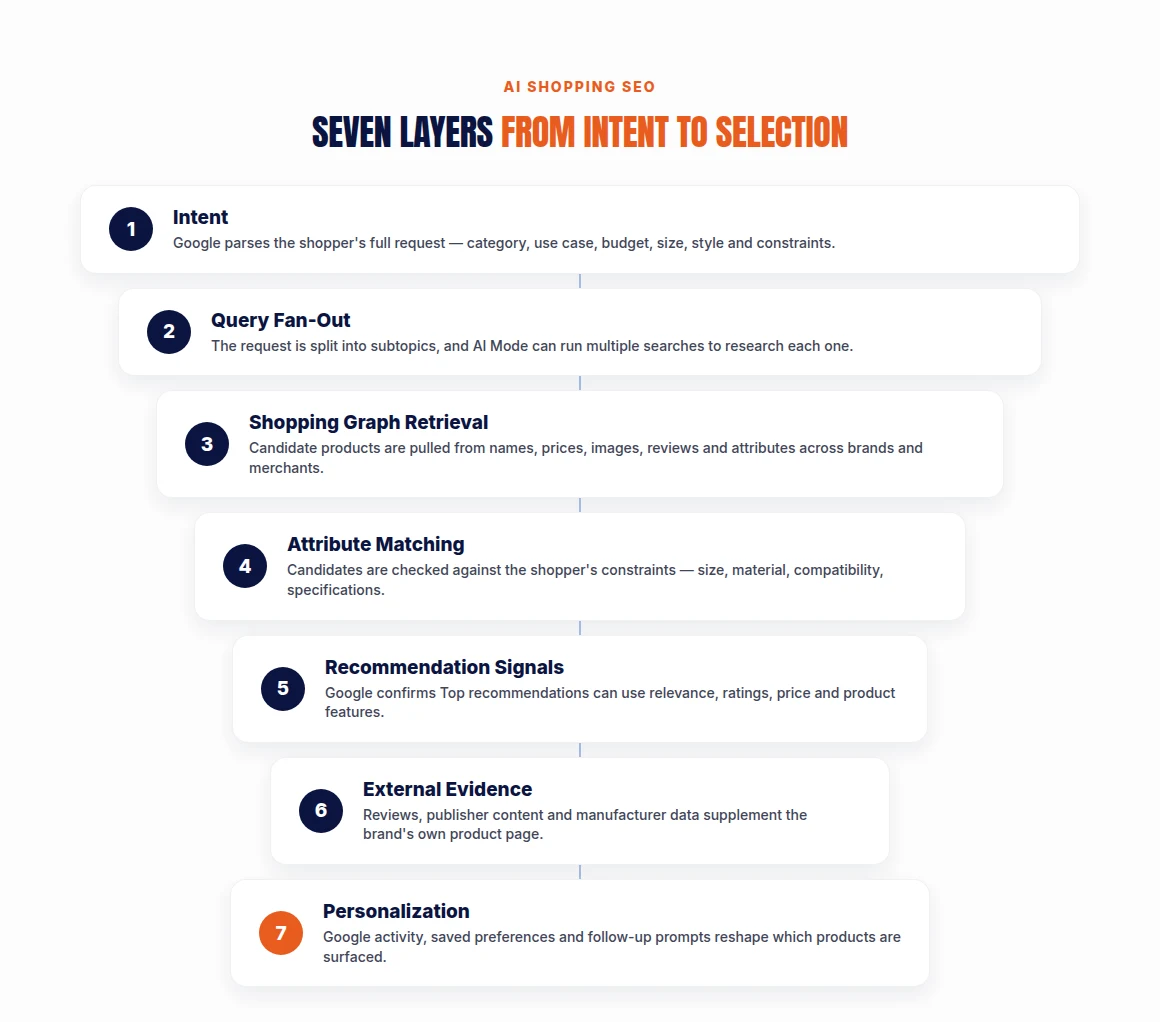
The Seven-Layer Model: How Google Can Choose Products in AI Mode
Google has not published a formal seven-step ranking pipeline.
The following framework is a practical model built from Google’s public documentation.
It separates confirmed mechanisms from interpretation.
Layer 1: Understanding the Shopper’s Intent
The process starts with the user’s request.
AI Mode is designed for complex, conversational queries.
Google says people can ask longer questions, include multiple requirements, and continue with follow-up questions.
That means the system may need to identify:
- product category;
- use case;
- budget;
- size;
- style;
- compatibility;
- material;
- availability;
- performance requirements;
- personal preferences.
Example
User:
Best laptop for a marketing consultant who travels weekly, edits short videos, uses two external monitors and wants at least 10 hours of battery life.
Potential intent signals:
- laptop;
- frequent travel;
- lightweight;
- video editing;
- graphics performance;
- dual-monitor support;
- battery life.
The query itself becomes an attribute map.
Layer 2: Query Fan-Out
Google says AI Mode can use query fan-out.
Instead of sending one search, the system can break the request into subtopics and run multiple searches.
Google has demonstrated this with shopping examples.
A shopper looking for a travel bag might cause AI Mode to research:
- destination weather;
- waterproofing;
- travel duration;
- accessibility;
- product characteristics.
Source: Google
For ecommerce SEOs, this matters because the product may need to perform across multiple retrieval contexts.
One Prompt Can Become Many Searches
Visible prompt:
best ergonomic chair for a tall person with lower-back pain under $800
Possible subtopics:
- chairs for tall users;
- seat-depth requirements;
- lumbar support;
- ergonomic certification;
- weight capacity;
- chairs under $800;
- long-session comfort.
You cannot optimize only for the original phrase.
You need product information that supports the underlying subtopics.
Layer 3: Shopping Graph Candidate Retrieval
Google’s Shopping Graph acts as a large, continuously updated repository of product information.
Google says the Shopping Graph includes information from:
- brands;
- merchants;
- retailers;
- other content providers.
The data can include:
- names;
- descriptions;
- prices;
- images;
- reviews;
- availability;
- product attributes.
Source: Google Shopping Help
Google uses Shopping Graph information across:
- Search;
- Ads;
- YouTube;
- generative AI;
- buying guides;
- recommendations.
This makes product data a core retrieval layer.
Merchant Center Matters Here
Brands and retailers send product information into Google’s ecosystem through tools such as Merchant Center.
If the product is poorly represented there, Google has weaker structured data to work with.
Layer 4: Product Attribute Matching
Once Google understands the user’s constraints, it needs to determine which products match them.
This is where attributes become critical.
Examples:
Apparel
- size;
- color;
- material;
- fit;
- gender;
- age group.
Electronics
- RAM;
- storage;
- processor;
- battery;
- ports;
- display;
- connectivity.
Furniture
- dimensions;
- material;
- weight;
- capacity;
- assembly;
- color.
Outdoor Gear
- waterproofing;
- weight;
- insulation;
- capacity;
- temperature rating;
- dimensions.
Google’s 2026 AI performance insights explicitly surface popular product attributes shoppers use in conversational queries.
Google also provides an attribute-completeness view so merchants can identify products missing those structured values.
Source: Google Merchant Center
That is one of the clearest signals available to ecommerce SEOs:
Product attributes are becoming direct inputs to conversational product matching.
Layer 5: Recommendation Signals
Google’s Shopping Help documentation provides unusually useful detail here.
Google says AI-assisted “Top recommendations” can be selected based on:
- relevance to the search;
- ratings;
- price;
- product features.
Source: Google Shopping Help
This does not mean those four signals are the entire AI Mode ranking system.
It also does not reveal exact weighting.
But it gives ecommerce teams several confirmed recommendation dimensions. If you want to see how these signals play out when Google compares specific products head to head, see how AI Mode ranks popular products against each other.
Relevance
Does the product fit the request?
Ratings
How is the product evaluated by customers?
Price
Does the price make sense relative to the user’s constraints and competing products?
Product Features
Does the product actually provide the capabilities being requested?
This makes AI Mode look less like a keyword-ranking system and more like a product recommendation engine.
Layer 6: External Evidence and Product Information
Google says AI-generated product recommendations are researched using Shopping data aggregated from:
- brands;
- stores;
- other content providers.
That means the product information ecosystem extends beyond the brand’s own product page.
Potential sources can include:
- reviews;
- merchant offers;
- publisher content;
- manufacturer data;
- technical documents;
- retailer listings.
This creates an important distinction.
First-Party Facts
Best for:
- current specifications;
- price;
- availability;
- compatibility;
- materials;
- plan details.
Third-Party Evidence
Useful for:
- reviews;
- product quality;
- user experience;
- comparisons;
- reputation.
AI shopping can potentially synthesize both.
Layer 7: Personalization and Presentation
Google Shopping already uses personalization.
Google says product listings can be influenced by:
- searches;
- product views;
- browsing activity;
- saved shopping preferences.
Source: Google Shopping Help
AI Mode adds conversational context.
A user can say:
Only show black options.
Then:
Under $150.
Then:
I prefer Nike or Adidas.
Each follow-up changes the selection context.
That means AI shopping results are not necessarily stable rankings.
They can be dynamic recommendations.
What Google Has Actually Confirmed
A strong AI shopping SEO strategy should distinguish confirmed facts from speculation.
Confirmed by Google
Google has publicly documented:
- AI Mode uses Gemini capabilities;
- AI Mode can perform query fan-out;
- Shopping Graph data supports generative AI shopping;
- Merchant Center product data is used across Google;
- AI-supported recommendations can use relevance, ratings, price and product features;
- personalization can use Google activity and shopping preferences;
- Merchant Center provides AI share-of-voice reporting;
- Google measures Discovery, Evaluation and Purchase stages;
- Google shows popular conversational product terms;
- Google shows popular product attributes;
- Google recommends improving missing structured attributes;
- Google supports conversational attributes designed for AI surfaces;
- Product Q&A is primarily intended for experiences such as AI Mode.
These are strong foundations.
What Google Has Not Confirmed
Google has not published:
- exact AI Mode ranking weights;
- a “GEO authority score”;
- a product schema boost percentage;
- a backlink weight for AI shopping;
- a fixed review threshold;
- an exact price preference;
- a preferred word count;
- a preferred product-description length;
- a guaranteed ranking benefit from conversational attributes;
- a formula connecting traditional Shopping rank to AI Mode rank.
Be skeptical of anyone presenting those as established facts.
AI Mode Is Closer to Recommendation Optimization Than Traditional Ranking
This is the key strategic shift.
Traditional ecommerce SEO asks:
Can this product rank?
AI shopping SEO asks:
Is this product a good enough match to be recommended?
Those questions overlap.
But recommendation systems require richer product understanding.
A product needs to be:
- relevant;
- accurately described;
- sufficiently detailed;
- competitive;
- well reviewed;
- available;
- appropriately priced;
- suitable for the user’s constraints.
This is why product data matters so much. For more on how individual product pages earn a place in these results, see our breakdown of what actually drives product visibility in AI Mode.
The Role of Merchant Center in AI Shopping SEO
Merchant Center is becoming one of the most important AI shopping optimization tools.
Google’s AI performance report gives merchants direct feedback about conversational shopping visibility.
Current metrics include:
Share of Voice
How much visibility your brand captures relative to competitors.
Competitor Average Share
A benchmark against a defined competitor set.
Frequency
How common certain terms, attributes or intents are.
Products Showing
How many of your products surface for the relevant conversational demand.
Source: Google Merchant Center
This gives ecommerce teams a new optimization loop.
Use AI Share of Voice as a Category Metric
Traditional rank tracking might tell you:
Product X ranks #3 for “running shoes.”
AI share of voice tells you something different:
How often does our brand appear across the relevant conversational shopping space?
This is a broader category-level metric.
It is useful because AI queries can vary dramatically. It also complements the ranking mechanics covered in our guide to how AI Mode shopping rankings actually work.
Measure the Shopping Funnel
Google now organizes AI shopping visibility into three stages.
Discovery
Users are exploring.
Examples:
- best lightweight laptops;
- comfortable office chairs;
- hiking shoes for beginners.
Optimization focus:
- category relevance;
- product attributes;
- use cases;
- descriptions;
- external coverage.
Evaluation
Users are comparing.
Examples:
- Product A vs Product B;
- best 14-inch laptop with 32GB RAM;
- compare trail shoes for wide feet.
Optimization focus:
- specifications;
- reviews;
- variants;
- Q&A;
- product details;
- comparison evidence.
Purchase
Users are close to purchase.
Examples:
- Product A in stock;
- Product B size 10;
- buy Product C under $300.
Optimization focus:
- price;
- availability;
- merchant eligibility;
- variant accuracy;
- transactional data.
A product can be strong at one stage and weak at another.
Product Titles Still Matter—but Differently
Product titles remain important because they define the product.
Google’s product-data specification recommends clear, specific titles.
For AI Mode, titles should help establish:
- product type;
- major differentiators;
- variant;
- high-value attributes.
Example:
Weak:
Summit Pro
Stronger:
Summit Pro Men’s Waterproof Wide-Fit Hiking Boots – Black
The stronger title communicates:
- model;
- gender;
- waterproofing;
- fit;
- category;
- color.
Do not stuff every possible attribute into the title.
Use the title to establish identity.
Use structured attributes and product details for depth.
Product Descriptions Should Become More Factual
Generic ecommerce copy creates weak product understanding.
Weak:
The ultimate choice for everyday performance.
Stronger:
Lightweight men’s trail-running shoe with a wide toe box, 6 mm heel-to-toe drop, rock plate, breathable mesh upper and grippy outsole designed for mixed terrain.
The second description creates attributes.
For AI shopping SEO, descriptions should explain:
- what the product is;
- what it is made from;
- what it does;
- who it is for;
- how it differs;
- where it is used.
Product Identifiers Help Connect the Product Entity
Use correct:
- GTIN;
- brand;
- MPN;
- SKU.
Google uses product identifiers to understand product identity across merchants.
Incorrect identifiers can create:
- duplicate confusion;
- mismatched reviews;
- incorrect offers;
- weak product relationships.
Do not invent GTINs.
Variants Are Critical in Conversational Shopping
AI users often ask for very specific variants.
Examples:
- women’s size 8 wide;
- 256GB model;
- navy version;
- EU plug;
- 65-inch screen.
Use correct variant structures.
Important attributes include:
item_group_id;- size;
- color;
- material;
- pattern;
- gender;
- age group.
A generic product entity may qualify.
The wrong variant may not.
Product Highlights Improve Scannable Feature Understanding
Google’s product_highlight attribute allows merchants to submit key product benefits and characteristics.
Google says these highlights can help users discover product information across AI-driven surfaces.
Use highlights such as:
- 100% recycled nylon shell;
- IP68 water resistance;
- up to 18 hours battery life;
- 32GB unified memory;
- wide-fit option available.
Avoid:
- amazing quality;
- best ever;
- premium design.
Highlights should communicate product facts.
Product Details Give AI More Technical Depth
The product_detail attribute allows merchants to submit additional specifications.
This is especially useful for products where technical details drive purchase decisions.
Examples:
- dimensions;
- capacity;
- voltage;
- materials;
- processor;
- waterproof rating;
- battery;
- weight.
This information can help Google match products to detailed prompts.
Conversational Attributes Are the New AI-Specific Layer
Google introduced conversational Merchant Center attributes specifically to help AI systems understand product nuances.
Current attributes include:
question_and_answer;document_link;related_product;item_group_title;variant_option;popularity_rank.
Source: Google Merchant Center
These attributes complement the standard product feed.
They are not replacements for it.
Product Q&A Is Particularly Important
Google says question_and_answer is primarily intended for conversational experiences such as AI Mode.
Source: Google Merchant Center
This gives merchants a structured way to answer questions such as:
- Is this machine washable?
- Does it support USB-C charging?
- Is the shoe available in wide sizes?
- Is the case included?
- Does the monitor work with MacBook Air?
- Can the sofa cover be removed?
Strong Product Q&A
Question:
Does this backpack fit under an airline seat?
Answer:
The backpack measures 17 × 12 × 7 inches and meets the published personal-item limits of several major U.S. airlines, but travelers should verify their specific airline’s current limits before flying.
This is more useful than:
Yes, perfect for travel!
Product Documents Can Become AI Evidence
Google’s document_link attribute can connect products with relevant supporting documents.
Examples:
- manuals;
- sizing guides;
- technical sheets;
- installation instructions;
- compatibility charts;
- care guides.
For complex products, this can be valuable.
A user might ask:
Can this amplifier support four 8-ohm speakers?
The answer may live in technical documentation rather than marketing copy.
Related Products Help Google Understand Product Relationships
The related_product attribute can describe connections such as:
- accessory;
- replacement;
- bundle;
- compatible product;
- upgrade.
Conversational shopping often involves these relationships.
Examples:
Which filter works with this vacuum?
Which battery fits this drill?
What’s the upgraded version?
Clear product relationships can help AI systems reason about the catalog.
Reviews Can Influence Recommendation Quality
Google explicitly lists ratings as one signal for AI-supported Top recommendations.
This makes review quality a legitimate AI shopping consideration.
Focus on:
- authentic reviews;
- review volume;
- review freshness;
- detailed customer feedback.
Do not manipulate reviews.
The objective is to create trustworthy evidence.
Price Matters, but Do Not Misread It
Google also lists price as a recommendation signal.
That does not mean:
cheapest product wins.
Nor does it mean:
more expensive products rank better.
Price can interact with the user’s request.
Example:
best laptop under $1,500
Price is a hard constraint.
Example:
best premium espresso machine
Higher price may be acceptable.
The system is matching price to intent.
Do not optimize AI Mode by arbitrarily changing prices.
Product Features Matter Because AI Mode Can Compare Them Directly
Google explicitly lists product features among Top recommendation signals.
This reinforces the importance of detailed feature data.
Examples:
- battery duration;
- waterproofing;
- dimensions;
- compatibility;
- weight;
- materials;
- supported protocols;
- certifications.
If important features are missing from the product-information system, AI Mode has less evidence to work with.
External Product Content Can Strengthen the Evidence Layer
Because Google says AI-generated shopping insights can research information from brands, stores and other content providers, external coverage matters.
Potential supporting sources include:
- expert reviews;
- industry publications;
- retailer listings;
- customer reviews;
- comparison guides;
- video reviews.
This is where digital PR and product SEO intersect.
A product should not exist only inside its own marketing page.
How to Optimize for “Best” Queries
Queries such as:
best laptop for travel
often require third-party comparison.
A brand’s own product page is not an impartial source for:
best.
To improve visibility:
- Build complete product information.
- Earn inclusion in credible roundups.
- Generate authentic reviews.
- Provide clear specifications.
- Make differentiating attributes easy to verify.
AI shopping SEO therefore includes earned visibility, not only owned content.
How to Optimize for Feature Queries
Example:
waterproof hiking shoe with wide toe box
Focus on:
- accurate title;
- description;
- width attribute;
- material;
- waterproof feature;
- product detail;
- landing-page text.
Feature queries are highly dependent on product data.
How to Optimize for Compatibility Queries
Example:
monitor that works with MacBook Air M4 and provides 90W charging
Make compatibility explicit.
Use:
- product description;
- technical specifications;
- Q&A;
- documentation;
- related-product data.
Do not assume Google will infer compatibility from generic port information.
How to Optimize for Price-Constrained Queries
Example:
best noise-cancelling headphones under $300
Keep:
- price;
- sale price;
- availability;
- currency;
- Merchant Center;
- schema
consistent.
If the price is stale, the product may no longer qualify.
How to Optimize for Use-Case Queries
Example:
office chair for 10-hour workdays
Product specs alone may not fully answer the question.
Add:
- intended use;
- ergonomic features;
- seat dimensions;
- adjustability;
- warranty;
- external reviews.
Use cases often combine factual data with experiential evidence.
How to Audit AI Shopping SEO
Use this 100-point framework.
It is a diagnostic tool, not Google’s algorithm.
Product Identity — 15 Points
- Clear title: 3
- Correct category: 3
- Correct brand: 3
- GTIN/MPN complete: 3
- Product type clear: 3
Product Attribute Depth — 20 Points
- Core attributes complete: 5
- Specifications detailed: 5
- Variants structured: 5
- Product highlights useful: 5
Transactional Accuracy — 15 Points
- Price current: 5
- Availability current: 5
- Feed/page/schema consistent: 5
Conversational Readiness — 20 Points
- Q&A available: 5
- Product documents linked: 5
- Related products clear: 5
- Product-family relationships clear: 5
Evidence and Reputation — 15 Points
- Ratings present: 5
- Reviews credible: 5
- External product coverage exists: 5
AI Measurement — 15 Points
- Share of voice monitored: 3
- Products showing monitored: 3
- Funnel stages monitored: 3
- Popular terms reviewed: 3
- Attribute gaps reviewed: 3
Score Interpretation
| Score | Assessment |
|---|---|
| 0–39 | Weak AI shopping readiness |
| 40–59 | Basic |
| 60–74 | Competitive |
| 75–89 | Strong |
| 90–100 | Excellent product-information foundation |
A high score does not guarantee AI Mode placement.
It means the product information is better prepared for AI-assisted discovery.
A Practical AI Shopping SEO Workflow
Step 1: Build a Conversational Prompt Set
Create 50–100 realistic shopping prompts.
Cover:
- Discovery;
- Evaluation;
- Purchase.
Step 2: Map Each Prompt to Product Attributes
Example:
lightweight waterproof jacket for hiking under $200
Attributes:
- product type;
- weight;
- waterproofing;
- use case;
- price.
Step 3: Audit Merchant Center
Check whether those attributes are present.
Step 4: Audit the Product Page
Check whether the same facts are visible.
Step 5: Audit Structured Data
Confirm:
- price;
- availability;
- product identity;
- offer.
Step 6: Add Conversational Attributes
Where appropriate:
- Q&A;
- documents;
- related products.
Step 7: Review Merchant Center AI Performance
Look for:
- low share of voice;
- missing attributes;
- top terms;
- funnel-stage gaps.
Step 8: Test Competitors
Identify which products consistently appear and why.
Step 9: Improve Evidence
Strengthen:
- reviews;
- external coverage;
- product documentation.
Step 10: Repeat
AI shopping visibility will change as:
- product data changes;
- competitors change;
- Google changes;
- demand changes.
Treat it as an ongoing channel.
The AI Shopping SEO KPI Framework
Do not use one metric.
Track:
Visibility
- share of voice;
- products showing;
- product inclusion rate.
Funnel
- Discovery;
- Evaluation;
- Purchase.
Data Quality
- attribute completeness;
- identifier completeness;
- feed errors.
Competitive
- competitor inclusion;
- competitor share.
Reputation
- ratings;
- review coverage;
- external mentions.
Commercial
- product views;
- branded search;
- conversions;
- revenue.
This creates a much stronger management system than “AI rank.”
Common AI Shopping SEO Mistakes
Mistake 1: Treating AI Mode Like Another Keyword Ranking
Conversational shopping contains multiple constraints.
Mistake 2: Ignoring Merchant Center
Google’s Shopping Graph depends heavily on merchant product information.
Mistake 3: Using Generic Product Descriptions
Generic copy creates weak product understanding.
Mistake 4: Missing Attributes
If shoppers ask for a specification, make sure it is structured when supported.
Mistake 5: Incorrect Variants
Variant confusion can eliminate relevance for exact queries.
Mistake 6: Treating Schema as the Entire Strategy
Structured data helps.
It does not replace product data, reviews, relevance or price.
Mistake 7: Manipulating Reviews
Authentic reviews build evidence.
Fake reviews create risk.
Mistake 8: Chasing Unconfirmed Ranking Factors
Do not treat correlation studies as Google documentation.
Mistake 9: Measuring One Prompt
Conversational outputs vary.
Use prompt sets.
Mistake 10: Ignoring Product Information Consistency
Feed, page and schema should agree.
How AI Shopping SEO Changes Ecommerce Team Structure
Historically, product-data responsibilities were fragmented.
SEO:
- landing pages;
- category pages;
- schema.
Paid media:
- Merchant Center.
Merchandising:
- attributes;
- categories.
Product team:
- specifications.
AI shopping makes that fragmentation inefficient.
The same product data can influence:
- Shopping;
- organic listings;
- AI Mode;
- AI Overviews;
- Gemini;
- recommendations.
AI shopping SEO should therefore become a cross-functional discipline.
The Future: From Product Search to Product Agents
Google is moving beyond product recommendations toward more agentic commerce.
As shopping assistants become capable of:
- researching;
- comparing;
- checking inventory;
- evaluating prices;
- selecting products;
- helping with checkout;
structured product data will become even more important.
The ecommerce website will still matter.
But it will increasingly operate as one node inside a machine-readable commerce ecosystem.
Brands that treat product data as a strategic asset will be better positioned than brands treating it as a feed-maintenance task.
FAQ
What is AI shopping SEO?
AI shopping SEO is the optimization of product information so AI-powered shopping systems can more accurately discover, understand, compare and surface products for conversational shopping queries.
How does Google choose products in AI Mode?
Google has not published a full ranking formula. It has confirmed that AI shopping uses Gemini capabilities, query fan-out, Shopping Graph data and AI research. Google also says Top recommendations can use relevance, ratings, price and product features.
Does Google AI Mode use Merchant Center?
Merchant Center product information contributes to Google’s Shopping Graph and broader commerce ecosystem. Google also provides Merchant Center AI performance insights specifically for AI Mode, AI Overviews and other conversational shopping experiences.
What product data matters most for AI Mode?
Important data includes product identity, titles, descriptions, identifiers, price, availability, variants, product attributes, specifications, ratings, reviews and relevant conversational attributes.
Does Product schema improve AI Mode rankings?
Product structured data helps Google understand product information and maintain consistency with Merchant Center data. Google has not stated that Product schema provides a guaranteed AI Mode ranking boost.
Are reviews important for AI shopping SEO?
Yes. Google explicitly lists ratings among the signals used for AI-supported Top recommendations. Authentic review quality and coverage can therefore matter.
Does price affect AI Mode recommendations?
Google says price can be considered for Top recommendations. However, Google has not published an exact price weighting, and higher or lower prices are not universally better. Relevance to the user’s budget and intent matters.
What is query fan-out?
Query fan-out is AI Mode’s process of dividing a complex question into related subtopics and running multiple searches before synthesizing the response.
What are conversational Merchant Center attributes?
They are optional product-data fields designed to help AI systems understand product nuances. Examples include question and answer, document link, related product, item group title and variant information.
How should ecommerce brands measure AI shopping SEO?
Track Merchant Center AI share of voice, products showing, shopping-stage visibility, top terms, attribute completeness, competitor inclusion, product accuracy, AI referral activity and downstream commercial outcomes.
Bottom Line
Google AI Mode is changing ecommerce search from a simple ranking problem into a product-selection problem.
The system is not only asking whether a page is relevant to a keyword. It can interpret an entire shopping scenario, break that scenario into subquestions, search across Google’s commerce and web information, compare product attributes, consider ratings, price and features, personalize the experience, and then surface a limited set of recommendations.
That makes AI shopping SEO fundamentally dependent on product information quality.
The winning strategy is not to chase hypothetical AI ranking factors. Google has already given merchants enough confirmed guidance to act: maintain accurate Merchant Center data, structure variants correctly, improve product titles and descriptions, complete product attributes, keep price and availability consistent, add product highlights and specifications, use conversational Q&A and documents where useful, earn authentic reviews, and monitor AI share of voice and shopping-stage visibility.
The long-term advantage will belong to brands that make their products easy for both humans and machines to evaluate. In AI shopping, the product that is easiest to understand, verify and match to the buyer’s real constraints has a much stronger chance of being selected.