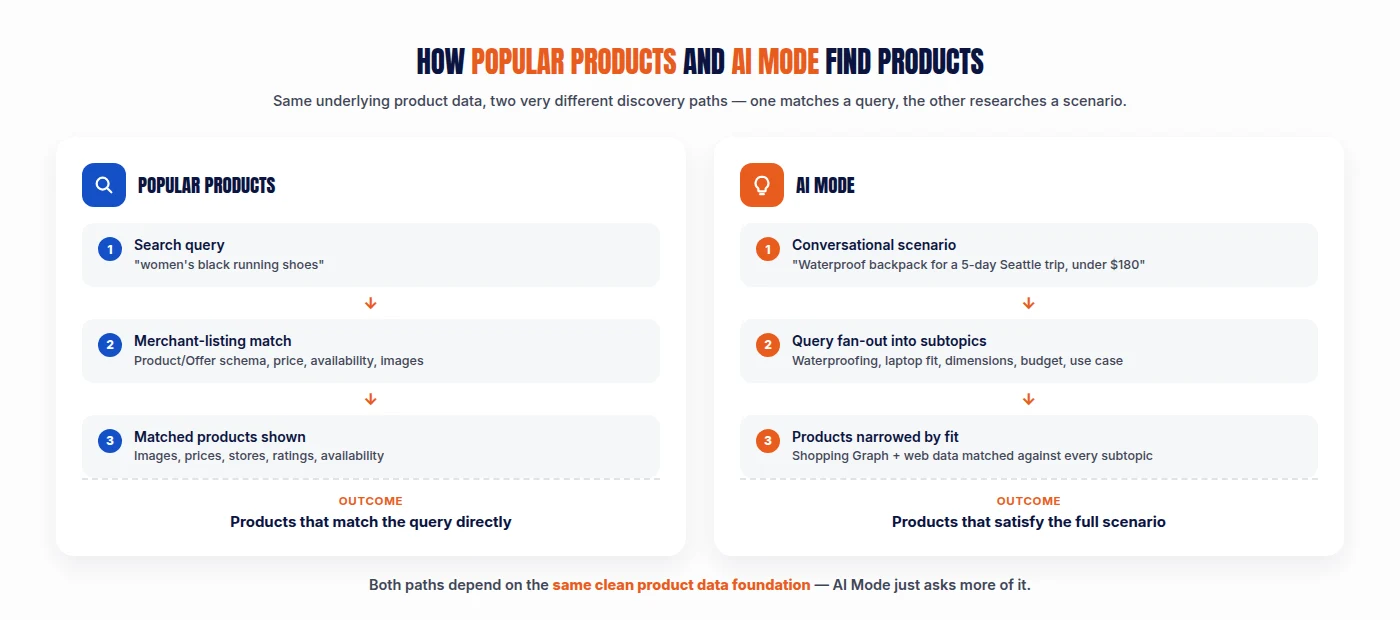
Popular Products is part of Google’s merchant-listing ecosystem. Product pages with valid Product and Offer structured data can become eligible for merchant listing experiences such as Popular Products, product snippets, Google Images, and shopping knowledge panels.
AI Mode is a conversational search experience. It can interpret complex multi-part requests, perform query fan-out, combine Shopping Graph data with information from across the web, and narrow products according to the full context of the user’s request. For a broader look at how that shift is reshaping ecommerce visibility overall, see how Google AI Mode is changing ecommerce.
The optimization foundation overlaps:
- accurate product data
- Merchant Center
- Product and Offer structured data
- correct price and availability
- strong product titles and descriptions
- complete variants
- reviews
- high-quality images
But AI Mode adds another requirement:
Your product needs enough structured and descriptive information to qualify for a conversational shopping intent, not just a conventional product query.
Ecommerce teams should therefore optimize once for a strong product-data foundation, then add an AI-specific layer around attributes, product Q&A, conversational data, intent coverage, and AI performance measurement.
What Is Google Popular Products?
Popular Products is one of Google’s merchant-listing experiences.
Google’s current Search Central documentation says that when merchants add eligible Product structured data to product pages, those pages may become eligible for merchant listing experiences including:
- Popular Products
- shopping knowledge panels
- Google Images
- product snippets
Source: Google Search Central
Popular Products is designed to help users browse products directly from search results.
A user might search:
women’s black running shoes
and receive a product-oriented search experience containing:
- images
- products
- prices
- stores
- ratings
- availability
The interaction still resembles conventional search and shopping discovery.
The user provides a search query. Google returns products matching that query.
What Is Google AI Mode Shopping?
AI Mode is Google’s conversational AI search experience.
Google says AI Mode can:
- answer complex questions
- support follow-up questions
- break questions into subtopics
- search multiple topics simultaneously
- use web information and Google’s information systems
- incorporate shopping data
For shopping, Google combines Gemini capabilities with the Shopping Graph.
Source: Google Search Help
This means a shopper can ask something much richer than a normal product query.
Example:
I need a lightweight waterproof backpack for a five-day business trip to Seattle. It needs a laptop sleeve, quick-access front pocket, airline personal-item dimensions, and should cost less than $180.
Instead of matching one phrase, AI Mode can reason across:
- waterproofing
- trip duration
- laptop compatibility
- dimensions
- pocket accessibility
- budget
- travel use
That creates a different product-selection environment. For more on how that environment affects what shows up for a given product, see what determines product visibility in AI Mode.
Google AI Mode vs Popular Products at a Glance
| Factor | Popular Products | Google AI Mode |
|---|---|---|
| User interaction | Search query | Conversational query |
| Follow-up questions | Limited | Core experience |
| Query complexity | Usually shorter | Often multi-part |
| Product discovery | Search/merchant listing | AI-assisted research |
| Query fan-out | Not the defining interface | Core AI Mode capability |
| Product structured data | Important | Important as part of broader product data |
| Merchant Center | Important | Important |
| Shopping Graph | Supports shopping ecosystem | Explicitly central to AI shopping |
| Product attributes | Important | Especially important for complex matching |
| Web research | Search environment | AI synthesis across multiple sources |
| Personalization | Can apply | Can apply deeply through conversation |
| Measurement | Search/Shopping metrics | AI share of voice, funnel stage, terms, attributes |
| Follow-up refinement | New query/filter | Natural-language conversation |
The important point is not that one system is “better.” They solve different shopping tasks.
The Shared Foundation: Product Data
Before discussing differences, ecommerce teams should understand what the two surfaces share.
Both depend on Google understanding the product accurately. That includes:
- product identity
- title
- brand
- price
- availability
- images
- variants
- specifications
- merchant information
This is why traditional ecommerce SEO remains relevant.
AI Mode does not make clean product data obsolete. It makes poor data more costly.
Product Structured Data Supports Merchant Listing Eligibility
Google recommends adding Product structured data to product pages.
For merchant listings, structured data can communicate information such as:
- name
- image
- price
- currency
- availability
- condition
- shipping
- return information
Google’s documentation states that product pages can become eligible for merchant-listing experiences when markup requirements are met.
Source: Google Search Central
Important Limitation
Eligibility is not ranking.
Adding Product schema does not guarantee:
- Popular Products visibility
- AI Mode visibility
- high Shopping rankings
Structured data improves machine-readable product understanding. It does not override relevance, competition, quality, or selection systems.
Popular Products Is More Closely Tied to Merchant Listing Eligibility
Popular Products exists within Google’s merchant-listing environment. That means technical eligibility matters significantly.
Google’s merchant-listing guidelines require product-focused pages where users can actually purchase the product.
Google also recommends:
- focusing markup on individual product pages
- correctly handling variants
- keeping product data current
- placing Product structured data in initial HTML where possible
Google specifically warns that JavaScript-generated Product markup can make shopping crawls less frequent and less reliable, particularly for fast-changing information such as price and availability.
Source: Google Search Central
For Popular Products, basic eligibility failures can stop the product before any ranking discussion begins.
AI Mode Adds a Conversational Interpretation Layer
AI Mode adds another step. The system needs to understand what the shopper actually wants.
Google explains that AI Mode can divide a question into subtopics and search for each one simultaneously.
For shopping, Google’s own example involved a shopper looking for a travel bag for Portland in May.
AI Mode researched:
- weather
- rain
- long journeys
- waterproofing
- pocket accessibility
It then used those criteria to suggest products.
Source: Google
This is the major distinction.
Popular Products: Match this product search.
AI Mode: Understand this shopping scenario, research what matters, then find products that satisfy it.
Why the Same Product May Appear in Popular Products but Not AI Mode
Imagine a retailer sells a hiking jacket. The product has:
- valid Product markup
- correct price
- strong images
- Merchant Center approval
- high Shopping visibility
It may be an excellent candidate for Popular Products.
Now the shopper asks AI Mode:
I need a lightweight waterproof hiking shell for Iceland in October that packs into a small backpack, has pit zips, and costs under $200.
The product may disappear if Google cannot establish:
- weight
- packability
- waterproof rating
- pit zips
- price
- intended use
The product is still a hiking jacket. It simply lacks the information needed for the conversational constraint set.
Why a Product May Appear in AI Mode but Not Dominate Popular Products
The reverse can also happen.
A niche product may not have:
- broad search volume
- strong Popular Products visibility
- massive brand demand
But it may be an excellent fit for a very specific AI query.
Example:
compact espresso machine under 12 inches wide with a built-in grinder for a small apartment kitchen
A niche product with excellent attribute matching may become relevant even if it is not one of the most visible products in broad product search.
This illustrates a key AI shopping opportunity: specific relevance can create visibility beyond broad popularity.
Popular Products SEO Is Still Search-Oriented
Popular Products optimization should emphasize:
- merchant listing eligibility
- Product/Offer structured data
- product-page indexing
- descriptive titles
- Merchant Center completeness
- price
- availability
- reviews
- images
- variants
The user still behaves more like a searcher. Examples:
- dining table
- gaming laptop
- women’s trail shoes
- leather sofa
The product-result interface helps the user browse options.
AI Mode SEO Is More Intent-Oriented
AI Mode users can describe:
- situation
- budget
- constraints
- preferences
- compatibility
- use case
- style
Examples:
gaming laptop under $1,700 with RTX graphics, at least 32GB RAM, good battery life, and a screen suitable for color-sensitive design work.
Or:
washable sectional sofa for a home with two dogs, narrow doorway access, neutral fabric, and budget under $3,500.
These requests do not map neatly to one traditional keyword. They map to clusters of attributes. This is the same shift covered in more depth in our guide to AI shopping SEO for Google AI Mode.
Product Attributes Become More Important in AI Mode
Google’s 2026 Merchant Center AI performance insights make this especially clear.
The report identifies popular product attributes users request in conversational shopping. Examples include:
- color
- style
- material
- specifications
Google then provides an attribute-completeness view to help merchants identify products missing these structured values.
Source: Google Merchant Center
This is direct optimization guidance. If users repeatedly ask for an attribute and your product actually has it, Google wants that attribute submitted clearly.
Merchant Center Is the Bridge Between Both Experiences
Ecommerce teams sometimes split responsibilities like this:
SEO: website
Paid media: Merchant Center
That division is becoming outdated.
Merchant Center is increasingly central to organic AI shopping discovery.
Google’s 2026 AI performance reporting explicitly covers product discovery through:
- AI Mode
- AI Overviews
- Gemini
Source: Google Merchant Center
SEO teams should therefore collaborate on:
- feeds
- attributes
- product titles
- descriptions
- identifiers
- variants
- AI performance insights
Merchant Center is becoming part of technical ecommerce SEO.
Google’s Shopping Graph Powers the Broader Commerce Ecosystem
Google says people shop across Google more than a billion times per day.
At Google I/O 2026, Google said the Shopping Graph contained more than 60 billion product listings.
Source: Google
The Shopping Graph supports a wide range of product discovery.
That means brands should think less about optimizing one SERP feature and more about maintaining one high-quality product entity across Google’s commerce systems.
Your product information should agree across:
- website
- schema
- Merchant Center
- manufacturer information
- images
- offers
AI Mode Adds Web Research to Product Data
Google explains that AI Mode is supported by Google’s understanding of web information and can search multiple sources.
This is important because AI shopping is not limited to merchant feeds.
A product’s information environment may include:
- reviews
- editorial content
- manufacturer documentation
- product pages
- forums
- merchant offers
The system can synthesize context. That means external reputation may matter more during conversational evaluation.
For example:
Which cordless vacuum works best for pet hair on hardwood floors?
Product specs matter. But so can:
- reviews
- expert testing
- comparison content
- user experiences
Both sources can matter.
Popular Products and AI Mode May Serve Different Stages
A useful way to think about the difference is the buyer journey. Google’s own funnel-stage terminology for AI shopping visibility is Discovery, Evaluation, and Purchase — not a generic “ready to buy” label.
| Funnel Stage | Example User Query | AI Mode’s Role | Popular Products’ Role |
|---|---|---|---|
| Discovery | best mattress for side sleepers | Synthesize criteria, explain firmness, identify candidates | Present purchasable options |
| Evaluation | mattress A vs mattress B for a 200-pound side sleeper | Compare attributes, research reviews, explain tradeoffs | May still show products, but the interface is less suited to long-form reasoning |
| Purchase | mattress A queen size | May provide purchasing assistance, availability, or checkout pathways | Popular Products and merchant listings become highly useful |
The two surfaces can therefore complement one another.
Google Is Moving Toward Agentic Shopping
The distinction becomes even more important when you look at Google’s 2026 commerce direction.
Google has introduced and expanded the Universal Commerce Protocol, designed to help shopping agents interact with retailers.
Google says UCP can support:
- real-time pricing
- inventory
- product details
- cart actions
- checkout flows
Source: Google
This suggests AI shopping will increasingly move beyond recommend a product toward research, compare, select, and help complete the purchase.
Traditional merchant-listing optimization remains necessary. But agentic commerce adds new data and interoperability requirements.
The Ecommerce SEO Strategy Should Be Layered
Do not create two completely separate optimization programs. Build three layers.
Layer 1: Product Eligibility
Needed for Google’s commerce ecosystem. Focus on:
- Merchant Center approval
- valid feed
- Product/Offer schema
- correct price
- availability
- identifiers
- images
- variants
Layer 2: Product Understanding
Needed for both traditional and AI discovery. Focus on:
- descriptive titles
- detailed descriptions
- product highlights
- specifications
- categories
- attributes
Layer 3: Conversational Qualification
Especially important for AI Mode. Focus on:
- product Q&A
- documents
- related products
- detailed variant relationships
- intent coverage
- external evidence
- AI share-of-voice measurement
This layered approach prevents duplicated work.
Popular Products Optimization Checklist
Product Page
- Product-focused URL.
- Indexable.
- Canonical correct.
- Product name visible.
- Price visible.
- Availability visible.
- Product image accessible.
Structured Data
- Valid Product markup.
- Valid Offer data.
- Price matches page.
- Currency matches.
- Availability matches.
- Variant implementation correct.
- Merchant listing eligibility tested.
Merchant Center
- Product approved.
- GTIN correct.
- Brand correct.
- Category accurate.
- Title descriptive.
- Description accurate.
- Images high quality.
AI Mode Optimization Checklist
Start with everything above. Then add:
- Important product attributes complete.
- Product details submitted.
- Product highlights added.
- Common product questions answered.
- Supporting product documents available.
- Related products structured.
- Variants clearly related.
- Landing page contains detailed specifications.
- External product evidence exists.
- AI performance insights reviewed.
- Discovery visibility measured.
- Evaluation visibility measured.
- Purchase visibility measured.
- Popular AI terms reviewed.
- Missing attributes fixed.
Product Structured Data: Shared Foundation, Different Outcome
Product schema is relevant to both experiences. But its role should not be exaggerated.
For Popular Products: Product markup is directly tied to merchant-listing eligibility.
For AI Mode: Product markup contributes structured product understanding inside a larger shopping and search ecosystem.
This is why the statement “Product schema helps AI Mode” is reasonable. But “Product schema makes you rank in AI Mode” is not supported. The AI selection process is more complex.
Do Category Pages Matter?
Yes.
Product pages are not the only useful ecommerce pages.
A user might ask:
show me compact dining tables for four people under $800
A category page can help organize relevant products.
Traditional Google experiences often use category pages for broader intent. AI Mode may also retrieve category-level content when it needs to understand product sets.
Strong category pages should include:
- clear category definition
- useful filters
- product attributes
- internal links
- buying guidance
- product relationships
Avoid category pages that consist only of a grid and no contextual information.
Reviews Matter in Both Systems
Google Shopping already uses ratings and reviews.
Google’s current Shopping Help documentation says AI-generated product recommendations can consider:
- relevance
- ratings
- price
- product features
Source: Google Shopping Help
That means product reputation matters in both conventional and AI-supported shopping.
But reviews may become especially valuable during evaluation-oriented AI questions.
Example:
Which air purifier is quieter in a bedroom?
Specifications may provide decibel ratings. Reviews may explain actual user experience. Both sources can matter.
Images Matter Differently in AI Mode
Google AI Mode increasingly supports visual discovery.
Google has described AI Mode as allowing shoppers to describe what they want conversationally and explore visual results.
Source: Google
This means image quality remains critical. Best practices include:
- accurate primary image
- clean background where appropriate
- variant-specific imagery
- useful lifestyle images
- consistent product representation
Do not rely on images to communicate attributes that should also exist as text or structured data.
The Role of Personalization
Traditional Shopping can personalize product results based on:
- searches
- views
- browsing activity
- saved preferences
Source: Google Shopping Help
AI Mode can add conversational context on top of that.
If the user says: I don’t like leather, the following product set can immediately change.
Then: Show only black options. The result narrows again.
This makes AI shopping visibility less static than a normal ranking position.
Why “Rank Tracking” Becomes Harder in AI Mode
Popular Products can still be monitored through conventional search-performance approaches.
AI Mode introduces:
- conversational variation
- follow-up queries
- dynamic query fan-out
- personalization
- changing product subsets
A fixed ranking position becomes less meaningful.
Better metrics include:
- product inclusion rate
- share of voice
- products showing
- buyer-stage visibility
- attribute coverage
- competitor inclusion
Google’s Merchant Center AI reporting is already moving in this direction — the same shift we track in detail in how AI Mode is changing shopping rankings.
What Ecommerce SEOs Should Optimize Once for Both
Do this once:
- Clean Merchant Center data.
- Accurate product identifiers.
- Strong titles.
- Strong descriptions.
- Product structured data.
- Correct variants.
- Price consistency.
- Availability consistency.
- High-quality images.
- Reviews.
These support Google’s broader commerce ecosystem.
What Ecommerce SEOs Should Add Specifically for AI Mode
Add:
- Deeper product attributes.
- Conversational Q&A.
- Product documents.
- Related-product relationships.
- Search-intent analysis.
- Discovery/evaluation/purchase measurement.
- AI share-of-voice tracking.
- Conversational prompt testing.
This is the incremental AI layer. For a step-by-step walkthrough of implementing it, see improving product visibility in AI Mode.
Common Mistakes
Mistake 1: Treating Popular Products and AI Mode as the Same SERP
They share infrastructure. They do not create identical product experiences.
Mistake 2: Creating Separate Product Pages for AI Mode
Do not create duplicate “AI versions” of your product pages. Improve the canonical product source.
Mistake 3: Ignoring Merchant Center
AI Mode does not eliminate product feeds. Google explicitly uses Shopping Graph data.
Mistake 4: Overvaluing Schema
Schema supports machine understanding. It is not the entire AI ranking system.
Mistake 5: Ignoring Conversational Attributes
Google is explicitly introducing fields designed for AI shopping experiences.
Mistake 6: Measuring Only Clicks
AI shopping can influence:
- discovery
- consideration
- later branded search
- purchase decisions
Visibility metrics need to broaden.
Mistake 7: Assuming Popular Products Success Guarantees AI Mode Success
A product can satisfy a short query while failing a complex conversational intent.
A Practical Optimization Workflow
Step 1: Validate Merchant Listing Eligibility
Use Google’s structured data tools and Merchant Center diagnostics.
Step 2: Audit Product Data
Review:
- titles
- descriptions
- identifiers
- price
- availability
- variants
- attributes
Step 3: Audit Product Pages
Ensure important product facts are visible.
Step 4: Add AI-Ready Depth
Implement:
- product highlights
- specifications
- Q&A
- product documentation
- related products
Step 5: Review AI Performance Insights
Identify:
- low share of voice
- missing attributes
- important terms
- funnel-stage weaknesses
Step 6: Test Conversational Queries
Compare results across:
- standard Search
- Shopping
- AI Mode
Step 7: Improve the Product Information System
Do not optimize only one surface. Improve the product entity across Google.
FAQ
What is the difference between Google AI Mode and Popular Products?
Popular Products is a merchant-listing/search product experience, while AI Mode is a conversational AI search experience that can interpret complex requests, perform query fan-out, synthesize information, and support follow-up questions.
Does Product schema help with Popular Products?
Yes. Google says eligible Product and Offer structured data can make product pages eligible for merchant-listing experiences including Popular Products.
Does Product schema help with AI Mode?
It can contribute to Google’s understanding of product information, but Google has not stated that Product schema guarantees AI Mode visibility.
Can a product appear in Popular Products but not AI Mode?
Yes. A product may satisfy conventional search intent but lack the detailed attributes needed for a complex AI Mode shopping request.
Can a product appear in AI Mode without being dominant in Popular Products?
Potentially. A niche product with strong attribute fit may be relevant to a specific conversational request even if it does not dominate broad product discovery.
Is Merchant Center important for both?
Yes. Merchant Center product data is part of Google’s broader commerce ecosystem and is increasingly important for AI-powered shopping experiences.
What is query fan-out?
Query fan-out is AI Mode’s process of breaking a complex question into multiple related searches and researching those subtopics before generating a response.
What should ecommerce SEOs optimize specifically for AI Mode?
Focus on detailed product attributes, product Q&A, supporting documents, related-product relationships, variant clarity, conversational intent coverage, and Merchant Center AI performance insights.
Is Popular Products replacing Google Shopping?
No. Google offers multiple overlapping product-discovery surfaces. Ecommerce teams should optimize their product information so it can perform across the broader Google commerce ecosystem.
How should I measure AI Mode compared with Popular Products?
Use conventional search and Merchant Center visibility metrics for merchant-listing surfaces, then add AI-specific metrics such as share of voice, products showing, shopping-stage visibility, popular terms, attributes, and product inclusion across conversational prompts.
Bottom Line
Google AI Mode and Popular Products should not be treated as competing versions of the same feature.
Popular Products represents the familiar merchant-listing side of Google commerce: structured product eligibility, price, availability, offers, images, reviews, and relevant product matching. AI Mode sits on top of a broader reasoning and research process. It can interpret an entire shopping scenario, break the request into subtopics, draw from the Shopping Graph and the web, then refine the product set through conversation.
The good news for ecommerce teams is that most of the foundation overlaps. You do not need one SEO strategy for Popular Products and a completely separate one for AI Mode. You need a strong underlying product-information system: accurate Merchant Center data, valid Product and Offer markup, complete identifiers, strong titles and descriptions, clean variants, reliable pricing and availability, useful images, and credible reviews.
Then AI Mode requires an additional layer. Product attributes need more depth. Common buyer questions need explicit answers. Product relationships and specifications need to be clear. AI visibility needs to be measured by intent and buyer stage rather than only by ranking position.
The strategic shift is from optimizing for individual Google product features to building a product entity that is strong enough to travel across Google’s entire shopping ecosystem. Popular Products rewards eligibility and product relevance. AI Mode adds conversational qualification. Ecommerce brands that prepare for both will be better positioned for where Google shopping is heading next.