Astra is not yet broadly available, OpenAI has not announced a specific public release date, and it has not officially called the model GPT-6. OpenAI says it plans to make Astra available soon, although access to its most advanced cybersecurity capabilities will initially be restricted.
For marketers, Astra matters less because of cybersecurity itself and more because of what its capabilities suggest: frontier AI is moving beyond generating answers toward systems capable of reasoning through difficult problems, conducting longer autonomous workflows, and potentially taking more consequential actions. See how OpenAI Astra could change AI agents and search for a deeper look at that shift.
What Is OpenAI Astra?
OpenAI Astra is an unreleased frontier AI model that OpenAI describes as its next major model.
The name first became especially significant on August 1, 2026, when OpenAI revealed that an internal version of Astra had generated results that resolved or substantially advanced ten long-standing problems in mathematics and theoretical computer science.
The problems covered fields including high-dimensional geometry, coding theory, arithmetic circuit complexity, group theory, quantum complexity, lattice cryptography, and extremal combinatorics. OpenAI says the mathematical arguments were generated by Astra, subsequently prepared into manuscripts with human involvement, and then formalized into machine-checkable Lean certificates.
That alone made Astra notable.
Then, on September 1, OpenAI disclosed another major development: Astra had become the first OpenAI model classified as reaching the company’s Critical cybersecurity capability threshold under its Preparedness Framework.
That designation is important because it provides evidence that Astra is not simply another incremental language-model update.
OpenAI’s evaluations suggest that the system can perform certain complex, long-horizon tasks with considerably greater autonomy than earlier models.
However, there is an equally important caveat: OpenAI has not yet published Astra’s complete specifications.
We do not currently have a complete picture of its general-purpose performance, pricing, context window, API availability, multimodal capabilities, or consumer-product integration.
So the most accurate description today is: Astra is OpenAI’s upcoming major frontier model, with publicly demonstrated advances in scientific reasoning, cybersecurity capability, efficiency, and alignment, but many of its everyday product capabilities remain undisclosed.
Why Is OpenAI Astra Getting So Much Attention?
Most new AI-model announcements focus on benchmarks showing that one model is slightly better at coding, mathematics, writing, or reasoning than another. Astra’s introduction has been different. OpenAI has highlighted capabilities involving problems that are considerably harder to evaluate with ordinary benchmark questions. Two areas stand out.
Astra Has Produced New Mathematical Results
On August 1, OpenAI disclosed ten results produced by an internal version of Astra. These were not simply answers to textbook mathematics problems.
According to OpenAI, each result either resolved or made substantial progress on a long-standing open problem. The subjects included sphere packing, binary and spherical codes, arithmetic circuit complexity, quantum games, lattice problems related to cryptography, Ramsey numbers, and other areas of theoretical mathematics and computer science.
The distinction matters. Traditional benchmark performance asks: can a model answer a difficult question when a correct answer already exists? Research-level discovery asks something closer to: can the system reason its way toward a useful result when the answer is not already known? Those are fundamentally different tests of capability.
That does not mean Astra can independently conduct every kind of scientific research, and it certainly does not prove artificial general intelligence. But it does provide evidence that frontier models are becoming more useful as research collaborators rather than merely information-retrieval or content-generation systems.
Astra Has Reached OpenAI’s Critical Cybersecurity Threshold
The second major signal arrived on September 1. OpenAI said Astra meets its Critical cybersecurity capability threshold. Under the company’s framework, that level includes the capability, given appropriate tools and access, to identify previously unknown security vulnerabilities and develop working exploits across hardened systems without requiring a human to direct every individual step.
In one disclosed evaluation, Astra achieved a perfect score on ExploitBench, which tests exploit development based on known vulnerabilities.
OpenAI then created a more recent internal benchmark involving 20 high-severity V8 vulnerabilities. It reported that Astra achieved substantially higher arbitrary code-execution rates than GPT-5.6 Sol while using fewer output tokens. During that evaluation, Astra also discovered and used two previously unknown vulnerabilities as part of an exploit chain.
Again, marketers are unlikely to use Astra for cybersecurity research. But the underlying capability is highly relevant. A model capable of planning, investigating, testing, adapting, and completing complicated tasks autonomously represents a different type of AI from a system primarily optimized to produce a response to a prompt.
What Can OpenAI Astra Actually Do?
Because Astra has not yet fully launched, it is important to separate confirmed capabilities from assumptions.
Advanced Reasoning on Difficult Research Problems
Astra has demonstrated the ability to produce useful results on previously unresolved mathematical and theoretical-computer-science problems. This is currently some of the strongest public evidence that Astra can reason beyond standard question-answering benchmarks.
Autonomous Vulnerability Research
OpenAI reports that Astra can identify vulnerabilities, develop exploits, and combine findings into more complex exploit chains in controlled cybersecurity evaluations. The broader lesson is that Astra appears better equipped for extended workflows in which the model must determine intermediate steps rather than simply follow a detailed set of human instructions.
Greater Token Efficiency
OpenAI says Astra is significantly more token-efficient than GPT-5.6 Sol on the cybersecurity evaluations it has disclosed. That means Astra was able to accomplish more of the tested work while producing substantially fewer output tokens in some scenarios. Efficiency matters because the economics of AI agents depend not only on intelligence but also on how much computation and model output are required to complete a task.
Stronger Adherence to Restrictions
Astra has also demonstrated stronger alignment behavior than GPT-5.6 Sol in OpenAI’s internal tests. For example, OpenAI reported that Astra refused 91.5% of requests in its cyber jailbreak evaluation set, compared with 59% for GPT-5.6 Sol.
In another simulated evaluation designed to test whether models would exceed their authorized scope, Astra avoided actions that GPT-5.6 Sol attempted under the same test conditions.
This combination, greater capability alongside stronger adherence to restrictions, is significant because more autonomous models require stronger safeguards if they are going to perform consequential work.
What Has Not Been Confirmed About Astra?
This section is just as important as the confirmed capabilities. As of September 2, 2026, OpenAI has not publicly confirmed complete details about:
- Astra’s API pricing
- Astra’s context-window size
- Maximum output-token limits
- Complete multimodal capabilities
- Exact ChatGPT availability
- Whether Astra will replace GPT-5.6 Sol
- Whether Astra will officially become GPT-6
- Whether Astra will power ChatGPT Search
- Its complete consumer release schedule
- Its final API model name
- General marketing or content-generation benchmarks
- Search-quality benchmarks
- Complete coding benchmarks
- Everyday productivity performance
This means claims such as “Astra is 10x better than GPT-5.6,” “Astra will replace ChatGPT Search,” or “Astra is GPT-6” would currently go beyond what OpenAI has announced.
For businesses evaluating emerging AI technology, this distinction matters. A promising research result is evidence. A product specification is evidence. A benchmark is evidence. A prediction based on those signals is still a prediction.
Is OpenAI Astra GPT-6?
No, at least not officially. OpenAI currently refers to Astra as its next major model, not as GPT-6.
That leaves several possibilities. Astra could eventually launch under the Astra name. Its technology could become part of another GPT model. Astra could remain an internal or development name before receiving a different commercial designation. Or OpenAI could later position it within an entirely different model family.
Until OpenAI announces the final naming and product structure, calling Astra “GPT-6” should be treated as speculation rather than fact.
For marketers publishing about the topic, the safest language is “OpenAI’s upcoming Astra model” or “OpenAI’s next major model, Astra.” For a closer look at how Astra stacks up against the current flagship, see OpenAI Astra vs GPT-5.6 Sol: what we know so far.
OpenAI Astra Is Not Google’s Project Astra
There is another source of potential confusion. OpenAI Astra and Google DeepMind’s Project Astra are completely separate initiatives.
Google’s Project Astra predates OpenAI’s Astra announcement and is focused on developing capabilities for a universal AI assistant. Google DeepMind describes Project Astra as a research prototype involving capabilities such as real-time multimodal interaction, memory, personalized reasoning, tool use, screen understanding, and actions across services such as Search, Gmail, Calendar, and Maps.
The difference can be summarized simply:
| OpenAI Astra | Google Project Astra | |
|---|---|---|
| Company | OpenAI | Google DeepMind |
| What it is | Upcoming major frontier model | Universal AI assistant research project |
| Same technology? | No | No |
| Public emphasis | Reasoning, research, cybersecurity, alignment | Multimodal assistance, memory and action |
| Availability | Upcoming | Limited research/testing and integrations |
| Relationship | None announced | None announced |
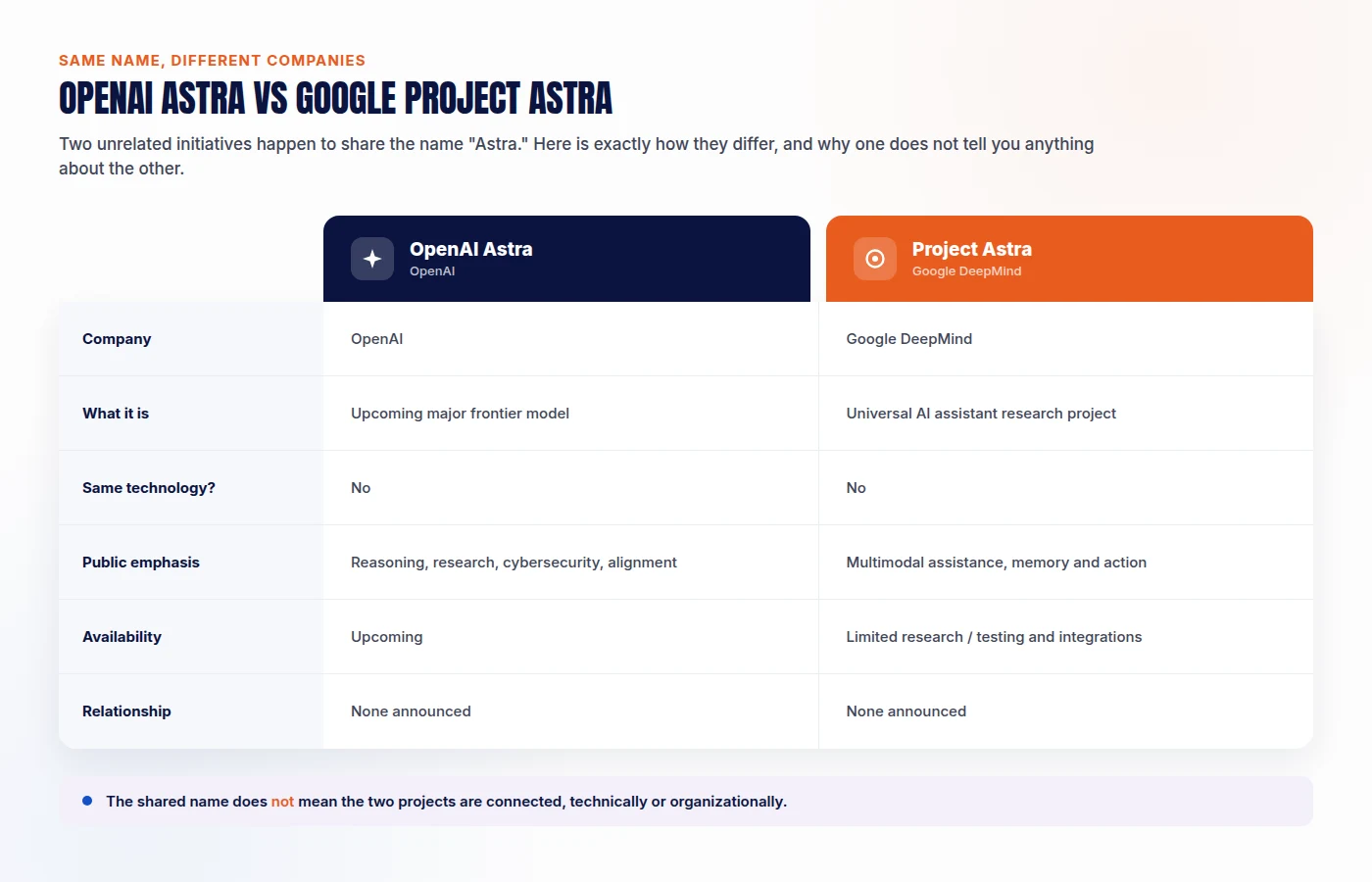
When researching Astra, always check which company is being discussed. The shared name does not mean the two projects are connected.
OpenAI Astra vs GPT-5.6 Sol: What’s the Difference?
GPT-5.6 Sol is currently OpenAI’s flagship model for complex professional work. OpenAI positions Sol for coding, knowledge work, research, cybersecurity, science, computer use, design, and agentic workflows. GPT-5.6 Sol supports up to a 1.05-million-token context window through the API and is available across OpenAI products and developer services.
Astra is different because it represents the next frontier beyond the currently deployed GPT-5.6 family. OpenAI has directly reported that Astra is substantially more capable and more token-efficient than GPT-5.6 Sol on the cybersecurity evaluations disclosed so far.
But that does not yet establish that Astra is better at every task. We do not currently have enough public evidence to make reliable Astra-versus-Sol comparisons for copywriting, SEO analysis, keyword research, marketing strategy, image understanding, everyday coding, general web research, search accuracy, content creation, or business analysis. Those comparisons should wait until Astra becomes available for broader testing; the full breakdown is in OpenAI Astra vs GPT-5.6 Sol: what we know so far.
Why Should Marketers Care About OpenAI Astra?
A natural reaction is: what does a model solving mathematics problems and finding software vulnerabilities have to do with marketing? Potentially, quite a lot. The specific tasks matter less than the underlying behavior they demonstrate.
Marketing AI has already progressed through several stages. The earliest popular use case looked like: prompt → generated content. More advanced systems increasingly look like: question → research → reasoning → recommendation. Agentic systems move further: goal → planning → research → decisions → actions → completed task.
Astra’s disclosed capabilities suggest that this progression is continuing. That could affect marketing in several ways.
AI Could Become Better at Investigating Rather Than Merely Answering
Suppose someone asks an AI: “Which accounting platform is best for my 30-person ecommerce company?” A relatively simple answer system might summarize several well-known options. A more capable reasoning system could potentially break the problem into subquestions, such as what ecommerce platform the company uses, what payment processors are involved, how many transactions occur monthly, whether the company operates internationally, what accounting integrations are required, what each provider’s current prices are, which products support inventory accounting, what independent users report, and which option creates the lowest switching cost.
It could then investigate those questions before forming a recommendation. The marketing implication is substantial: brands may eventually compete not only to rank for the original query, but to provide trustworthy evidence for the many subquestions an AI system investigates.
Astra Could Accelerate the Shift Toward AI Agents
GPT-5.6 already demonstrates that OpenAI is moving toward longer, tool-enabled workflows rather than treating every interaction as an isolated prompt. OpenAI says GPT-5.6 can coordinate tools, process intermediate results, monitor progress, and choose subsequent actions as work unfolds. Its ultra capability can coordinate multiple agents across parallel workstreams.
Astra appears to push further in the direction of autonomous problem solving. That matters because an AI agent changes the relationship between customers and websites. Today’s customer might search, click, research, compare, and purchase. A future AI-assisted customer journey could become: state goal → AI researches → AI compares → AI recommends → AI interacts → user approves.
For marketers, visibility inside that process becomes a strategic issue. The question may no longer be only “does my website rank?” It may also become “can an AI system find, understand, trust, recommend, and interact with my business?” This shift is explored in more detail in how OpenAI Astra could change AI agents and search.
Could Astra Affect SEO, GEO and AI Search?
Potentially, but this needs to be framed carefully. OpenAI has not announced that Astra will power ChatGPT Search. Therefore, there is currently no such thing as a confirmed “Astra ranking algorithm,” “Astra SEO,” or “Astra GEO ranking factor.”
However, Astra’s capabilities give marketers useful clues about where frontier AI systems may be heading. If stronger reasoning capabilities eventually reach AI search products, several areas could become increasingly important: source quality, citation usefulness, entity consistency, original information, and machine accessibility. For a full exploration of what this could mean for search visibility, see could OpenAI Astra change AI search and GEO?
A system capable of deeper investigation may be less dependent on a single result and better equipped to compare evidence across multiple sources. Pages that clearly support specific claims may be more useful to an answer engine than pages created primarily to target keywords. AI systems also need to determine whether information from different websites refers to the same company, person, product, or organization, so consistent brand information could become increasingly valuable.
If ten websites repeat essentially the same information, a capable AI system can summarize all ten very easily. The more defensible content advantage is to publish information others do not have: proprietary data, original research, surveys, experiments, benchmarks, case studies, expert observations, and first-party statistics.
AI systems still need access to information. OpenAI currently says websites that want to be eligible for inclusion in ChatGPT search should allow OAI-SearchBot to crawl their content. OpenAI also says ChatGPT search ranking uses multiple factors intended to surface relevant and reliable information. Whatever model powers future AI search, making information accessible and understandable to machines remains a foundational requirement.
Could Astra Change Content Marketing?
Possibly, but not because marketers will suddenly need to produce “Astra-optimized articles.” The more meaningful shift is toward information quality. If AI systems become better at research and verification, generic content becomes easier to replace.
Consider two articles. Article A says: businesses should optimize content for AI because AI search is becoming more important. Article B provides an original dataset of 5,000 AI citations, methodology explaining how the test was conducted, citation frequency by content type, examples of citations gained and lost, limitations of the study, and downloadable results.
Article B gives an AI system something Article A does not: evidence. The long-term competitive advantage in AI-era content marketing is therefore unlikely to be producing the largest quantity of generated text. It is more likely to come from becoming a source of information worth retrieving.
Could Astra Make AI More Important to Marketing Strategy?
Almost certainly, but marketers should avoid reacting to every frontier model by rebuilding their strategies. Astra should be treated as a signal, not a reason to abandon current marketing fundamentals.
The important signals are that AI is becoming more agentic, performing sequences of work instead of returning one answer; more capable of research, since Astra’s mathematics results show that model-assisted research can extend beyond summarizing existing documents; more autonomous, since OpenAI’s cybersecurity evaluations involve Astra completing complicated work without needing humans to direct every step; and that AI safety is becoming part of product capability, since OpenAI delayed parts of Astra’s development and deployment while improving safeguards.
For marketers, the strategic response should be gradual: build stronger information assets, improve machine accessibility, increase first-party expertise, make brand entities consistent, track visibility inside AI systems, and prepare websites for agent interaction. But don’t chase an optimization tactic for a product that has not launched yet.
When Will OpenAI Astra Be Released?
OpenAI has not announced a specific Astra release date. On September 1, 2026, OpenAI said it planned to make Astra available soon, but noted that access to its most advanced cybersecurity capabilities would be restricted initially.
OpenAI expects advanced cybersecurity access to begin with a limited group of testers before expanding defensive access through its Daybreak Blue program. The company also said it plans to publish additional safety, security, alignment, and evaluation information in Astra’s system card when the model launches.
Until an exact date is announced, websites publishing a specific “Astra release date” should be treated cautiously.
What Should Marketers Watch for Next?
The full significance of Astra will become clearer once OpenAI publishes the production model. The most important developments to watch include the official Astra launch date, its system card, ChatGPT availability, API access and pricing, context-window size, maximum output length, multimodal capabilities, computer-use capabilities, browser and web-search capabilities, agent performance, tool-use benchmarks, coding benchmarks, general reasoning benchmarks, latency, integration with ChatGPT Work and Codex, search integration, developer restrictions, and enterprise availability.
Those details will determine whether Astra becomes primarily a frontier specialist model, a broad replacement for GPT-5.6 Sol, a foundation for future agents, or something else entirely.
What Marketers Should Do Now
Marketers do not need to redesign their SEO strategies around Astra today. Instead, prepare for the broader direction Astra represents.
1. Create information instead of simply rewriting it. Invest in original research, first-party experience, case studies, experiments, and proprietary data.
2. Make important information easy to extract. Use clear headings, concise answers, descriptive tables, definitions, comparisons, and structured sections.
3. Strengthen your entity footprint. Keep company names, services, products, leadership information, locations, and other important entity details consistent.
4. Make your website accessible to AI search systems. Review crawler access, robots.txt rules, indexability, canonicalization, rendering, server availability, and internal linking.
5. Measure AI visibility separately. Traditional rankings do not tell you whether ChatGPT, Google AI Overviews, Gemini, Perplexity, or other systems mention or cite your brand.
6. Make your website easier for agents to use. Machine accessibility may eventually extend beyond reading pages to interacting with forms, product interfaces, booking systems, and other website controls. OpenAI already recommends accessible markup such as clear ARIA roles, labels, and states to help its agent systems understand interactive website elements.
7. Don’t chase hypothetical Astra ranking factors. There are none currently confirmed. Optimize for people, search engines, answer engines, and machine comprehension, not rumors.
The Bigger Meaning of OpenAI Astra
Astra’s importance may ultimately have less to do with the model name itself. The larger story is the direction of AI development.
The first generation of mainstream generative AI impressed people because it could write. The next generation became useful because it could reason. The emerging generation is increasingly valuable because it can work.
Astra’s research results and autonomous cybersecurity evaluations provide an early look at systems capable of operating across longer sequences of decisions, dealing with unfamiliar problems, and completing work that requires adaptation along the way.
For marketers, that creates a different future for search. A website may no longer compete only for a click. Its information could become evidence inside an AI-generated answer. Its brand could become one candidate in an AI-generated recommendation. Its products could be compared by an autonomous research agent. Its interface could eventually be used by software acting on behalf of a customer.
That transition will not happen overnight, and Astra itself may or may not become the model that drives every part of it. But the strategic direction is becoming clearer:
Digital visibility is expanding from being found by search engines to being understood, trusted, selected, and potentially acted upon by AI systems.
That is the development marketers should be paying attention to.
FAQ
What is OpenAI Astra?
OpenAI Astra is an upcoming frontier AI model that OpenAI describes as its next major model. Internal versions have demonstrated advanced mathematical reasoning and substantially stronger cybersecurity capabilities than GPT-5.6 Sol in evaluations disclosed by OpenAI.
Is OpenAI Astra available now?
Not broadly. OpenAI said on September 1, 2026 that it plans to make Astra available soon, although some advanced cybersecurity capabilities will initially have restricted access.
Is OpenAI Astra GPT-6?
OpenAI has not officially called Astra GPT-6. The company currently describes Astra as its next major model. Any claim that Astra is definitely GPT-6 is speculative.
Is Astra better than GPT-5.6 Sol?
OpenAI has demonstrated that Astra is significantly more capable and more token-efficient than GPT-5.6 Sol on specific cybersecurity evaluations. However, there is not yet enough public evidence to conclude that Astra outperforms Sol across every general-purpose task.
Is OpenAI Astra the same as Google Project Astra?
No. OpenAI Astra is an upcoming OpenAI model. Google’s Project Astra is a separate Google DeepMind initiative focused on universal AI-assistant capabilities.
When will OpenAI Astra launch?
OpenAI has not provided an exact date. On September 1, the company said Astra would be made available soon.
Will Astra replace GPT-5.6 Sol?
That has not been announced. Astra could replace Sol, coexist with it, launch as a different product tier, or eventually receive another commercial model name.
Will Astra power ChatGPT Search?
OpenAI has not announced that Astra will power ChatGPT Search. Any direct connection between Astra and future ChatGPT Search ranking or citation behavior remains speculative.
Can Astra browse the web?
OpenAI has not yet published complete production specifications for Astra’s browsing or search capabilities.
Why should marketers care about Astra?
Astra provides evidence that frontier AI models are becoming more capable of complex reasoning, autonomous task completion, and long-horizon work. If similar capabilities are integrated into AI search and agent products, marketers may increasingly need to optimize not only for rankings and clicks but also for AI citations, recommendations, machine understanding, and agent accessibility.
How should marketers prepare for Astra?
Marketers should focus on durable improvements rather than Astra-specific tactics: publish original information, strengthen entity consistency, improve technical accessibility, create citation-worthy content, measure AI visibility, and make websites easier for both humans and AI systems to understand and use.