Quick Answer
That AI layer includes:
- detailed product attributes;
- product highlights;
- product details;
- conversational attributes;
- product Q&A;
- supporting documents;
- related-product relationships;
- variant information;
- strong product structured data;
- AI performance monitoring inside Merchant Center.
Google says Merchant Center product data is a foundational input for its AI-powered formats and experiences. Google also now provides AI performance insights for conversational shopping queries and recommends using those reports to improve titles, descriptions, terms, and missing attributes.
The key shift is this:
Traditional ecommerce SEO often optimizes for the product keyword. AI Mode optimization needs to qualify the product for the full shopping intent.
A shopper might not ask for “waterproof hiking boots.” They might ask for “lightweight waterproof hiking boots for wide feet that are suitable for Iceland in October and cost under $180.”
Your product data needs enough depth for Google to understand whether the item satisfies that entire request.
What Is Google AI Mode Ecommerce Optimization?
Google AI Mode ecommerce optimization is the process of improving product information so Google can more confidently retrieve, understand, match, and surface your products during conversational and AI-assisted shopping journeys.
This is broader than traditional product-page SEO.
A traditional ecommerce optimization workflow might focus on:
- product keyword targeting;
- category-page rankings;
- title tags;
- internal linking;
- product schema;
- reviews;
- links;
- organic traffic.
AI Mode adds new questions:
- Does Google understand the product’s detailed attributes?
- Can the product satisfy a complex multi-part request?
- Are variants clearly structured?
- Are price and availability current?
- Does Merchant Center contain the same information as the landing page?
- Are common product questions explicitly answered?
- Does Google know which products are related?
- Does the product have enough structured specifications?
- Is the product appearing during discovery, evaluation, or purchase AI queries?
This is why AI shopping SEO increasingly requires collaboration between:
- SEO;
- ecommerce;
- feed management;
- merchandising;
- product teams;
- development;
- paid media.
Product data is no longer only an advertising concern.
How Google AI Mode Finds and Understands Products
Google has explained that its AI shopping experiences combine Gemini capabilities with the Shopping Graph.
The Shopping Graph contains tens of billions of product listings with information such as:
- price;
- availability;
- ratings;
- reviews;
- colors;
- product attributes;
- merchant information.
As part of Google’s 2026 Shopping and AI Mode announcements, Google has said that more than two billion product listings are refreshed every hour.
Source: Google
That matters because AI Mode is not simply reading one product page and deciding whether it likes the copy.
It can operate across a much broader product-information system.
That system can include:
- Merchant Center;
- product landing pages;
- structured data;
- reviews;
- retailers;
- manufacturer data;
- product attributes;
- Shopping Graph information.
Your optimization strategy should therefore improve the product entity, not only the HTML page. That entity-first mindset is also central to understanding AI Mode product visibility more broadly.
Why Query Fan-Out Changes Ecommerce SEO
Google AI Mode can use query fan-out.
That means it can take one conversational request and run multiple related searches to understand the user’s needs.
Google’s example involved a shopper looking for a travel bag for a Portland trip in May. AI Mode researched factors such as:
- rainy weather;
- long journeys;
- waterproofing;
- accessible pockets.
It then used those criteria to suggest suitable products.
That creates a new optimization challenge.
Traditional Search
User:
waterproof travel bag
Potential optimization target:
waterproof travel bag
AI Mode
User:
I need a lightweight travel bag for Portland in May that can handle rain, fits under an airline seat, has quick-access pockets and costs under $150.
Now the product may need Google to understand:
- waterproof material;
- weight;
- dimensions;
- airline compatibility;
- pocket design;
- price;
- travel use case.
This is why attributes matter.
Step 1: Fix Merchant Center Before Doing Anything “AI-Specific”
The most common mistake will be trying advanced AI optimization while the catalog itself is incomplete.
Google’s current Merchant Center product-data specification states that product data is used to match products to relevant queries and serves as a foundational input for AI-powered formats and experiences.
Source: Google Merchant Center
Start with the foundation.
Required and Core Product Data
Review:
- ID;
- title;
- description;
- link;
- image;
- availability;
- price;
- condition where required;
- brand;
- GTIN;
- MPN where relevant.
Product Data Problems That Can Limit Visibility
Google specifically warns about issues including:
- incorrect Google product category;
- missing or incorrect GTIN;
- missing variant information;
- incorrect color;
- incorrect size;
- low-quality images;
- feed and landing-page conflicts.
Do not treat these as housekeeping.
They affect whether Google can confidently classify and display the product.
Step 2: Optimize Product Titles for Meaning, Not Keyword Stuffing
Google says the product title should clearly identify what is being sold.
A specific and accurate title helps Google show products to the right users.
Source: Google Merchant Center
The title should answer:
What exactly is this item?
Weak Title
Alpine Pro
Better Title
Alpine Pro Men’s Waterproof Wide-Fit Hiking Boots – Brown
The second title communicates:
- model;
- gender;
- waterproof feature;
- fit;
- product type;
- color.
Useful Product Title Attributes
Depending on the category, include high-value differentiators such as:
- brand;
- product type;
- model;
- size;
- color;
- material;
- capacity;
- gender;
- major compatibility;
- variant.
Do not cram every possible attribute into the title.
The goal is clarity.
Important: AI-Generated Titles
Google’s current specification distinguishes between normal title and structured_title.
If a product title was created using generative AI, Google instructs merchants to use the structured title format with the appropriate digital-source designation.
That is another reason ecommerce teams should understand current Merchant Center specifications rather than copying old feed templates indefinitely.
Step 3: Rewrite Product Descriptions Around Product Facts
Google recommends descriptions that accurately describe the product and match the landing page.
Descriptions should focus on the product itself.
Useful information may include:
- intended use;
- material;
- dimensions;
- major features;
- compatibility;
- capacity;
- performance;
- fit;
- care instructions;
- technical details.
Weak Description
The perfect premium jacket for your next adventure.
Stronger Description
Men’s lightweight waterproof shell made with a three-layer nylon membrane, adjustable hood, sealed seams and pit zips. Designed for hiking and travel in wet conditions. Available in sizes S–XXL.
The stronger description gives AI Mode attributes it can work with.
Step 4: Complete Product Identifiers
Product identifiers are easy to overlook because they do not look like content.
They are important machine-readable product signals.
Common identifiers include:
- GTIN;
- brand;
- MPN;
- SKU.
Google’s product-data documentation warns that products with a GTIN that should have been submitted but are missing one can receive limited visibility.
Do not invent GTINs.
Do not reuse identifiers incorrectly.
Correct identifiers help Google connect the same product across:
- merchants;
- manufacturers;
- offers;
- reviews;
- product listings.
That can strengthen product-entity understanding.
Step 5: Structure Product Variants Properly
Variants create major ecommerce data problems.
A product might exist in:
- five colors;
- eight sizes;
- three materials.
Google needs to understand what changes and what remains the same.
Use appropriate variant attributes such as:
item_group_id;- color;
- size;
- material;
- pattern;
- gender;
- age group.
Google’s Merchant Center documentation explicitly identifies missing or incorrect variant data as a common product-data issue.
For AI Mode, this becomes even more important because users may specify a very particular variant.
Example:
Show me the navy version in women’s size 8.
If variant relationships are ambiguous, Google has less reliable information for matching that request.
Step 6: Make Price and Availability Consistent Everywhere
Price and availability are high-value transactional facts.
Google requires Merchant Center data to match:
- the product landing page;
- checkout;
- structured data.
Source: Google Merchant Center
A product should not show:
- $129 in the feed;
- $149 on the page;
- $139 in schema.
Nor should the feed say:
in stock
while the landing page says:
sold out.
Consistency matters because AI Mode may be helping users make purchase decisions.
Incorrect transactional data creates a poor experience and weakens trust in the product record.
Step 7: Add Product Highlights
Google’s product_highlight attribute allows merchants to provide short, scannable product highlights.
Google explicitly says these highlights can help customers discover product information across AI-driven surfaces such as AI Mode.
Source: Google Merchant Center
Product highlights are ideal for important selling points.
Example:
- Waterproof three-layer nylon shell
- Adjustable wide-fit design
- 1.8-pound total weight
- Compatible with standard carry-on dimensions
- Machine washable
These are more useful than:
- Premium quality
- Amazing design
- Must-have product
Product Highlight Rule
Use a highlight for information the buyer may actually use to filter or compare products.
Step 8: Submit Detailed Product Specifications
For many products, specifications are the difference between broad relevance and exact suitability.
Examples:
Electronics
- screen size;
- RAM;
- storage;
- ports;
- battery;
- processor;
- connectivity.
Furniture
- dimensions;
- materials;
- weight;
- seat height;
- assembly requirements;
- load capacity.
Apparel
- fabric;
- fit;
- sizing;
- waterproof rating;
- insulation;
- weight.
Tools
- voltage;
- power;
- torque;
- blade size;
- battery compatibility.
Google’s AI performance reporting now specifically surfaces popular product attributes shoppers are asking about.
If Google identifies a high-demand attribute that is absent from your feed, that is a direct optimization opportunity.
Step 9: Use Google’s Conversational Attributes
This is one of the biggest 2026 additions to AI shopping optimization.
Google now supports optional conversational attributes designed to help AI systems and conversational agents understand product nuances.
Current attributes include:
question_and_answer;document_link;related_product;item_group_title;variant_option;popularity_rank.
Source: Google Merchant Center
Google says these attributes are designed to help customers discover product information across AI-driven surfaces such as AI Mode.
That makes them directly relevant to ecommerce GEO.
Step 10: Add Product Questions and Answers
The question_and_answer attribute is particularly important.
Google states that this attribute is primarily intended for conversational experiences such as AI Mode.
Source: Google Merchant Center
Use it to answer detailed recurring questions.
Examples:
Laptop
Question: Does this model support two external 4K monitors?
Answer: Yes. It supports two external 4K monitors through its Thunderbolt ports.
Shoe
Question: Is this model suitable for wide feet?
Answer: Yes. It is available in standard and wide widths.
Camera
Question: Does it record 4K video at 120fps?
Answer: Yes, when using the supported recording mode.
Sofa
Question: Can the covers be removed and washed?
Answer: The seat and back cushion covers are removable and machine washable according to the care instructions.
Best Practices
Questions should be:
- genuine;
- product-specific;
- current;
- accurate;
- useful during research.
Do not create fake questions purely to repeat keywords.
Step 11: Add Supporting Documents
The document_link conversational attribute can help Google connect supporting files or documentation with a product.
Useful documents may include:
- manuals;
- installation guides;
- spec sheets;
- safety information;
- sizing guides;
- compatibility guides;
- technical documentation.
This is particularly useful for high-consideration products.
Examples:
- industrial equipment;
- electronics;
- appliances;
- medical devices;
- technical tools;
- B2B products.
If critical product facts live in documentation, make those relationships clear rather than expecting AI systems to infer them.
Step 12: Define Related Products
Users frequently ask:
- What accessory works with this?
- What replacement part do I need?
- What is the upgraded model?
- What product should I pair with this?
Google’s related_product attribute gives merchants another way to express those relationships.
Use it where the relationship is real.
Examples:
- compatible accessories;
- replacement parts;
- bundles;
- related models;
- upgrade paths.
Product relationship data can become increasingly important as shopping moves toward agentic and conversational experiences.
Step 13: Make Variant Relationships Conversationally Understandable
Google’s newer attributes such as:
item_group_title;variant_option
allow additional product-family context.
This is useful when users compare variants conversationally.
Example:
What’s the difference between the 128GB and 256GB versions?
Or:
Does this jacket come in a women’s tall fit?
Do not treat variants as duplicate products with slightly different titles.
Build a coherent product-family structure.
Step 14: Use Product Structured Data Correctly
Your product page should also communicate structured information through Product and Offer markup where applicable.
Google’s Merchant Center documentation recommends Product structured data and explains how values such as:
- name;
- description;
- image;
- SKU;
- GTIN;
- material;
- pattern;
- price;
- currency;
- availability;
- condition
can map between schema and Merchant Center.
Source: Google Merchant Center
Important Product Schema Principle
The feed and structured data should agree.
Google specifically recommends correct values for:
- price;
- price currency;
- availability;
- condition.
Structured data helps Google retrieve current product information from the site.
It is not a shortcut that compensates for poor product data.
Step 15: Make the Landing Page Match the Feed
This is essential.
Your landing page should confirm the product information Google receives elsewhere.
The page should visibly include important facts such as:
- product name;
- price;
- availability;
- product description;
- major specifications;
- variants;
- reviews where relevant.
Avoid situations where:
- feed says one material;
- page says another;
- structured data says a third.
AI systems benefit from corroborating information.
Consistency reduces ambiguity.
Step 16: Improve Product Images
Product images still matter in AI shopping.
Google’s Shopping experiences are highly visual.
Use:
- clear main images;
- accurate product photography;
- useful angles;
- variant-specific images;
- contextual images where appropriate;
- high resolution.
Do not rely on images to communicate essential specifications.
If a dimension, compatibility feature, or material matters, also provide it as text or structured data.
Step 17: Build Reviews and External Product Evidence
Google’s AI shopping experiences can use product information beyond your feed.
Google has repeatedly referenced reviews as part of Shopping Graph information and product recommendations.
That means authentic external evidence matters.
Improve:
- verified customer reviews;
- expert reviews;
- publisher coverage;
- product testing;
- retailer data;
- manufacturer data.
Do not manufacture reviews.
Do not manipulate rating systems.
The long-term goal is corroborated product quality, which also plays into how Google evaluates Google AI Mode results against already-popular products in a given category.
Step 18: Optimize for Shopping Stages, Not Just Keywords
Google’s AI performance report organizes conversational queries into three stages:
Discovery
Users are exploring.
Examples:
- best office chairs for back pain;
- good laptops for graphic design;
- lightweight hiking gear.
Evaluation
Users are comparing.
Examples:
- Product A vs Product B;
- best 14-inch laptop under $1,500;
- compare waterproof hiking shoes for wide feet.
Purchase
Users are close to transacting.
Examples:
- where to buy Product A;
- Product A size 10 in stock;
- Product A under $200.
Source: Google Merchant Center
This is a better AI Mode measurement model than traditional keyword rankings alone.
Step 19: Use Merchant Center AI Performance Insights
Google’s AI performance report provides direct visibility into how products perform for conversational shopping queries.
Current metrics include:
- share of voice;
- competitor average share;
- frequency;
- products showing.
It also exposes:
- top terms;
- popular attributes;
- top search intents.
This gives ecommerce teams a repeatable optimization loop.
Example
Suppose Merchant Center shows:
Popular term: maximum cushioning
Frequency: high
Your share of voice: low
Ask:
- Do relevant products actually have maximum cushioning?
- Is that information in the title?
- Is it in the description?
- Is there a structured attribute?
- Is the landing page explicit?
If yes, improve the data.
If no, do not falsely add the term.
Optimization must follow product truth.
Step 20: Prioritize Missing Attributes
Google specifically recommends populating missing attributes shown in AI performance insights.
This is one of the clearest AI Mode optimization actions available.
Imagine shoppers repeatedly ask for:
- recycled material;
- wide fit;
- battery life;
- waterproof rating.
Your products may support those attributes, but the catalog might not document them.
That is lost retrieval potential.
Attribute Gap Workflow
- Open AI performance.
- Review popular attributes.
- Sort by frequency.
- Identify missing values.
- Verify actual product facts.
- Update feed.
- Update page.
- Update structured data where supported.
- Monitor share of voice.
This is real AI optimization, not speculation.
Step 21: Optimize Top Terms Without Keyword Stuffing
Google also recommends incorporating relevant top terms into titles and descriptions.
The critical word is relevant.
If users often search:
arch support
and the product genuinely has arch support, make that clear.
Do not add:
arch support
to every shoe because the term is popular.
AI Mode optimization should increase information accuracy.
Not distort it.
Step 22: Measure Products Showing
Google’s AI report includes a “Products showing” metric.
This tells you how many products are appearing for:
- terms;
- attributes;
- search intents.
This may become one of the most useful ecommerce AI KPIs, and it connects directly to broader AI Mode shopping rankings across your catalog.
Instead of only asking:
What position do we rank?
ask:
How many products from our catalog qualify for the high-value conversational intents in this category?
That is a portfolio-level visibility metric.
Step 23: Compare Your Share of Voice With Competitors
AI performance insights also include competitor benchmarking.
Track:
- your share of voice;
- competitor average;
- stage-specific performance.
This can reveal patterns.
Example:
Discovery
You: 8%
Competitor average: 22%
Evaluation
You: 16%
Competitor average: 18%
Purchase
You: 31%
Competitor average: 14%
Interpretation:
Your brand may have strong late-stage product recognition but weak category discovery.
The SEO response may involve:
- better attribute coverage;
- category content;
- product-data enrichment;
- stronger third-party coverage.
Step 24: Create Your Own Conversational Query Set
Merchant Center reporting is valuable, but you should also test real user prompts.
Build 30–100 queries.
Product Feature
Best cordless drill with at least 700 in-lbs torque and two batteries
Constraint
Lightweight waterproof hiking boots for wide feet under $180
Occasion
Formal wedding guest dress for an outdoor summer wedding under $250
Compatibility
USB-C monitor that works with MacBook Air and provides power delivery
Comparison
Product A vs Product B for long-distance travel
Purchase
Product A size 10 available near me
Track whether:
- your products appear;
- competitor products appear;
- product facts are correct;
- prices are correct;
- variants are correct.
Step 25: Separate Confirmed Google Guidance From SEO Hypotheses
This is essential for a serious AI shopping strategy.
Confirmed by Google
Google has publicly documented:
- Shopping Graph use in AI Mode;
- query fan-out;
- Merchant Center AI performance reporting;
- shopping-stage reporting;
- top terms;
- popular attributes;
- product-data optimization guidance;
- conversational attributes;
- Q&A for AI Mode;
- Product and Offer structured data;
- the importance of accurate product data.
Not Confirmed as Ranking Factors
Google has not published exact AI Mode weights for:
- backlinks;
- review count;
- schema;
- price;
- brand authority;
- organic rank;
- title keywords;
- product-page word count.
Treat these as testable hypotheses, not established facts.
Google AI Mode Ecommerce Optimization Checklist
Merchant Center Foundation
- Products approved.
- IDs stable.
- Titles accurate.
- Descriptions accurate.
- GTINs correct.
- Brand correct.
- MPN correct where relevant.
- Price current.
- Availability current.
- Category correct.
- Images high quality.
Variants
- Item groups configured.
- Size complete.
- Color complete.
- Material complete.
- Variant landing pages accurate.
- Variant images accurate.
AI Product Depth
- Product highlights added.
- Product details complete.
- Important specifications submitted.
- Conversational attributes evaluated.
- Product Q&A added where useful.
- Supporting documents linked.
- Related products defined.
- Variant options structured.
Landing Page
- Feed and page title align.
- Description aligns.
- Price matches.
- Availability matches.
- Specifications visible.
- Reviews visible where relevant.
- Product structured data valid.
- Offer data valid.
AI Performance
- AI performance report reviewed.
- Discovery share of voice monitored.
- Evaluation share monitored.
- Purchase share monitored.
- Top terms reviewed.
- Popular attributes reviewed.
- Search intents reviewed.
- Missing attributes fixed.
- Products showing monitored.
- Competitor visibility benchmarked.
A 30-Day Google AI Mode Ecommerce Optimization Plan
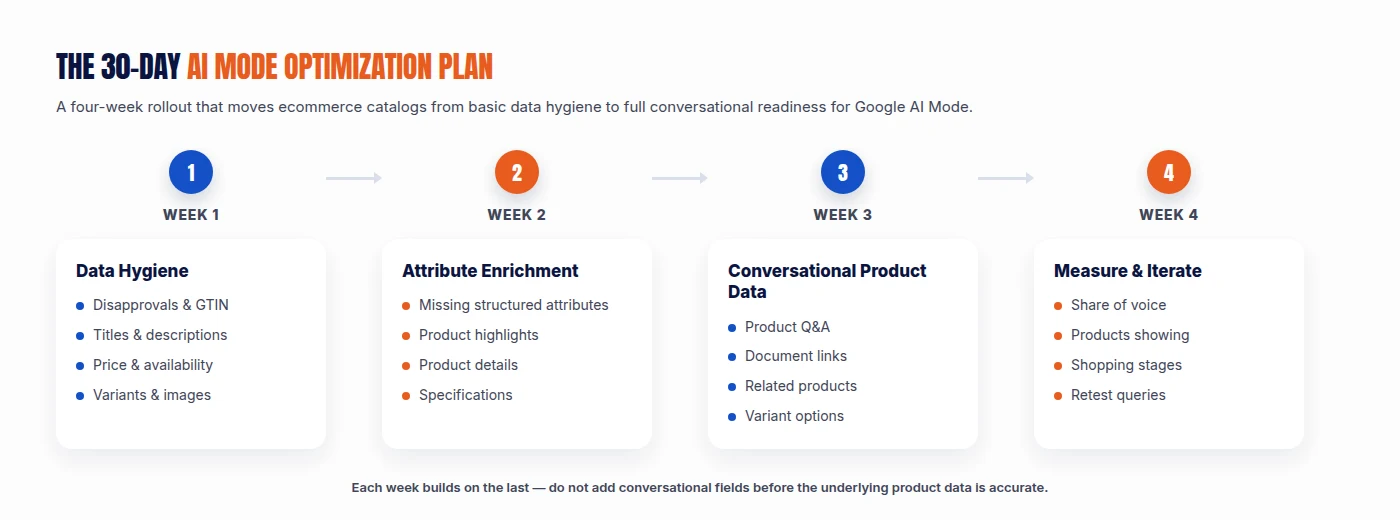
Week 1: Data Hygiene
Audit:
- disapprovals;
- GTIN;
- titles;
- descriptions;
- price;
- availability;
- variants;
- images.
Fix the highest-impact catalog problems.
Week 2: Attribute Enrichment
Add:
- missing structured attributes;
- product highlights;
- product details;
- specifications.
Use Merchant Center AI insights where available.
Week 3: Conversational Product Data
Implement relevant:
- Q&A;
- document links;
- related-product data;
- variant options.
Do not add fields without meaningful content.
Week 4: Measure and Iterate
Review:
- share of voice;
- products showing;
- shopping stages;
- terms;
- attributes;
- competitors.
Then retest conversational queries.
The goal is continuous catalog improvement.
FAQ
How do I optimize products for Google AI Mode?
Start with accurate Merchant Center product data, then improve product titles, descriptions, identifiers, variants, structured attributes, product highlights, product details, landing-page consistency, Product/Offer structured data and conversational attributes. Monitor AI performance insights and fix terms or attributes where visibility is weak.
Does Google Merchant Center affect AI Mode?
Yes. Google states that product data is a foundational input for AI-powered formats and experiences, and its AI performance report directly measures product discovery on conversational shopping surfaces.
What are Google Merchant Center conversational attributes?
They are optional attributes designed to help AI systems understand product nuances. Current examples include question and answer, document link, related product, item group title, variant option and popularity rank.
Is the question_and_answer attribute specifically for AI Mode?
Google says the attribute is primarily intended for conversational experiences such as AI Mode in Search. It allows merchants to provide detailed product questions and answers.
Does Product schema help with Google AI Mode?
Product structured data helps Google understand and retrieve product information and can support Merchant Center data consistency. Google has not stated that Product schema by itself guarantees AI Mode visibility.
Should I put AI search terms in product titles?
Only when they accurately describe the product. Google recommends using relevant terms from AI performance insights in titles and descriptions, but merchants should not add attributes or claims the product does not actually have.
What is AI share of voice in Merchant Center?
It is the share of AI impressions captured by your brand or products relative to your defined competitor set for related conversational shopping queries.
What are the shopping stages in Merchant Center AI reporting?
Google classifies conversational shopping queries into Discovery, Evaluation and Purchase.
Why are product attributes important for AI Mode?
Conversational shopping queries can include detailed constraints such as size, color, material, fit, compatibility or specifications. Complete attributes give Google stronger structured information for matching products to those requests.
How often should I review AI performance insights?
Review them routinely. Google says the report updates regularly, and historical data is currently updated daily with a short lag. Prioritize high-frequency terms and missing attributes that accurately apply to your products.
Bottom Line
Optimizing for Google AI Mode is not about abandoning ecommerce SEO and starting again. The strongest strategy is to make the existing product-information system substantially better.
Merchant Center remains the foundation. Accurate titles, descriptions, identifiers, variants, prices, availability, images and categories give Google a reliable product record. Structured data reinforces that information on the landing page. Detailed attributes help the product qualify for more specific requirements. Conversational attributes add a new layer for product Q&A, documents, relationships and variants. AI performance insights then show which terms, attributes and shopping stages deserve attention.
The major change is in how demand is expressed. Shoppers no longer have to compress what they want into two or three keywords. AI Mode can accept an entire shopping scenario and research multiple requirements through query fan-out. That means ecommerce brands need product data deep enough to answer those requirements.
The brands most likely to benefit will not be the ones that discover a secret AI Mode hack. They will be the brands whose product catalogs are accurate, complete, structured, specific and continuously improved using real conversational demand data. In AI shopping, better product information is becoming better search visibility.