Quick Answer
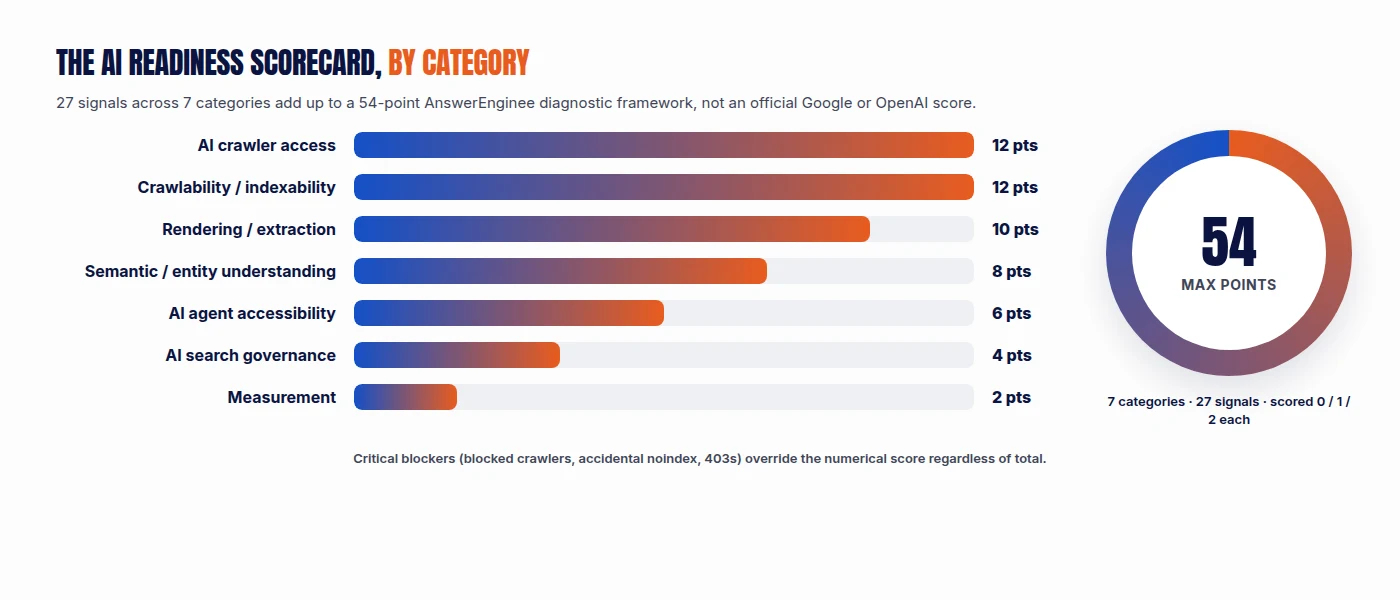
This AnswerEnginee audit scores 27 technical signals across seven areas of Technical GEO:
- AI crawler access
- Crawlability and indexability
- Rendering and content extraction
- Semantic and entity understanding
- AI agent accessibility
- AI search governance
- Measurement
Each signal receives 0 points (failing), 1 point (partial), or 2 points (passing). The maximum score is 54 points.
| Score | AI Readiness Status |
|---|---|
| 46–54 | Strong AI readiness |
| 36–45 | Mostly ready |
| 25–35 | Significant technical gaps |
| 0–24 | High AI visibility risk |
However, the numerical score should never hide a critical technical failure. A website scoring 48/54 but accidentally blocking OAI-SearchBot, returning noindex on its most important pages, or serving 403 errors to crawlers should not be considered fully AI-ready. For that reason, this audit also includes critical blockers that override the raw score.
What Is an AI Readiness Audit?
An AI readiness audit examines whether a website’s technical infrastructure supports visibility across the emerging AI discovery ecosystem.
Traditional technical SEO audits usually focus on whether search engines can crawl → render → index → rank. AI readiness expands the audit to include crawl → retrieve → understand → use → cite → interact → measure.
The difference matters because today’s website may need to serve several types of machine users. Googlebot may crawl a page for Google Search. Google’s AI systems may retrieve indexed information for AI Overviews or AI Mode. OAI-SearchBot may discover content for ChatGPT Search. GPTBot and Google-Extended involve different decisions around model-training-related uses. Browser-based AI agents may need to understand forms, navigation, buttons, and other interactive controls.
An AI readiness audit evaluates whether those systems encounter unnecessary technical barriers. That distinction is exactly why being crawlable isn’t enough for AI search visibility on its own — a page can return a clean 200 status and still fail every downstream step an AI system needs to actually use it.
AI Readiness Is Not an Official Google Score
Before using this framework, one distinction is important.
Google does not publish an “AI readiness score.” OpenAI does not publish one either.
The 54-point scoring system in this article is an AnswerEnginee diagnostic framework designed to turn a complex technical review into something measurable and repeatable.
It should be used to:
- identify technical risks;
- prioritize remediation;
- compare progress over time;
- benchmark different sections of a site;
- support Technical GEO audits.
It should not be presented as a Google ranking score or a guarantee of AI citations. Technical readiness creates eligibility. It does not guarantee selection.
How to Score the 27-Point AI Readiness Audit
For every signal, assign one of three point values.
2 Points — Passing. The implementation is intentional, technically correct, and verified.
1 Point — Partial. The implementation exists but has weaknesses, uncertainty, inconsistent coverage, or incomplete verification.
0 Points — Failing. The signal is missing, misconfigured, unintentionally blocked, or creates a significant technical barrier.
Do not award points based on assumptions. Test the implementation. For example: do not score robots.txt as passing because you remember configuring it six months ago — fetch it today. Do not assume Cloudflare allows OAI-SearchBot — check logs or test access. Do not assume schema is correct because a plugin added it — validate it.
Critical Blocker Rule
Some failures are severe enough that the total score should not override them. Treat these as Critical AI Readiness Blockers:
- important pages returning non-200 responses;
- desired crawlers blocked by robots.txt;
- important pages accidentally set to
noindex; - WAF/CDN returning 403 errors to wanted crawlers;
- major canonicalization errors;
- Google generative AI visibility unintentionally disabled;
- critical content unavailable after rendering.
If any of those are present, mark the site Critical remediation required even if the numerical score looks healthy.
AI Readiness Audit Scorecard
| # | Technical Signal | Max |
|---|---|---|
| 1 | robots.txt availability | 2 |
| 2 | Googlebot access | 2 |
| 3 | OAI-SearchBot access | 2 |
| 4 | GPTBot policy | 2 |
| 5 | Google-Extended policy | 2 |
| 6 | CDN/WAF crawler access | 2 |
| 7 | HTTP status health | 2 |
| 8 | noindex control | 2 |
| 9 | Canonical consistency | 2 |
| 10 | XML sitemap quality | 2 |
| 11 | Internal discovery | 2 |
| 12 | Duplicate URL control | 2 |
| 13 | Rendered content availability | 2 |
| 14 | Interaction-independent information | 2 |
| 15 | JavaScript reliability | 2 |
| 16 | Important facts available as text | 2 |
| 17 | HTML and page complexity | 2 |
| 18 | Heading structure | 2 |
| 19 | Semantic HTML | 2 |
| 20 | Structured data accuracy | 2 |
| 21 | Entity consistency | 2 |
| 22 | Form accessibility | 2 |
| 23 | Button/control accessibility | 2 |
| 24 | Navigation/state accessibility | 2 |
| 25 | Google generative AI participation | 2 |
| 26 | Search vs training governance | 2 |
| 27 | AI visibility measurement | 2 |
| Total | 54 | |
Category 1: AI Crawler Access (Maximum Score: 12)
This category asks a fundamental question: can the systems you want to reach actually access your website? Access is the precondition for everything else in this audit — see how AI crawlers understand your website for the mechanics behind each of the crawlers referenced below.
1. robots.txt Is Reachable and Valid
Why it matters. Your robots.txt file communicates crawler-access rules. A broken, inaccessible, or incorrectly configured file can create unexpected crawler behavior.
Test. Visit https://yourdomain.com/robots.txt and check the HTTP response, syntax, unexpected broad Disallow rules, bot-specific rules, and conflicting directives.
Scoring. 2 points: file is reachable, returns correctly, and rules are intentional. 1 point: file works but contains unclear, outdated, or redundant rules. 0 points: file is inaccessible, broken, or contains serious accidental blocking.
Common failure:
User-agent: *
Disallow: /
That blocks compliant crawlers from the entire website.
Recommended fix. Maintain the simplest robots.txt configuration that accurately represents your crawler policy.
2. Googlebot Access Is Intentional
Critical signal.
Why it matters. Google’s generative Search experiences remain grounded in its normal Search infrastructure. If Googlebot cannot access important pages, this can affect ordinary Search eligibility and consequently Google’s generative Search ecosystem.
Test. Review robots.txt, Google Search Console URL Inspection, server logs, and firewall configuration.
Scoring. 2: Googlebot has appropriate access to all intended public pages. 1: most important content is accessible but some questionable blocking exists. 0: important pages or sections are unintentionally inaccessible.
Fix. Remove accidental Googlebot restrictions unless exclusion is intentional.
3. OAI-SearchBot Access Is Intentional
Critical for websites seeking ChatGPT Search visibility.
Why it matters. OpenAI says publishers that want content discoverable, surfaced, cited, and linked in ChatGPT Search should make sure they are not blocking OAI-SearchBot.
Test. Review robots.txt for:
User-agent: OAI-SearchBot
Disallow: /
Then inspect server/WAF logs where available.
Scoring. 2: OAI-SearchBot access matches your intended ChatGPT Search strategy. 1: no robots.txt block exists, but actual server/WAF access has not been verified. 0: OAI-SearchBot is unintentionally blocked while ChatGPT visibility is desired.
Important. Do not confuse OAI-SearchBot with GPTBot — they serve different purposes.
4. GPTBot Policy Is Intentional
Why it matters. OpenAI distinguishes ChatGPT Search discovery from potential model-training use. OAI-SearchBot relates to search visibility. GPTBot relates to content publishers may wish to exclude from potential training.
Test. Review your GPTBot robots.txt policy and ask: do we intentionally allow or disallow GPTBot? The answer can legitimately be either. The problem is having no policy while assuming the opposite.
Scoring. 2: GPTBot policy is explicitly decided and documented. 1: current behavior is known but undocumented. 0: current behavior conflicts with the organization’s intended policy.
Key principle. AI Search visibility and AI training access should not be treated as the same decision.
5. Google-Extended Policy Is Intentional
Why it matters. Google-Extended is separate from ordinary Google Search crawling and should be treated as a governance decision rather than automatically grouped with Googlebot.
Test. Inspect robots.txt for Google-Extended rules and document whether its current setting is intentional.
Scoring. 2: policy matches your organization’s intended AI-use policy. 1: configuration exists but ownership/purpose is unclear. 0: configuration conflicts with your intended policy.
6. CDN/WAF Does Not Block Wanted AI Crawlers
Critical signal.
Why it matters. robots.txt can say “Allow” while Cloudflare, Akamai, a security plugin, or another WAF still returns 403 Forbidden. OpenAI specifically warns that bot-protection platforms can mistakenly block legitimate crawler traffic.
Test. Inspect CDN firewall events, server logs, bot-management logs, 403 responses, 429 responses, and CAPTCHA challenges.
Scoring. 2: wanted crawlers are verified to receive normal responses. 1: no known problem, but access has not been technically verified. 0: legitimate wanted crawler traffic is being blocked.
Practical rule. robots.txt permission does not guarantee server access.
Category 1 Score
Add signals 1–6. Maximum: 12.
| Score | Status |
|---|---|
| 11–12 | Strong |
| 8–10 | Acceptable |
| 5–7 | Needs attention |
| 0–4 | High access risk |
Category 2: Crawlability and Indexability (Maximum Score: 12)
Being crawlable is not enough. The correct URLs must also be eligible, canonical, and discoverable.
7. Important URLs Return HTTP 200
Critical signal.
Test. Crawl key templates — homepage, category pages, articles, products, services, location pages, tools — and look for 3xx chains, 404s, soft 404s, 403s, 429s, and 5xx errors.
Scoring. 2: important canonical pages reliably return 200. 1: small number of non-critical errors. 0: significant important pages return incorrect status codes.
8. Important Pages Are Not Accidentally Noindexed
Critical signal.
Test. Check <meta name="robots" content="noindex"> and HTTP X-Robots-Tag headers.
Scoring. 2: index directives are intentional. 1: some questionable exclusions exist. 0: important pages are accidentally noindexed.
Important distinction. A crawler may successfully fetch a page and still be told not to index it. Crawlability ≠ indexability.
9. Canonicals Point to the Intended URLs
Critical signal.
Test. For key page types, inspect <link rel="canonical" href="..."> and look for canonicalizing to the homepage, staging URLs, HTTP versions, wrong parameter URLs, category/article mismatches, and cross-domain errors.
Scoring. 2: canonicals consistently identify intended URLs. 1: minor inconsistencies. 0: significant canonical conflicts affect important content.
10. XML Sitemaps Are Clean and Current
Test. Check whether XML sitemaps contain canonical URLs, indexable URLs, correct 200 URLs, and current URLs. Remove redirects, 404s, noindexed URLs, and unnecessary duplicates.
Scoring. 2: sitemap contains clean, canonical, indexable URLs. 1: minor hygiene issues. 0: sitemap contains major errors or important pages are missing.
11. Important Pages Have Crawlable Internal Links
Why it matters. Machines should not need to guess that a page exists.
Test. Identify orphan or near-orphan pages. Check whether important content is reachable through navigation, hubs, categories, contextual internal links, and breadcrumbs.
Scoring. 2: important pages are strongly integrated into site architecture. 1: some pages have weak discovery paths. 0: important pages are orphaned or effectively isolated.
12. Duplicate URL Patterns Are Controlled
Test. Look for duplicates caused by parameters, pagination, filters, trailing slash inconsistencies, uppercase/lowercase, printer pages, tracking URLs, and faceted navigation.
Scoring. 2: duplicate patterns are technically controlled. 1: limited duplication exists but canonicalization mostly works. 0: extensive duplication creates unclear preferred URLs.
Category 2 Score
Maximum: 12.
| Score | Status |
|---|---|
| 11–12 | Strong |
| 8–10 | Acceptable |
| 5–7 | Needs work |
| 0–4 | Serious indexability risk |
Category 3: Rendering and Content Extraction (Maximum Score: 10)
AI systems cannot use information they cannot reliably retrieve.
13. Main Content Is Available After Rendering
Critical signal.
Test. Compare raw HTML, rendered DOM, and the visible page. Check whether essential content disappears when JavaScript fails.
Scoring. 2: primary content reliably renders. 1: some non-critical sections depend on fragile rendering. 0: critical content frequently fails or requires unsupported behavior.
14. Critical Information Is Not Hidden Behind Unnecessary Interaction
Test. Ask whether essential facts require tab clicks, accordions, modal activation, infinite scroll, login, or mouse hover. Tabs and accordions are not automatically bad — the question is whether important information becomes unnecessarily difficult to retrieve.
Scoring. 2: important facts are straightforward to access. 1: some useful information requires interaction. 0: major content is inaccessible without complicated user actions.
15. JavaScript Is Reliable
Test. Review console errors, failed API calls, hydration failures, blocked resources, client-side route failures, and rendering delays.
Scoring. 2: important pages render consistently without major JS errors. 1: minor errors exist but core information survives. 0: JavaScript failures regularly remove critical information.
16. Important Facts Exist in Textual Form
Test. Look for important information available only inside images, infographics, video, canvas, graphics, or visual widgets. Examples of facts that should usually exist as text: prices, product names, service areas, definitions, specifications, and company details.
Scoring. 2: core information exists as accessible text. 1: some important information is primarily visual. 0: major information requires image/video interpretation.
17. HTML and Page Complexity Are Controlled
This is not a simplistic “smaller HTML ranks better” rule. The question is whether excessive complexity creates crawling and parsing inefficiency.
Check. Enormous DOM trees, massive inline scripts, redundant page-builder markup, repeated hidden elements, unnecessary third-party scripts, and malformed HTML.
Scoring. 2: page structure is reasonably efficient. 1: heavy markup exists but content remains stable. 0: technical complexity regularly causes rendering, performance, or extraction problems.
Category 3 Score
Maximum: 10.
| Score | Status |
|---|---|
| 9–10 | Strong |
| 7–8 | Good |
| 5–6 | Needs improvement |
| 0–4 | Extraction risk |
Category 4: Semantic and Entity Understanding (Maximum Score: 8)
This category asks: once machines access the page, how difficult is it to understand what the page is actually about?
18. Heading Hierarchy Describes the Content
Test. Review H1–H6 usage. Do headings identify meaningful sections, or are headings used mainly for visual styling?
Scoring. 2: headings create a clear document outline. 1: mostly understandable with minor structural issues. 0: heading hierarchy is chaotic or semantically meaningless.
19. Semantic HTML Is Used Sensibly
Check use of: <main>, <article>, <nav>, <header>, <footer>, real <button> elements, proper lists, and tables where tabular data is appropriate. Perfect semantic HTML is not required — the goal is meaningful structure.
Scoring. 2: native semantic elements are used appropriately. 1: mostly generic markup but machine interpretation remains reasonable. 0: page structure is highly ambiguous or inaccessible.
20. Structured Data Is Accurate
Test. Validate structured data. Check syntax, supported properties, entity relationships, and visible-content consistency. Potential schema includes Organization, Person, Product, Article, LocalBusiness, and BreadcrumbList.
Scoring. 2: relevant structured data is valid and matches visible content. 1: minor errors or incomplete coverage. 0: major invalid, misleading, or contradictory markup.
Important. There is no universal “AI citation schema.” Schema improves explicit machine understanding; it does not guarantee an AI citation.
21. Core Entities Are Consistent
Test. Compare the homepage, About page, schema, contact page, author profiles, product pages, and social profiles. Check consistency of organization name, people, products, locations, and services.
Scoring. 2: core entities are consistently described. 1: minor inconsistencies. 0: significant conflicting or ambiguous entity information.
Category 4 Score
Maximum: 8.
| Score | Status |
|---|---|
| 7–8 | Strong |
| 5–6 | Adequate |
| 3–4 | Weak |
| 0–2 | Serious understanding gap |
Category 5: AI Agent Accessibility (Maximum Score: 6)
This category is increasingly important because AI systems are moving beyond reading websites toward interacting with them. OpenAI says better website accessibility helps ChatGPT Agent in Atlas understand websites — its agent uses ARIA roles and labels to interpret interactive elements such as buttons, menus, and forms.
22. Forms Have Clear Labels
Test. Check contact forms, quote requests, newsletter forms, checkout, search, and booking interfaces. Every important input should have a meaningful label.
Scoring. 2: fields have explicit accessible labels. 1: most fields are understandable but some rely on placeholders or ambiguous markup. 0: important forms lack meaningful labels.
23. Buttons and Controls Have Descriptive Names
Bad: <div onclick="...">→</div>. Better: <button>Request a Quote</button>
Test. Review CTA buttons, icon-only buttons, product selectors, menu controls, pagination, and checkout actions.
Scoring. 2: important interactive controls have meaningful accessible names. 1: some ambiguous controls exist. 0: important actions are unlabeled or difficult to interpret.
24. Navigation and Interface States Are Machine-Interpretable
Test. Can software determine whether a menu is expanded, which option is selected, whether a field is invalid, whether a button is disabled, or whether submission succeeded? Use appropriate ARIA states when native HTML does not communicate this naturally.
Scoring. 2: navigation and interface states are clearly represented. 1: core interactions work but some states are unclear. 0: major workflows rely heavily on visually inferred state.
Category 5 Score
Maximum: 6.
| Score | Status |
|---|---|
| 6 | Strong |
| 4–5 | Good |
| 2–3 | Weak |
| 0–1 | Poor agent readiness |
Category 6: AI Search Governance (Maximum Score: 4)
Technical GEO is not only about maximizing access. It is also about deciding which systems should receive which kinds of access.
25. Google Search Generative AI Participation Is Intentional
Critical if Google AI visibility is a business goal.
As of August 31, 2026, Google has rolled out its Search generative AI control globally. Site owners can manage participation through Search Console → Settings → Search generative AI. Google says the control covers AI Overviews, AI Mode, and generative AI features in Discover. The default is inclusion. If a site is excluded, Google says its links/content will not appear in those controlled generative AI surfaces or be used to ground responses there, and the site will not receive traffic or impressions from them.
Test. Open Search Console and check the property and inherited parent settings.
Scoring. 2: setting is verified and matches business strategy. 1: default setting is being used without a documented decision. 0: site is unintentionally excluded — or intentionally participating when policy says it should not.
26. Search Access and Training Permissions Are Documented Separately
This is a governance test. Your organization should be able to answer: for OpenAI, do we allow OAI-SearchBot, and do we allow GPTBot? For Google, do we want Google Search visibility, and what is our Google-Extended policy?
Scoring. 2: policies are explicitly documented and reviewed. 1: technical configuration exists but policy is informal. 0: nobody knows which systems are allowed or why.
Why this matters. A common mistake is “block AI” — that phrase is too broad to be a useful technical policy. Search discovery, model training, and agent interactions are different activities.
Category 6 Score
Maximum: 4.
| Score | Status |
|---|---|
| 4 | Intentional governance |
| 3 | Mostly controlled |
| 2 | Weak governance |
| 0–1 | Uncontrolled |
Category 7: AI Visibility Measurement (Maximum Score: 2)
A site is not fully AI-ready if it cannot tell whether AI visibility exists.
27. AI Visibility and Crawler Activity Are Measurable
This signal combines several measurement layers. Google’s Generative AI performance report in Search Console now measures impressions from AI Overviews and AI Mode, and Google says the report can break performance down by pages, countries, dates, and devices.
OpenAI says ChatGPT referral URLs include utm_source=chatgpt.com, which can be tracked in analytics. Server logs can help identify crawler requests, status codes, frequency, and blocked requests. Where practical, also track AI citations, brand mentions, cited URLs, competitor mentions, and AI-assisted conversions — the same measurement discipline covered in how to measure AI Overview visibility in an SEO audit.
Scoring. 2: Google AI performance, AI referrals, and crawler activity are meaningfully measurable. 1: some AI traffic/visibility data exists but monitoring is incomplete. 0: no meaningful AI-specific measurement exists.
Your Final AI Readiness Score
Add all seven categories.
| Category | Maximum |
|---|---|
| AI crawler access | 12 |
| Crawlability/indexability | 12 |
| Rendering/extraction | 10 |
| Semantic/entity understanding | 8 |
| Agent accessibility | 6 |
| AI search governance | 4 |
| Measurement | 2 |
| Total | 54 |
How to Interpret Your AI Readiness Score
46–54: Strong AI Readiness
Your technical foundation is strong. The priority should shift toward content quality, citation-worthiness, original research, entity authority, and AI visibility measurement. Do not assume a high technical score guarantees AI citations — it means technical barriers are unlikely to be your primary problem.
36–45: Mostly Ready
Your foundation is functional but has meaningful weaknesses. Typical problems: incomplete crawler policies, weak measurement, accessibility gaps, inconsistent entities, and minor rendering issues. Fix the lowest-scoring category first.
25–35: Significant Technical Gaps
Your website may perform adequately in traditional search while being poorly prepared for broader AI discovery. Common issues include crawler uncertainty, poor accessibility, rendering dependencies, weak semantic structure, missing governance, and no AI measurement. A structured remediation plan is recommended.
0–24: High AI Visibility Risk
The site has major technical weaknesses. Focus first on crawler access, HTTP/indexing, rendering, and canonicalization. Do not begin with speculative tactics such as llms.txt, “AI schema,” or AI keyword optimization while fundamental access issues remain unresolved.
Add a Critical Blocker Override
Do not rely only on the percentage. A site scoring 48/54 could still have a catastrophic problem if its most valuable section is accidentally noindexed.
Use this rule: if any critical blocker exists, overall status becomes Critical remediation required until the blocker is fixed.
Critical blockers include: desired crawler blocked; important URLs returning 403/5xx; accidental noindex; serious canonical conflict; failed rendering; unintended Google AI exclusion.
This prevents the audit score from creating false confidence.
Convert the Score to a Percentage
For reporting, calculate: AI Readiness Percentage = Points Earned ÷ 54 × 100
Example: a website scores 42/54. Calculation: 42 ÷ 54 × 100 = 77.8%. Report: “AI Readiness Score: 78% — Mostly Ready.”
Then list the strongest category (e.g., Crawlability and indexability: 11/12), the weakest category (e.g., Agent accessibility: 2/6), any critical blockers (e.g., None), and a priority recommendation (e.g., improve accessible labels, navigation states, and forms). This makes the score useful rather than decorative.
Example AI Readiness Audit
Imagine an ecommerce site receives the following scores:
| Category | Score |
|---|---|
| AI crawler access | 10/12 |
| Crawl/indexability | 11/12 |
| Rendering | 7/10 |
| Semantic/entity | 7/8 |
| Agent accessibility | 2/6 |
| Governance | 4/4 |
| Measurement | 1/2 |
| Total | 42/54 |
Percentage: 78%. Status: Mostly Ready.
The site does not need to begin by rewriting 5,000 product descriptions. Its largest technical weakness is obvious: agent accessibility. The action plan should therefore prioritize accessible product selectors, descriptive Add to Cart controls, form labels, navigation states, and conversion workflow clarity.
A score-based audit converts an abstract “AI readiness” conversation into a technical roadmap.
How to Prioritize Fixes
Do not simply start with Signal #1 and work downward. Use this order:
Priority 1 — Critical Blockers
Fix anything preventing access, indexing, rendering, or intended participation. Examples: 403, noindex, wrong canonical, crawler block.
Priority 2 — Discovery and Retrieval
Fix internal linking, sitemap quality, duplicate URLs, and important text availability.
Priority 3 — Machine Understanding
Improve entities, headings, structured data, and semantic structure.
Priority 4 — Agent Accessibility
Improve forms, buttons, navigation, and interface states.
Priority 5 — Governance and Measurement
Document policies and build tracking.
That sequence prevents teams from optimizing advanced layers while fundamental layers are broken.
AI Readiness Audit vs Technical SEO Audit
There is substantial overlap. The two audits share a foundation but the AI readiness audit adds an entire governance and agent-accessibility layer that technical SEO vs Technical GEO doesn’t traditionally cover.
| Technical SEO Audit | AI Readiness Audit |
|---|---|
| Googlebot crawling | Multi-crawler access |
| Indexability | Retrieval eligibility |
| Canonicals | Canonicals |
| XML sitemap | XML sitemap |
| Rendering | Rendering |
| Internal linking | Internal linking |
| Schema | Entity/machine understanding |
| Core Web Vitals | Relevant UX/performance |
| Search Console | Search Console + AI reports |
| — | Search vs training policy |
| — | OAI-SearchBot |
| — | GPTBot |
| — | Google-Extended governance |
| — | AI agent accessibility |
| — | AI referral tracking |
| — | Google generative AI participation |
The correct approach is not to replace your technical SEO audit. Expand it.
Should You Use llms.txt in an AI Readiness Audit?
Not as a core scored signal. That decision is intentional. There is no universal evidence that an llms.txt file is required for AI visibility. For an audit framework to be useful, signals should represent reasonably defensible technical requirements or controls. Adding speculative technologies to the core score would weaken the methodology.
You can still inspect llms.txt if your organization uses it for a platform that explicitly supports it. But it should not earn arbitrary AI-readiness points merely because the file exists.
Should Schema Get More Weight?
No. Schema is valuable, but over-weighting it would produce a misleading score. A website could have perfect Organization, Article, Product, and FAQ markup while blocking OAI-SearchBot, returning 403s, noindexing pages, and failing JavaScript rendering. That site is not AI-ready. Structured data belongs within the broader technical system. It is not the system itself.
Should Content Quality Be Included in This Score?
No. This is intentionally a technical AI readiness score. Content quality deserves its own evaluation. A technically ready site can still have generic articles, no original research, unsupported claims, weak expertise, and poor information gain. That would be a content GEO problem, not a technical readiness problem. Keeping the two separate improves diagnosis.
Think of it as: Technical AI Readiness asks whether AI systems can access and understand the information. Content GEO Readiness asks whether the information is worth using and citing. Both matter. They answer different questions.
How Often Should You Run an AI Readiness Audit?
For most sites, quarterly is a sensible baseline. Run it sooner after migration, redesign, a CDN change, firewall implementation, a robots.txt change, a major JavaScript framework change, a Search Console configuration change, a CMS migration, or a security-plugin deployment.
Large publishers and ecommerce sites may need more frequent automated monitoring. The most important access signals should ideally be continuously monitored.
Bottom Line
AI readiness should be measurable. Saying a website is “optimized for AI” without checking whether relevant AI crawlers can access it, whether important URLs are indexable, whether the content renders reliably, whether entities are understandable, or whether AI visibility can be measured is not a technical strategy. It is an assumption.
The 27-signal audit provides a more disciplined approach across seven questions: can the relevant systems reach the site (access); can the intended information enter the appropriate discovery systems (indexability); can machines reliably retrieve the content (extraction); can they identify what the page, company, product, or service represents (understanding); can browser-based agents understand important controls and workflows (interaction); have you deliberately decided which AI systems can use your content and for what purpose (governance); and can you see whether AI visibility is actually happening (measurement).
The maximum score is 54. But the objective is not to chase 54 points for the sake of a number. The score exists to answer a more valuable question: what is technically preventing this website from competing effectively in AI-mediated discovery?
For one site, the answer may be crawler blocking. For another, it may be JavaScript rendering. For another, ambiguous entities. For an ecommerce site, agent-inaccessible product controls may be the largest future risk. For a publisher, the biggest issue may simply be an unintended generative AI exclusion setting.
A useful AI readiness audit identifies those differences. That is why the final rule is: fix blockers before optimizations, fix access before citations, fix technical eligibility before chasing AI visibility.
Once the website can reliably be accessed, discovered, interpreted, and measured, the next question is no longer purely technical. It becomes: is the information good enough for an AI system to choose it? And that is where Technical GEO moves from infrastructure into content, authority, and citation-worthiness.
FAQ
What is an AI readiness audit?
An AI readiness audit checks whether a website is technically prepared for AI crawlers, generative search, retrieval systems, and AI agents. It covers crawler access, indexability, rendering, machine understanding, agent accessibility, governance, and measurement.
What is a good AI readiness score?
Using the AnswerEnginee framework in this article, 46–54 points indicates strong technical AI readiness. However, any critical blocker such as accidental noindex, 403 responses, or blocked desired crawlers should override the numerical score.
Is the AI Readiness Score a Google metric?
No. The 54-point score in this article is an AnswerEnginee auditing framework. Google and OpenAI do not publish an official AI readiness score.
How do I know whether ChatGPT can crawl my website?
Check that OAI-SearchBot is not blocked in robots.txt and verify that your CDN, firewall, or bot-management system is not denying crawler requests. OpenAI recommends allowing OAI-SearchBot when ChatGPT Search discovery and citation visibility are desired.
Is GPTBot required for ChatGPT Search visibility?
No. OpenAI distinguishes OAI-SearchBot, which supports ChatGPT Search discovery, from GPTBot controls associated with potential model training.
Can Cloudflare block AI crawlers?
Yes. Bot-management and security systems can incorrectly classify legitimate automated crawlers. OpenAI specifically warns that systems such as Cloudflare and Akamai can return 403 responses to legitimate crawlers when rules are too restrictive.
Does AI readiness affect Google rankings?
There is no separate Google “AI readiness ranking score.” Many signals in this audit overlap with traditional technical SEO because crawlability, indexability, canonicalization, rendering, and internal linking remain foundational.
Can I measure Google AI visibility?
Yes. Google now provides a Generative AI performance report in Search Console for AI Overviews and AI Mode. It reports impression data and supports dimensions including pages, countries, dates, and devices.
Does Google let websites opt out of AI Overviews?
Yes. Google’s Search generative AI control is now available globally and can exclude a site’s links and content from AI Overviews, AI Mode, and covered generative AI features in Discover.
Do I need structured data to be AI-ready?
Appropriate structured data can improve explicit machine understanding, but it is only one signal. A technically ready site also needs proper crawler access, indexability, rendering, internal discovery, and other foundations.
Do I need llms.txt to pass this audit?
No. llms.txt is intentionally not one of the 27 scored signals because it is not a universal requirement for AI search visibility.
How often should I run an AI readiness audit?
Run a full audit at least quarterly for most sites and after major technical changes such as migrations, redesigns, robots.txt edits, firewall changes, or CMS changes.