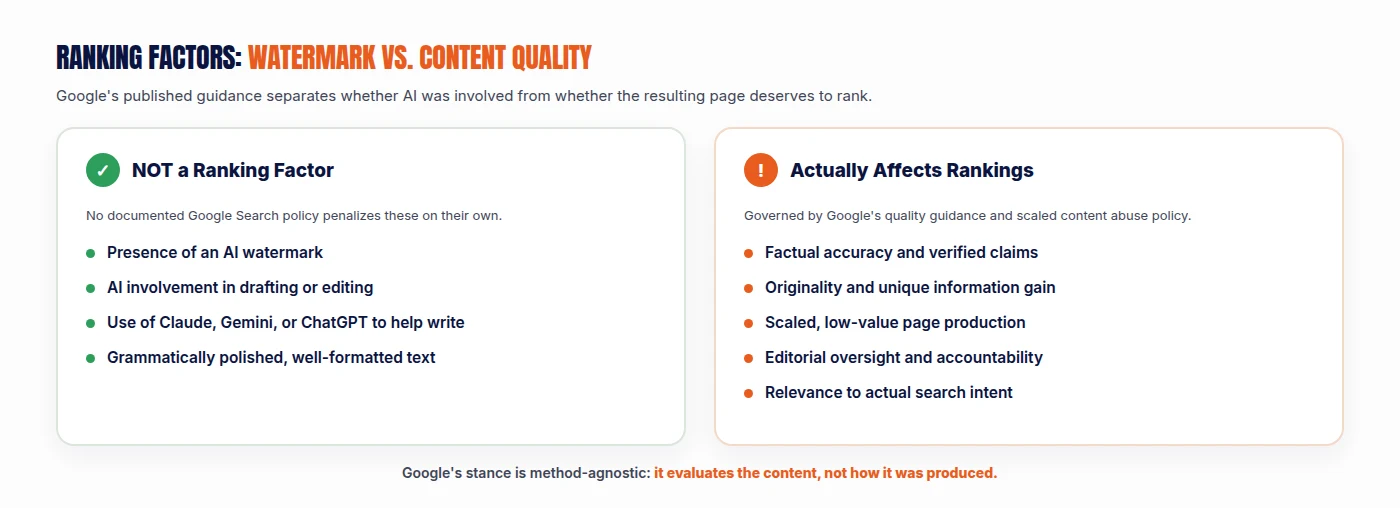
Google’s guidance focuses on the accuracy, quality, relevance, originality, and usefulness of content rather than automatically penalizing content because generative AI helped create it. Google does, however, warn that using generative AI or other automation to produce large numbers of pages without adding value can violate its scaled content abuse policy.
That distinction is critical.
AI watermark present ≠ Google ranking penalty.
A watermark can potentially help establish that an AI system participated in generating text. It does not, based on Google’s published guidance, determine whether that content deserves to rank. For a deeper look at how detection and provenance actually work under the hood, see Claude watermark vs AI content detection: what’s the difference.
For SEOs, the real risk is not the watermark itself. The bigger risks are mass-produced commodity content, weak originality, factual errors, poor editorial oversight, and creating pages primarily to capture search traffic rather than help users.
What Is an AI Watermark?
An AI watermark is a machine-detectable signal designed to indicate that an AI system was involved in generating content.
Text watermarks are different from visible watermarks on photographs.
For example, Anthropic’s Claude text watermark does not place:
- a logo on the content,
- hidden Unicode characters inside the article,
- a visible disclosure,
- an HTML marker,
- or identifying information about the user.
Instead, Claude creates a statistical pattern through choices it makes while generating tokens. For a closer look at how that mechanism works and who can currently detect it, see Claude AI watermarking: how it works and what it means for SEO.
Anthropic announced its text-watermarking implementation on August 14, 2026 and says it uses a version of Google DeepMind’s SynthID-Text approach. Anthropic also says watermarking does not meaningfully affect the quality, creativity, or readability of Claude’s output. Anthropic has said it is working to enable third-party detection of the watermark and will share further technical details in forthcoming documentation, though as of September 2026 there is no confirmed public program or eligibility list for outside access to a detection tool.
For SEO, that immediately raises a bigger question:
If a search engine can determine that content was generated with AI, could it rank that content differently?
Technically, many things are possible.
But technical possibility and documented ranking policy are not the same thing.
Do AI Watermarks Hurt SEO?
Based on Google’s currently published documentation, there is no evidence that an AI watermark itself is a negative SEO signal.
Google’s official guidance on generative AI content does not tell site owners to avoid AI-generated material.
Instead, Google says generative AI can be useful for purposes such as researching a topic or adding structure to original content.
The warning comes when generative AI is used to generate many pages without providing additional value to users.
That creates two very different situations.
Scenario 1: AI Helps Produce Valuable Content
An SEO specialist interviews a subject-matter expert, collects original information, researches primary sources, and uses Claude to help organize the article.
The final page includes:
- unique expertise,
- original examples,
- verified facts,
- useful explanations,
- proprietary insights,
- and strong editorial review.
The text may contain an AI watermark.
But the watermark doesn’t erase the value added by the humans involved.
Scenario 2: AI Produces 5,000 Commodity Pages
A publisher uploads a keyword list and automatically creates thousands of articles.
The pages:
- repeat existing information,
- use nearly identical structures,
- include no original research,
- contain little human review,
- target slightly different keyword variations,
- and primarily exist to acquire organic traffic.
This presents a much more serious SEO risk.
The difference isn’t necessarily whether the second group contains watermarks.
The difference is the purpose, scale, originality, and value of the content.
Google’s Scaled Content Abuse Policy Matters More Than AI Watermarks
For SEOs using generative AI, Google’s scaled content abuse policy deserves far more attention than AI watermarking.
Google defines scaled content abuse as generating many pages primarily to manipulate search rankings rather than help users.
Critically, Google says the policy applies regardless of how the content is created.
Google gives examples including:
- using generative AI tools to generate many pages without adding value,
- scraping search results or feeds and turning them into pages,
- automatically transforming existing content without meaningful added value,
- combining information from multiple pages without adding value,
- creating many sites to disguise the scaled nature of the operation,
- and producing keyword-focused pages that provide little useful information.
That policy reveals something important about Google’s approach.
Google doesn’t necessarily need to answer:
Was this written by Claude?
It can instead ask:
What is this website doing, and does the resulting content provide meaningful value?
From a ranking perspective, that is the far more important question.
Watermark Detection Is Not the Same as a Ranking Penalty
This distinction is easy to lose in discussions about AI SEO.
Imagine Google could determine with 99% confidence that Claude generated an article.
That would establish one fact:
AI likely participated in producing the text.
It would not automatically establish:
- that the article is inaccurate,
- that the article is unoriginal,
- that the website is spam,
- that the content violates Google’s policies,
- that a human didn’t review it,
- or that the page should rank lower.
Detection and evaluation are different processes.
A watermark is fundamentally a provenance signal.
It can potentially provide information about where content came from.
A ranking system must make a different judgment:
Is this result useful and relevant enough to show to the searcher?
Those questions can interact, but they are not equivalent.
What Google Actually Says About AI-Generated Content
Google’s current guidance gives publishers several clear priorities.
Accuracy
AI-generated content should be factually accurate.
This matters because generative systems can produce:
- outdated facts,
- invented statistics,
- incorrect explanations,
- nonexistent citations,
- or plausible-sounding misinformation.
Quality
The fact that content is grammatically polished does not necessarily mean it is high quality.
Useful content should meaningfully satisfy the user.
Relevance
Automatically creating content around a keyword does not guarantee that the page addresses the actual intent behind the search.
Added Value
This is particularly important.
Google’s guidance warns against generating many pages without providing additional value.
The implication for AI SEO is straightforward:
Using AI isn’t the shortcut. Adding value is the work.
Is AI-Generated Content Against Google’s Guidelines?
No.
Using generative AI is not automatically a violation of Google’s Search policies.
Google’s guidance explicitly acknowledges legitimate uses of generative AI and focuses on whether the resulting content meets Search Essentials and spam policies.
This means the simple equation:
AI content = spam
is wrong.
But this equation is also wrong:
AI content = safe as long as the article reads well
A polished AI article can still be:
- derivative,
- shallow,
- factually wrong,
- redundant,
- or produced as part of scaled search manipulation.
The method is not enough to determine the outcome.
Could Google Use AI Watermarks as a Ranking Signal in the Future?
It is technically conceivable.
AI provenance signals may become increasingly useful across the web for purposes including:
- transparency,
- synthetic media identification,
- misinformation analysis,
- regulatory compliance,
- content authentication,
- and understanding AI involvement.
Google DeepMind developed SynthID specifically to improve transparency around AI-generated content.
Anthropic’s Claude watermark is based on the SynthID-Text approach. Whether Google Search could reliably detect that watermark in practice is a separate question worth understanding on its own; see can Google detect Claude-written content through AI watermarks for that mechanism.
But there is a large gap between:
Google can work with AI provenance technology
and:
Google Search will demote pages containing an AI watermark.
There is currently no published Google Search documentation establishing the second claim.
If Google ever formally incorporates AI provenance into Search ranking or spam enforcement, publishers should evaluate the change when Google provides evidence or documentation.
Until then, building an SEO strategy around an assumed secret watermark penalty is speculation.
Why a Blanket AI-Watermark Penalty Would Be Problematic
There is another reason to be skeptical of the idea that every watermarked page should automatically rank lower.
AI now participates in legitimate content production in many different ways.
Examples include:
- correcting grammar,
- translating content,
- summarizing internal research,
- organizing interview notes,
- generating article outlines,
- improving accessibility,
- explaining technical concepts,
- analyzing data,
- assisting programmers,
- and helping experts communicate more clearly.
Consider two articles.
Article A: A doctor writes the research notes, supplies firsthand expertise, checks every medical claim, and uses AI to improve clarity.
Article B: A content farm asks AI to generate 2,000 health articles with almost no expert oversight.
Both may technically involve AI.
Treating them identically because a watermark exists would ignore almost everything that matters about the quality and reliability of the final content.
This is why SEOs should separate AI involvement from content quality.
What Actually Makes AI Content Risky for SEO?
The biggest risks are much more practical than watermarking.
1. Commodity Content
AI models are extremely good at summarizing information that already exists.
That creates a problem.
If your article simply reproduces information anyone could receive from Claude, Gemini, ChatGPT, or the existing top-ranking pages, why should Google rank your version?
Google’s guidance for its AI Search experiences increasingly emphasizes unique, valuable, non-commodity content. Its May 2026 generative AI optimization guidance specifically highlights the importance of material that offers unique value rather than generic information.
This is a much more important strategic signal than whether an AI watermark exists.
2. Zero Information Gain
Ask:
What does this page teach the reader that the existing results don’t?
If the answer is “nothing,” the article has a differentiation problem.
Possible sources of additional value include:
- original testing,
- proprietary datasets,
- real examples,
- screenshots,
- expert commentary,
- customer observations,
- experiments,
- original calculations,
- practical frameworks,
- and documented firsthand experience.
3. AI Hallucinations
Generative models can confidently state incorrect information.
This becomes particularly dangerous for:
- medical content,
- financial content,
- legal subjects,
- scientific claims,
- news,
- statistics,
- product specifications,
- and current events.
A human editor should verify important claims against reliable sources.
4. Fake or Weak Citations
An article can look well researched while citing sources that:
- don’t exist,
- don’t support the claim,
- are outdated,
- repeat another secondary source,
- or are lower quality than the available primary source.
AI-assisted publishing makes source verification more important, not less.
5. Template Repetition
If every article begins:
In today’s rapidly evolving digital landscape…
and then follows the same definition, benefits, challenges, best practices, conclusion structure, the content becomes predictable.
The problem isn’t merely stylistic.
It often reveals that the website is producing interchangeable commodity content rather than building a distinctive body of expertise.
6. Publishing Too Much Too Quickly
Scale isn’t automatically bad.
Large websites legitimately publish huge amounts of useful information.
The problem occurs when scale becomes the goal and quality control disappears.
Publishing 10,000 pages isn’t inherently a violation.
Publishing 10,000 largely unoriginal pages primarily to capture search queries is much closer to the behavior described by Google’s scaled content abuse policy.
7. Lack of Editorial Accountability
Someone should be responsible for what gets published.
A mature AI-assisted workflow should answer:
- Who checked the factual claims?
- Who decided the article was useful?
- Who reviewed the sources?
- Who removed unsupported statements?
- Who added original expertise?
- Who approved publication?
If nobody can answer those questions, watermarking is probably not the site’s biggest problem.
Can Watermarked AI Content Still Rank #1?
There is no documented rule preventing it.
An AI-watermarked page can still potentially possess the characteristics that make content useful:
- strong search-intent satisfaction,
- comprehensive coverage,
- original expertise,
- authoritative evidence,
- good internal linking,
- clear site architecture,
- strong technical SEO,
- relevant backlinks,
- brand authority,
- good page experience,
- and unique information.
The watermark doesn’t automatically remove those qualities.
This is why it is useful to think about AI as part of the production process, rather than treating “AI content” as a single type of content.
A professionally researched article in which Claude helped organize sections and a one-click mass-generated article are both technically “AI-assisted.”
Strategically, they are completely different products.
Do AI Watermarks Affect Google AI Overviews?
Google has not announced an AI-watermark exclusion for AI Overviews.
Google’s documentation says the same foundational SEO practices remain relevant to its AI features, including AI Overviews and AI Mode.
To be eligible as a supporting link, a page generally needs to be indexed and eligible to appear in Google Search with a snippet. Google says there are no additional technical requirements specifically for inclusion in these AI experiences.
Google’s newer 2026 generative AI optimization guidance also says its AI features are connected to Google’s core Search ranking and quality systems.
Therefore, there is currently no basis for assuming:
Claude watermark → excluded from AI Overviews
or:
AI-generated page → excluded from AI Mode
The same broader issues of quality, relevance, uniqueness, crawlability, indexability, and policy compliance remain much more important.
Could AI-Watermarked Content Be Cited by Answer Engines?
Yes, potentially.
A watermark does not inherently stop content from containing information that an AI system may find useful.
For Answer Engine Optimization and Generative Engine Optimization, publishers should pay more attention to characteristics such as:
- clear factual statements,
- strong entity relationships,
- direct answers,
- high-quality primary sources,
- original statistics,
- trustworthy authorship,
- unique expertise,
- logical structure,
- concise definitions,
- and evidence supporting important claims.
Content provenance may become an additional transparency layer.
It doesn’t replace these qualities.
Should You Remove AI Watermarks Before Publishing?
For SEO purposes, there is currently no documented reason to build a workflow around removing AI watermarks.
More importantly, focusing on watermark removal can lead teams in the wrong strategic direction.
Consider the two questions:
Question A: How can we make Google unable to identify that AI helped create this?
Question B: How can we make this page so useful, original, accurate, and defensible that it doesn’t matter whether AI helped create it?
Question B leads to a stronger SEO strategy.
Question A creates an arms race against detection technology.
Even if one watermark could be removed today, other provenance technologies may emerge tomorrow.
The durable competitive advantage isn’t hiding AI.
It is creating information worth retrieving.
A Better AI Content Workflow for SEO
A strong AI-assisted content process should look more like this:
Step 1: Start With Search Intent
Determine what the person actually wants, what they already know, what decision they need to make, and what existing search results fail to explain.
Don’t begin by simply feeding a keyword to an AI model.
Step 2: Research the Existing Information Landscape
Identify primary sources, competing explanations, missing information, outdated claims, conflicting evidence, and questions existing articles haven’t answered.
Step 3: Use AI to Accelerate Work
AI can help with structure, brainstorming, summarization, terminology, comparison frameworks, and drafting.
But acceleration should not replace expertise.
Step 4: Add Original Value
This is where competitive advantage appears.
Add firsthand experience, internal data, expert opinion, original examples, testing, screenshots, calculations, or observations.
Step 5: Verify Every Important Claim
Whenever possible, move upstream to primary sources.
For example, instead of citing an SEO blog explaining Google’s policy, check whether Google has published the policy itself. Instead of citing a news article describing Claude’s watermark, check Anthropic’s announcement.
Step 6: Apply Human Editorial Judgment
Remove unnecessary sections, repetitive explanations, unsupported certainty, generic AI phrasing, and information that doesn’t serve the searcher.
Step 7: Optimize for SEO and Answer Engines
Use descriptive headings, concise answers, tables where appropriate, clear entity references, internal links, logical content relationships, and structured information.
Step 8: Publish With Accountability
A person or editorial team should take responsibility for the finished content.
The workflow can be summarized as:
AI → Expert → Evidence → Editorial Review → SEO/AEO → Publish
That is much more resilient than:
Keyword → AI → Publish
AI Watermark SEO: Risk Matrix
| Situation | Watermark Risk | Actual SEO Risk |
|---|---|---|
| AI assists an expert-written article | Low concern | Low if content is strong |
| Claude structures original research | Low concern | Low |
| AI rewrites existing web content | Watermark may exist | Medium to high |
| Hundreds of generic AI articles published | Watermark may exist | High |
| Thousands of keyword-variation pages | Watermark may exist | Very high |
| AI article with original data and expert review | Watermark may exist | Depends on overall quality |
| AI content containing factual errors | Watermark irrelevant | High |
| Human-written scaled spam | No AI watermark | Still high |
The final row is especially important.
A page does not become good simply because a human wrote it.
Google’s scaled content policy deliberately focuses on the behavior and value of the content rather than the technology used to create it.
What If Google Starts Using AI Watermarks Later?
SEO teams should monitor this area, but they shouldn’t overreact before evidence exists.
If Google eventually announces that AI provenance contributes to ranking, spam classification, eligibility, disclosure, or particular Search features, the appropriate response would be to analyze exactly how the signal is being used.
A provenance signal could theoretically serve many different purposes.
For example:
Possible use: transparency.
That does not mean:
Automatic consequence: ranking demotion.
Google could also use AI provenance as one signal among many without assigning a negative value to AI involvement itself.
Until there is official documentation or convincing empirical evidence, it is better to avoid building SEO strategies around an assumed hidden AI-watermark penalty. Publishers operating in the EU should also keep an eye on how transparency regulation could shape this; see EU AI Act and AI-generated content: what SEOs need to know.
How Should SEO Agencies Advise Clients?
Clients are likely to ask increasingly simple questions:
Is AI content safe?
The best answer isn’t a blanket yes or no.
A better framework is:
Green: AI-Assisted
AI supports human expertise.
Examples: structuring expert notes, summarizing research, refining copy, generating questions, editing drafts.
Yellow: AI-Led
AI produces most of the initial content, but humans substantially research, verify, rewrite, and enrich the material.
This can work, but quality control becomes critical.
Red: AI-Autopublished
AI generates pages from keywords, databases, scraped information, or competitor content with little meaningful editorial intervention.
This is where scaled-content and quality risks increase rapidly.
The watermark is secondary.
The production model is the risk.
What SEOs Should Monitor Going Forward
AI watermarking is still developing quickly.
SEO teams should monitor at least five areas:
1. Google Search Documentation
Look for explicit guidance concerning AI provenance or watermarking.
2. Google Spam Policy Changes
Scaled automation remains the clearest policy risk.
3. Anthropic’s Watermark Rollout
Anthropic says future Claude models will produce watermarked text, while older models are being transitioned.
4. AI Overviews and AI Mode
Google continues to expand and refine its generative Search experiences, making content retrieval and citation visibility increasingly relevant alongside traditional rankings.
5. AI Transparency Regulation
Regulation such as the EU AI Act may make provenance more common across AI systems, meaning publishers are likely to encounter AI marking from multiple model providers rather than Claude alone.
The Bottom Line
Will AI-watermarked content affect Google rankings?
Based on Google’s currently published policies, there is no evidence that an AI watermark itself causes a ranking penalty.
Google’s guidance focuses on whether content is accurate, relevant, useful, original, and compliant with its Search spam policies. Using generative AI is not inherently prohibited, while mass-producing pages without meaningful added value can violate Google’s scaled content abuse policy.
That makes the strategic distinction clear:
AI provenance is not the same as SEO quality.
A watermarked Claude article can potentially contain original research, expert analysis, accurate information, and significant user value.
A completely human-written article can still be thin, repetitive, manipulative, or useless.
SEOs should therefore spend less time asking:
Can Google see the AI watermark?
and more time asking:
What does this page contribute that deserves visibility?
The strongest defense against future changes in AI detection isn’t hiding how content was made.
It is making the finished content genuinely worth ranking, retrieving, and citing.
FAQ
Do AI watermarks affect SEO?
There is currently no publicly documented Google Search policy stating that the presence of an AI watermark directly reduces rankings. Google focuses on content quality, relevance, accuracy, usefulness, and compliance with its spam policies.
Does Google penalize watermarked content?
Google has not announced a specific penalty for AI-watermarked text. A page can still create SEO problems if it is low quality, unoriginal, inaccurate, or part of scaled content created primarily to manipulate rankings.
Does Google penalize AI-generated content?
Not automatically. Google says generative AI can be useful, but generating many pages without adding value may violate its scaled content abuse policy.
Can Claude-written content rank on Google?
There is no Google rule preventing a page from ranking simply because Claude assisted in producing it. The final page still needs to satisfy Google’s relevance, quality, policy, and technical requirements.
Can AI-written articles rank number one?
Potentially, yes. Google’s published guidance does not impose a universal ranking ceiling on AI-generated content. Whether a page ranks first depends on the broader signals Google’s systems use and the competition for the query.
Does Claude’s watermark lower Google rankings?
Google has not publicly documented Claude’s watermark as a negative ranking signal. Anthropic says Claude’s watermark is designed as an AI-provenance mechanism and reports no practical degradation in output quality from watermarking.
Should I remove Claude’s watermark before publishing?
There is currently no documented SEO requirement to remove Claude’s watermark. A stronger strategy is to improve the content through expert input, original information, fact-checking, and editorial review rather than focusing on hiding AI participation.
Can AI-watermarked pages appear in Google AI Overviews?
Google has not published a rule excluding AI-watermarked content from AI Overviews. Google says pages appearing as supporting links in AI Overviews and AI Mode follow the same fundamental Search requirements, with no additional technical requirements specifically for those AI features.
Does Google AI Mode use different SEO rules?
Google says foundational SEO best practices continue to apply to AI Mode and AI Overviews. Its generative AI features are connected to Google’s existing Search ranking and quality systems.
What is the biggest SEO risk of AI-generated content?
For large-scale publishers, one of the clearest risks is scaled content abuse: producing many largely unoriginal pages primarily to manipulate rankings and providing little additional value to users. Google explicitly states that this can involve generative AI but that the policy applies regardless of how the content is produced.
Will Google use AI watermarks as a ranking signal in the future?
It is technically possible that provenance information could become useful to Search systems, but Google has not announced that AI watermarks will become a ranking signal. Until there is evidence or official guidance, claims that Google will penalize watermarked content remain speculative.