Claude’s watermarking technology is based on Google DeepMind’s SynthID-Text approach, but that does not mean Google can automatically identify every piece of Claude-generated content. Anthropic says its implementation uses a watermarking key, and different AI systems can use different keys. Detection of Claude’s official watermark therefore depends on the specific watermark pattern, not simply knowing how SynthID works. For a broader look at how the watermark itself compares to other detection methods, see Claude watermark vs AI content detection.
More importantly for SEO, even if Google were technically capable of determining that AI assisted in producing a page, Google’s published Search guidance does not say that AI authorship itself causes a ranking penalty. Google focuses on the quality, usefulness, originality, accuracy, and purpose of the content, while its spam policies target scaled content created primarily to manipulate rankings.
Current status — September 2026: Anthropic announced Claude text watermarking on August 14, 2026. Anthropic has said it is working to enable third-party detection of the watermark and plans to share details in forthcoming technical documentation, but that broader detection capability is not yet publicly available. Google has not publicly documented Claude watermark detection as part of Google Search ranking.
Can Google Detect Claude-Written Content?
The most accurate answer is:
We don’t currently know whether Google Search can specifically detect Anthropic’s Claude watermark, and there is no public evidence showing that it uses Claude watermark detection in Search rankings.
That answer needs several important qualifications.
Google clearly has sophisticated AI-content technology.
Google DeepMind developed SynthID, the technology family Anthropic says its Claude watermark is based on. Google already uses SynthID to watermark content generated through some of its own AI products.
But three separate questions are often being incorrectly combined:
- Can Google detect AI-generated content in general?
- Can Google detect Anthropic’s specific Claude watermark?
- Would Google Search use that information to change rankings?
The answer to one does not automatically answer the others.
That distinction is the key to understanding the relationship between Claude watermarking and SEO.
Why People Think Google Can Detect Claude’s Watermark
The theory sounds convincing at first:
Claude uses SynthID → Google created SynthID → therefore Google can identify Claude content.
The first two parts are true.
The conclusion is not proven.
Claude Uses a Version of SynthID-Text
Anthropic says Claude’s text watermark is a version of the SynthID-Text method published by Google DeepMind.
SynthID-Text modifies the way an AI model selects tokens during generation so that a statistical pattern can later be detected.
Google DeepMind originally developed SynthID-Text and has deployed the technology in its own generative AI ecosystem.
Google Understands How SynthID Works
Also true.
Google DeepMind developed the technology, published research about it, and has made SynthID-Text code available for generating and detecting compatible watermarks. The underlying research describes a watermarking system involving a random seed generator, sampling algorithm, scoring function, and watermarking key.
But knowing the watermarking method is not necessarily the same as knowing another provider’s specific watermark.
Anthropic Uses Its Own Watermarking Key
This is where the theory becomes weaker.
Anthropic explains that its detector uses a key associated with Claude’s watermark.
According to Anthropic, using Claude’s key can answer a specific question:
What is the likelihood that Claude was partly involved in producing this text?
Anthropic also states that another AI provider using watermarking would have a different key and could potentially use a different method altogether.
So the fact that Google invented the broader SynthID-Text method does not, by itself, prove that Google Search has Anthropic’s production watermark key.
Does Google Have Anthropic’s Claude Watermark Key?
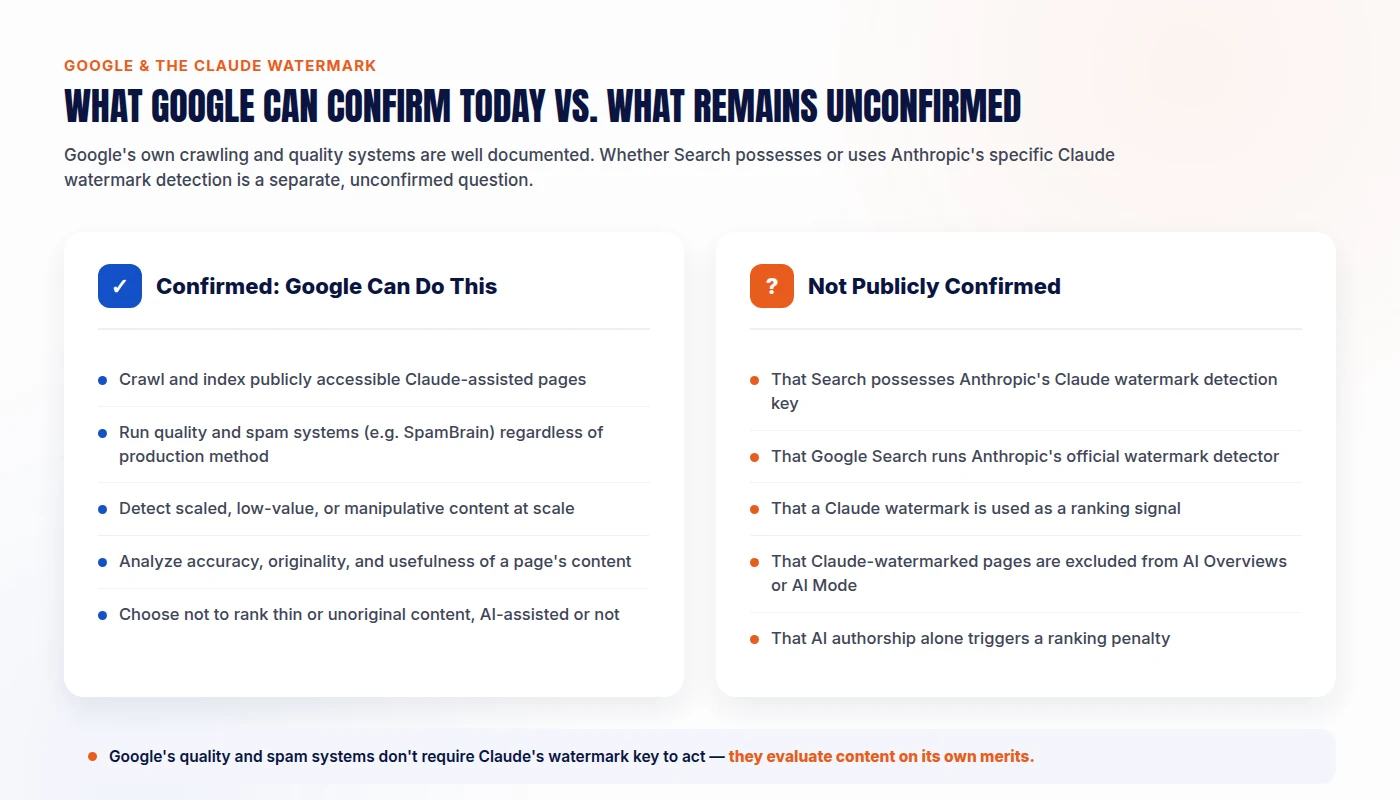
There is currently no public information confirming that Google Search has Anthropic’s Claude watermark key.
Anthropic has not publicly stated that it shares the key with Google Search.
Google has not publicly stated that it has the Claude watermark key.
That matters because Anthropic describes detection as key-dependent. As of September 2026, Anthropic has said it is working to enable third-party watermark detection and will share technical details in forthcoming documentation, but a broadly available, publicly documented detection tool with a confirmed eligibility list is not something Anthropic has published. Categories of organizations that would plausibly have a legitimate use case for such access, such as researchers, journalists, or regulators, are easy to guess at, but any specific list should be treated as illustrative rather than an official, confirmed program until Anthropic documents one.
Therefore, it would be speculative to claim:
Google definitely has Claude’s watermark key.
It would be equally speculative to claim:
Google definitely cannot detect Claude’s watermark.
Neither claim is supported by publicly available evidence.
The defensible position is:
Google has extensive expertise in text watermarking, but whether Google Search specifically possesses or uses Anthropic’s Claude watermark detection mechanism is not publicly known.
How Claude’s AI Watermark Works
Understanding the technology helps explain why simply being familiar with SynthID does not necessarily mean every implementation is universally detectable. For a deeper walkthrough of the mechanism itself, see how Claude AI watermarking works.
Large language models generate text one token at a time.
Suppose Claude begins:
The best way to improve the article is to…
Several continuations might work:
- simplify
- clarify
- restructure
- expand
- revise
The model evaluates the probability of possible next tokens and makes a selection.
Text watermarking takes advantage of situations where several choices are acceptable.
Anthropic says Claude’s watermark alters the source of randomness used to select among those acceptable alternatives. Over a sufficiently long piece of text, those choices create a statistical pattern.
Google DeepMind describes SynthID-Text similarly: the system alters token selection during generation in a way that creates an imperceptible statistical watermark without materially changing the quality of the output.
A detector can then analyze the sequence of generated tokens against the expected watermark pattern.
This is fundamentally different from looking for:
- hidden Unicode characters,
- HTML tags,
- metadata,
- unusual punctuation,
- a specific phrase,
- or a visible label.
There is no simple claude-watermark=true property sitting inside an article.
Can Google Find the Claude Watermark by Crawling the Page?
Googlebot can obviously crawl and process publicly accessible text on webpages.
But crawling the text and detecting Anthropic’s watermark are different operations.
To perform Claude’s official watermark detection, the text has to be evaluated against the statistical pattern associated with Claude’s watermarking system.
Anthropic says that pattern is detectable by someone with the appropriate key.
Therefore:
Google having access to the webpage does not automatically mean Google has access to Claude’s official watermark signal.
Google can analyze the page in many other ways, but that is a separate question from Anthropic’s watermark detector.
Can Google Detect AI Content Without Claude’s Watermark?
Potentially, yes.
In fact, Google does not need a Claude watermark to evaluate whether content creates problems for Search.
Google has spent decades analyzing webpages for quality and spam.
Its systems can evaluate patterns and signals associated with content regardless of whether the material was produced by:
- a human,
- AI,
- automation,
- freelancers,
- content farms,
- scrapers,
- or combinations of those methods.
Google has specifically said it has systems such as SpamBrain that analyze patterns and signals associated with spam, regardless of how the content was produced.
This changes the practical SEO question.
The important issue isn’t necessarily:
Can Google prove Claude wrote this?
It is:
Can Google determine that this page provides little original value or was created primarily to manipulate rankings?
Google doesn’t need an Anthropic watermark key to answer the second question.
Watermark Detection and AI Detection Are Not the Same Thing
Another source of confusion is the phrase AI detection.
There are at least two very different technologies involved.
Claude Watermark Detection
Claude watermark detection looks for a pattern deliberately created during generation.
Anthropic’s detector effectively asks:
Is this sequence statistically consistent with Claude generating or substantially processing the text using its watermarking key?
Traditional AI Content Detection
Traditional AI detectors don’t normally have Anthropic’s private watermark key.
Instead, they attempt to infer AI involvement based on characteristics of the finished text.
That might include linguistic and statistical patterns.
Anthropic itself distinguishes ordinary AI detection software from watermark detection, noting that external detectors examine patterns and stylistic characteristics because they don’t possess Anthropic’s watermark key.
Google DeepMind has also noted limitations with classifier-based AI detectors, including inconsistent performance across different types of content and the possibility of misclassification.
So a commercial AI detector saying:
92% AI-generated
is not the same as Anthropic’s watermark detector identifying Claude’s specific signal.
Claude Watermark Detection vs General AI Detection
| Question | Claude Watermark Detection | General AI Detection |
|---|---|---|
| What does it look for? | Intentionally generated watermark pattern | Characteristics associated with AI writing |
| Was the signal inserted during generation? | Yes | No |
| Does it require Anthropic’s implementation/key? | Official detection relies on Claude’s watermark pattern | Usually no |
| Can it identify any AI model? | No | May attempt to |
| Does detection prove full AI authorship? | No | No |
| Does it identify the user? | No | No |
| Is it inherently an SEO ranking system? | No | No |
The distinction becomes critical when discussing Google.
Google may be capable of running many types of content analysis.
That doesn’t establish that Google Search is running Anthropic’s watermark detector.
Can Google Detect Claude Content After It Has Been Edited?
Even Anthropic’s own watermark detection is not perfect under every form of editing.
Anthropic says light editing probably will not completely remove the watermark, but a complete rewrite can eliminate the original statistical signal.
Google DeepMind has documented similar limitations with SynthID-Text.
The technology performs reasonably under modifications such as:
- cropping parts of a passage,
- changing some words,
- and mild paraphrasing.
However, detection confidence can fall substantially when text is thoroughly rewritten or translated.
Text length also matters.
Longer pieces give the detector more token decisions to analyze, while short passages provide less statistical evidence.
Anthropic similarly says detection works poorly on small samples and becomes more confident as passage length increases.
This means Claude watermark detection is better understood as a probability assessment than an infallible binary identification system.
Does Google Know When Content Has Been Written by AI?
There is no need to assume Google has a perfect universal AI-content detector.
Google’s published Search policies don’t depend on proving AI authorship.
That’s strategically important.
Consider two pages.
Page A
Written entirely by a person.
But it:
- rewrites competitors,
- offers no original insight,
- targets keywords mechanically,
- contains thin information,
- exists primarily to capture Search traffic,
- and is part of thousands of similar pages.
Page B
Claude assists with the draft.
But a subject-matter expert:
- conducts original research,
- verifies every important claim,
- adds firsthand observations,
- includes unique data,
- improves the analysis,
- and produces something genuinely useful.
From Google’s stated policy perspective, the production method alone doesn’t make Page A superior.
Google has consistently said its focus is on rewarding useful, high-quality content rather than simply judging whether AI participated in creation.
Does Google Penalize Claude-Written Content?
There is no Google Search policy that says:
Claude content = penalty.
Google explicitly says appropriate use of AI or automation is not inherently against its guidelines.
The problem arises when AI or other methods are used primarily to manipulate Search rankings, particularly by creating large amounts of unoriginal content that adds little or no value.
Google’s current guidance for generative AI content tells site owners to focus on:
- accuracy,
- quality,
- relevance,
- and compliance with Search Essentials and spam policies.
Therefore, there is an important equation SEOs should avoid:
AI detected = Google penalty
There is no public basis for treating that as a Google ranking rule. This is also the practical crux of whether AI-watermarked content affects Google rankings more broadly, not just for Claude specifically.
Is Claude’s Watermark a Google Ranking Signal?
Google has not publicly documented Claude’s AI watermark as a ranking signal.
Its current generative-AI content guidance discusses:
- content quality,
- accuracy,
- relevance,
- transparency,
- structured data,
- and scaled content abuse.
It does not tell publishers that an AI text watermark causes demotion.
Google’s 2026 guidance for appearing in its generative AI Search experiences also emphasizes unique, non-commodity content and warns against creating excessive numbers of pages for every possible query variation.
This doesn’t prove Google will never use provenance information in Search.
Search systems evolve.
Google could potentially use many new signals in the future.
But there is a substantial difference between:
What Google technically could do
and
What Google has publicly documented as part of Search.
SEO decisions should be based primarily on the second.
Could Google Use AI Watermarks in Search in the Future?
Technically, AI provenance signals could become more useful over time.
Watermarking could potentially help platforms understand:
- where synthetic content originated,
- whether media was AI-generated,
- misinformation risks,
- content authenticity,
- large-scale automated behavior,
- or disclosure requirements.
Google itself describes SynthID as a tool for increasing transparency around AI-generated content.
But that doesn’t mean Google would need to turn:
AI-generated
into:
lower ranking.
That would be a very different decision.
AI is increasingly involved in legitimate content workflows, including:
- research,
- translation,
- editing,
- coding,
- data analysis,
- accessibility,
- content organization,
- summarization,
- and drafting.
Google’s own Search documentation acknowledges that generative AI can be useful for researching topics and adding structure to original content.
A binary penalty for AI involvement would therefore ignore the massive difference between responsible AI assistance and automated content spam. This is also where disclosure regulation enters the picture; publishers operating in the EU should also weigh what the EU AI Act means for AI-generated content and SEO, since transparency obligations there are separate from anything Google does with ranking.
Google Can Fight Bad AI Content Without Detecting Claude
This may be the most important takeaway for SEOs.
Imagine a website publishes 25,000 articles in three months.
Each article:
- follows almost exactly the same template,
- repeats information already available elsewhere,
- answers hundreds of trivial keyword variations,
- provides no original evidence,
- contains occasional factual mistakes,
- and exists primarily to generate organic traffic.
Does Google really need Anthropic’s watermark key to identify a problem?
No.
Google’s scaled content abuse policy specifically addresses large amounts of unoriginal content produced primarily to manipulate rankings, regardless of whether it is created using AI, humans, or a combination of methods.
Examples Google provides include generating many pages with generative AI without adding value and transforming existing content through methods such as synonymizing or other automated processes while providing little additional value.
The underlying issue is scale + low originality + ranking manipulation, not the presence of a Claude watermark.
What Should SEOs Worry About Instead?
If you’re publishing Claude-assisted content, these issues deserve substantially more attention than watermark detection.
1. Commodity Content
If Claude can generate essentially the same article for anyone using a simple prompt, what makes your version worth ranking?
Add:
- proprietary insights,
- firsthand observations,
- data,
- testing,
- examples,
- screenshots,
- expert commentary,
- unique frameworks.
2. Factual Errors
Claude can produce confident but incorrect statements.
Important claims should be checked against authoritative primary sources.
3. Source Quality
Don’t just ask AI for citations and trust the results.
Open the source.
Verify the claim.
Check the date.
Make sure the source actually supports what you’re saying.
4. Search-First Content Production
Creating one page for every slightly different keyword variation can become counterproductive.
Google’s current AI Search guidance explicitly warns against creating large quantities of pages merely to cover every possible query variation.
5. Lack of Human Expertise
A polished article can still be shallow.
For competitive or high-trust queries, subject-matter insight often separates useful content from generic synthesis.
6. No Information Gain
If your article merely summarizes the same five results already ranking, there is little reason for Google—or an answer engine—to choose yours.
Give the web something it didn’t already have.
What About Google AI Overviews and AI Mode?
The same core principle applies beyond traditional blue-link rankings.
Google’s current guidance for generative AI experiences says publishers should focus on unique, valuable, satisfying content rather than attempting to create special pages solely for AI systems.
For Answer Engine Optimization and Generative Engine Optimization, the important signals are more likely to involve whether content is:
- understandable,
- relevant,
- factual,
- well sourced,
- distinctive,
- easy to extract,
- and useful for answering the query.
A Claude watermark does not inherently prevent any of those qualities.
And Google has not publicly stated that Claude-watermarked webpages are excluded from AI Overviews, AI Mode, or other generative Search experiences.
Should You Try to Hide That Claude Helped Write Your Content?
No SEO strategy should depend on defeating AI provenance technology.
That approach focuses on the wrong optimization target.
If the content only works when Google doesn’t know AI helped produce it, that suggests the publishing process itself needs reconsideration.
Instead, build an AI-assisted editorial workflow where detecting AI participation would not be embarrassing or damaging.
For example:
Research → Claude Assistance → Expert Contribution → Source Verification → Editing → SEO/AEO Optimization → Human Approval
The finished article should be useful enough that the production tool becomes secondary.
This is also much more resilient.
Detection technology will change.
AI models will change.
Search ranking systems will change.
Regulation will change.
But original information, expertise, strong evidence, and satisfying answers remain valuable regardless of the technology used during production.
Claude Watermark Google Detection: What We Know vs What We Don’t
| Question | Current Evidence |
|---|---|
| Does Claude use AI text watermarking? | Yes, Anthropic is rolling it out |
| Is Claude’s approach based on SynthID-Text? | Yes |
| Was SynthID-Text developed by Google DeepMind? | Yes |
| Does Claude’s watermark use a key? | Yes |
| Would another AI provider necessarily use the same key? | No |
| Does Google Search have Claude’s production watermark key? | Not publicly known |
| Has Google announced Claude watermark scanning in Search? | No public announcement |
| Has Google said Claude watermarks reduce rankings? | No |
| Is AI-generated content automatically against Google’s rules? | No |
| Can scaled low-value AI content violate Google’s spam policies? | Yes |
| Does Google need a Claude watermark to identify low-value content? | No |
The Bottom Line
Can Google detect Claude-written content through AI watermarks?
Possibly under some circumstances, but there is currently no public evidence showing that Google Search possesses or uses Anthropic’s Claude watermark detector.
The connection between the companies’ technologies is real: Claude’s text watermark is based on Google DeepMind’s SynthID-Text approach. But Anthropic’s implementation uses its own watermarking key, and Anthropic explicitly notes that different AI systems can use different keys.
More importantly, watermark detection and Search ranking are entirely different questions.
Google’s published guidance does not say AI-generated content is automatically penalized. Its focus remains on whether content is accurate, relevant, useful, original, and created in accordance with its spam policies.
For SEOs, the strategic takeaway is straightforward:
Don’t optimize your workflow around preventing Google from discovering that AI was involved. Optimize the content so that AI involvement doesn’t matter.
A Claude watermark may eventually make AI provenance easier to establish.
It doesn’t determine whether a page deserves to rank.
FAQ
Can Google detect Claude AI content?
Google has sophisticated AI and content-analysis technology, but Google has not publicly confirmed that Search specifically detects Claude’s watermark. Claude’s watermark uses a provider-specific key, and whether Google Search has access to Anthropic’s production key is not publicly known.
Does Google own the technology Claude uses for watermarking?
Claude’s text watermark is based on Google DeepMind’s SynthID-Text approach. However, Anthropic implements the approach for Claude and uses its own watermarking key. Using the same underlying methodology does not necessarily mean the resulting watermarks are identical.
Does Google have Claude’s watermark key?
There is no public confirmation that Google Search possesses Anthropic’s Claude watermark key. As of September 2026, Anthropic has said it is working to enable third-party watermark detection and will share technical details in forthcoming documentation, but a publicly available detection tool has not yet launched.
Can Google detect Claude without the watermark?
Google can evaluate webpages using many quality and spam systems without knowing whether Claude created them. Google says systems including SpamBrain analyze patterns and signals associated with spam regardless of how the content was produced.
Is Claude content detectable after editing?
Claude’s watermark may survive light editing, but extensive rewriting can weaken or eliminate the original statistical signal. Both Anthropic and Google DeepMind acknowledge limitations when watermarked text undergoes major transformations.
Does copying Claude text leave a watermark?
If the original response was generated by a watermarked Claude model, copying and pasting the words does not inherently change the statistical sequence responsible for the watermark. Simply moving the same text into WordPress would therefore not, by itself, remove the pattern.
Does Google penalize Claude-written articles?
Google has not announced a specific penalty for Claude-written content. Google says appropriate AI use is not against its guidelines, while using AI or other methods to create large amounts of low-value content primarily to manipulate rankings can violate its scaled content abuse policy.
Is AI-generated content bad for SEO?
Not automatically. AI-assisted content can perform well when it is accurate, original, valuable, relevant, and properly reviewed. The greater risk comes from using AI to mass-produce generic or unoriginal content with little additional value.
Is a Claude watermark a Google ranking factor?
Google has not publicly documented Claude’s watermark as a Search ranking factor. Google’s current AI-content guidance focuses on quality, accuracy, relevance, usefulness, and spam-policy compliance.
Can Claude-watermarked content appear in Google AI Overviews?
Google has not published a rule excluding Claude-watermarked webpages from AI Overviews or its other generative Search experiences. Its current guidance emphasizes valuable, unique, people-focused content for both traditional and generative Search.
Does Google need to detect AI authorship to penalize AI spam?
No. Google can identify scaled content abuse based on the characteristics and purpose of a website’s content without proving which model created each page. Google’s policy explicitly applies regardless of whether content is produced through automation, human effort, or a combination of both.