A business can hold a strong #1 ranking in the traditional map pack and still be poorly visible overall. That happens if the pack has lost its call button, if an AI local pack is siphoning off a share of searches without including that business, or if Ask Maps queries are resolving the customer’s need without ever surfacing a ranked list at all.
Why this distinction didn’t used to matter much
For most of the map pack’s history, ranking and visibility were nearly the same thing. A top-three position reliably came with a call button, a direction button, and prominent placement above the fold. If you ranked well, customers found you, and they had an obvious, frictionless way to act. Tracking rank position was a perfectly good proxy for tracking real-world outcomes, because the two moved together almost automatically.
That’s the assumption most local SEO reporting still runs on. It’s also the assumption that’s stopped holding up.
Why ranking and visibility have come apart
Three structural changes are driving the split, and they compound rather than operating independently.
The call button is disappearing from a growing share of map pack listings, so holding a top position no longer guarantees the customer has an obvious, frictionless action available to them. (One large study found it surviving in only about 1 in 5 local searches today.)
AI local packs are selecting a narrower set of businesses through a different logic than traditional ranking, entity confidence rather than proximity, relevance, and prominence, which means a business can rank well in the traditional pack while never appearing in the AI-generated summary sitting near it.
And Ask Maps is resolving a growing number of local queries through direct, conversational answers rather than a ranked list at all, meaning some customer decisions now complete without any ranking ever entering the picture.
Each of these on its own would be a modest shift. Together, they mean rank position increasingly measures something narrower than it used to.
A concrete illustration
Picture a business holding #1 in the map pack for a competitive local query. If the call button has been removed from that specific search result, and an AI local pack showing nearby doesn’t include that business, the ranking is technically unchanged from two years ago. But most of the practical value that ranking used to carry, the frictionless call, the visibility boost from the AI-generated summary, is gone. The business is still winning the competition it’s measuring. It’s just a smaller competition than it used to be.
What visibility actually means as something you can track
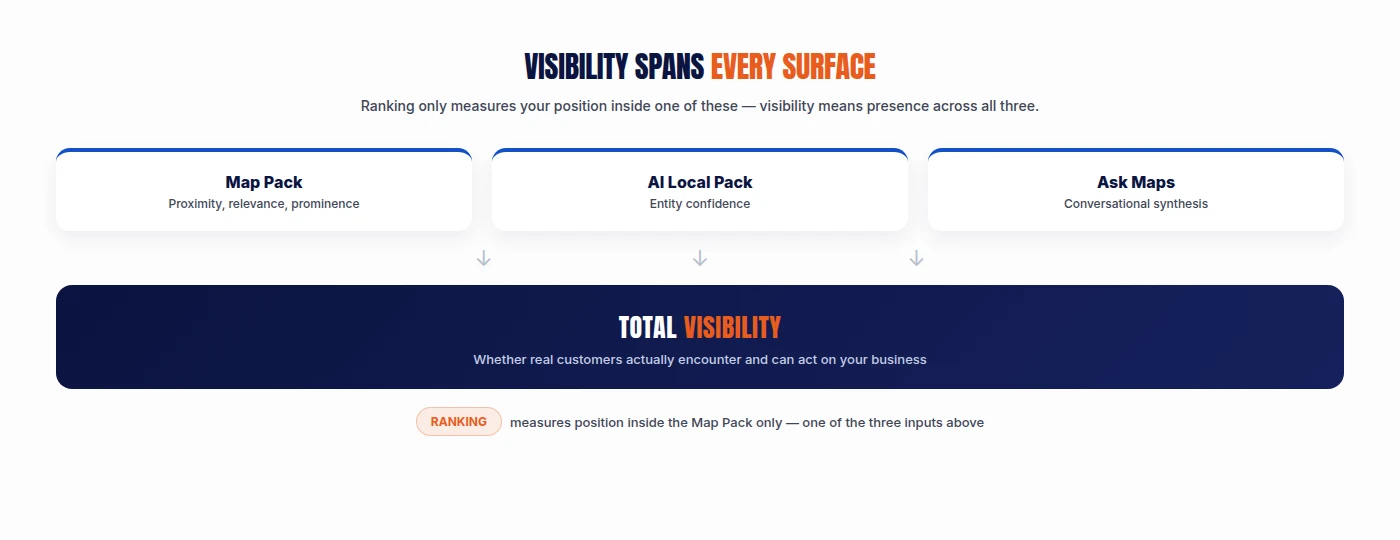
Visibility means presence across surfaces, not just position within one of them. That means checking map pack ranking, yes, but also checking whether your business appears in AI local packs for your priority queries, and whether it shows up as a named option when a customer runs an Ask Maps-style conversational query in your category.
The goal is coverage across the full discovery landscape a customer might actually use, not depth in a single channel that’s become one of several parallel paths rather than the whole picture. For a concrete, step-by-step way to start tracking that, see how to measure local SEO when calls and clicks are falling.
Why this matters strategically
The entity-level signals that influence AI local pack selection and Ask Maps inclusion, structured data completeness, detailed and specific review content, cross-platform NAP and hours consistency, aren’t separate from traditional ranking factors. They overlap with and reinforce them. Investing in these signals tends to help across every surface at once, rather than requiring a completely different strategy for each one.
That’s the practical argument for reallocating some effort here. It’s not asking a business to abandon what’s worked before. It’s asking them to invest in the layer of signals that increasingly determines whether a strong ranking translates into a customer action, or just a position on a page that fewer customers are converting from than they used to.
A grounding caveat
Don’t overcorrect. The traditional map pack still drives the majority of local pack traffic and remains genuinely valuable: businesses in the top three positions generate significantly more traffic and customer actions, roughly 126% more traffic and 93% more calls, clicks, and direction requests, than businesses ranking four through ten, based on available local search data.
This is about adding a layer of focus, not walking away from ranking work that still matters. A strong map pack position paired with strong entity-level signals outperforms either one alone, and neither replaces the other.
FAQ
What’s the difference between local ranking and local visibility?
Ranking measures your position relative to competitors within one specific result type, most often the map pack. Visibility measures whether real customers actually encounter and can act on your business across every surface where local discovery now happens, including the map pack, AI local packs, and Ask Maps, which a ranking number alone doesn’t capture.
Can a business really rank #1 and still lose customers?
Yes. A #1 map pack ranking on a query where the call button has been removed, or where an AI local pack is siphoning off a share of searches without including that business, delivers far less practical value than the same ranking would have a few years ago, even though the position itself hasn’t changed.
Should businesses stop focusing on map pack rankings altogether?
No. The traditional map pack still drives the majority of local pack traffic and remains highly valuable, with top-three positions generating significantly more traffic and customer actions than lower positions. The shift is toward adding visibility across AI local packs and Ask Maps as an additional priority, not abandoning traditional ranking work.
How do I actually start tracking visibility instead of just ranking?
Begin by checking your priority queries for AI local pack presence separately from map pack position, since these use different selection logic and one doesn’t guarantee the other. From there, build out the entity-level signals, structured data completeness, specific review content, and cross-platform consistency, that influence both traditional ranking and AI-driven selection at the same time.