That makes the AI local pack a narrower, more selective, and genuinely harder-to-earn placement than the map pack it sometimes replaces. Here’s what it actually is, how often it shows up, and why the selection logic works differently than what you’re used to.
What it looks like, and what it isn’t
An AI local pack reads as a short, synthesized paragraph, Google’s AI describing and naming a business or two rather than presenting a clean list of three listings with individual call and direction buttons. That structural difference matters. The traditional map pack gives every listed business its own clickable actions. An AI local pack gives the AI’s own summary the primary space, with the named businesses folded into that summary rather than standing on their own.
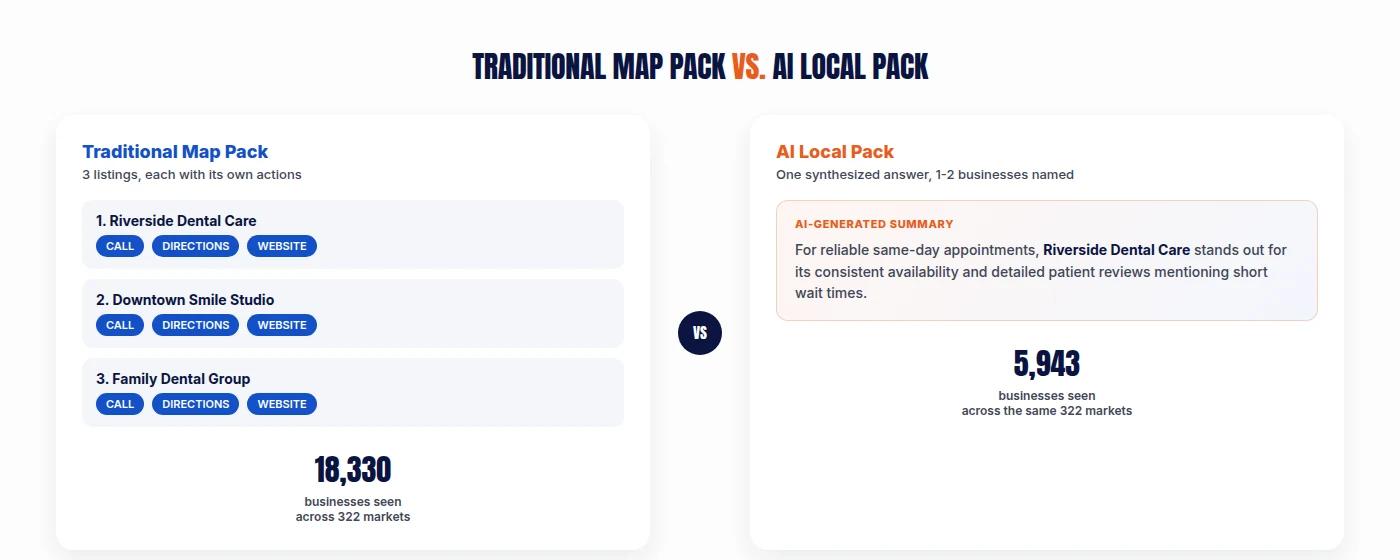
Worth being precise about what it isn’t, since the terminology gets used loosely across the industry. An AI local pack is not the same thing as a general AI Overview, which can appear on any kind of query, informational or local. And it’s not Ask Maps, the separate conversational feature inside the Google Maps app itself. An AI local pack is specifically the AI-generated summary block that shows up within local search results.
How often it actually appears
Be skeptical of any single number here, including this one. One dataset found AI local packs appearing on roughly 7% of the local keywords studied. Separately, Ahrefs found about 7.9% of local searches trigger a general Google AI Overview, a related but distinct measurement that isn’t specific to local packs.
Those two figures land close together, but they’re measuring different things from different studies, not one consistent statistic. What’s fair to say across the data available: AI local packs remain a minority experience in local search today, appearing on a meaningful but still limited share of queries, while growing quickly enough that the share is worth tracking rather than dismissing.
Why fewer businesses get selected
The traditional map pack runs on a familiar formula: proximity, relevance, and prominence. Get close enough, relevant enough, and well-established enough, and you’re in the running alongside every other business that clears the same bar.
AI local pack selection appears to work differently, following something closer to entity confidence, how clearly and consistently Google’s systems can verify who a business actually is, what it specifically offers, and how reliable its quality signals are. Structured data and cross-platform consistency carry more weight in this model than they do for traditional ranking, since the AI is synthesizing a confident recommendation rather than simply listing everyone who qualifies.
That’s the mechanical reason fewer businesses make it in. A business can be perfectly proximate, relevant, and prominent by traditional standards and still not clear the higher confidence bar an AI summary requires before it’s willing to name that business specifically.
The quality bar looks stricter here
A pattern from broader AI-recommendation research is worth flagging, even though it’s not local-pack-specific data on its own. SOCi’s analysis of AI-driven local recommendations found ChatGPT tending to recommend only businesses averaging 4.3 stars or higher, effectively filtering out otherwise-qualified listings with lower ratings or thin review responsiveness, a noticeably higher bar than the range of ratings Google Maps will still readily surface for a nearby, relevant business.
If that same pattern holds for AI local pack selection specifically, and the directional logic suggests it likely does, it helps explain why a business with a decent but unremarkable review profile might comfortably hold a map pack position while never showing up in an AI-generated summary for the same query. Tracking how consistently your business shows up as a named answer, versus simply ranking, is worth building into your own brand visibility metrics for generative search.
What this means if you’re good but not AI-selected
Don’t read a missing AI local pack appearance as a verdict on your local SEO. AI local packs still don’t appear on most local searches, and the traditional map pack remains the primary discovery surface for the large majority of queries. A strong, well-earned map pack position continues to deliver real value regardless of whether an AI local pack happens to be showing for that specific search today.
The more useful frame is treating AI local pack inclusion as an additional, harder-to-earn tier sitting above solid map pack performance, not a replacement threshold every business now has to clear.
A practical adaptation checklist
Structured attribute completeness matters more here than for traditional ranking alone. Fill in specific services rather than relying on a broad category, keep hours accurate down to the day, and complete every relevant attribute field the profile offers.
Detailed, specific review content outperforms review volume or star rating on their own. Reviews that describe what a customer actually experienced give an AI system something concrete to synthesize into a confident summary; generic five-star reviews with no detail don’t.
Cross-platform NAP and hours consistency deserves real attention. Conflicting information across your website, Yelp, Apple Maps, and other directories erodes the entity confidence an AI system needs before it’s willing to name your business specifically.
Service-list specificity rounds it out. A business that clearly and precisely lists what it does gives AI systems a much easier synthesis job than one that leaves Google to infer the details.
FAQ
What is an AI local pack?
An AI local pack is a Gemini-generated summary block that Google shows for some local searches, describing and often naming just one or two businesses in paragraph form, instead of, or alongside, the traditional three-listing map pack with individual call and direction buttons.
How common are AI local packs right now?
Estimates vary by study and query type, but current data suggests they appear on a meaningful yet still minority share of local searches, roughly single-digit percentages in some datasets, while growing quickly. Treat any specific percentage as a snapshot rather than a fixed figure, since this is one of the fastest-moving parts of local search right now.
Why do AI local packs show fewer businesses than the traditional map pack?
AI local pack selection appears to follow entity confidence, how clearly and consistently Google can verify a business’s identity, services, and quality signals, rather than the proximity, relevance, and prominence formula the traditional map pack uses. That stricter, more selective standard is why one analysis found AI local packs surfacing only about 32% as many unique businesses as the traditional pack across the same markets.
Does losing a spot in the AI local pack mean my business is failing at local SEO?
Not necessarily. AI local packs don’t yet appear on most local searches, so the traditional map pack remains the primary discovery surface for most queries. A strong traditional pack position still delivers real value even when a business isn’t currently being selected into an AI local pack summary.