As of August 31, 2026, Google’s Search generative AI control is available worldwide in Search Console. Publishers can choose whether their site’s links and content are eligible to appear in AI Overviews, AI Mode, and generative AI features in Google Discover.
If a publisher opts out, Google says the site’s content will no longer appear as links in those covered generative AI features and will not be used as grounding input for responses there. The site will also stop receiving traffic and impressions from those features. Importantly, Google says the opt-out is not used as a ranking or inclusion signal for ordinary Google Search.
That creates a real strategic choice. Publishers now have more control, but opting out means voluntarily giving up visibility inside Google surfaces that Google says already reach billions of users.
The better question is not “Should publishers block Google AI?” It is “Is the value of protecting or withholding our content greater than the value of remaining visible inside Google’s AI-driven discovery ecosystem?”
For many publishers, the answer will be no. For some publishers with premium content, licensing concerns, or weak economic returns from AI Search, opting out may be rational.
Publishers can now opt out of Google AI Search
For much of the AI Search debate, publishers faced an awkward technical problem. They could control traditional crawling and indexing through tools such as:
- robots.txt
noindex- Snippet controls
- Google-Extended
But those controls did not provide a clean way to say “keep me in ordinary Google Search, but exclude my content from AI Overviews and AI Mode.” That has now changed. Google introduced a dedicated Search generative AI control in Search Console in June 2026 and completed the worldwide rollout on August 31, 2026. The rollout follows a period of intense regulatory attention on how Google surfaces AI-generated answers; for the DMA background that shaped this control, see Google AI Overviews and the DMA: What SEOs Need to Know and EU Investigates Google AI Search: What Publishers Need to Know.
Site owners can find the control under Search Console → Settings → Search generative AI. Publishers can choose to include the site’s links and content in Search generative AI features, or exclude the site’s links and content from those features. This is a meaningful change because publishers no longer have to leave ordinary Google Search entirely in order to avoid participation in Google’s covered generative AI Search experiences.
What does Google’s AI opt-out cover?
Google currently says the Search generative AI control applies to:
- AI Overviews — AI-generated responses shown within Google Search results.
- AI Mode — Google’s more conversational and exploratory AI Search interface.
- Generative AI features in Google Discover — AI-generated experiences appearing within Discover.
Google says it expects the list of covered features to evolve as Search changes. That means publishers should not treat the current scope as permanently fixed. The setting should be reviewed as Google introduces additional AI Search experiences.
What happens when a publisher opts out?
The consequences are broader than simply removing a citation. Google says that when a site is excluded:
- Links to the site will not appear in the covered generative AI features.
- The site’s content will not appear there.
- Crawled content from the site will not be eligible as input for generating AI responses or previews in those features.
- The site will receive no traffic from those features.
- The site will receive no impressions from those features.
This distinction is strategically important. Opting out is not merely “don’t summarize my article.” It is closer to “remove my site from this generative-search visibility layer.” That includes both content use and potential discovery.
Does opting out of Google AI hurt SEO rankings?
According to Google, no — not through this control itself. Google explicitly states that the Search generative AI control is not used as a ranking or inclusion signal for other parts of Google Search. That means a publisher can theoretically remain indexed, continue ranking in ordinary Search, and receive traditional organic traffic while being excluded from AI Overviews and AI Mode.
This separation is one of the most important developments in publisher control over AI Search. However, publishers should understand what this does not mean. It does not mean opting out has zero business impact. A site could keep the same traditional ranking positions while losing AI Overview exposure, AI Mode links, generative AI impressions, potential referral visits, and brand visibility inside AI-generated answers.
So the distinction is: no direct ordinary-Search ranking penalty does not mean no visibility cost. For a closer look at that gap between rankings and AI-driven traffic, see Can You Rank #1 and Still Lose Traffic to AI Overviews?
Google AI opt-out vs Google-Extended
These controls are easy to confuse. They do different things.
| Control | Main Purpose |
|---|---|
| Search generative AI control | Controls participation in covered Google generative Search features |
| Google-Extended | Controls specified Gemini-related training and grounding uses |
noindex |
Removes content from Google Search entirely |
| robots.txt Googlebot block | Restricts Googlebot crawling |
Google explicitly says the Search generative AI control does not control AI training. Publishers who want to limit applicable training uses need to look at Google-Extended separately. This is a critical publisher-governance point: a publisher may choose to allow ordinary Search and AI Overviews/AI Mode while declining specified training use, or decline AI Overviews/AI Mode participation while also declining training use. These are separate policy decisions.
Why some publishers may want to opt out
1. The publisher believes AI Search extracts too much value
A publisher’s business model often depends on users reaching the site. Traffic can produce advertising revenue, subscription conversions, newsletter signups, affiliate clicks, memberships, and product sales. If Google provides enough information directly inside an AI answer to satisfy the user’s need, some publishers may believe the economic exchange becomes unfavorable — the publisher supplies reporting, expertise, and information while receiving insufficient traffic in return. The new opt-out provides a way to act on that concern without leaving ordinary Search entirely.
2. The content has high licensing value
Consider a publisher producing premium financial research, exclusive investigations, proprietary datasets, specialist legal analysis, or expensive original reporting. The organization may decide that widespread generative use weakens the scarcity or licensing value of its content. In that situation, maximizing AI Search reach may not be the highest-priority objective. Control can be economically valuable.
3. The publisher uses a subscription model
Subscription publishers face a different tradeoff from businesses using content primarily for customer acquisition. For a B2B SaaS company, AI exposure may generate awareness for a product. For a subscription publisher, the content itself is often the product. If AI Search gives users enough of the informational value without encouraging subscription activity, the publisher may reasonably question participation. But that decision should be based on evidence, not fear.
4. The publisher wants negotiating leverage
Some publishers may view exclusion as part of a broader licensing or negotiation strategy. If original reporting becomes important grounding material for AI systems, controlling access can potentially become part of commercial negotiations. However, this strategy has a cost: withdrawing your content also removes your opportunity to influence the answers users receive. That tradeoff should be explicit.
Why most publishers should be careful before opting out
The opposite argument is equally strong. AI Search is increasingly becoming part of mainstream Google discovery. Google says AI Overviews now have more than 2.5 billion monthly active users, while AI Mode has exceeded one billion monthly active users. These are Google-reported figures and should be treated as such, but they illustrate the scale Google says these surfaces have reached. Completely abandoning those surfaces could therefore mean withdrawing from a major discovery channel.
1. You lose AI Search visibility
The most obvious cost is exposure. If your content is excluded, users cannot encounter your site through the covered AI Search links. For publishers focused on GEO, that is significant: traditional visibility becomes Google Search ranking, while AI visibility becomes zero by choice inside those controlled features.
2. You lose citation and link opportunities
Google has been increasing direct website links inside AI Search experiences — increasing inline links in AI responses, adding website previews, extending Preferred Sources into AI Overviews and AI Mode, and introducing additional source-discovery features. If a publisher exits those features, it also exits the opportunity to benefit from those improvements. The relevant comparison is therefore not “AI summary vs traditional click” but “AI visibility plus potential links” versus “no participation.”
3. Competitors can remain
This may be the most underestimated downside. If Publisher A opts out, Google does not stop answering the question. Google explicitly says content from other sites remains available and may contain information similar to the excluded publisher’s material. That means the user may still receive an answer — the sources may simply become Publisher B, Publisher C, official sources, or competitors. Opting out removes your participation, not the AI feature itself. That creates a competitive question: if you leave the answer ecosystem, who takes your place?
4. You lose GEO data
Google has introduced dedicated generative AI performance reporting in Search Console. The reporting gives publishers a view into AI Search impressions and can help identify which pages and markets are appearing in generative experiences. If you opt out, those impressions disappear because the site is no longer participating. That removes not just visibility but also an important source of intelligence about how users are discovering your content.
5. Brand visibility can matter without the click
Traditional publishing economics focus heavily on traffic, and that remains important. But AI Search introduces another dimension: influence before the click. A publisher may be cited, surfaced as a preferred source, associated with an important topic, or repeatedly exposed to users. That brand reinforcement can matter even when every impression does not generate an immediate visit. Publishers should therefore avoid measuring AI Search exclusively through last-click traffic. For more on what this visibility layer is actually worth, see Google AI Opt-Out vs GEO Visibility: What Do Publishers Lose?
The real decision: traffic economics vs information control
The opt-out decision can be simplified into two competing values.
Value A: Distribution. Remaining included provides potential reach, AI impressions, links, referrals, topic authority, brand exposure, and GEO visibility.
Value B: Control. Opting out provides greater control over whether your own site content is used inside the covered generative Search features.
The correct strategy depends on which side produces more business value.
Publisher decision matrix
| Publisher Type | Default Direction | Why |
|---|---|---|
| Ad-supported editorial publisher | Test carefully before opting out | Traffic matters, but AI summarization may affect economics |
| Subscription publisher | Evaluate closely | Content itself may be the paid product |
| Affiliate publisher | Usually remain initially | AI links can still create commercial discovery |
| Brand content site | Usually remain included | Visibility is often more valuable than content scarcity |
| B2B company | Usually remain included | Content supports lead generation and authority |
| Ecommerce site | Usually remain included | Product discovery is commercially valuable |
| Proprietary research publisher | Case-by-case | Licensing value may outweigh reach |
| Local business | Usually remain included | Discovery and visibility are generally beneficial |
| Government/nonprofit information site | Usually remain included | Distribution often aligns with mission |
These are strategic defaults, not universal rules.
A better framework: score the opt-out decision
Instead of arguing abstractly, publishers can score five factors. Give each factor 1–5 points.
- Dependence on Google AI traffic — 1: AI Search traffic has no measurable value. 5: AI Search generates meaningful traffic or conversions.
- Value of content scarcity — 1: Content is primarily marketing/distribution material. 5: Content is premium, exclusive, or highly licensable.
- Importance of GEO visibility — 1: AI Search visibility is strategically unimportant. 5: Being cited or recommended in AI Search is a major strategic goal.
- Competitive risk of withdrawal — 1: Few substitutes exist. 5: Competitors can easily replace your content in AI answers.
- Need for content-control leverage — 1: No licensing/control concern. 5: Content-use control is central to commercial strategy.
Separate the factors into two pressure groups. Stay-In Pressure combines AI traffic, GEO importance, and competitive risk, for a maximum of 15 points. Opt-Out Pressure combines content scarcity and control leverage, for a maximum of 10 points.
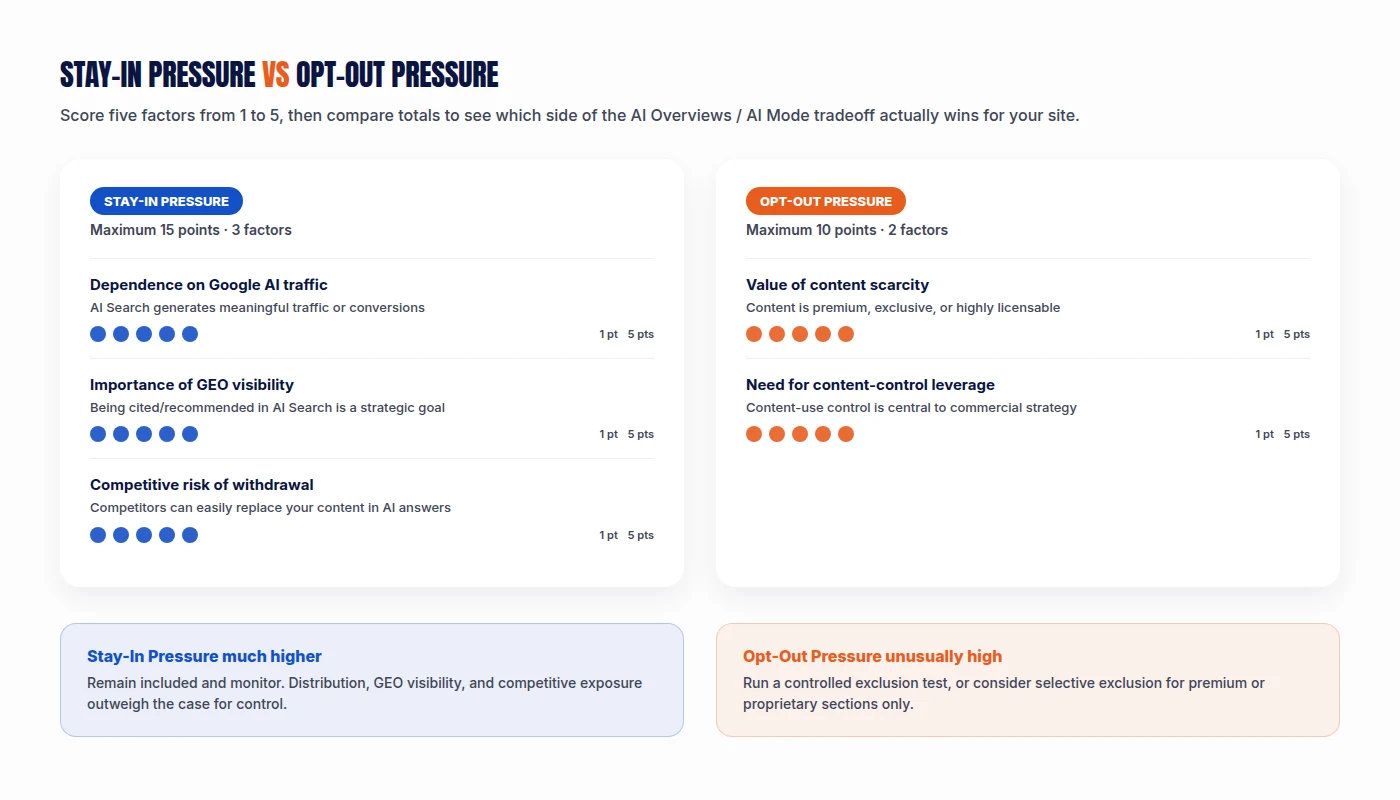
If Stay-In Pressure is much higher, remain included and monitor. If Opt-Out Pressure is unusually high, run a controlled exclusion test or consider selective exclusion. The purpose is not to create an official score. It is to force the business to articulate the economic tradeoff.
Test before you opt out
This is the approach most publishers should take. Do not begin with ideology. Begin with data. Google’s generative AI performance reporting makes this easier than it was previously. Before changing the setting, establish a baseline. Track:
- AI impressions — How often do pages appear?
- Pages — Which URLs receive the visibility?
- Countries — Where is the exposure happening?
- AI referral traffic — How much traffic is generated?
- Engagement — Do AI visitors stay?
- Conversions — Do they subscribe, buy, join newsletters, or generate leads?
- Topic visibility — Which subjects generate AI exposure?
Only after collecting this baseline should the publisher make a serious exclusion decision.
Measure revenue per AI visit
Raw traffic can be misleading. Suppose traditional Google organic traffic delivers 100,000 visits and AI Search traffic delivers 5,000 visits. That does not automatically mean AI Search is unimportant. If AI visitors convert at three times the rate, their commercial value may be disproportionate.
Calculate AI Revenue ÷ AI Visits and compare it with Traditional Organic Revenue ÷ Traditional Organic Visits. For subscription publishers, measure subscription starts, registration rate, newsletter signups, and returning visitors. The decision should be based on economic quality, not only traffic volume.
Not all publisher value is directly attributable, either. Branded search growth, direct traffic, returning users, subscriptions occurring later, social sharing, and brand recall can all trace back to a citation inside AI Search that created awareness converting through another channel. That makes measurement imperfect. It does not make measurement unnecessary.
Can publishers opt out of only part of a website?
Yes, Google’s property-inheritance system can make selective control possible when Search Console properties are configured appropriately. Google says child properties inherit their closest configured parent property’s generative AI setting by default, but owners can manually configure a child URL-prefix property differently.
For example, example.com could remain included, while a configured property such as https://example.com/premium-research/ could potentially use a different setting. This creates a much more sophisticated strategy than “whole website in” or “whole website out.” Publishers may eventually distinguish between free news, premium analysis, evergreen guides, and proprietary research. However, the Search Console property structure must align correctly with the URLs being controlled.
For many publishers, selective exclusion could be the strongest approach: keep free editorial content and evergreen reference guides included for maximum distribution, while considering separate controls for proprietary research and evaluating whether AI Search distribution supports or undermines subscription-only analysis. That is more rational than treating every URL as economically identical.
How long does the Google AI opt-out take, and can you opt back in?
Google says a Search generative AI setting change generally takes several days to propagate. Once the control is live, content is usually excluded within 1–2 days, although some cached content can take longer to disappear across Google’s systems. Publishers should therefore not expect an immediate before/after comparison, and should allow time for propagation, caching, and reporting delays.
The setting can also be changed back. That makes controlled experimentation possible: establish a baseline, exclude a section, monitor traffic and business impact, then re-enable participation if the economic result is unfavorable. This is strategically preferable to treating the first decision as permanent.
What doesn’t the Google AI opt-out control?
The setting is specific. It does not automatically control every Google AI use. Google says:
- It does not affect ordinary Search ranking. The setting is not used as a ranking or inclusion signal outside the controlled generative AI features.
- It does not control AI training. Google directs publishers to Google-Extended for applicable training controls.
- It does not override other Google programs. Participation in Merchant Center, Ads, and other services remains separately governed.
- It does not remove your site from Google Search. For that, publishers would need broader controls such as
noindex.
This is why the new setting should be understood as a Search-surface control, not a universal Google AI switch.
Should news publishers opt out?
There is no universal answer. News publishers have a particularly difficult tradeoff. They invest heavily in reporting, investigation, fact-checking, journalists, and editorial infrastructure, and that content can then contribute to AI-generated answers that may reduce the need for some users to visit the original article. That concern is legitimate.
But news publishers also depend heavily on distribution. Withdrawing from AI Search may reduce discovery, citations, brand exposure, direct links, and potential subscriptions. The correct response is therefore not automatically block or allow — it is to measure the exchange. How much value is Google receiving? How much value is the publisher receiving? That is fundamentally a business-model question.
Should SEO and content marketing sites opt out?
Usually not. The purpose of an SEO agency blog, SaaS resource center, ecommerce guide, or business knowledge hub is generally to increase discoverability, build authority, generate leads, and influence purchase decisions. Withholding the content from one of Google’s major discovery surfaces works against that objective. For these businesses, visibility is usually the asset — content scarcity is not. A lead-generation website should be extremely cautious about voluntarily reducing reach.
Should premium research sites opt out?
This is where the case becomes stronger. If the product is proprietary research, paid datasets, premium market intelligence, or high-value analysis, then unrestricted generative use may conflict with the commercial model. A selective strategy may make more sense: keep public research summaries included while excluding or separately controlling detailed proprietary datasets. This preserves discoverability while protecting the highest-value information.
Could opting out improve direct traffic, or let competitors gain?
Possibly, but publishers should not assume it. The theory is that if Google cannot answer from your content, the user will click your normal Search result instead. But that is not guaranteed — Google can still use other websites, and the user may read a competitor, receive a similar answer from another publisher, stop searching, or use another AI system. Google explicitly says similar information from other websites may continue appearing after your site is excluded. So opt-out does not equal a recovered click, and that assumption needs testing.
The competitive risk cuts the other way, too. Imagine three publishers dominate a topic. If Publisher A removes itself from Google AI Search, the system can still retrieve information from B and C. A’s departure may reduce competition for links, citations, source visibility, and topical association. This doesn’t mean Google automatically replaces A with B, but the eligible source pool changes — and that creates a real competitive cost to exclusion.
The GEO cost of opting out
From a Generative Engine Optimization perspective, opting out means willingly giving up several forms of visibility: retrieval eligibility, since your content can no longer serve as grounding input in the covered features; citation and link eligibility, since your links no longer appear there; AI impressions, which disappear; referral opportunities, since there’s no traffic from those features; topic association, since your brand loses an opportunity to be repeatedly associated with relevant questions; and competitive share, since other eligible publishers remain. For a company actively pursuing GEO, this is a substantial tradeoff.
A publisher opt-out checklist
Before changing the setting, answer these questions:
- Measurement — Do we know our current Google AI Search impressions?
- Traffic — How much referral traffic comes from AI Search?
- Conversion — Does that traffic generate meaningful business outcomes?
- Brand — Is being visible in AI answers strategically important?
- Content value — Is the underlying content freely distributable marketing content or a proprietary asset?
- Licensing — Could excluding the content strengthen licensing opportunities?
- Competition — Will competitors remain eligible?
- Search dependence — How important is traditional Google traffic?
- Selectivity — Can we isolate only high-value sections instead of the whole site?
- Reversibility — What test period will we use before reviewing the decision?
If a publisher cannot answer these questions, it probably lacks enough evidence to make a sitewide opt-out decision.
Bottom line
Google has finally given publishers a meaningful choice: participate in its generative AI Search ecosystem or remain in ordinary Search while opting out of the covered AI features. That is an important improvement in publisher control. But control should not be confused with strategy — the existence of an opt-out does not mean using it is automatically good for publishers.
When you exclude a site, Google says you lose AI Overview visibility, AI Mode visibility, covered generative Discover visibility, links, grounding eligibility, AI impressions, and AI referral opportunities, while ordinary Search remains separately available. That means the decision is fundamentally an economic tradeoff.
For publishers whose content is the product — premium journalism, proprietary research, expensive datasets, subscription analysis — the value of protecting or withholding that content may justify exclusion. For businesses using content primarily to gain visibility, authority, leads, customers, and brand recognition, opting out is much harder to justify.
There is also a competitive reality. If you leave Google AI Search, the question does not disappear. Your competitors may remain, Google can still retrieve other sources, and users may still receive the answer. The difference is simply that your content is no longer eligible to influence it.
That is why the strongest default strategy for most publishers is: measure first, decide second. Use Google’s generative AI performance data. Measure referral traffic. Measure subscriptions and conversions. Estimate the commercial value of your content. Assess whether competitors can replace it. Then decide whether distribution or control creates more value — and where possible, avoid treating the decision as all-or-nothing. A publisher can potentially keep high-distribution content visible while using separate Search Console properties and policies for premium or strategically sensitive sections.
The final question is not “Do we like Google AI?” It is “Which outcome creates more value for this business: being part of the AI-mediated answer, or withholding our information from it?” For most brands trying to grow visibility, the answer will still favor participation. For some publishers whose information itself is the scarce asset, the answer may be different. The new Search generative AI control finally makes that choice possible.
FAQ
Can publishers opt out of Google AI Overviews?
Yes. Google’s Search generative AI control is now available worldwide through Search Console and can exclude a site’s links and content from covered generative AI features including AI Overviews.
Can publishers opt out of AI Mode?
Yes. AI Mode is included in the Search generative AI control.
Does opting out of Google AI hurt normal SEO rankings?
Google says the Search generative AI control is not used as a ranking or inclusion signal affecting other parts of Search.
What happens when I opt out?
Your site’s links and content stop appearing in the covered generative AI features, the content is no longer eligible as grounding input there, and you stop receiving traffic and impressions from those features.
Does the opt-out stop Google from training AI on my content?
Not through this control. Google says the Search generative AI control does not affect AI training and directs publishers to Google-Extended for applicable training controls.
Is Google-Extended the same as the AI Search opt-out?
No. Google-Extended addresses specified model-training and grounding uses, while the Search generative AI control manages participation in covered generative Search features.
Can I opt out of AI Search but remain in ordinary Google Search?
Yes. That is one of the main purposes of the new control. Google says exclusion from covered generative AI features is not used as a ranking or inclusion signal elsewhere in Search.
Can I opt out of only part of my website?
Google allows child Search Console properties to have settings different from their parent property when manually configured, making section-level strategies possible where the property structure supports them.
How long does Google AI exclusion take?
Google says changes generally take a few days, with content usually excluded within one to two days after the setting becomes live. Cached content may take longer.
Can I opt back into Google AI Search later?
Yes. The Search Console setting can be changed again.
Will Google AI still show information similar to mine after I opt out?
Yes. Google explicitly says content from other sites remains available and may contain information similar to yours.
Should news publishers opt out of Google AI?
Not automatically. News publishers should compare AI visibility, traffic, subscription impact, licensing value, and the competitive cost of withdrawing before making the decision.
Should business blogs opt out?
Usually not if the primary purpose of the content is discovery, authority, lead generation, or brand visibility. Exclusion directly reduces participation in Google’s generative AI discovery surfaces.