The formal antitrust investigation began on December 9, 2025 and also covers Google’s use of YouTube content for generative AI. The Commission said it would examine whether Google may be imposing unfair terms on publishers and creators or giving itself privileged access to online content in ways that disadvantage competing AI developers.
The issue became more significant in 2026 because Google introduced a dedicated Search generative AI control. As of August 31, 2026, the control is available worldwide and lets websites exclude their links and content from AI Overviews, AI Mode, and covered generative AI features in Discover without that decision being used as a ranking signal for ordinary Google Search. For a deeper look at how that control interacts with DMA obligations, see Google AI Overviews and the DMA: What SEOs Need to Know.
But the investigation is not necessarily over. On September 1, Reuters reported that EU antitrust regulators had asked publishers whether Google’s new opt-out meaningfully addresses their concerns and what factors would determine whether they use it.
For publishers, the central question is shifting from “Can we opt out?” to “Does the new opt-out create a fair enough choice between AI participation, search visibility, compensation, and control?”
Why Is the EU Investigating Google AI Search?
The dispute starts with the relationship between three things: Google’s dominance in Search, publisher dependence on Google traffic, and Google’s use of publisher content inside AI-generated answers.
Publishers have historically relied heavily on Google Search to distribute journalism, reference material, reviews, analysis, and other web content. Google’s AI Overviews and AI Mode change that relationship. Instead of directing users immediately toward webpages, Google can generate a response within Search based partly on information retrieved from across the web.
That raises an economic question: if publisher content helps create the answer, what does the publisher receive in return? Potential value to publishers can include:
- links
- citations
- impressions
- referral traffic
- brand exposure
But publishers have raised concerns that AI-generated answers may also satisfy users directly, reducing the need to click through to the original source. The European Commission’s investigation examines whether Google’s position in Search gives it the ability to impose unfair conditions around that exchange.
What Happened on December 9, 2025?
On December 9, 2025, the European Commission opened a formal antitrust investigation into Google’s use of online content for artificial intelligence purposes. The investigation covers two main areas.
1. Publisher Content Used in Google AI Search
The Commission said it was examining Google’s use of web-publisher content to provide generative AI services including AI Overviews and AI Mode. Its concerns included whether publishers were receiving appropriate compensation and whether they had been given a meaningful opportunity to refuse this AI-related use of their content.
2. YouTube Content Used for AI
The investigation also covers Google’s use of videos and other material uploaded to YouTube for training generative AI models. The Commission raised a separate competitive concern here: YouTube creators grant Google certain rights over uploaded content, while YouTube policies may restrict competing AI developers from using the same material. The Commission said it would investigate whether this could provide Google with privileged access to content in a way that disadvantages competing AI-model developers.
The legal basis is traditional EU competition law concerning potential abuse of a dominant position, including Article 102 of the Treaty on the Functioning of the European Union and Article 54 of the European Economic Area Agreement. That matters because this is an antitrust investigation. It is not the same thing as a DMA non-compliance case.
Has the EU Found Google Guilty Over AI Overviews?
No. This distinction is essential. Opening a formal investigation means regulators believe there is enough concern to examine the conduct. It does not mean the Commission has already concluded that Google broke the law.
As of September 2, 2026, the AI-content investigation remains an ongoing regulatory matter. Publishers and SEOs should therefore avoid headlines such as “EU Rules Google AI Overviews Illegal” or “Google Fined for AI Overviews.” Those statements would overstate the current legal position.
What Are Publishers Concerned About?
There are several overlapping concerns.
1. AI Answers Could Reduce Publisher Traffic
Traditional Google Search creates a relatively straightforward exchange: the publisher provides content, Google provides distribution, and a click sends the user to the publisher’s page. AI Overviews can alter that sequence. Google retrieves information, generates an answer, and the user may or may not click through afterward.
If the generated response fully satisfies the information need, the user has less reason to visit the source. That creates a potential economic problem for publishers whose business models depend on display advertising, subscriptions, affiliate revenue, newsletter acquisition, or memberships. The European Commission has acknowledged media-industry concerns about traffic losses associated with AI Overviews while monitoring Google’s AI Search integration.
2. Publishers Historically Had Limited Ability to Separate Search From AI Use
Before Google’s new Search generative AI control, publishers faced a difficult choice. Google Search visibility depended on Google crawling and indexing their pages, but publishers did not have an equivalent clean control that said “keep my site in ordinary Search, but do not use my content in AI Overviews or AI Mode.” That technical coupling was central to the policy debate, since a publisher that depends on Google Search traffic may not realistically view leaving Google Search altogether as a meaningful option. The Commission’s investigation therefore looks not only at whether content is technically accessible, but at whether the commercial conditions surrounding its use are fair.
3. Publishers Question Compensation
Original journalism is expensive. Producing it can require reporters, editors, photographers, investigations, travel, legal review, and data analysis. If an AI-generated response derives value from that work, publishers may argue that links alone do not necessarily constitute adequate compensation. This is ultimately part of a broader debate about how value should be divided between content producers and the AI/search platforms that aggregate and synthesize their information. The Commission specifically identified compensation as one of the issues it would examine when opening its investigation.
4. Google May Have a Competitive Data Advantage
The investigation goes beyond publishers losing clicks. Google operates the dominant search engine in many European markets, plus YouTube, Gemini, AI Overviews, and AI Mode. That raises a further competition question: can Google use content available through its own dominant platforms to strengthen its AI products while competing AI companies have less access to the same material?
That issue is especially visible with YouTube. If Google can use creator content for its own models while YouTube policies restrict rival AI developers from accessing the same material, regulators may examine whether Google is giving itself a competitive advantage unavailable to rivals. That is one reason the case is broader than a simple publisher-traffic dispute.
What Changed in 2026?
The biggest development is Google’s new publisher control. On June 2, 2026, Google announced that it was beginning to test a dedicated Search Console option allowing site owners to control participation in generative AI Search. Google initially tested the feature with selected publishers in the UK. By August 31, 2026, Google said the control had been rolled out worldwide.
The control is found under Search Console → Settings → Search generative AI. It lets website owners choose between including their site’s links and content in Search generative AI features, or excluding them.
What Does Google’s New AI Opt-Out Actually Do?
According to Google, excluding a site removes its content and links from covered generative AI Search experiences including AI Overviews, AI Mode, and generative AI features in Discover. Google says excluded content is also not eligible to be used as input to generate AI responses or previews in those covered features.
Most importantly, Google says the setting is not used as a ranking or inclusion signal for other parts of Search. That means publishers can now theoretically choose ordinary Google Search participation while declining generative AI Search participation, without using noindex or blocking Googlebot and leaving Search entirely.
This directly addresses one of the central concerns regulators and publishers had raised. But whether it resolves the broader competition issue is still being examined.
Why Is the EU Asking Publishers About the New Opt-Out?
On September 1, 2026, Reuters reported that EU antitrust regulators had surveyed publishers about Google’s new AI Search opt-out. According to Reuters, the Commission sent publishers a questionnaire in July, with responses due by August 28. Regulators asked about publishers’ willingness to use the opt-out and what considerations would affect that decision.
That is strategically important. The Commission is not only asking whether Google created an opt-out; it appears interested in whether the control works as a meaningful remedy in practice. A technically available control does not automatically resolve every competitive concern. Regulators may still need to consider questions such as:
- Is the choice economically realistic?
- What visibility do publishers lose if they opt out?
- Is compensation still an issue?
- Does Google’s Search dominance affect the bargaining relationship?
- Can publishers exercise the control selectively enough?
- Does the system provide sufficient transparency?
Those questions go beyond the existence of a button in Search Console.
Does Google’s Opt-Out Solve the EU Investigation?
It potentially addresses one major concern, but it may not resolve the entire case. The Commission originally raised concerns about publishers being unable to refuse certain AI uses while remaining dependent on Google Search. The new control clearly improves that situation: a publisher can now remain eligible for ordinary Search while excluding its own content from covered Google generative AI features. But other questions remain.
Compensation does not automatically disappear as an issue. Giving publishers a choice does not determine what constitutes fair compensation for publishers that choose to participate. Wanting AI Search distribution while arguing the economic exchange is still unfair is a different position than wanting to block AI Search entirely. The market may eventually need to address both participation and compensation.
Traffic impact remains relevant. Publishers that stay included can still be concerned that generated answers reduce clicks. Google argues that generative AI creates new discovery opportunities, and says AI Overviews now have more than 2.5 billion monthly active users, while AI Mode has passed one billion monthly users. These figures come from Google and should be treated as company-reported usage data. That scale increases the significance of any change in how traffic is distributed between Google and publishers.
Competitive advantage remains a separate question. Even if publishers can opt out, regulators can still examine whether Google’s control over Search, content discovery, and AI products creates unfair competitive advantages over rival AI providers. The YouTube part of the investigation demonstrates that the Commission is not looking only at website opt-outs — it is examining access to online content as an input into the broader AI market.
The Antitrust Investigation Is Not the Same as the DMA
This is where many articles become legally confusing. There are several separate EU regulatory developments involving Google, and they should not be merged into one “EU vs Google AI” case.
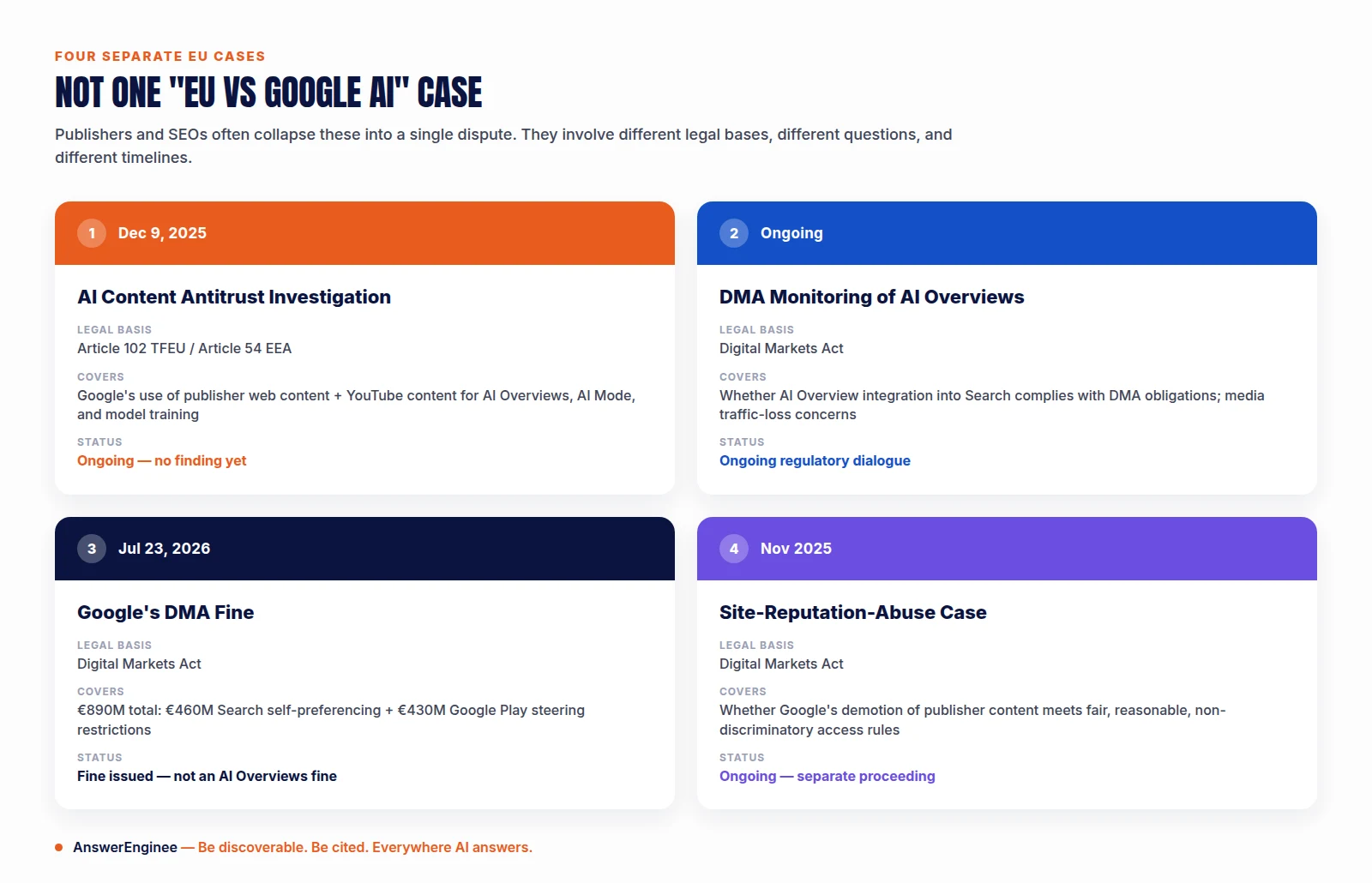
| Case | Legal basis | What it covers | Status |
|---|---|---|---|
| 1. AI content antitrust investigation (December 9, 2025) |
Article 102 TFEU / Article 54 EEA Agreement (traditional competition law) | Google’s use of publisher web content and YouTube content for AI Overviews, AI Mode, and generative AI models | Ongoing investigation, no finding yet |
| 2. DMA monitoring of AI Overviews | Digital Markets Act (Google Search designated as a core platform service) | Whether AI Overview integration into Search complies with existing DMA obligations; media traffic-loss concerns | Ongoing monitoring and regulatory dialogue |
| 3. Google’s DMA fine (July 23, 2026) |
Digital Markets Act | €890 million total: €460M for Search self-preferencing, €430M for Google Play steering restrictions | Fine issued; not an AI Overviews fine, though dialogue continues on applying the principles to AI Overviews and AI Mode |
| 4. Site-reputation-abuse DMA case (November 2025) |
Digital Markets Act | Whether Google’s demotion of publisher content complies with fair, reasonable, and non-discriminatory access requirements | Ongoing proceeding, separate from the AI-content case |
Case 2 sits closest to the AI Overviews debate on the DMA side; see Google AI Overviews and the DMA: What SEOs Need to Know for how that monitoring track works. This illustrates why publishers should be cautious when reading simplified headlines about “the EU Google case.” There are multiple cases involving different legal questions.
What Does This Mean for Publishers Right Now?
Publishers do not need to wait for a final European Commission decision before taking action. Several practical steps are available today.
1. Review your Google generative AI performance
Google now provides a dedicated Generative AI performance report in Search Console. Publishers can analyze AI impressions over time, pages receiving AI visibility, countries, and devices. Before deciding whether Google’s AI Search participation is economically beneficial, establish a baseline.
2. Measure AI Search traffic separately
Do not combine all Google organic traffic into one bucket. Compare traditional Search against generative AI Search where reporting allows, measuring visits, engagement, subscriptions, ad revenue, and conversions. The debate should move from hypothetical traffic loss toward measurable economics.
3. Review your Search generative AI setting
Check Search Console → Settings → Search generative AI to confirm whether the property is included or excluded. Do not assume the inherited setting matches your organization’s policy — Google says the default behavior is inclusion unless the site owner changes the control.
4. Do not confuse Search opt-out with Google-Extended
Google explicitly says its Search generative AI control does not govern AI training. Google-Extended is a separate mechanism for applicable training-related controls. A serious AI governance policy should distinguish Search visibility, AI training, and other platform participation from one another.
5. Preserve historical performance data
Regulatory changes can create natural experiments. Publishers should preserve Search Console exports, AI impressions, click data, page-level traffic, revenue, and subscription conversions. If Google changes AI Search interfaces or EU remedies lead to new controls, historical data will become extremely valuable for measuring the effect.
6. Measure whether AI users are actually lower value
Do not assume. Visitors arriving after an AI-generated recommendation may be fewer in number but further along in the decision journey. Measure revenue per AI referral, subscription rate, newsletter signup rate, and lead rate — a smaller traffic source can still be commercially valuable.
7. Identify content with high licensing value
Not every page should necessarily have the same policy. Separate commodity marketing content designed primarily for distribution, original reporting that is expensive to produce, proprietary research that is potentially licensable, and premium subscriber content that is directly monetized. Publishers may eventually decide that different content classes deserve different AI-distribution strategies.
Could Publishers Lose SEO Visibility by Opting Out?
Under the dedicated Search generative AI control, Google says the decision itself is not used as a ranking or inclusion signal outside the covered generative AI Search features. That is a major change from earlier publisher concerns.
But there is an important strategic distinction: a publisher can preserve traditional SEO visibility while deliberately losing Google GEO visibility inside AI Overviews and AI Mode. So the site may continue ranking normally while its AI Search footprint disappears. That makes the decision less dangerous technically, but still potentially significant commercially. For a full breakdown of that tradeoff, see Should Publishers Opt Out of Google AI Overviews and AI Mode?
What Do Publishers Lose If They Opt Out?
According to Google, excluded sites lose:
- AI Overview visibility — their content and links will not appear in covered AI Overviews
- AI Mode visibility — their site will not participate in covered AI Mode responses
- Generative Discover visibility — the setting also covers Google’s listed generative AI Discover features
- Grounding eligibility — Google says crawled content from an excluded site cannot be used as input to generate responses or previews in those controlled features
- AI impressions — no participation means no generative AI Search impressions
- AI referral traffic — Google explicitly says opted-out sites will not receive traffic from those features
A closer look at how these losses weigh against GEO visibility gains is available in Google AI Opt-Out vs GEO Visibility: What Do Publishers Lose?
What Happens to Competitors When a Publisher Opts Out?
This is a major strategic question. Google says content from other sites remains available after a publisher opts out, and some of that information may be similar to the excluded publisher’s content.
Consider three news organizations covering the same policy announcement. Publisher A opts out, while Publishers B and C remain included. Google AI can still answer the user’s question, but Publisher A no longer has the opportunity to provide grounding information, receive links, gain impressions, or influence source visibility. Opting out therefore does not necessarily reduce the user’s access to the information — it may simply shift AI visibility toward alternative sources.
Google’s Preferred Sources Makes Visibility More Strategic
Google now allows users to select Preferred Sources that can influence source prominence across Top Stories, AI Mode, and AI Overviews. For publishers, this adds another layer to the decision. A publisher investing in brand loyalty, recurring readership, preferred-source adoption, and topical authority may have even more reason to remain eligible for AI Search. Opting out eliminates the opportunity to benefit from that type of user preference inside covered generative features.
What Could the EU Investigation Change?
Several outcomes are possible. These are scenarios, not predictions.
Scenario 1: Google convinces regulators the new controls are sufficient
The Commission could ultimately conclude that Google’s changes adequately address some or all concerns. The investigation could close without major additional intervention.
Scenario 2: Google offers further commitments
Google could agree to additional measures involving controls, transparency, publisher data, attribution, or participation terms. Competition investigations sometimes resolve through commitments rather than fines.
Scenario 3: Regulators seek compensation-related changes
If the Commission concludes that publisher compensation remains unfair, remedies could potentially address the economic terms under which content contributes to Google’s AI systems. The form of any such remedy is currently unknown.
Scenario 4: Additional publisher controls
Regulators could push for more granular controls, such as section-level participation, content-type controls, expanded reporting, or greater transparency. Google already supports some property-level inheritance and overrides through Search Console, but the ecosystem could evolve further.
Scenario 5: Formal antitrust finding and fine
If regulators ultimately find that Google abused a dominant position, the Commission could order changes and potentially impose financial penalties under EU competition law. But this remains a possible future outcome, not the current status.
Could Google AI Search Work Differently in Europe?
Potentially. Technology companies frequently implement region-specific product behavior when regulatory requirements differ. The EU already regulates Google through competition law, the Digital Markets Act, the Digital Services Act, copyright law, and the AI Act — see EU AI Act and AI-Generated Content: What SEOs Need to Know for how that separate framework touches AI-generated content.
If regulators impose specific remedies affecting AI Search, Google may need to adjust source presentation, controls, data access, publisher treatment, or ranking and interface behavior within the European Economic Area. That does not mean Europe will necessarily receive a completely different AI Search product. It means regional divergence is possible.
What Does This Mean for SEO?
The immediate lesson is that SEO strategy now has a regulatory dimension. Historically, SEOs primarily monitored algorithms, crawling, indexing, and SERP features. Now teams also need to monitor publisher controls, AI participation settings, regulatory remedies, AI-specific Search Console data, and regional Search differences. A regulatory change can alter Search visibility just as meaningfully as a product update.
What Does This Mean for GEO?
For GEO, the implication is even clearer. Publishers now have an explicit decision about whether to participate in Google’s generative Search ecosystem, creating a measurable tradeoff between content control and generative visibility. A publisher choosing exclusion can preserve ordinary Search visibility while intentionally giving up AI Overview and AI Mode visibility under Google’s current system.
That means GEO is no longer purely about optimization. It is partly about governance. Before asking “how do we get cited?”, publishers increasingly need to answer “do we want to be eligible for citation at all?”
What Publishers Should Monitor Next
The regulatory situation is moving quickly. Track:
- European Commission investigation updates — preliminary findings, commitments, remedies, closure, or formal infringement findings
- Publisher consultation results — the Commission’s current publisher feedback could influence how regulators evaluate Google’s new controls
- Google Search Console changes — more granular controls, reporting, and AI traffic metrics
- AI Overview and AI Mode interface changes — links, source previews, citations, and preferred sources
- DMA decisions — AI Overviews and AI Mode are also part of a wider DMA regulatory dialogue around Google Search
- European SERP differences — whether EEA Search experiences begin diverging from those elsewhere
Bottom Line
The EU investigation into Google AI Search is fundamentally about who captures the economic value created from publisher content when search becomes generative. The old exchange was relatively easy to understand: the publisher creates information, Google indexes it, a user searches, and Google sends some users to the publisher. AI Overviews and AI Mode complicate that exchange because Google can increasingly retrieve, synthesize, and answer before the user visits the source.
Google’s new Search generative AI control answers one of those questions more clearly than before. Publishers can now opt out of covered generative AI Search features while remaining eligible for ordinary Search, and Google says that decision does not act as a normal Search ranking signal. That is significant. But it does not automatically settle every competition concern. The European Commission is still examining publisher compensation, the fairness of the economic relationship, Google’s access to publisher and YouTube content, Google’s position relative to competing AI developers, and whether the new publisher choice is meaningful enough in practice.
For publishers, the strategic takeaway is not simply that Europe may punish Google. It is more immediate: the economics of organic visibility are changing. Publishers should now measure at least three separate channels — traditional Search visibility, generative Search visibility, and content-control value — and those numbers will differ dramatically between a SaaS blog, a news organization, an affiliate site, and a premium research publisher. That is why no universal publisher strategy exists.
The legal outcome may eventually change Google’s obligations. But the business question exists today: is participating in AI Search creating enough value to justify giving generative systems access to your content? Publishers that can answer that with real data will be in a far stronger position, whether they ultimately choose to participate, opt out, negotiate, or adapt to whatever remedies European regulators require next.
FAQ
Why is the EU investigating Google AI Search?
The European Commission is investigating whether Google’s use of publisher web content and YouTube content for AI purposes may violate EU competition law, including through potentially unfair terms, inadequate compensation, or privileged access that disadvantages competing AI developers.
When did the investigation begin?
The formal antitrust investigation into Google’s use of online content for AI purposes was announced on December 9, 2025.
Is Google AI Overviews illegal in the EU?
No such conclusion has been reached. The European Commission is investigating certain Google practices and separately monitoring AI Overviews under the DMA, but that does not mean AI Overviews have been declared illegal.
Has Google been fined for AI Overviews?
No. The European Commission fined Google €890 million on July 23, 2026 for separate DMA violations involving Search self-preferencing and Google Play steering restrictions. The Commission said dialogue would continue over how its Search decision applies to AI Overviews and AI Mode.
Is the Google AI investigation a DMA investigation?
The December 2025 publisher-content AI investigation is an antitrust case under traditional EU competition law. The Commission is separately monitoring Google AI Overviews under the Digital Markets Act. They are related regulatory issues but legally distinct.
Why are publishers concerned about AI Overviews?
Publishers are concerned that AI-generated answers may use their information while reducing referral traffic, advertising opportunities, subscriptions, and other forms of direct monetization. The Commission has acknowledged media-industry concerns about traffic losses.
Can European publishers opt out of Google AI Overviews?
Yes. Google’s Search generative AI control is now available worldwide and lets sites exclude their links and content from AI Overviews, AI Mode, and covered generative AI Discover features.
Does opting out hurt ordinary Google rankings?
Google says the Search generative AI control is not used as a ranking or inclusion signal affecting other parts of Search.
Does Google’s new opt-out end the EU investigation?
Not necessarily. Reuters reported on September 1, 2026 that EU regulators were asking publishers for feedback about Google’s new opt-out as part of the ongoing antitrust investigation.
What is the EU asking publishers?
According to Reuters, the Commission asked publishers about their willingness to use Google’s new AI opt-out and what considerations would influence that decision.
Could Google face another fine?
Potentially, if the Commission ultimately concludes that Google violated EU competition rules. However, no such final finding has been made in this investigation as of September 2, 2026.
What should publishers do now?
Publishers should measure Google generative AI visibility, AI referral value, subscription or advertising impact, review Search Console participation settings, distinguish Search controls from AI-training controls, and preserve historical data while the investigation continues.