Here’s how to actually build that, step by step. If you want the strategic case for why this shift matters, see why visibility now matters more than ranking alone; this piece is the practical follow-through.
Why click volume alone is now misleading
Click volume used to be a reasonable stand-in for overall performance, because ranking and clickability moved together for most of the map pack’s history. That’s no longer true. A falling click number today can mean a real decline in interest, or it can mean Google removed the call button from your listing, or it can mean more customers are completing their decision inside Google’s own interface before a click ever happens.
Treating click volume as your primary KPI conflates all three of those very different situations into one number. That’s the core problem worth fixing first. (For the full breakdown of why the call button specifically is disappearing, see why GBP clicks are falling while rankings stay stable.)
The full native action set to build around
Google Business Profile itself now reports a broader set of customer actions than most reporting dashboards actually use. Calls and website clicks are the two everyone tracks. Direction requests, messages, bookings, menu views, and offer clicks are also available, and each one represents a real customer taking a real step toward becoming a customer, even when it doesn’t show up as a traditional click.
Building your primary dashboard around this full set, rather than isolating call and website click volume, gives a far more honest picture of what’s actually happening. A business seeing flat calls but rising direction requests and messages isn’t necessarily losing ground. It may simply be seeing customer behavior shift toward different action types as the map pack interface itself changes. It’s worth cross-checking this expanded set against the broader weekly SEO metrics you’re already tracking, so local-specific reporting doesn’t live in a silo.
Separating real decline from measurement artifact
Before diagnosing anything as a real problem, rule out known measurement changes first. The clearest example: Google removed the num=100 URL parameter from search in September 2025, which cut most third-party rank trackers down to only the first 10 results per query. Any business ranking positions 11 through 100 for long-tail terms saw reported impressions vanish from some tools around that time, for reasons entirely unrelated to real visibility.
A simple methodology checklist helps here. Check whether reported ranking depth changed around a known tool or Google update, not just around a date that looks suspicious on its own. Compare year-over-year data with awareness of what version of a tracking tool was in use at each point, since tool changes can look identical to real ranking changes if you’re not tracking which is which. And cross-reference any third-party tool’s numbers against Google Business Profile’s own native insights before concluding a decline is real, since GBP’s own data isn’t subject to the same third-party tracking limitations.
Adding visibility metrics beyond native reporting
Native GBP insights cover actions on your own listing. They don’t tell you whether an AI local pack is appearing for your priority queries, or whether it includes your business when it does. That requires separate tracking.
For your priority queries, check AI local pack presence directly, manually through search or via emerging tools built for this, and note whether your business is named when one appears. This is a different question than your map pack ranking and needs its own answer.
A rough share-of-voice check adds another layer: run the same category query several times with varied phrasing, and note how often your business gets named versus competitors. This won’t produce a precise statistic, but it gives a real, repeatable signal about how AI systems are currently treating your business relative to others in your category.
A practical reporting framework
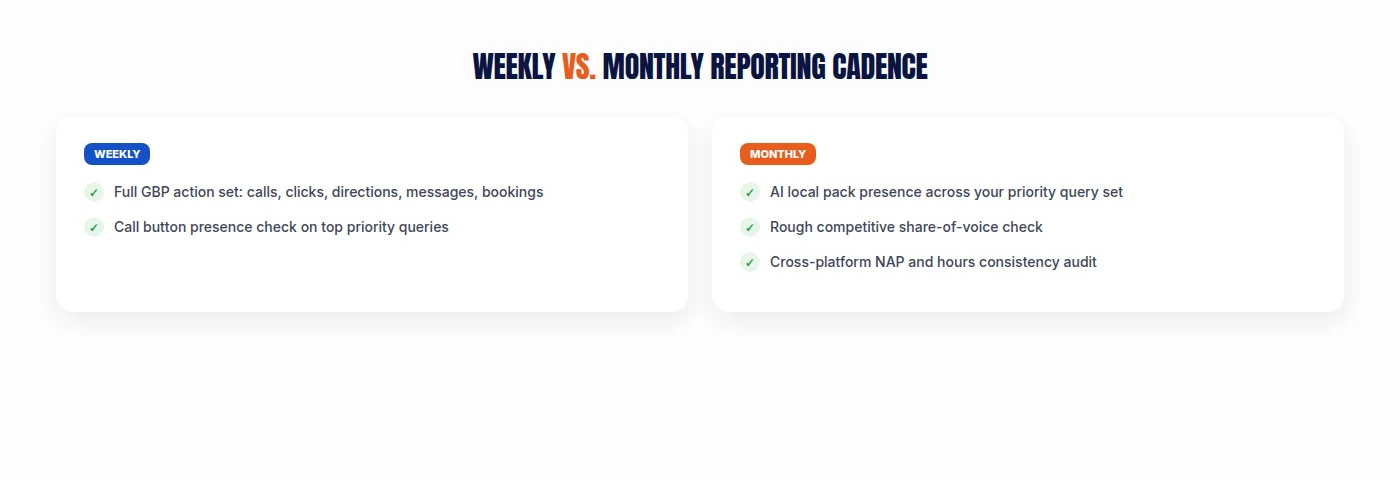
Weekly: track native GBP actions across the full set, calls, website clicks, direction requests, messages, and bookings, plus a quick check on whether the call button is still present for your top few priority queries, since that can shift without warning.
Monthly: check AI local pack presence for your priority query set, run a rough competitive share-of-voice check across those same queries, and audit cross-platform NAP and hours consistency across your website, Yelp, Apple Maps, and other directories, since inconsistencies here quietly erode the entity confidence that influences AI-driven selection.
Businesses in categories where AI local packs already appear frequently may benefit from checking that specific metric weekly instead of monthly, since it’s likely to be more volatile there than the broader average.
Reporting this honestly to clients and stakeholders
Frame the shift as an industry-wide interface change affecting nearly every local business simultaneously, not a sign of declining performance specific to them. That’s accurate, and it’s also the framing that tends to land best, since it neither downplays a real change nor overstates it as a crisis unique to their business.
Pair that context with the concrete, expanded KPI framework above. Showing exactly what’s being tracked now, and why it’s a better measure of real performance than the old click-only approach, gives stakeholders something solid to hold onto instead of just an explanation for why a familiar number looks worse than it used to.
FAQ
What should replace call and website click volume as a primary local SEO KPI?
A fuller action set that Google Business Profile itself now reports, including direction requests, messages, bookings, and menu views alongside calls and website clicks, combined with visibility metrics like AI local pack presence and share of voice in AI-generated local answers, which click volume alone never captured.
How can I tell if a drop in my numbers is a real decline or a tracking issue?
Start by checking whether the drop coincided with a known measurement change, such as Google’s removal of the num=100 URL parameter in September 2025, which caused some rank trackers to under-report impressions for reasons unrelated to real visibility. Cross-referencing third-party tool data against Google Business Profile’s own native insights is the more reliable way to confirm whether a decline is genuine.
How often should I check AI local pack presence for my priority local queries?
Monthly is a reasonable starting cadence for most businesses, since AI local pack presence is still a smaller and less volatile share of total local search than the traditional map pack. Businesses in categories where AI local packs already appear frequently may benefit from checking weekly instead.
How do I explain this shift to a client or stakeholder without causing panic?
Frame it as an industry-wide interface change affecting nearly every local business simultaneously, not a sign of declining performance specific to them. Pairing that context with a concrete, expanded KPI framework, showing what’s actually being tracked now and why, tends to land better than either downplaying the shift or overstating it as a crisis.