On March 12, 2026, Google launched Ask Maps, a Gemini-powered conversational layer inside Google Maps that answers multi-constraint questions directly, rather than returning a ranked list. That means a growing share of local decisions can now be made entirely inside the Maps app, without a user ever generating a traditional search results page at all.
What Ask Maps actually is
Old-model local search worked like this: someone searches “Italian restaurant downtown,” Google returns a map pack, and the business’s job is to rank in the top three. Ask Maps works differently. A user can ask something like “where can four of us eat Italian tonight that’s not too loud, has good vegetarian options, and is easy to get to from the East Side by 7,” and Ask Maps doesn’t return a ranked list at all. It synthesizes a direct answer, reading actual review text, checking attribute data, and cross-referencing real-time signals like current busyness.
That’s a meaningfully different task than ranking. A business optimized purely for map pack position, strong reviews count, consistent citations, a reasonable proximity, isn’t automatically well-positioned for a query this specific and conversational. It’s also worth being precise about what Ask Maps isn’t: it’s not the same thing as the AI local pack that now appears directly inside regular Google Search results. Ask Maps lives inside the Maps app itself; the AI local pack is a Search-results feature. They’re separate mechanisms driven by related but distinct logic.
Why this matters for discovery
A real share of local decisions can now complete entirely inside Maps, without the user ever touching a traditional search results page. That’s the part worth sitting with. It’s not that Google Maps is stealing traffic from search results in some competitive sense. It’s that an entire category of decision-making, the multi-constraint, conversational kind, increasingly has no reason to route through a results page at all.
The platform fragmentation context
It’s worth resisting the temptation to treat this as a two-horse race between Maps and the search results page, because local discovery was already fragmented before Ask Maps existed. BrightLocal’s 2026 local consumer research found roughly 71–75% of consumers use Google Search for local discovery, with about 1 in 5 now searching directly inside a maps app rather than the main search bar. That multi-platform pattern shows up in trust data too: consumers report trusting Google Search at 66%, Google Maps at 45%, Facebook at 32%, and Yelp at 32% for local business information.
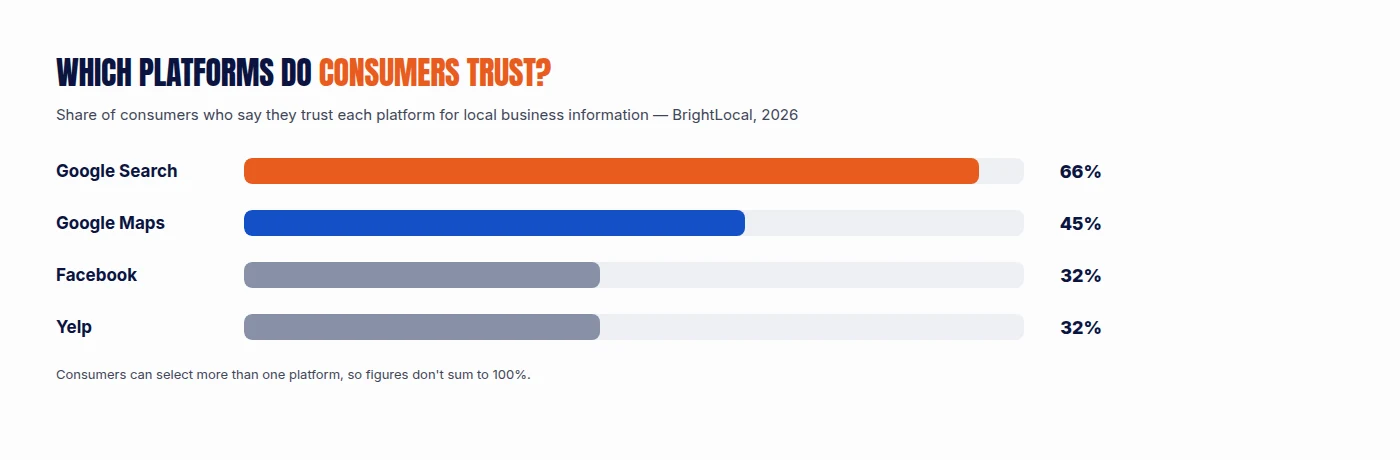
Those figures don’t sum to 100% because people use multiple platforms for local discovery, often for different kinds of decisions. Maps isn’t replacing the search results page so much as it’s becoming one of several parallel discovery paths that already existed alongside it.
Where the results page still matters most
The traditional local pack remains prominent for the large majority of transactional and near-me queries. And it’s worth grounding this whole conversation in a useful reality check: Ahrefs found only about 7.9% of local searches currently trigger a Google AI Overview at all. The disruption here is real and growing, but it hasn’t yet become the default experience across most local search.
That’s not a reason to ignore Ask Maps or AI-driven local discovery. It’s a reason not to overreact and abandon traditional local pack optimization, which still does most of the work for most queries today. For a broader look at how AI Overviews are reshaping search more generally, see how Google AI Overviews are going to affect SEO.
What matters most for Ask Maps specifically
If you want a business to be well-positioned for the kind of conversational query Ask Maps handles, a few things matter more here than they do for traditional map pack ranking.
Structured attribute completeness carries real weight. Hours listed accurately by day, specific named services rather than a generic category, and accessibility information all feed directly into what Ask Maps can confidently synthesize into an answer.
Review text quality matters more than review count or star rating alone. Ask Maps reads the actual content of reviews, looking for the kind of specific detail, noise level, vegetarian options, wait times, that a multi-constraint question needs answered. A business with fifty generic five-star reviews may be less useful to Ask Maps than one with twenty reviews that actually describe the experience.
Cross-platform consistency matters too, and in a fairly unforgiving way. If your hours conflict across Yelp, Apple Maps, and your own website, that inconsistency erodes Google’s confidence in the underlying facts about your business, which can mean getting skipped in favor of a competitor with cleaner, more consistent data.
The practical takeaway
Treat Maps-specific optimization as a parallel workstream sitting alongside local pack and search results optimization, not a subset of it or a replacement for it. The signals that help you rank in a traditional map pack, proximity, relevance, prominence, aren’t the same signals that make a business a confident answer inside a conversational Ask Maps response. Both are worth investing in, since both are live, real discovery paths today, and neither has replaced the other — a distinction that matters even more once you start tracking visibility across surfaces rather than just ranking within one of them.
FAQ
What is Ask Maps and when did it launch?
Ask Maps is a Gemini-powered conversational feature inside Google Maps, launched March 12, 2026, that answers complex, multi-constraint local questions directly by synthesizing review content, business attributes, and real-time signals, rather than returning a simple ranked list of businesses.
Does Ask Maps replace traditional local SEO?
No, but it changes what matters most within it. Structured, accurate, detailed profile data, hours, specific services, accessibility information, and review text quality become more important, since Ask Maps reads and synthesizes that information directly rather than relying primarily on aggregate signals like star rating or review count.
Is Google Maps becoming more important than the regular search results page for local businesses?
It’s becoming a more independent and increasingly important discovery path, but not a full replacement. Google Search still leads local search usage overall, and the traditional local pack remains prominent for most transactional queries. The more accurate framing is that Maps and the search results page are increasingly parallel discovery surfaces rather than one clearly succeeding the other.
How common are Ask Maps-style conversational queries right now?
Still a minority of overall local search volume. Ahrefs found only about 7.9% of local searches currently trigger a Google AI Overview, and Ask Maps usage sits within that broader, still-developing shift toward conversational local discovery. It’s growing, but the traditional map pack experience remains the more common path for most local searches today.