This is not a hedge. How these systems work makes the answer clear, and ignoring it means missing one of the more actionable levers available for improving AI citation. This article explains the mechanism, what kinds of mentions carry weight, how to audit where you stand, and what to do about it.
The short answer
Brand mentions affect AI search visibility. That is the position here, stated plainly, because most articles on this topic either avoid committing or bury the answer in qualifications.
The reason this is different from traditional SEO comes down to how each system assesses credibility. Google’s link graph, the system that powers much of organic ranking, was built around links. A backlink from an authoritative site passes authority to your page. An unlinked mention of your business name on that same site passes essentially nothing through Google’s link-based system.
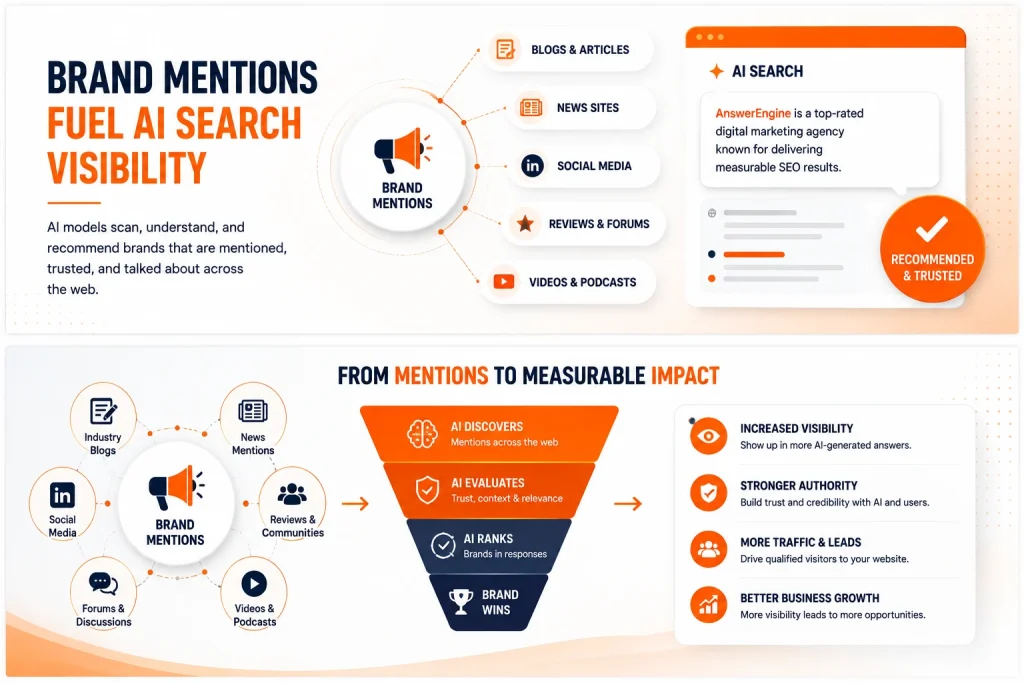
AI engines work differently. They do not primarily use a link graph. They build entity associations by reading text. When a language model or retrieval system encounters your business name repeatedly across credible sources, it builds a map of what your business is, what it does, where it operates, and what topics it belongs to. That map is built from mentions, linked or not.
This is why unlinked brand mentions matter more for AI visibility than they do for traditional SEO. The link is irrelevant to the association. The text is what counts.
How AI engines use brand mentions
AI search systems process brand mentions in two distinct ways depending on their architecture: through training data absorbed before deployment, and through real-time retrieval at the moment someone asks a question.
Training data and LLM brand associations
Large language models like the ones powering ChatGPT are trained on massive datasets scraped from the web. During training, the model absorbs patterns, facts, and associations from billions of documents. If your business name appears across those documents in consistent, credible contexts, the model learns an association between your name and whatever topics those documents cover.
A local accounting firm quoted in three regional business journals, mentioned in two tax guidance articles, and referenced in a chamber of commerce newsletter over several years has, through those mentions, built an association into the model. When someone asks ChatGPT for a recommended accountant in that region, the response draws partly on those absorbed patterns.
This is not a direct control mechanism. You cannot submit mentions to a training run. But the volume and quality of your presence in credible text on the web shapes what the model knows about you.
Retrieval-augmented generation and real-time mentions
Perplexity, Google’s AI Overviews, and ChatGPT when using its browse function work differently from a pure language model. These systems use retrieval-augmented generation, or RAG: at query time, they pull from the live web, find relevant content, and synthesize an answer from what they retrieve.
For RAG systems, what matters is whether your business appears in the content that gets retrieved for a given query. If someone asks Perplexity “who are the best family dentists in Tucson,” it pulls pages that rank well for relevant queries, review sites, local directories, and any editorial content covering the topic. If your dental practice is mentioned in those sources, you show up in the retrieved context. If you are not mentioned in those sources, you are not in the answer pool at all.
This is why getting your business into topically relevant, authoritative content is an ongoing strategy, not a one-time effort.
Named Entity Recognition and context
AI systems use Named Entity Recognition, or NER, to identify and classify entities in text: people, places, organizations, products. When an AI system encounters “Riverside Dental” in a passage about pediatric dentistry in Phoenix, NER tags “Riverside Dental” as an organization, “Phoenix” as a location, and “pediatric dentistry” as a topic. That tagging links your business name to the surrounding concepts.
This is why the context around a mention matters as much as the mention itself. A reference to your accounting firm in an article about small business tax strategy connects your name to that topic in a meaningful way. A reference in a general local directory, surrounded by plumbers and pet groomers, builds a much weaker association.
What kinds of brand mentions carry weight
Not all mentions are equal. Several factors determine whether a mention actually moves your AI visibility.
Domain authority and editorial credibility matter most. A mention on a low-quality directory, a spammy blog network, or a site that publishes anything for a fee carries little weight. AI systems, particularly RAG-based ones, pull from sources that rank well in search. If the page mentioning your business is not itself credible or well-indexed, the mention does not enter the retrieved context pool.
A mention in a regional newspaper, a trade association publication, an industry blog with real readership, or a government directory carries considerably more. These are sources retrieval systems are likely to pull from when answering relevant queries.
Topical relevance of the surrounding content is the second factor. A dental practice mentioned in a dental health article builds a stronger topic-entity association than the same practice listed in a generic local business roundup. When building your mention strategy, prioritize publications and pages that are actually about your industry or service area.
NAP consistency matters specifically for local businesses. Name-Address-Phone consistency across mentions is a foundational entity signal for businesses with a physical location or service area. AI engines handling local queries need to be confident they are talking about one specific business, not three variations of a similar name. Every time your business appears with a slightly different name format or an outdated phone number, that confidence drops.
Sentiment and framing round out the picture. AI systems pick up on sentiment in surrounding text. A mention in a positive article, a favorable review summary, or an expert recommendation frames your business as a credible choice. A mention in a complaint thread or a critical editorial frames it differently. Sentiment is not a binary signal, but it shapes the entity picture AI engines build over time.
How to audit your brand mention footprint
Before building new mentions, you need a clear picture of where you currently stand.
Google Alerts is the free starting point. Set up alerts for your business name, common misspellings, and any notable people associated with your brand. Alerts will not catch everything, but they give you a running baseline of where you are being mentioned on the open web.
Ahrefs and Semrush both have brand mention monitoring tools that go beyond links. Ahrefs’ Content Explorer and Semrush’s Brand Monitoring tool let you search for unlinked mentions across indexed pages, see the domain rating of the mentioning page, and filter by date. These are paid tools, but worth using if you are doing this seriously.
Brand24 is a dedicated mention monitoring platform that tracks mentions across news, blogs, forums, and some social platforms. It is more focused on brand tracking than general SEO tools and can surface mentions that Ahrefs and Semrush miss.
Manual AI engine testing is the most direct check. Search for your business name and your main service-plus-location combinations in ChatGPT, Perplexity, and Google’s AI Overviews. Note whether you appear, in what context, and what surrounding information the AI includes. This tells you what the AI currently knows about your business, which is the outcome you are working to shape.
When you audit, check where you are being mentioned, what topic context surrounds those mentions, and whether the information is accurate and current. Outdated mentions, like an old address or a discontinued service, are worth correcting wherever you can reach them.
How to build brand mentions that actually influence AI visibility
Digital PR targeting topically relevant publications is the highest-impact approach. This means pitching local news outlets for stories related to your area of expertise, contributing to trade publication roundups, and being available as a quoted source on topics your business covers.
A plumbing company whose owner is quoted in a local news article about water conservation gets two things: a credible, contextual mention on a source retrieval systems respect, and a topic-entity association between the business name and water management. That is worth more than a hundred directory listings.
Contributing quotes and expert commentary builds mentions steadily over time. Many publications, from local news sites to industry blogs, use services like HARO or Qwoted to find expert sources. Being an active responder to relevant queries earns mentions that are in context, on credible sites, and associated with your area of expertise. Those are exactly the properties that make a mention useful for AI visibility.
Partner and supplier co-mentions are an underused source. If your business works with suppliers, partners, or complementary businesses, there are often natural co-mention opportunities. A contractor who partners with an architect on projects might appear in the architect’s project case studies. A caterer might be listed in a venue’s vendor recommendations. These contextual co-mentions, especially on well-regarded sites, build your brand’s presence in credible contexts without requiring a full press campaign.
Review platforms carry particular weight for local AI citation. Google’s AI Overviews, when recommending local businesses, pull heavily from review signals: volume, recency, rating, and the text of recent reviews. A steady stream of current, specific reviews is both a traditional local SEO signal and an AI citation input.
The text of reviews matters more than many owners realize. A review that says “best family dentist in Tucson, they got my kids in same week and the team was great with them” is building entity associations that a star rating alone never will.
What brand mentions alone cannot do
Brand mentions are a meaningful signal, but they are one input in a system that weighs many things.
A business with strong mention coverage but a slow, poorly structured website that AI crawlers struggle to index will still underperform in AI citations. A business with solid mentions but no schema markup is leaving direct citation surfaces unused. A business with consistent mentions but thin, generic content on its own site gives AI engines little to extract and present when the business does come up.
Mentions work best as part of a broader AEO approach: structured content and schema on your own site, technical crawlability, entity consistency across the web, and a mention-building strategy layered on top of all that.
The trap to avoid is chasing volume over quality. Low-quality mention spam, the AI-era equivalent of buying links from link farms, creates noise rather than signal. A mention on a site that retrieval systems do not index, or that is surrounded by irrelevant content, does not enter the answer pool. It just takes up time. Ten mentions in credible, topically relevant contexts will consistently outperform a hundred in low-quality directories.
If you want to see where your current mention footprint stands and how it is affecting your AI search presence, an AnswerEnginee free audit covers entity consistency and citation readiness alongside technical and content signals. For a practical overview of what else goes into AI visibility beyond mentions, the guide to brand visibility solutions for AI search covers the full picture.
Frequently asked questions
Do unlinked brand mentions help with AI search?
Yes, more so than they help with traditional SEO. Google’s link-based ranking system gives little weight to unlinked mentions. AI engines build entity associations from text rather than links, so an unlinked mention in a credible, contextually relevant source contributes to the entity map those systems build around your business. The link is not the signal. The mention in context is.
How many brand mentions do I need to appear in AI search results?
There is no threshold number. AI citation is not a point system where a specific count unlocks visibility. What matters is the quality and context of your mentions relative to the businesses currently being cited for your target queries. A local business in a small market may achieve AI citation with a modest footprint of credible local mentions. A business competing nationally in a crowded category needs considerably more. The more useful question is whether your mention footprint is stronger or weaker than your competition in a given topic and geography.
Do Google reviews count as brand mentions for AI search?
Yes, and they are among the more influential ones for local queries specifically. Google’s AI Overviews draw on Google Business Profile data, including review signals, when surfacing local business recommendations. The review text itself contributes to the entity associations AI systems build around your business name. Reviews that include specific service details, location references, and positive framing are more useful for AI visibility than brief or generic ones.
Can negative brand mentions hurt my AI search visibility?
They can, though the mechanism is not as direct as many assume. AI engines are not simply tallying positive versus negative sentiment. But if the predominant context in which your business name appears across the web is negative, complaint-oriented, or associated with poor outcomes, that shapes the entity picture those systems hold. For local queries especially, a pattern of negative review text alongside critical editorial mentions will influence how AI systems characterize and recommend your business. Reputation management and AI search visibility are not separate concerns.
What is the difference between brand mentions and backlinks for AEO?
Backlinks are the primary currency of traditional SEO. A link from a credible site passes authority through Google’s PageRank system and influences rankings directly. For AEO, the relevant signal is the mention in context, with or without a link attached. A backlink on an authoritative site also tends to appear alongside a mention, so high-quality link building and mention building often produce the same result. The distinction matters most for unlinked mentions: in traditional SEO, they add little. In AEO, they contribute to entity association and influence what retrieval systems surface. Both matter, but for different reasons and through different mechanisms.