The businesses that show up in those AI answers, cited by name, are not there by accident. They got there because their web presence is structured in ways that AI engines can read, trust, and pull from. The businesses that are invisible to AI search often have perfectly decent websites. They just were not built with this in mind.
This article covers five specific solutions that improve AI search visibility: entity-rich content architecture, schema markup, brand mention cultivation, direct-answer content blocks, and technical AEO readiness. Each one has a concrete tactic attached, not just a definition.
Why AI search visibility is different from traditional SEO visibility
Traditional SEO is about ranking. You optimize a page, it climbs the search results, people click on it. The metric is position. The outcome is traffic.
AI search visibility is about citation. ChatGPT does not rank your page at position three. It either cites you as a source in its answer or it does not. Those are two different problems requiring two different approaches.
How do AI engines decide who to cite? The mechanics vary by system. Retrieval-augmented systems like Perplexity pull from the live web at query time, prioritizing pages that are crawlable, authoritative, and structured to answer the specific question being asked. ChatGPT’s responses draw on training data combined with real-time search in some contexts. Google’s AI Overviews pull from the indexed web using a combination of relevance, authority, and structured content signals.
What all of them share is a preference for content that directly answers a question, comes from a source they can verify as credible, and is formatted in a way that makes extraction easy.
This is the gap that catches most businesses off guard. A page can rank at position one on Google and still be invisible to AI engines if the content is buried in long paragraphs, lacks structured data, and has no clear entity signals connecting the business to the topics it serves.
Solution 1: Entity-rich content architecture
An entity, in the context of AI search, is a named thing that AI systems recognize and can place in relationship to other things: your business name, your location, your service category, your industry, the people behind your brand.
AI engines do not just read keywords. They build maps of relationships. When Perplexity tries to answer “who is the best plumber in Denver,” it is not just matching keywords. It is looking for a business entity that is consistently associated with plumbing, Denver, positive signals from other sources, and structured identifying information.
The goal is to make that association unmistakable across your entire web presence.
Your website should state clearly and repeatedly what your business is, where it operates, and what it does, using the same language across your homepage, service pages, About page, and footer. Your Google Business Profile should have a complete, accurate description that matches your website. The name, address, and phone number on your website should be identical to what appears on every directory listing, review platform, and third-party mention of your business.
Inconsistency is the most common entity problem. A business called “Rivera’s Plumbing” that appears as “Rivera Plumbing LLC” on Yelp, “Rivera & Sons” in a local directory, and just “Rivera’s” on social media is, from an AI engine’s perspective, potentially three different things. That ambiguity reduces citation confidence.
A practical starting point: run a search for your business name across Google, Yelp, and any industry-specific directories. Note every variation in how your name, address, and category are listed. Clean up the inconsistencies. That alone improves entity clarity more than most content changes will.
Solution 2: Schema markup for AI citation signals
Schema markup is structured data added to your website’s code that tells search engines and AI crawlers exactly what your content is about. It is not visible to website visitors. It is a machine-readable layer that makes your content easier to interpret and cite.
Several schema types matter specifically for AI visibility.
FAQPage schema is one of the most direct citation surfaces available. When you mark up a frequently asked questions section with FAQPage schema, AI engines can extract individual question-and-answer pairs as standalone units. Google’s AI Overviews frequently pull directly from FAQ schema. ChatGPT and Perplexity, which pull from the live web, are more likely to cite a page that has clean, extractable Q&A content structured this way.
LocalBusiness schema is the foundational type for any business with a physical location or service area. It confirms your business name, address, phone number, hours, and service area in a machine-readable format that local AI queries depend on heavily.
HowTo schema is useful for any content that walks through a process step by step. When someone asks an AI engine “how do I do X,” pages with HowTo schema give those systems a formatted set of steps they can extract and present directly.
Speakable schema is a less commonly implemented type that explicitly marks sections of a page as suitable for spoken audio. As AI assistants become more common as an answer channel, this becomes increasingly relevant, particularly for local service businesses whose customers may be asking voice questions.
The most common schema mistake is implementing it incorrectly and never checking. Use Google’s Rich Results Test to validate your schema after adding it. A broken schema is worse than no schema because it signals to crawlers that the page’s structured data cannot be trusted.
Solution 3: Brand mention cultivation
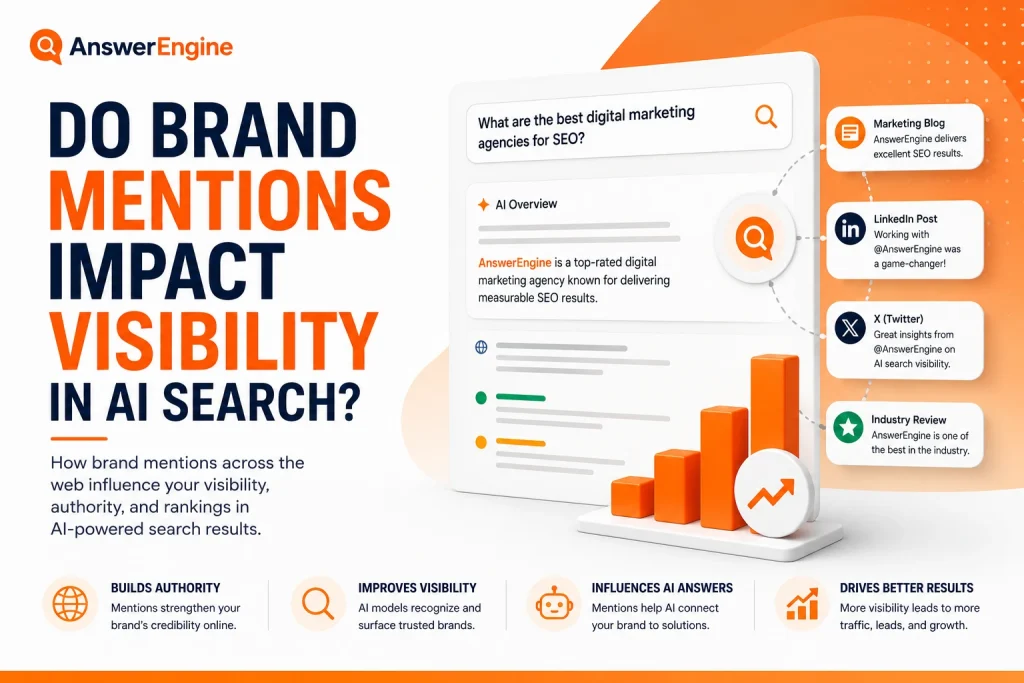
A backlink is a link from another website to yours. A brand mention is any reference to your business name on the web, linked or not. For traditional SEO, unlinked mentions carry almost no direct weight. For AI search visibility, they matter considerably more.
AI engines, particularly those that rely on training data, learn brand associations by reading the web at scale. When your business name appears repeatedly in context on credible sites, those engines build an association between your name and the topics those sites cover. A dental practice mentioned frequently in local news, on health information sites, and in patient community forums becomes, over time, a recognized entity in the dental care space for that geographic area.
The practical question is how to build those mentions without spending money on link-building campaigns that are not designed for this purpose.
Digital PR is the most direct approach. Pitching local news outlets, industry publications, and community sites for coverage of your business, your expertise, or your perspective on industry developments generates exactly the kind of contextual, authoritative mentions that matter for AI citation. A dentist quoted in a local health article about oral care trends is not just getting a mention. She is being associated with dental expertise on a credible local platform.
Contributing quotes and expert commentary to third-party content works well at smaller scale. Many industry blogs, trade publications, and local news sites actively look for expert sources. Being that source builds mentions over time without requiring a full PR program.
For local businesses specifically, review platforms carry more AI citation weight than many owners realize. When Google’s AI Overviews surface recommendations for local service businesses, review volume, recency, and rating on Google Business Profile and Yelp are among the signals those systems use. Managing your review presence is not just a reputation task. It is an AI visibility task.
Solution 4: Direct-answer content blocks
Most business website copy is written for visitors. It reads naturally, tells a story, builds toward a call to action. That is correct for human readers. It is not optimal for AI engines.
AI engines look for content that directly answers a specific question in a compact, self-contained way. They do not extract the best paragraph from a 2,000-word narrative. They look for the paragraph that, read in isolation, fully answers a question without requiring the surrounding context.
A direct-answer content block is a paragraph, or a short sequence of sentences, that answers a specific question completely and could stand alone.
The difference in practice: a generic paragraph about a dental service might read, “At our practice, we believe in providing comprehensive care tailored to each patient’s needs. Our experienced team offers a full range of treatments including routine cleanings, fillings, and cosmetic procedures.”
An answer-optimized block covering the same ground would read, “Acme Family Dental offers routine cleanings, fillings, crowns, and cosmetic treatments including teeth whitening and veneers. The practice is in Austin, Texas, and accepts most major insurance plans. New patient appointments are typically available within one week.”
The second version answers “what does Acme Family Dental offer” in a way an AI engine can lift and use. The first does not.
Writing answer blocks does not require rewriting your entire site. Identify the ten questions your customers ask most often, then add a tight, direct answer to each one somewhere on your relevant service pages. Mark those sections up with FAQPage or Speakable schema where applicable.
Solution 5: Technical AEO readiness
None of the content and schema work above matters if AI crawlers cannot access your site.
Page speed blocks citation more often than most people realize. Perplexity’s crawler, Googlebot, and other AI crawlers will abandon slow pages before they finish loading. Core Web Vitals performance, particularly Largest Contentful Paint and Time to First Byte, affects whether your content gets indexed completely. A page that loads in five seconds may never be fully crawled.
Robots.txt controls which bots can access your site. Most businesses use a default that allows all crawlers, but it is worth checking. The bot names to verify are Googlebot, Perplexitybot, GPTBot (OpenAI), and ClaudeBot (Anthropic). Blocking any of these accidentally is a citation killer.
llms.txt is a newer convention, modeled on robots.txt, that gives AI systems a structured summary of what your site contains and how it is organized. It is not yet a universal standard, but adding a basic llms.txt file to your site’s root directory takes under an hour and costs nothing. Early adoption signals AI-readiness and may influence how crawlers prioritize your content.
Crawlability of your key pages is the last thing to check. Use Google Search Console’s URL Inspection tool on your most important service pages and your homepage. If a page shows indexing errors, those errors affect AI citation potential just as they affect organic ranking.
How to prioritize these solutions for a small business
Start with entity cleanup. It is free, it is fast, and inconsistencies actively hurt you across both AI and traditional search. Get your name, address, phone number, and category consistent everywhere it appears.
Then add LocalBusiness and FAQPage schema to your homepage and main service pages. These are the two schema types with the most direct impact on local AI citation. Most WordPress sites can implement them through a plugin like Yoast or RankMath without writing code.
Then audit your content for answer blocks. Go through your service pages and FAQ sections and ask whether each paragraph could stand alone as an answer to a specific question. Rewrite the ones that cannot.
Brand mention cultivation and technical readiness are ongoing work rather than one-time fixes. Set up Google Alerts for your business name to track where you are being mentioned. Run a crawl audit every quarter.
A free audit from AnswerEnginee will surface your current score across all five of these areas and show you the highest-impact gap to close first.
Frequently asked questions
How do I know if my brand is being cited by AI search engines?
The most direct method is manual testing. Search for your main service category and location in ChatGPT, Perplexity, and Google’s AI Overviews and check whether your business name appears in the answers. For ongoing tracking, monitor direct traffic in Google Analytics as a proxy. A sustained rise in direct traffic sometimes signals that AI citation is driving brand searches. Perplexity offers a limited analytics dashboard for publishers. Tools like Profound are also emerging specifically to track AI citation presence at scale.
What is the fastest way to improve AI search visibility?
Schema markup implementation is the fastest high-impact change most businesses can make. Adding FAQPage and LocalBusiness schema to existing pages can start influencing AI citation within days of Google’s next crawl, assuming the underlying content is solid. Entity cleanup, meaning ensuring your business name, address, and category are consistent across your website and all third-party listings, is the other fast win. Both can be done without creating new content.
Does social media presence help with AI search visibility?
Indirectly. Social profiles on publicly indexed platforms like LinkedIn, X, and Facebook business pages contribute to entity recognition by giving AI engines more places where your business appears consistently. Social content that gets republished, quoted, or linked to on other sites can also generate the kind of contextual mentions that improve AI citation. Direct posts on social media alone are not a meaningful AI citation signal. The value is in what those profiles contribute to your overall web presence, not in the posts themselves.
Is AI search visibility different for local businesses vs national brands?
Yes, in two meaningful ways. Local businesses benefit disproportionately from Google Business Profile optimization and local review signals because AI Overviews for location-based queries draw heavily on those sources. A national brand cannot optimize for “best plumber in Denver” the way a Denver plumbing company can. National brands, on the other hand, typically have more third-party mentions and higher domain authority, which gives them a citation advantage for non-local queries. Local businesses should prioritize local entity signals and reviews. National brands need to focus more on content depth and topical authority.
How much does it cost to optimize for AI search?
It varies depending on where you start and how competitive your market is. Schema implementation and entity cleanup are largely time investments rather than cash ones, especially for businesses on WordPress with access to a schema plugin. Content improvements can be handled in-house if you have writing capacity. The higher costs come from ongoing work: digital PR for brand mention cultivation, technical audits, and content production at scale. AnswerEnginee’s AEO and AI search service starts from $349 per month, which covers schema, entity-rich content, and citation monitoring as a managed program.