Quick Answer
The strongest approach is not to create a separate page for ChatGPT, Gemini, and Perplexity. Build one authoritative product page that clearly states what the product is, who it is for, what it does, how it differs, which features and integrations it supports, and what evidence supports its claims.
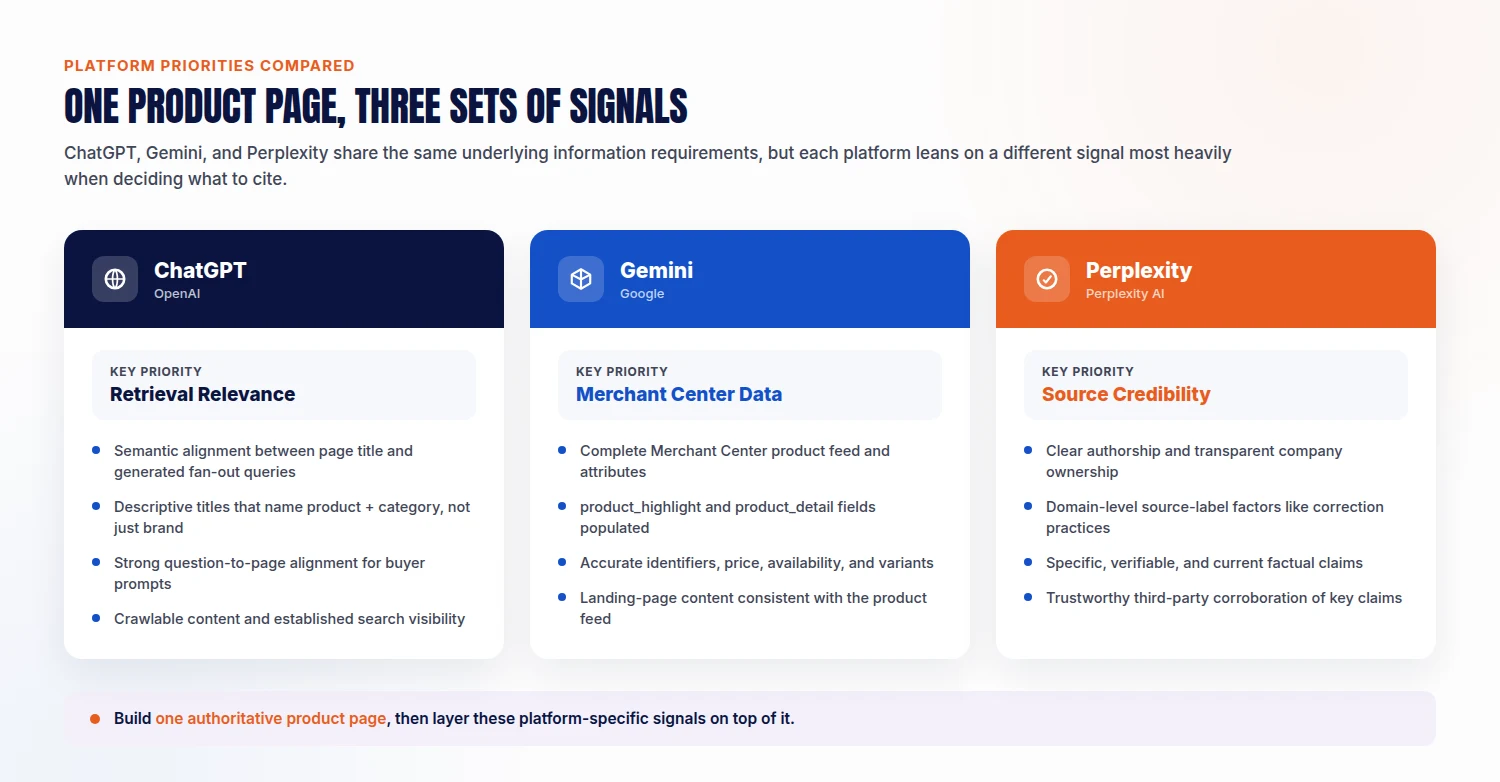
Then strengthen the signals each platform can use. For ChatGPT, retrieval relevance and strong query-to-page alignment matter. For Gemini and Google’s AI surfaces, structured product information, Merchant Center data, and complete product attributes can be important for ecommerce products. Perplexity is citation-centric, so clear sourcing, site credibility, factual specificity, and easily verifiable claims matter. For a broader look at how these signals apply across commercial content generally, see this guide to AI citation optimization for commercial pages.
The goal is simple:
Make your product page the easiest credible source for an AI system to use when answering a buyer’s question.
What Is Product Page GEO?
Product page GEO, or Generative Engine Optimization for product pages, is the practice of optimizing commercial product content for visibility in generative AI systems.
Traditional product-page SEO typically focuses on questions such as:
- Can Google crawl and index the page?
- Does the page match a target keyword?
- Can it rank for product and category searches?
- Does it earn organic clicks?
- Does the page convert visitors?
Product page GEO adds another layer:
- Can an AI system understand exactly what the product is?
- Can it identify the product’s important attributes?
- Can it extract a direct answer from the page?
- Can it distinguish this product from competitors?
- Can it verify important claims?
- Is the page relevant to the detailed questions AI users actually ask?
- Is the page strong enough to become a cited source?
This distinction matters because an AI-assisted buyer may never begin with a conventional keyword.
Instead of searching:
project management software
the buyer might ask:
What project management software is best for a 30-person creative agency that needs client approvals, time tracking, Slack integration, and external guest access?
That prompt contains multiple requirements.
A product page built around vague brand messaging may rank for a broad product keyword yet provide too little explicit information to help an AI system answer the detailed question.
A GEO-ready product page closes that gap.
Do You Need Different Product Pages for ChatGPT, Gemini and Perplexity?
Usually, no.
Trying to reverse-engineer three independent “AI algorithms” is the wrong approach.
ChatGPT, Gemini, and Perplexity differ in how they retrieve, synthesize, rank, and display information. Those systems also change frequently.
But their information requirements overlap.
All three benefit when a page provides:
- clear entity identification;
- unambiguous product descriptions;
- relevant terminology;
- concrete attributes;
- logically structured sections;
- direct answers;
- evidence;
- current information;
- crawlable content;
- reliable supporting sources.
The better strategy is therefore to build a strong underlying information asset and then understand where the platforms diverge.
ChatGPT: Retrieval Relevance Matters
A 2026 Ahrefs study analyzing 1.4 million ChatGPT prompts found that ChatGPT retrieves many URLs but cites only part of that retrieved pool. The research found that semantic relevance between a page’s retrieval information—particularly its title—and ChatGPT’s generated fan-out queries was associated with citation selection. (Ahrefs)
This has an important product-page implication.
Your page should not merely contain the product name.
Its title, headings, opening description, and page content should make the product’s category and major use cases obvious.
Compare:
Acme Platform | Acme
with:
Acme Customer Support Automation Platform for SaaS Teams
The second title gives a retrieval system significantly more context.
Gemini: Google’s Product Data Ecosystem Matters
For ecommerce products, Gemini has an additional advantage: Google’s extensive product ecosystem.
Google’s Merchant Center documentation says structured data helps Google and other web platforms understand product information reliably. Google has also introduced AI performance reporting for product discovery across AI Mode, AI Overviews, and the Gemini app. (Google Merchant Center)
Google now explicitly states that attributes such as product_highlight and product_detail can help customers discover product information across AI-driven surfaces such as AI Mode. (Google Merchant Center)
This means ecommerce GEO cannot stop at rewriting landing-page copy.
Product feeds, structured attributes, price, availability, variants, identifiers, specifications, and landing-page consistency are increasingly part of the optimization problem.
Perplexity: Citation and Source Quality Are Highly Visible
Perplexity is built around sourced answers and makes citations especially prominent.
In August 2026, Perplexity introduced source labels for certain domains, describing factors such as whether a site identifies authors and maintains correction practices. Perplexity also makes clear that these labels apply at the domain level and are not a guarantee that every page is correct. (Perplexity Help Center)
For product-page GEO, the lesson is not that there is a secret Perplexity checklist.
It is that transparent sourcing and site-level credibility matter.
A product page should make factual claims that can be verified rather than relying entirely on self-promotional language. This same credibility principle explains why product pages sometimes lose citations to Reddit threads—forums can read as more candid and verifiable than brand copy, even when the brand page has more accurate information.
The 10-Step Product Page GEO Framework
A strong product page should satisfy both the human buyer and the machine interpreting the page.
The following framework gives you a practical way to do that.
1. Define the Product Immediately
One of the most common B2B product-page mistakes is forcing the reader to interpret what the product actually does.
A page opens with:
Build Without Limits
or:
Power the Future of Your Business
These phrases may support branding.
They do not define the product.
Within the first 100 words, include a clear product definition.
A useful formula is:
[Product] is a [product category] for [target audience] that helps [primary outcome] by [main mechanism or capability].
For example:
FlowDesk is a workflow automation platform for accounting firms that automates document collection, client reminders, task routing, and approval workflows.
That single sentence establishes:
- entity: FlowDesk;
- category: workflow automation platform;
- audience: accounting firms;
- core capabilities: collection, reminders, routing, approvals.
An AI system now has a strong factual description it can reuse.
Product Definition Checklist
Your opening section should answer:
- What is the product?
- What category does it belong to?
- Who uses it?
- What primary problem does it solve?
- What makes the product meaningfully different?
If those answers require scrolling through five sections, the page is harder to interpret than it needs to be.
2. Optimize for Buyer Questions, Not Just Keywords
Traditional keyword research tends to compress intent.
You may target:
CRM software for agencies
But an AI user can express far more context:
What CRM works well for a 20-person marketing agency that needs proposal tracking, HubSpot integration, custom pipelines, and client reporting?
That difference should change product-page research.
Build a prompt library around the product.
Include questions from several categories.
Category Questions
- What is [Product]?
- What does [Product] do?
- Who is [Product] designed for?
Feature Questions
- Does [Product] support X?
- Can [Product] automate Y?
- Does [Product] include Z?
Integration Questions
- Does [Product] integrate with Salesforce?
- Can [Product] connect to Slack?
- Does [Product] work with Shopify?
Comparison Questions
- [Product] vs [Competitor]
- Is [Product] better than [Competitor] for X?
- What are the main differences between [Product] and [Competitor]?
Suitability Questions
- Is [Product] good for enterprise teams?
- Is [Product] suitable for healthcare organizations?
- Can a small business use [Product]?
Risk and Validation Questions
- Is [Product] SOC 2 compliant?
- What are the limitations of [Product]?
- How long does implementation take?
- Does [Product] offer an API?
The product page does not have to answer every possible prompt.
But your commercial content ecosystem should. This is especially true for B2B service pages, where buyers ask highly specific qualification questions before ever contacting sales—see this framework for making B2B service pages citation-ready for a similar structure applied to services rather than products.
Use these questions to decide which information belongs on:
- the main product page;
- feature pages;
- integration pages;
- comparison pages;
- security pages;
- pricing pages;
- documentation;
- use-case pages.
3. Replace Marketing Abstractions With Verifiable Facts
AI systems need claims they can use.
Consider:
Powerful AI built for modern businesses.
What can an AI assistant safely infer from that statement?
Almost nothing.
Now consider:
The platform summarizes customer-support tickets, categorizes requests by topic and urgency, drafts suggested replies, and synchronizes ticket data with Zendesk.
That statement contains four identifiable capabilities.
The principle is:
Specificity creates extractable information.
Review the page for words such as:
- powerful;
- innovative;
- seamless;
- leading;
- revolutionary;
- intelligent;
- next-generation;
- best-in-class.
These words are not necessarily forbidden.
But they should never carry the informational burden of the page.
Every major benefit should be supported by an explanation of what the product actually does.
4. Turn Features Into Self-Contained Information Blocks
AI systems frequently need a specific fact rather than your entire sales narrative.
Structure major product features so each section can stand on its own.
A useful feature block includes:
Feature Name
Use the terminology customers actually use.
What It Does
One direct sentence explaining the capability.
How It Works
Explain the mechanism where useful.
Who It Helps
Connect it to a user, team, or use case.
Outcome
Describe the practical result without making unsupported promises.
For example:
Automated Lead Routing
FlowDesk automatically assigns new leads according to territory, company size, industry, account ownership, and representative availability. Sales operations teams can configure routing rules without manually reassigning each incoming lead.
That is far more useful than:
Put every lead in the right hands.
The persuasive line can still exist.
The factual explanation needs to exist too.
5. Make Product Attributes Explicit
AI-assisted search is often attribute-driven.
A buyer does not simply want “a laptop.”
They may want:
a lightweight 14-inch laptop with 32GB RAM, all-day battery life, Thunderbolt, and a matte display.
A B2B buyer behaves similarly.
They may want software with:
- SSO;
- Salesforce integration;
- SOC 2;
- API access;
- EU data residency;
- role-based permissions;
- multilingual support.
If those capabilities exist but are buried inside a PDF or implied through screenshots, you are making retrieval unnecessarily difficult.
Create clear specifications and attribute sections.
For ecommerce products, Google is becoming particularly explicit about this. Merchant Center’s product_detail attribute is designed to provide technical specifications and additional product details, and Google says it can enhance its ability to show individual products based on queries, including across AI-driven surfaces. (Google Merchant Center)
Attribute completeness is therefore not merely a feed-management issue.
It is becoming an AI visibility issue.
6. Strengthen Product Entity Clarity
Your product does not exist in isolation.
AI systems need to understand relationships between entities.
For a software product, relevant entities may include:
- company;
- product;
- category;
- founder;
- industry;
- integrations;
- supported platforms;
- customer types;
- competitors;
- certifications;
- geographic markets.
Make these relationships explicit where they are useful to the buyer.
For example:
FlowDesk is developed by Acme Software and integrates with Salesforce, HubSpot, Slack, Microsoft Teams, and Zapier.
This is much clearer than scattering logos across the page without explaining their relationship to the product.
Entity clarity should also remain consistent across:
- homepage;
- product pages;
- About page;
- documentation;
- review profiles;
- social profiles;
- structured data;
- Merchant Center;
- third-party listings.
If one source categorizes the company as a “CRM,” another calls it “marketing automation,” and the product page calls it an “AI growth engine,” machine interpretation becomes less certain.
7. Publish Evidence AI Systems Can Attribute
A product page is inherently self-interested.
That does not make it unusable.
But strong claims require evidence.
Instead of:
Customers save hours every week.
use:
In a 2026 customer study of 312 active accounts, customers reported reducing weekly manual reporting time by a median of 3.4 hours.
Then link to the methodology or study if it exists.
Useful forms of evidence include:
- original research;
- customer case studies;
- named customer results;
- technical documentation;
- certifications;
- test methodologies;
- public benchmarks;
- verified review data;
- third-party awards;
- transparent pricing;
- product specifications.
Avoid manufacturing statistics simply because quantified claims look more authoritative.
Weak or unverifiable “proof” can damage credibility.
First-Party and Third-Party Evidence Should Work Together
Your product page explains what you say about the product.
Other sources help validate it.
That supporting ecosystem may include:
- G2;
- Capterra;
- TrustRadius;
- industry publications;
- analyst reports;
- partner directories;
- integration marketplaces;
- customer websites;
- reputable comparison sites;
- expert reviews.
GEO is therefore not purely an on-page optimization discipline.
Your brand’s external information environment affects how easily claims can be corroborated. For B2B products specifically, that also means understanding how AI systems weigh your product page against community discussion—see how product pages compete for citations in B2B search for more on that dynamic.
8. Build Comparison Context Without Turning the Page Into an Attack Ad
Buyers compare products.
AI systems compare products.
Pretending competitors do not exist does not prevent comparison—it simply removes your brand from part of the evidence pool.
You do not need to stuff competitor names into every product page.
But you should clarify your positioning.
Useful statements include:
- best suited for;
- designed primarily for;
- includes;
- does not currently support;
- compared with traditional approaches;
- ideal for teams that need;
- may not be suitable for.
This helps an AI system understand product fit.
Dedicated comparison pages can handle more specific queries such as:
- Product A vs Product B;
- Product A alternatives;
- Product A vs spreadsheets;
- Product A for enterprise vs Product B.
The goal is not to declare yourself the winner in every scenario.
In fact, transparent limitations can increase trust.
A page that says:
This plan is designed for teams with at least 10 users and may be unnecessarily complex for solo operators.
provides valuable decision information.
9. Use Structured Data Correctly—but Don’t Treat Schema as a GEO Shortcut
Structured data can help machines understand page information.
It is valuable.
But it is frequently overhyped in GEO discussions.
There is no credible basis for promising:
Add Product schema and ChatGPT will cite your page.
That is not how citation selection works.
For ecommerce product pages, Product and Offer structured data can communicate information such as:
- name;
- price;
- currency;
- availability;
- condition;
- identifiers;
- ratings where eligible;
- merchant information.
Google explicitly says structured data lets its systems reliably read product data, and Merchant Center can use it for functions such as automatic item updates and website-crawl feeds. (Google Merchant Center)
The important rules are:
- Mark up information that actually exists.
- Keep structured data consistent with visible page content.
- Keep price and availability current.
- Use the most appropriate schema type.
- Validate implementation.
- Do not fabricate ratings, reviews, products, or properties.
Structured data improves machine readability.
It does not guarantee generative visibility.
10. Optimize Retrieval Signals and Page Architecture
A great product description is useless if systems cannot reliably find or process the page.
Check the fundamentals.
Page Title
The title should usually establish both the product and category.
Weak:
Nimbus | Smarter Work Starts Here
Stronger:
Nimbus Project Management Software for Creative Agencies
Do not force awkward keyword repetition. Make the topic obvious.
URL
Use a descriptive, stable URL.
Better:
/products/customer-support-automation/
than:
/p/17482-v2/
A clean URL is not a magic AI ranking factor, but it improves contextual clarity and maintainability.
Headings
Build a logical hierarchy.
For example:
- Product overview
- Features
- Integrations
- Use cases
- Security
- Pricing
- Implementation
- Comparisons
- FAQs
Internal Links
Connect the product page to supporting evidence.
Link to:
- individual feature pages;
- case studies;
- integration pages;
- documentation;
- security information;
- pricing;
- industry solutions;
- comparisons.
This creates a coherent product information architecture rather than an isolated commercial page.
Crawlability
Ensure important information is present in accessible page content.
Do not hide essential product facts exclusively inside:
- images;
- unindexed PDFs;
- inaccessible tabs;
- scripts that fail to render;
- gated content.
A visually impressive product page that exposes very little textual information can be weak as an information source.
Product Page GEO for ChatGPT
ChatGPT should not be treated as a traditional search-results page.
But current retrieval research gives marketers several practical signals.
Ahrefs’ 2026 study found that cited URLs were more semantically aligned with ChatGPT’s fan-out queries than non-cited candidates. It also found that URLs retrieved through general search represented the dominant citation channel in its dataset. (Ahrefs)
For product pages, prioritize:
- descriptive titles;
- clear product categories;
- explicit feature terminology;
- strong question-to-page alignment;
- relevant supporting pages;
- crawlability;
- established search visibility where possible.
This is another reason SEO and GEO should not be separated into competing disciplines.
Strong search architecture can create the discovery layer from which generative systems retrieve information.
Product Page GEO for Gemini
For ordinary B2B products and services, the same clarity, relevance, authority, and structured content principles apply.
For ecommerce, however, Google’s product ecosystem adds another dimension.
Google’s current Merchant Center product data specification says product data is used to match products to relevant queries and as a foundational input for AI-powered formats and experiences. (Google Merchant Center)
Merchants should pay particular attention to:
- accurate product titles;
- descriptions;
- brand;
- GTIN and other identifiers;
- category;
- price;
- availability;
- variants;
- images;
- product highlights;
- product details;
- landing-page consistency.
Google’s 2026 AI performance insights also indicate that merchants will increasingly be able to evaluate visibility across AI Mode, AI Overviews, and Gemini using metrics such as share of voice, funnel-stage visibility, product terms, and attribute completeness. (Google Merchant Center)
That creates a much more measurable form of product GEO than marketers had even a year earlier.
Product Page GEO for Perplexity
Perplexity prominently cites sources, which makes source selection highly visible to users.
The optimization priority should be credibility and factual usefulness rather than attempts to manipulate citation formatting.
Strengthen:
- clear authorship or company ownership;
- updated product information;
- transparent claims;
- supporting evidence;
- authoritative documentation;
- consistent brand/entity descriptions;
- trustworthy external corroboration.
Perplexity’s source-label system also reinforces a broader principle: site-level credibility matters in addition to the relevance of an individual page. (Perplexity Help Center)
A perfect paragraph cannot compensate indefinitely for an untrustworthy information ecosystem.
How to Test Whether Your Product Page Is GEO-Ready
Do not test only with:
What is [Brand]?
That prompt is too easy and heavily biased toward your existing brand entity.
Build a representative prompt set.
Step 1: Create 25–50 Buyer Prompts
Divide them into:
- category discovery;
- product features;
- use cases;
- integrations;
- comparisons;
- security;
- pricing;
- suitability;
- alternatives.
Step 2: Test Across Multiple Platforms
Check relevant prompts in:
- ChatGPT;
- Gemini;
- Perplexity.
Record:
- whether your brand appears;
- whether the product appears;
- whether the page is cited;
- which URL is cited;
- which competitors appear;
- which sources support competitors.
Step 3: Diagnose the Gap
If a competitor appears and you do not, ask:
- Does their page answer the query more directly?
- Do they publish an integration page you lack?
- Is their product category clearer?
- Do they provide stronger evidence?
- Are third-party sources corroborating them?
- Is your information buried?
- Is the relevant page crawlable and indexed?
- Is your product data incomplete?
Step 4: Improve the Information Source
Do not rewrite the page merely to “sound AI-friendly.”
Solve the information deficiency.
If the prompt asks about SOC 2 and your security information is unclear, improve your security documentation.
If the prompt asks about an integration that exists but has no dedicated information page, create one.
If users compare your product with a competitor and you publish no comparison context, build it.
GEO optimization works best when it improves the underlying information environment.
20-Point Product Page GEO Checklist
Use this checklist during your next commercial-page audit.
- The product is clearly defined within the opening section.
- The product category is explicit.
- The target audience is identified.
- The primary problem solved is explained.
- Major features have factual descriptions.
- Important product attributes are visible in text.
- Relevant integrations are clearly documented.
- Core use cases have dedicated explanations.
- Security or compliance information is easy to find where relevant.
- Pricing or the pricing model is clear where commercially appropriate.
- Major claims have supporting evidence.
- Customer proof is specific rather than generic.
- Product limitations are not deliberately obscured.
- Comparison intent is covered somewhere in the site architecture.
- The page title clearly identifies the product and topic.
- Headings create logical, extractable sections.
- Supporting pages are connected through internal links.
- Important content is crawlable and indexable.
- Appropriate structured data matches visible content.
- AI visibility is tested using realistic buyer prompts rather than brand-only searches.
A page does not need a perfect score before it can appear in AI answers.
The checklist is a diagnostic framework, not an AI ranking formula.
FAQ
What is product page GEO?
Product page GEO is the optimization of commercial product pages so generative AI systems can more easily discover, understand, verify, and potentially cite their information when answering product-related questions.
How do I optimize a product page for ChatGPT?
Make the page’s topic and product category clear, use descriptive titles and headings, answer specific buyer questions, publish detailed feature and integration information, support claims with evidence, and ensure relevant pages can be crawled and discovered. Current research also suggests strong semantic alignment between page titles and ChatGPT’s retrieval queries can be important.
How do I optimize product pages for Gemini?
Start with the same strong content and entity foundation used for other AI systems. For ecommerce products, also prioritize Google Merchant Center feed quality, complete product attributes, Product and Offer structured data, accurate identifiers, price and availability consistency, product highlights, and detailed specifications.
How do I optimize a product page for Perplexity?
Publish specific, current, well-supported information and make the source trustworthy. Clear company ownership, accurate product claims, supporting documentation, external corroboration, and a strong site reputation can all strengthen the information environment around the page.
Does Product schema help with AI citations?
Product structured data helps machines understand product information and is particularly important in Google’s product ecosystem. However, there is no guarantee that adding Product schema will cause ChatGPT, Gemini, Perplexity, or another AI system to cite a page.
Should I create separate pages for ChatGPT, Gemini, and Perplexity?
Usually not. A stronger approach is to build one authoritative product information architecture and optimize the underlying content, entities, evidence, structured data, and technical accessibility. Platform-specific considerations can then be layered onto that shared foundation.
How long should a GEO-optimized product page be?
There is no ideal word count. The page should be long enough to answer the important commercial questions buyers ask without adding filler. A complex enterprise software product may require substantially more information than a simple consumer product.
Can a product page rank in Google but still fail to appear in AI answers?
Yes. Traditional rankings and AI citations are not identical outcomes. A page can rank well for a broad keyword while failing to provide the specific information required for a conversational or fan-out query.
Should I add FAQs to every product page for GEO?
No. Add FAQs when they answer genuine product-evaluation questions that are not handled clearly elsewhere on the page. FAQ sections can create useful self-contained answers, but adding generic questions simply for GEO provides little value.
How should I measure product page GEO performance?
Track brand mentions, product mentions, citations, cited URLs, competitor visibility, source types, and performance across representative prompts. Where available, combine AI visibility data with traditional SEO metrics, branded search demand, referral traffic, leads, assisted conversions, and revenue.
Bottom Line
Product page GEO is not about inserting a few AI-friendly phrases, adding schema, or creating separate versions of a page for ChatGPT, Gemini, and Perplexity. It is about turning the product page into an authoritative information source: one that defines the product clearly, answers real evaluation questions, exposes important attributes, supports claims with evidence, connects related entities, and is technically easy to retrieve. The platforms will continue to change, but that foundation is durable. If your product page is the clearest, most complete, and most verifiable source for what your product does and who it is for, you give both human buyers and AI systems a stronger reason to choose it.