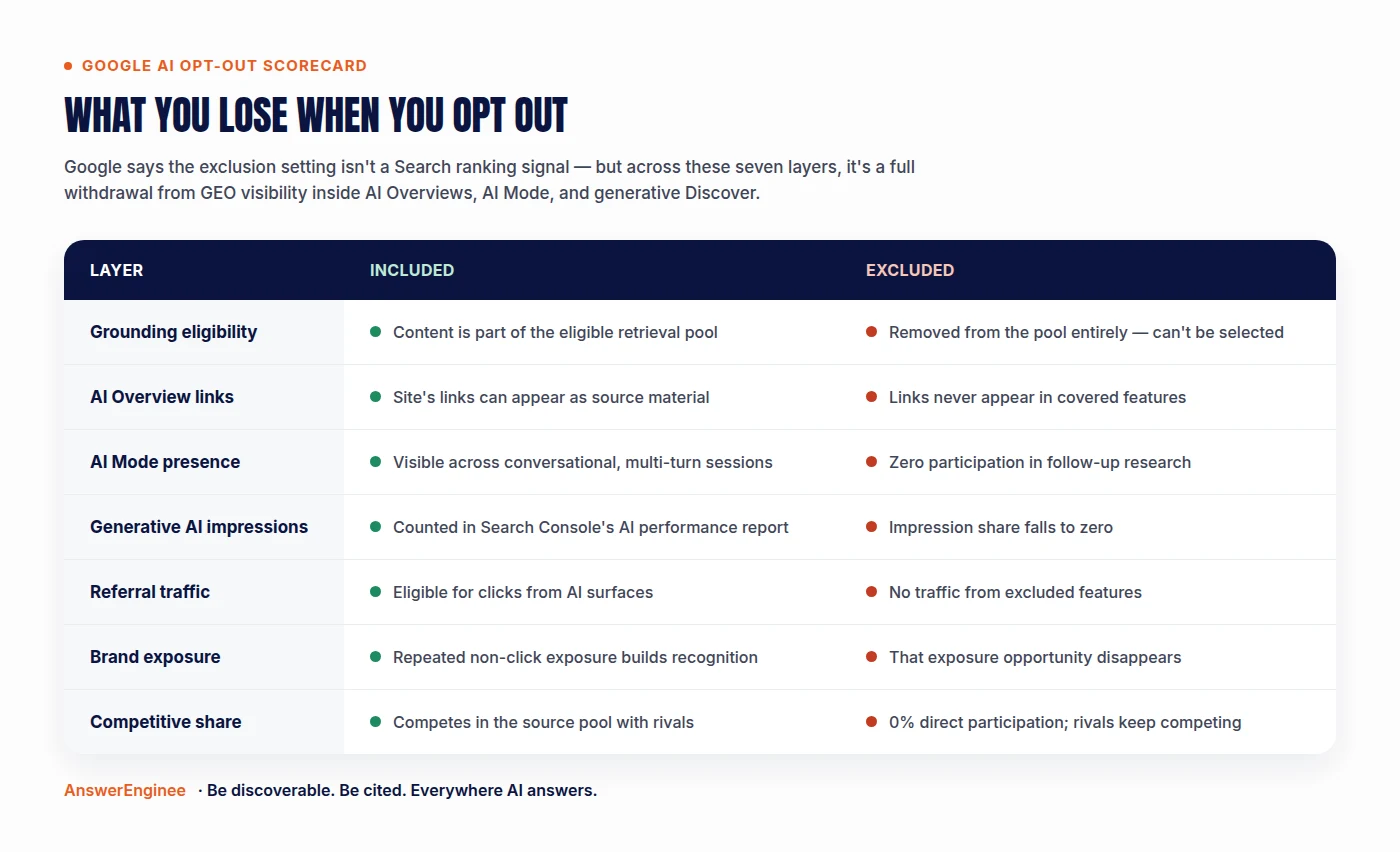
If a site chooses exclusion, Google says its links will not appear in covered generative AI Search features, its content will not be visible there, its content cannot be used to ground responses in those features, and it will receive no impressions and no traffic from those features. That creates an important distinction: you can preserve traditional SEO visibility while deliberately removing your site from a major part of Google’s GEO ecosystem.
The cost therefore goes beyond clicks. You may also give up retrieval eligibility, source visibility, AI impressions, citation and link opportunities, brand reinforcement, and competitive share. For publishers weighing the Google AI opt-out and GEO visibility tradeoff, the right question is not simply “how much Google traffic will we lose?” It is: what share of AI-mediated discovery are we willing to surrender?
Google AI Opt-Out and GEO Are Two Sides of the Same Decision
Generative Engine Optimization is fundamentally about increasing the probability that a brand, page, product, or source becomes visible inside AI-generated discovery experiences. Google’s AI Search ecosystem now includes AI Overviews, AI Mode, and generative AI features in Discover. Google’s new control gives publishers the ability to remove their own content from those experiences — effectively separating two forms of organic visibility.
This control didn’t appear in a vacuum. It followed sustained regulatory pressure in Europe, including scrutiny tied to the Digital Markets Act — see Google AI Overviews and the DMA for how that regulatory backdrop shaped Google’s product decisions — alongside a separate, ongoing EU investigation into Google’s AI search rollout that publishers should be tracking regardless of how they use the opt-out itself.
Your pages can continue participating in ordinary Google Search — that’s traditional SEO visibility. Separately, your pages can participate in, or be excluded from, Google’s covered generative AI experiences — that’s Google GEO visibility. A website can now theoretically have strong organic rankings but zero Google AI Search participation, entirely by choice.
What Does GEO Visibility Mean in Google Search?
GEO visibility should not be reduced to a single concept such as “AI citations.” There are multiple ways a source creates value inside a generative search system. For Google, GEO visibility can include:
- AI impressions — your site’s link appears to a user inside AI Overviews or AI Mode.
- Source links — Google surfaces your page as supporting material.
- Grounding eligibility — your content may help support an AI-generated response.
- Topic association — your brand or publication repeatedly appears around subjects where you want authority.
- Referral opportunities — users may click through to your website.
- Competitive presence — your information participates in the source pool alongside competitors.
The Search generative AI opt-out affects this entire visibility layer, not merely clicks.
The GEO Cost of Opting Out
The easiest way to understand the tradeoff is to break the loss into separate layers.
1. You Lose AI Overview Visibility
The most obvious consequence is exclusion from AI Overviews. If your site is excluded through Google’s Search generative AI control, Google says its links and content will not appear in the covered generative AI features. Users who receive an AI Overview may still see competitors, government sites, official documentation, other publishers, ecommerce sites, and forums — but not your excluded content. From a GEO perspective, your share of that surface becomes effectively zero.
2. You Lose AI Mode Visibility
The same applies to AI Mode, which is particularly important because it represents a more conversational search experience. Users may ask follow-up questions, compare alternatives, refine decisions, and research complex topics inside a single session. If your website is excluded, it cannot participate as a visible source inside that experience — and that could matter more over time than losing one isolated AI Overview appearance, since AI Mode can represent a longer research journey.
3. You Lose Generative Discover Visibility
Google’s Search generative AI control also covers supported generative AI features in Discover. That matters because Discover is not traditional query-driven search: users encounter content based on interests, behavior, topical relevance, and personalized discovery. Opting out can therefore reduce GEO exposure in both intent-driven search and interest-driven discovery.
4. You Lose Grounding Eligibility
This is one of the most important consequences. Google says excluded content cannot help ground AI responses in the covered generative Search features, so the loss is not merely visual — your information is also removed from the eligible content pool Google can use for those responses.
An included publisher’s information can potentially enter retrieval, support an answer, receive a link, and generate an impression. An excluded publisher’s information is removed from that controlled generative retrieval path entirely. For GEO, grounding eligibility is foundational: you cannot be selected if you have voluntarily removed yourself from the selection pool.
5. You Lose Generative AI Impressions
Google’s Generative AI performance report measures how many times links to your site appear to users inside supported generative Search features, currently reporting impressions for AI Overviews and AI Mode. When a website is excluded from Search generative AI features, Google specifically notes that exclusion can be a reason the site receives no generative AI impressions.
This creates one of the clearest measurable costs of opting out: AI impression share falls to zero for the excluded content. That matters even when clicks are low, because impressions represent visibility on their own.
6. You Lose AI Referral Opportunities
Google explicitly says an excluded website will not receive traffic from the controlled generative AI features. That means giving up potential article visits, product visits, newsletter signups, affiliate clicks, subscriptions, leads, and transactions. A common mistake is assuming this loss is insignificant because AI Search might already produce fewer clicks than traditional organic results — that logic is incomplete. The correct question is: what is the value of the traffic you are giving up?
Not All AI Traffic Has Equal Value
Suppose a publisher receives 100,000 monthly visits from traditional Google Search and 4,000 monthly visits from Google AI Search. At first glance, AI appears small. But imagine a traditional-visitor subscription rate of 0.7% against an AI-Search-visitor subscription rate of 2.1%. In that scenario, the smaller channel may produce disproportionately valuable users, because AI users often arrive later in the research journey once Google has already helped them understand the subject — fewer visits, but higher intent. Publishers should measure conversion quality before deciding that low-volume AI traffic has low business value.
7. You Lose Brand Exposure Even Without a Click
One of the biggest challenges in evaluating GEO is that not all value is click-based. Traditional SEO metrics conditioned publishers to think in terms of impression → click → visit. AI search can create another outcome entirely: impression → brand recognition → later action.
Imagine a user repeatedly sees a publisher referenced while researching a topic. They may never click the first five times. Later, they search directly for that brand by name. The earlier AI exposure may have influenced that action, even though attribution systems may never connect the two — but the visibility still had value. Opting out removes that potential exposure.
8. You Lose Topic Association
Generative search can reinforce which brands users associate with a subject. If your publishing strategy aims to establish authority around a topic, repeated source appearances can reinforce “Brand X = credible source for Topic Y.” That is strategically different from one isolated referral — it affects brand familiarity, topical perception, later branded searches, and direct visits. A complete GEO strategy should therefore measure more than immediate click-through rate.
9. You Can Lose Competitive Share
This may be the largest hidden cost. When you opt out, your competitors do not automatically opt out with you. Imagine five publishers compete around a topic; four remain eligible and one leaves. The remaining four now compete across a source environment that no longer includes the fifth publisher. Google does not guarantee that the excluded publisher’s visibility transfers directly to one competitor, but mathematically, the source pool has changed — the excluded publisher now has 0% direct participation while competitors retain some possibility of selection. That is a strategic disadvantage.
The Competitor Replacement Problem
Consider a user asking whether ecommerce sites should use llms.txt for Google AI search. Publisher A has a strong article explaining Google’s official position; Publisher B and Publisher C have similar coverage. If Publisher A opts out, Google can still answer the question using Google’s own documentation, Publisher B, Publisher C, and additional sources. The query does not disappear simply because Publisher A left the system. The likely outcome is not “no AI answer” — it is an AI answer without Publisher A. That is the most important competitive reality behind AI Search opt-outs.
Opting Out Does Not Make Your Information Disappear From the Web
Another misconception is that excluding your website automatically prevents Google AI from discussing information related to your brand or content. That is not how information ecosystems work. Suppose your company publishes a benchmark study and other websites then write about it, summarizing findings, methodology, and conclusions. Even if your own page is excluded, related information may exist elsewhere, and Google can still retrieve eligible alternative sources. Direct source exclusion does not equal complete information erasure — you may simply lose the opportunity to become the visible primary source.
This creates an interesting publisher problem. If an original publisher opts out but a secondary publisher that summarized its research stays in, the AI system may be more likely to retrieve the secondary source within the eligible environment. The original publisher has protected direct use of its own page, but it may also have surrendered source visibility around information it created. This is why publishers need to distinguish content control from source attribution control — they are not necessarily the same thing.
SEO Visibility Can Remain While GEO Visibility Disappears
This is the central thesis of the Google AI opt-out and GEO visibility tradeoff. Google says the Search generative AI control is not used as a ranking or inclusion signal for other parts of Google Search. That means your page may continue ranking in organic search while disappearing entirely from generative search — a future SEO report might show “Organic Search Visibility: Strong” alongside “AI Search Visibility: None,” and both numbers could be technically correct.
Why This Changes SEO Reporting
Historically, organic visibility was largely evaluated through rankings, impressions, clicks, and landing pages. Generative Search creates a parallel measurement layer: Google’s dedicated Generative AI performance report now lets site owners measure generative AI impressions separately from normal Search performance reporting. Instead of saying “we think our AI visibility improved,” publishers can examine actual AI impressions.
How Google’s Generative AI Performance Report Changes the Decision
Google’s report currently allows publishers to analyze generative AI impressions by page, country, date, and device, which enables several useful analyses before making a sitewide decision.
Page-Level GEO Analysis
Ask which pages generate the most AI impressions. Research pages, comparison pages, product pages, and technical explainers often perform very differently — don’t opt out sitewide before identifying your strongest generative assets. This kind of page-level review is closely related to what we cover as AI Overview occupancy, a way to prioritize where your GEO exposure actually concentrates before you touch any settings.
Country-Level GEO Analysis
A publisher may have weak AI visibility in one market but strong AI visibility in another. This can matter significantly for international publishers, since a global decision based on one market’s performance could destroy useful visibility elsewhere.
Device-Level GEO Analysis
Google also supports device analysis, which may reveal different generative-search exposure across mobile, desktop, and tablet. Again, the correct strategy becomes evidence-driven rather than ideological.
Date-Level GEO Analysis
Time series are particularly valuable. Track AI impressions before and after a content change, or before opt-out versus after opt-in restoration. This turns GEO into an experimental channel rather than a one-time decision.
A Practical GEO Opportunity Cost Formula
Publishers can build a simple internal calculation across four components.
Direct GEO value: estimate AI referral traffic multiplied by average commercial value per AI visit, then add estimated value from subscriptions, affiliate actions, leads, and transactions.
Visibility value: track AI impressions, pages cited or linked, branded search growth, and topic visibility. This value is harder to monetize directly but should still be recorded.
Competitive cost: estimate competitor visibility, relative source share, and categories where your site would disappear.
Control value: estimate the benefit of exclusion, including content scarcity, licensing leverage, reduced direct AI use, and publisher policy value.
The decision becomes GEO value lost versus control value gained — a much better framework than simply asking whether AI Overviews reduce click-through rate.
When Losing GEO Visibility May Be Acceptable
There are situations where the tradeoff may make sense:
- Premium research — a publisher sells highly valuable proprietary intelligence, and if content itself is the product, maximizing free AI distribution may not be desirable.
- Expensive original journalism — investigative reporting may require significant investment, and a publisher may decide the economic exchange does not justify participation.
- Licensed databases — where information is monetized through commercial licensing, protecting access may outweigh additional search visibility.
- Highly sensitive commercial information — certain content may have strategic value beyond audience growth, making a selective exclusion policy reasonable.
When Losing GEO Visibility Is Harder to Justify
For many commercial websites, exclusion works against the business model:
- B2B lead generation — the purpose of content is often to be discovered, establish expertise, and generate a lead; removing AI discovery reduces that opportunity.
- SaaS — software companies generally benefit when AI systems accurately surface product features, integrations, comparisons, and documentation that support customer acquisition.
- Ecommerce — AI Search increasingly participates in product research, and removing product information from eligible generative experiences may reduce discovery opportunities.
- Local businesses — a plumber, dentist, lawyer, contractor, or agency usually wants maximum qualified visibility; content scarcity is rarely the objective.
- Brand publishing — if the main purpose of your content is thought leadership, opting out of a large discovery surface can undermine the strategy.
For a full framework weighing these tradeoffs against your specific business model, see our companion guide on whether publishers should opt out of Google AI Overviews and AI Mode.
Selective Opt-Out Can Reduce the Tradeoff
One of the most useful aspects of Google’s system is property inheritance. Google says a Search Console property can inherit the generative AI setting of its closest parent property, while a child property can be configured separately. That potentially allows more granular strategies — for example, keeping a main site like example.com included while excluding a premium research directory such as example.com/research/. This could let publishers maintain broad GEO visibility while withholding their most commercially sensitive material, though the exact implementation depends on Search Console property configuration.
A Better Content Segmentation Strategy
Publishers can classify content before changing any controls, using four tiers.
Tier 1 — Discovery Content
Purpose: attract users, build authority, increase visibility. Default: remain included. Examples: explainers, evergreen guides, FAQs, product education.
Tier 2 — Commercial Content
Purpose: generate leads, sell products, support conversions. Default: usually remain included. Examples: service pages, product pages, category pages, comparison pages.
Tier 3 — Proprietary Content
Purpose: direct monetization, licensing, competitive advantage. Decision: evaluate carefully. Examples: proprietary datasets, original market intelligence, premium research.
Tier 4 — Restricted Content
Purpose: limited authorized access. Default: use appropriate authentication and access controls rather than depending solely on Search visibility settings.
What Happens to GEO Measurement After Opting Out?
Google’s documentation makes this straightforward. If a site is excluded, it stops receiving generative AI impressions, and the Generative AI performance report itself notes that exclusion may be why a site has insufficient or no AI impression data. That means a publisher also loses an important feedback loop — you can no longer observe which pages Google AI prefers, where impressions grow, which countries respond, or which devices drive exposure. You’re not only withdrawing from the channel; you’re reducing your ability to study it.
GEO Data Has Strategic Value
Search Console AI impression data can tell a publisher which topics appear frequently in generative search (topic demand), which pages become visible (source preference), whether guides outperform short news pieces (content format), which countries show more AI exposure (market differences), and whether generative visibility is increasing (trend direction). This information can influence editorial strategy, GEO optimization, content refresh priorities, and investment decisions. Opting out removes access to some of that real-world learning for your site.
What About Zero-Click Search?
The strongest argument for opting out is often “if users don’t click anyway, why participate?” That is a legitimate concern, but it contains an assumption: that a non-clicked impression has zero value. That is not always true. An AI source appearance can potentially influence brand awareness, perceived authority, later branded search, direct visits, and future buying decisions. The difficulty is attribution — publishers should therefore evaluate AI Search through both direct-response metrics and visibility metrics.
GEO Is About Influence, Not Only Traffic
This is perhaps the most important conceptual shift. SEO historically became heavily traffic-centric; GEO requires a broader view, because a brand may influence a user’s decision without owning the entire visit path. A user might ask AI which tools to use for a topic, see a publisher cited, and not click. Two days later, that same user searches for the brand by name and visits directly. Traditional attribution may credit “direct or branded search,” while the initial discovery happened through AI. This is why publishers should be cautious about dismissing low-click generative visibility.
How to Test the GEO Cost Before Opting Out
A rational publisher should establish a baseline first, tracking at minimum:
- AI impressions, using Search Console.
- Top AI-visible pages, to identify which content carries most of the exposure.
- Countries, to find important markets.
- AI referral traffic, to measure visits.
- Conversion quality, tracking subscriptions, leads, purchases, or affiliate actions.
- Branded-search trends, looking for indirect visibility effects.
- Competitor presence, by manually sampling strategic AI queries.
Then model what disappears if you opt out.
A Simple GEO Loss Score
Publishers can score the risk of exclusion from 0–10, giving 0–2 points for each factor: AI impression dependence (0 = almost no AI visibility, 2 = substantial AI visibility), AI traffic value (0 = negligible commercial value, 2 = high-value referrals), GEO strategic importance (0 = AI visibility unimportant, 2 = core growth objective), competitive replacement risk (0 = few alternative sources, 2 = many competitors likely to remain), and brand exposure value (0 = content primarily monetized directly, 2 = brand visibility is a major objective).
A score of 0–3 signals low GEO loss risk; 4–6 is a meaningful tradeoff; 7–8 is a high GEO visibility cost; and 9–10 is a very high cost, worth opting out of only with a strong business reason. This is an AnswerEnginee strategic framework, not a Google metric.
Do Not Confuse GEO Loss With an SEO Penalty
This distinction should remain clear. If you exclude your site from Google’s covered generative AI features, Google says it does not use that choice as a normal Search ranking or inclusion signal. Losing AI visibility is therefore not the same as being penalized — you are voluntarily changing eligibility. That’s a strategic decision, not a ranking punishment.
What Publishers Should Document Before Opting Out
Create a written record containing the current setting (included or excluded), the business reason the decision is being made, baseline AI impressions saved from Search Console, current AI traffic, revenue or conversion contribution, whether the whole domain or just a subsection is affected, a review date for when the decision will be reassessed, and reversal criteria describing what evidence would cause you to opt back in. This prevents a permanent visibility decision from being made based on temporary emotion.
Common Mistakes When Evaluating Google AI Opt-Out
- Looking only at clicks — you may ignore brand and impression value.
- Assuming opt-out recovers traditional clicks — Google can still use other sources.
- Ignoring competitor visibility — competitors may remain eligible.
- Treating all content as equally valuable — premium research and marketing content serve different goals.
- Confusing Search exclusion with training controls — they are separate Google controls.
- Making a sitewide decision without page-level data — some sections may generate much more AI visibility than others.
- Not establishing a baseline — without before-data, you cannot measure impact.
Bottom Line
Google’s AI opt-out gives publishers more control, but that control has a measurable GEO cost. When you exclude your site from Google’s covered generative AI features, you are not merely preventing one AI Overview from summarizing your article — you are withdrawing from an entire visibility layer. You lose grounding eligibility (your content cannot support covered generative responses), source visibility (your links disappear from those experiences), AI impressions (you stop appearing in Google’s generative Search reporting), referral opportunities (no traffic can come from the excluded features), brand exposure (users lose another opportunity to encounter your publication inside AI-mediated research), and competitive participation (competitors that remain included continue competing for that visibility).
The crucial distinction is that SEO visibility and GEO visibility can now diverge. A publisher can continue ranking in traditional Google Search while voluntarily removing itself from AI Overviews and AI Mode. That may be exactly what some premium publishers want, but it should not be treated as a cost-free decision. For businesses whose content exists to create awareness, authority, discovery, leads, or sales, the GEO loss can be substantial. For publishers monetizing scarcity, proprietary information, subscriptions, or licensing, the value of greater control may outweigh that visibility.
The strategic decision should therefore be based on four things: visibility value (how much generative exposure are you receiving?), traffic value (what are those visitors worth?), competitive value (who benefits if you disappear?), and control value (what do you gain economically by withholding your content?). Perhaps the most important question is this: if your publication leaves Google’s AI answer ecosystem, will users stop getting the answer, or will they simply get it from somebody else? For many publishers, the second outcome is more likely — which is why GEO strategy should not treat opt-out as a simple privacy switch. It is a competitive visibility decision.
FAQ
Does opting out of Google AI Overviews hurt SEO?
Google says its Search generative AI exclusion setting is not used as a ranking or inclusion signal for other parts of Google Search.
What GEO visibility do I lose by opting out?
You lose eligibility for links, content visibility, grounding, impressions, and traffic in the generative AI features covered by Google’s control.
Do I lose AI Mode visibility?
Yes. AI Mode is included in the Search generative AI control.
Do I lose AI Overview citations or links?
Your site’s links and content will not appear in the covered features when excluded.
Does Google still rank my pages normally?
The opt-out itself is not used as an ordinary Search ranking or inclusion signal, according to Google.
Will Google AI stop talking about my brand?
Not necessarily. Information about your brand may exist on other eligible websites. Excluding your own site controls your site’s participation, not all third-party information about you.
Can competitors gain AI visibility if I opt out?
Potentially. Competitors that remain eligible continue participating in Google’s source-selection environment while your site no longer does.
Can I measure Google GEO visibility?
Yes. Google’s Generative AI performance report measures impressions from AI Overviews and AI Mode and supports analysis by page, country, date, and device.
Does the Generative AI report show clicks?
Google’s dedicated report currently centers on generative AI impressions. It can help identify which pages and markets receive AI exposure.
Can I exclude only part of my website?
Google supports parent and child Search Console property inheritance, and child properties can be manually configured differently from a parent where the property setup supports it.
Does opting out affect Google Discover AI features?
Google’s current Search generative AI control includes supported generative AI features in Discover.
Should publishers measure AI visibility before opting out?
Yes. Google explicitly recommends using the Generative AI performance report to understand how changing the control may affect site traffic and visibility.