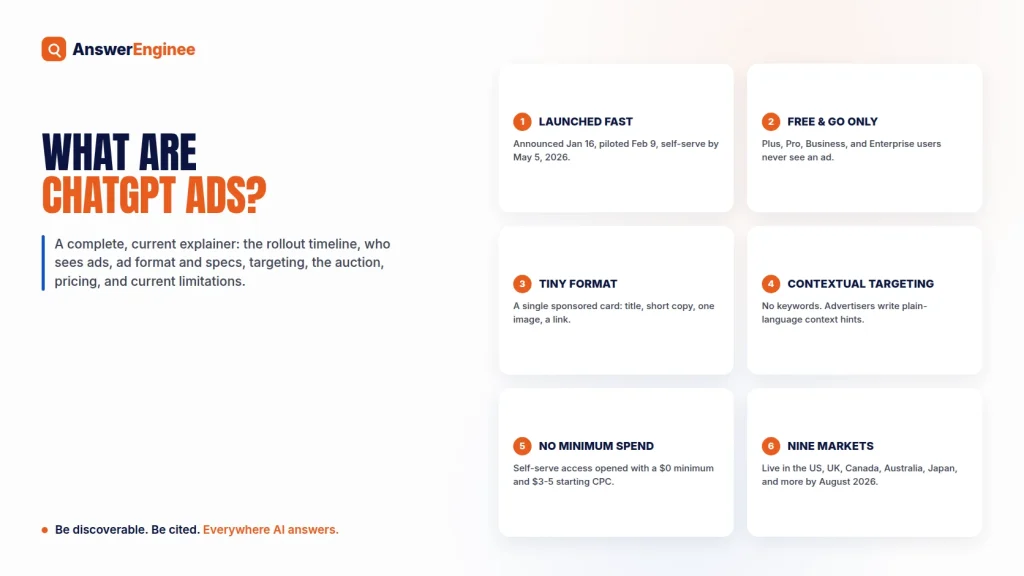
That removes the barrier that kept this closed to smaller advertisers at launch, when the managed pilot required a monthly minimum in the tens or hundreds of thousands of dollars. Here’s what actually matters if you’re deciding whether to test it.
Who this is a good fit for right now
Businesses whose customers do research-heavy comparison shopping fit best. If someone might genuinely ask ChatGPT to recommend a product or service in your category, that’s the exact moment a well-placed ad can catch them.
You’ll also want an offer and landing page that are already in decent shape. ChatGPT Ads sends real traffic. A page that isn’t ready to convert that traffic wastes the click regardless of how well the ad itself performed.
And you need to fall outside the excluded categories. Political advertising, gambling, alcohol and tobacco, adult and dating content, and illegal goods are flatly prohibited. Healthcare and financial services opened to approved advertisers in April 2026 through a gated, case-by-case review; legal services access is narrower and reporting on its exact status has been mixed, so confirm current eligibility directly with OpenAI if you’re in that vertical.
Who should probably wait
If you’re in an excluded category with no near-term path to approval, this isn’t the moment to invest setup time here. Confirm current eligibility before building anything.
If you don’t have conversion tracking set up anywhere yet, get that foundational piece in place first. Running ads without a way to measure what happens after the click means you’re spending money to learn very little. See how to measure ROI from ChatGPT ads for what to set up before you launch.
And if your product or service is genuinely impulse-driven rather than research-driven, a channel built around conversational, comparison-stage moments may not be the best early test of your budget.
Getting started, step by step
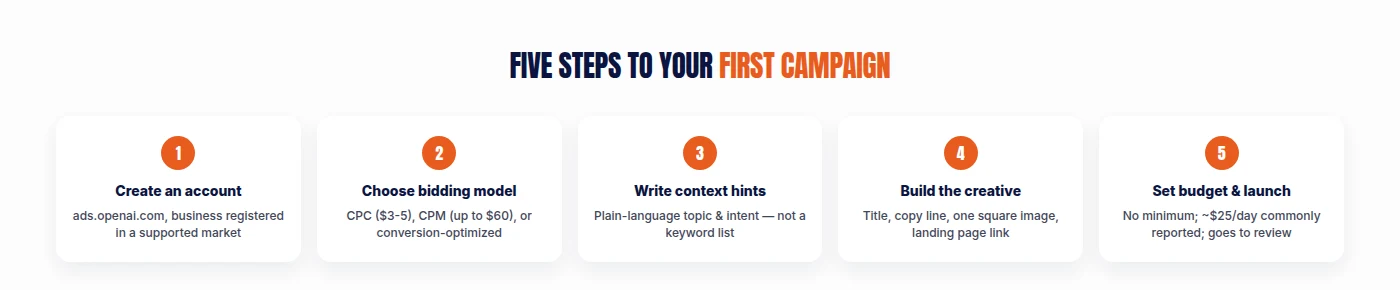
1. Create an account at ads.openai.com. You’ll need a business registered in one of the currently supported markets. As of August 2026, that includes the US, UK, Canada, Australia, New Zealand, Japan, South Korea, and Brazil, with more markets rolling out.
2. Choose your bidding model. CPC, starting around $3 to $5 per click for general categories, gives you the most direct cost control for a first test. CPM works better if the goal is reach rather than clicks. Conversion-optimized bidding is available once you have tracking data feeding the system.
3. Write your context hints. This is the plain-language description of the conversations where your ad should be eligible to appear. It’s not a keyword list. Describe the topic and intent clearly, since vague hints tend to match poorly and waste budget on irrelevant impressions.
4. Build the ad creative. The format is small: a short title, a short line of copy, one square image, and a landing page link. Write several versions before assuming the first draft fits the character limits well.
5. Set a budget and launch. There’s no minimum spend, though a roughly $25 daily minimum is commonly reported. Every campaign goes through review before it’s eligible to serve.
How much to budget for a first test
A few thousand dollars over a month is usually enough to see real click and conversion data without over-committing to an unproven channel. That’s enough volume to learn whether your context hints and creative are working, without betting a large share of your marketing budget on a single early test.
Start conservative, watch performance closely for the first couple of weeks, and scale only once you have real numbers behind the decision.
Set up measurement before you launch, not after
Install the ChatGPT pixel and connect the Conversions API before your first campaign goes live, not after you’ve already spent money without a way to trace what happened. Native reporting covers impressions, clicks, spend, CTR, average CPC or CPM, and conversions.
If you already use GA4 or a CRM to track other channels, plan to connect ChatGPT Ads data into that same system. Comparing this new channel against everything else you already measure will tell you far more than looking at its numbers in isolation.
Common early mistakes
Writing context hints too broadly is the most common one. A hint that’s too general matches too many unrelated conversations, which burns budget on low-relevance impressions.
Skipping landing page prep is another. A generic homepage link converts worse than a page built specifically around the offer in your ad.
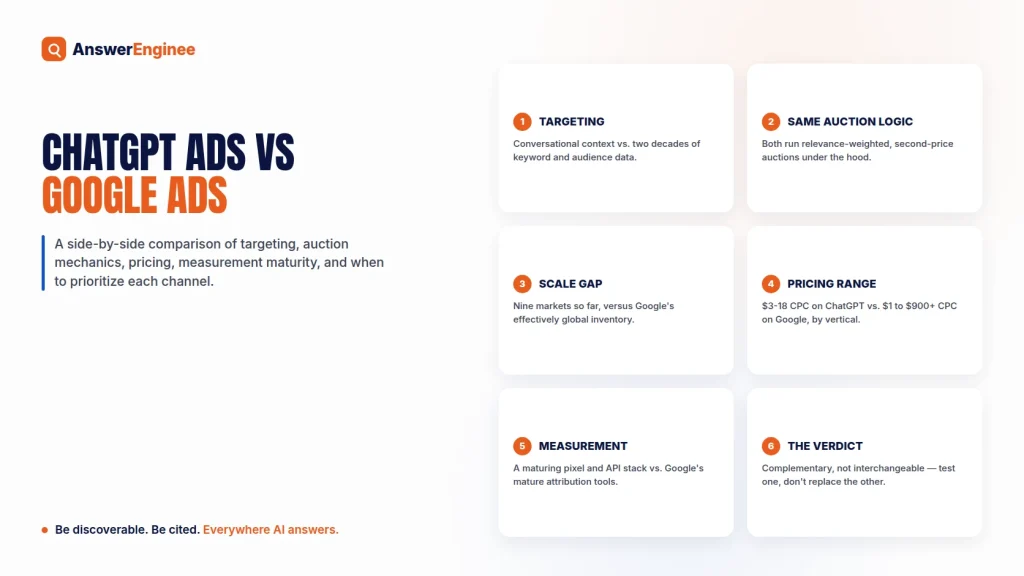
And treating this like a Google Ads keyword campaign trips up a lot of first-time advertisers. There’s no keyword list, no match type, and no query-level targeting. Thinking in topics and conversational context, not keywords, gets better results here. For a broader look at how this channel stacks up against building organic AI visibility instead, see ChatGPT Ads vs. GEO.
What to expect in the first few weeks
Every campaign goes through review before it can serve, so build in a few days of lead time before you need it live. Early performance can also swing more than you’d expect from a mature platform, since the auction, inventory, and your own context hints are all still being refined in real time.
Treat the first two to three weeks as a learning period rather than a final verdict. Adjust context hints, creative, and bids based on what the data shows rather than judging the channel on day one.
When to bring in outside help
The self-serve Ads Manager is built for direct access, so DIY is genuinely possible here. Plenty of small businesses will run a first test entirely on their own.
That said, targeting options and measurement tools are still more limited than on a mature platform like Google Ads, which makes early missteps easy and sometimes expensive. If you’d rather skip the learning curve, or if you’re already stretched thin running other channels, bringing in outside help to set up and monitor that first test can be worth the cost of avoiding a wasted budget.
FAQ
How much does it cost to start advertising on ChatGPT?
There’s no minimum spend on the self-serve Ads Manager. Recommended starting bids are roughly $3 to $5 per click for CPC campaigns, or a default up to $60 CPM for reach-based campaigns, so a small business can test with a modest budget and scale based on results.
Do I need an agency to advertise on ChatGPT?
No. The self-serve Ads Manager is designed for direct access without a managed agency relationship. That said, because targeting options and measurement tools are still more limited than mature platforms like Google Ads, some businesses choose to bring in outside help to avoid early missteps while the platform matures.
What kind of small business benefits most from ChatGPT ads right now?
Businesses whose customers do research-heavy comparison shopping in conversational form, where someone might genuinely ask ChatGPT for recommendations, tend to be the best early fit, provided the business isn’t in an excluded category like political or adult advertising, or a gated category like health and finance that requires extra approval.
How long does campaign approval take?
OpenAI reviews every campaign before it’s eligible to serve, though exact turnaround isn’t published. Build in a few days of lead time before you need a campaign live, and expect gated categories like healthcare or financial services to take longer given the additional case-by-case review.