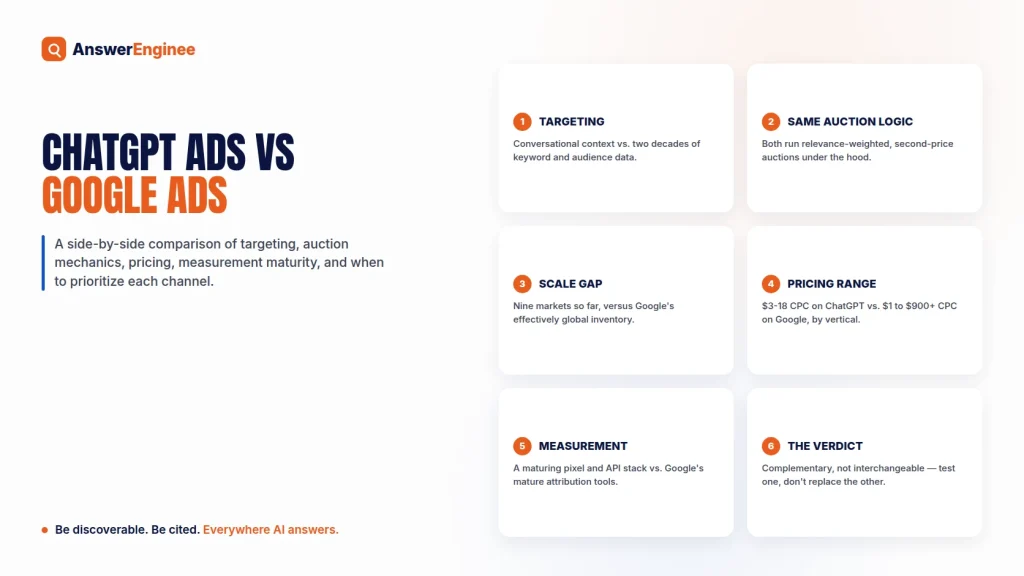
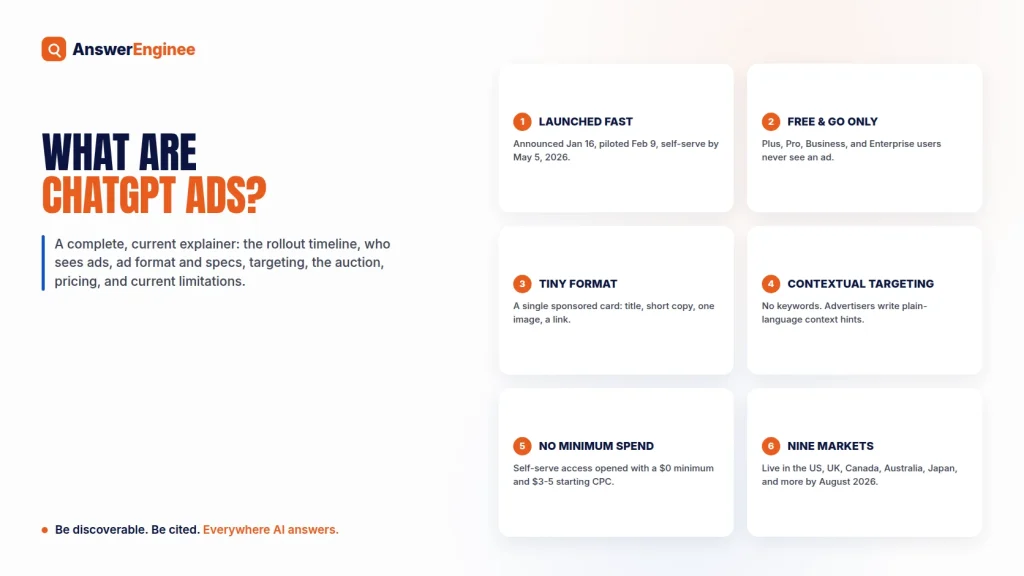
These aren’t competing strategies. Ads provide fast, testable visibility. GEO investment compounds in value across every AI platform your customers use, ChatGPT, Perplexity, Gemini, Claude, and Google AI Overviews, rather than just one.
Here’s what that actually means in practice, and how to decide where to put your first dollar. If you’re weighing whether ads change what ChatGPT says organically in the first place, they don’t, per OpenAI’s own answer-independence policy, so this comparison is really about which lever to pull first, not whether one corrupts the other.
Side by side
| ChatGPT Ads | GEO | |
|---|---|---|
| Cost structure | Fixed cost per impression or click | No per-placement cost; ongoing content investment |
| Speed to visibility | Live within a review cycle | Weeks to months of consistent signal-building |
| Control | Placement guaranteed if you win the auction | Never guaranteed, only made more probable |
| Durability | Ends the moment budget stops | Persists as long as content stays authoritative |
| Reach | Free and ChatGPT Go tier users, in supported markets only | Every ChatGPT tier, plus Perplexity, Gemini, Claude, AI Overviews |
| Measurement | Clicks, impressions, conversions, fairly direct | Citation rate, mention tracking, harder to attribute |
| Risk if you stop | Visibility disappears immediately | Prior content keeps working, though momentum slows |
Speed: ads win this one clearly
A ChatGPT ad campaign can be live within a single review cycle, often days. Write the creative, set the context hints, submit for approval, and you have a real, measurable placement in front of real users. For the exact steps, see how to get a first campaign running.
GEO doesn’t work that fast, and it’s honest to say so upfront. Earning a citation takes weeks or months of consistent content clarity, entity authority, and structured data doing their work quietly in the background. There’s no submit-and-go button for organic AI visibility.
If you need proof of concept this month, ads are the faster path. That’s a genuine advantage, not a consolation prize.
Durability: this is where GEO pulls ahead
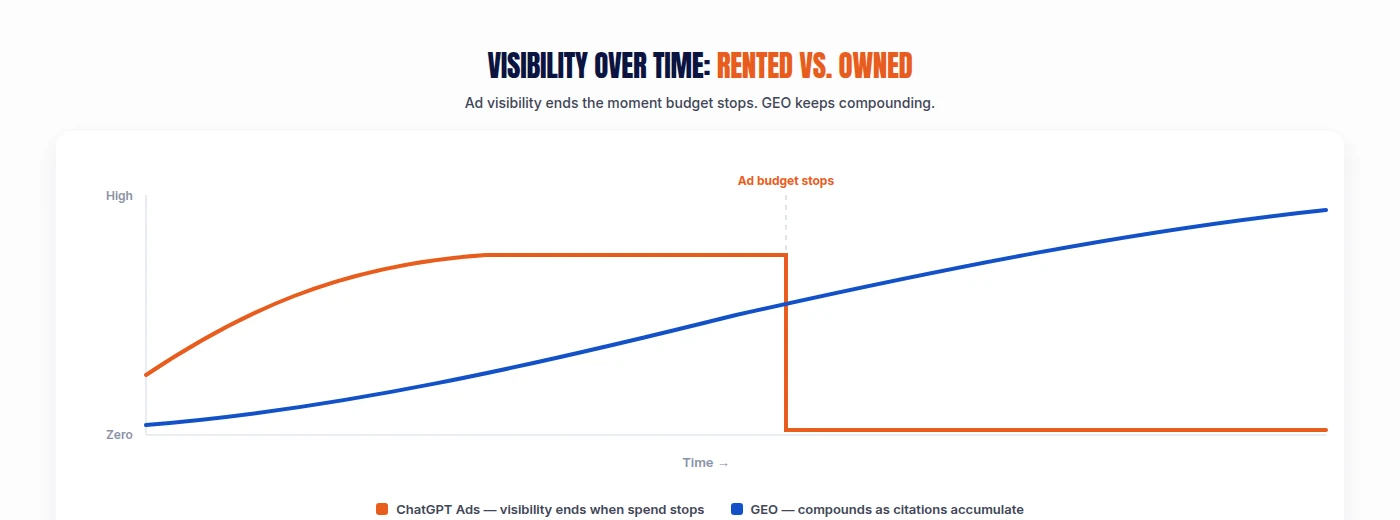
Ad visibility is rented, not owned. The moment a campaign budget runs out, the placement disappears. Nothing carries forward.
A well-structured, authoritative page works differently. Once it’s earning citations, it can keep earning them indefinitely, and it can be cited across multiple AI engines at the same time, at no incremental cost per citation. The same page that gets cited in ChatGPT might also get pulled into a Perplexity answer or a Google AI Overview, without any additional spend.
That compounding is the core case for GEO. It’s slower to build, but it doesn’t evaporate the day you stop paying for it.
Reach: ads have a structural ceiling GEO doesn’t
ChatGPT Ads only reaches Free and ChatGPT Go tier users, and only in markets where the ad program has launched. Plus, Pro, Business, Enterprise, and Education subscribers never see an ad, on any query, in any market.
GEO-earned citations have no such ceiling. A brand cited organically shows up for ChatGPT users on every tier, including the paid subscribers ads structurally cannot reach, and that same underlying content authority extends to Perplexity, Gemini, Claude, and Google AI Overviews as well.
If your buyer is a Plus or Enterprise ChatGPT subscriber, which is common in B2B and higher-consideration purchases, ChatGPT Ads simply cannot reach them today. GEO is the only lever that touches that audience at all.
Control: guaranteed placement vs. probable placement
Ads offer something GEO can’t: a guarantee, conditional on winning the auction. Bid competitively, get approved, and your ad will serve to the audience your context hints target.
GEO offers no such guarantee, ever. The most well-structured, authoritative content improves the odds of citation. It doesn’t lock in a placement the way a won auction does. That uncertainty is real, and it’s the honest tradeoff for the durability and reach GEO offers instead.
A decision framework
Budget-rich, need fast proof of concept: start with ChatGPT Ads. If you need to show a client or a stakeholder measurable AI-channel results in the next few weeks, ads deliver that faster than GEO ever will. Pair the campaign with a real ROI measurement setup from day one.
Budget-constrained, long time horizon: prioritize GEO. If ad spend isn’t there or a purchase decision plays out over months rather than days, the compounding value of durable, cross-platform citation is worth more than a fast but temporary placement.
Most mature brands, resources allow: run both in parallel. Use ad campaign data, what messaging converts, what offers resonate, to sharpen the content you’re building for organic citation. The two channels teach you different things, and each one makes the other more effective.
Two scenarios
A new DTC skincare brand with a modest but real ad budget and no existing content footprint is a strong candidate to start with ChatGPT Ads. There’s no citation history to lean on yet, so paid buys visibility while GEO investment gets underway in parallel, with the ad data informing which product claims and angles actually land.
An established B2B service company with a long sales cycle and a content library already in decent shape is usually better served leading with GEO. Their buyers are more likely to be on ChatGPT’s paid tiers anyway, where ads can’t reach them, and durable citation across multiple AI engines matches how a considered, multi-touch purchase decision actually unfolds. For the mechanics of earning that citation, see how to get brand mentions in AI search engines.
Neither scenario says “only do one.” They say which one earns the first investment.
FAQ
Is it worth running ChatGPT ads if I’m already investing in GEO?
Often yes, as a complementary test. Ads can generate faster signal on which messaging and offers resonate with ChatGPT users, which can then inform the organic content built for GEO. The two channels answer different questions: ads test what converts right now, GEO builds durable presence over time.
Which gives better long-term ROI, ChatGPT Ads or GEO?
GEO tends to compound, since a well-structured, authoritative page can be cited across ChatGPT, Perplexity, Gemini, Claude, and Google AI Overviews simultaneously at no incremental cost per citation, while ad visibility is strictly pay-per-impression or click and stops the moment spend stops. Ads typically win on speed and predictability in the short term.
Can a competitor’s ChatGPT ad spend hurt my organic GEO visibility?
There’s no evidence of that happening. OpenAI states ads don’t influence the model’s answers, so a competitor’s ad budget shouldn’t affect whether your content gets cited organically. The two systems currently operate separately.
Should a small business with a tight budget skip ads entirely and just focus on GEO?
It’s a reasonable choice, especially if your buyers are likely to be on ChatGPT’s paid tiers where ads can’t reach them anyway. GEO doesn’t require ad spend, only content investment, so it’s the more accessible starting point for a business that can’t fund even a modest ad test yet.