That’s the direct answer. If you’re asking this question, though, you probably want more than a company’s own assurance. Fair enough. Here’s what’s actually behind that claim, what real people think of it, and how to check it yourself.
What OpenAI has actually committed to
OpenAI has published a set of named advertising principles, and answer independence sits at the center of them. The commitment is specific: advertiser spend, identity, or campaign activity has no influence on the organic answer ChatGPT generates, because the ad system and the answer-generation system run on separate layers.
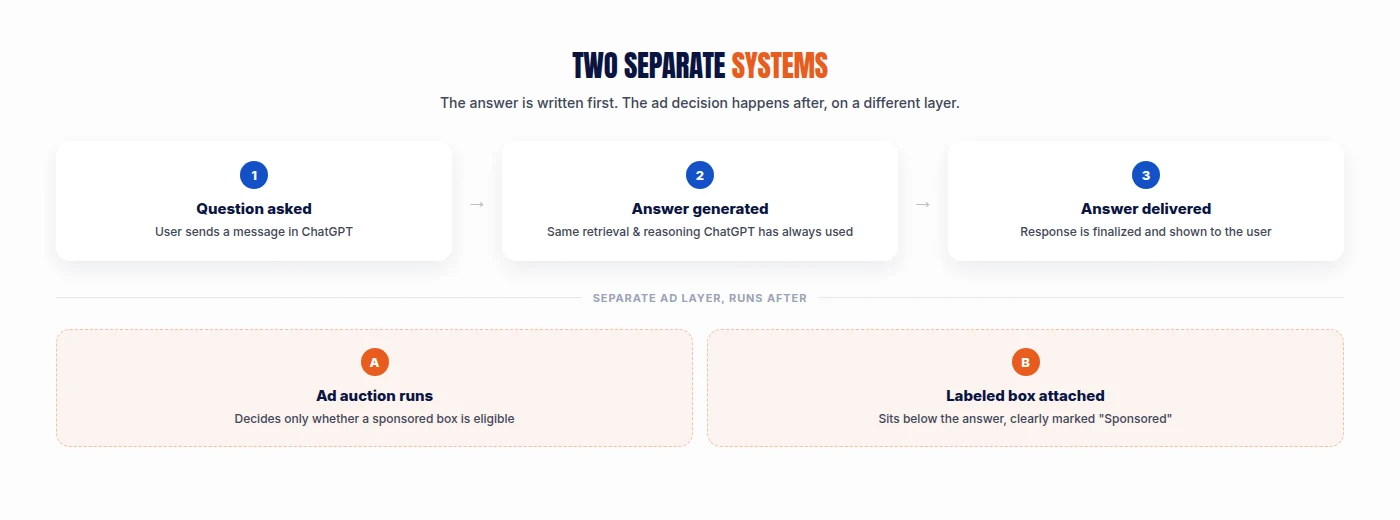
Mechanically, that means the response gets written first, using the same retrieval and reasoning ChatGPT has always used. The ad auction runs afterward, purely to decide whether a relevant sponsored box should be attached underneath. One process doesn’t feed the other.
OpenAI’s advertiser policy backs this up with rules that would be strange to write if the goal were selling influence. Ad copy can’t imply ChatGPT endorsed or recommended a product. Ads can’t mimic the model’s conversational tone or use language suggesting they’re part of the answer rather than sitting next to it. OpenAI has stated plainly that brands cannot buy influence over ChatGPT’s answers.
Why people are skeptical anyway, and why that’s reasonable
The skepticism here isn’t paranoia. It’s pattern recognition. Google made a nearly identical promise in 1998, and over two decades, the visual and structural line between paid and organic results on a search page got measurably thinner.
Survey data backs up how much this bothers people right now. A January 2026 Ipsos survey found 63% of US adults say ads in AI search results would make them trust the output less. A separate Partnercentric survey found 57% say ads in AI chatbots would reduce trust in the advertised brand specifically. Only 24% of consumers currently say AI chatbots offer the least biased recommendations, well behind Reddit at 41%.
Not every data point points the same direction, worth noting. A May 2026 survey by Zappi found 82% of AI assistant users considered advertising inside AI assistants at least as trustworthy as Google Search advertising, and OpenAI has told Reuters its pilot showed no measurable impact on consumer trust metrics. But the same Zappi research found real underlying worry: 33% feared answers would become biased toward advertisers, and 27% worried about commercial influence over recommendations specifically.
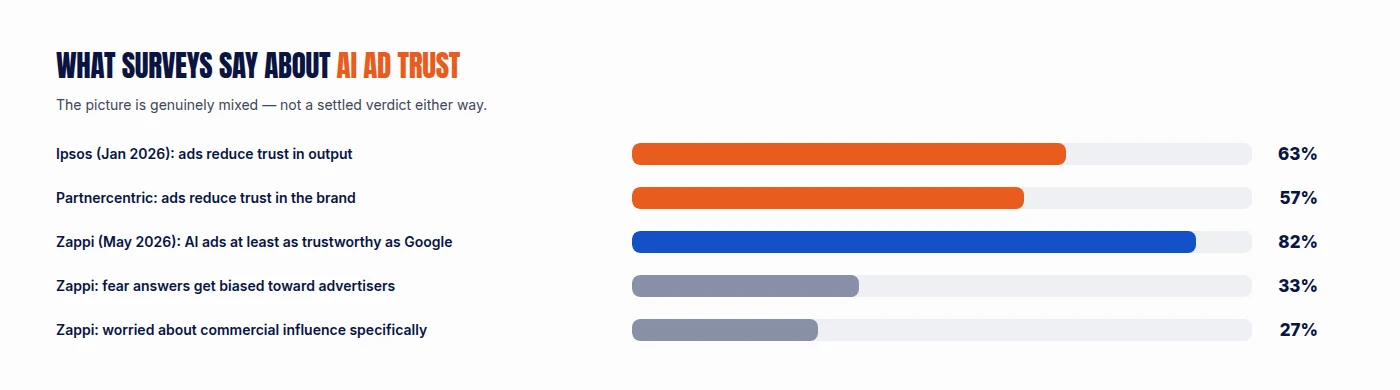
So the honest picture is mixed, not settled. People are watching for exactly the shift this article is asking about, and that watchfulness is a healthy thing, not something to dismiss.
What actually determines whether ChatGPT mentions your brand
None of the ad system changes what has always driven organic mention in ChatGPT. The fundamentals are the same ones that drive citation across any AI answer engine, the same ones covered in more depth in how to get brand mentions in AI search engines.
Content clarity matters most. ChatGPT tends to cite sources that answer a specific question directly, not ones that bury the point under throat-clearing.
Entity consistency matters too. When a business is described the same way, with the same facts, across its own site and the rest of the web, models have an easier time trusting that information enough to repeat it.
Structured data helps, without guaranteeing anything on its own. Schema markup gives the model a cleaner signal about who you are and what you offer.
And genuine topical authority, built over time through consistently useful coverage of a subject, shows up in training data and retrieval results in a way no single optimized page can fake. If you’re weighing whether to build that organic authority instead of, or alongside, running ads, see ChatGPT Ads vs. GEO for the fuller tradeoff.
How to check this yourself
You don’t have to take anyone’s word for it. Ask ChatGPT the same category question across several fresh sessions, spaced out over a few days. Note which brands come up in the actual answer versus which only ever show up in the labeled sponsored box beneath it.
Consistent organic mentions across unrelated sessions are a stronger signal of genuine model-level relevance than anything in a single response. If a brand you know is running ads never appears organically across repeated tries, that’s a data point worth noting. If it does appear organically and consistently, that’s more likely earned relevance than coincidence. For a more structured version of this kind of tracking, see how to track brand mentions in AI search.
This kind of DIY spot-check won’t give you statistical certainty. But it’s a real, repeatable way to build your own evidence rather than relying entirely on a company’s stated policy or a single survey.
What to watch going forward
The structural separation OpenAI has built looks real today, and the evidence so far, including the advertiser policy’s own restrictions on endorsement-style ad copy, supports that. Whether it holds as the ad business matures and starts chasing more revenue, a business OpenAI has told investors it expects to scale toward tens of billions of dollars a year, is a fair thing to keep watching rather than assume settled either way.
Worth knowing: a broader multi-state attorney general inquiry into OpenAI surfaced in mid-2026, covering a range of concerns including ad practices, data handling, and model safety, rather than being narrowly focused on the answer-independence claim specifically. That’s a set of claims under scrutiny, not a finding of wrongdoing, but it’s the kind of development worth checking on periodically if this question matters to you.
FAQ
Has OpenAI said anything specific about keeping ads from influencing answers?
Yes. OpenAI has published “answer independence” as one of its named advertising principles, stating that ads do not influence the answers ChatGPT gives and that responses remain optimized for what’s most helpful to the user, with ads appearing as a separate, clearly labeled element.
How can I check whether a brand seems to be getting favorable treatment?
Ask ChatGPT the same category question across several fresh sessions and note which brands come up organically versus which only show up in the labeled sponsored slot. Consistent organic mentions across unrelated sessions are a stronger signal of genuine model-level relevance than a single response.
What actually determines whether ChatGPT mentions my brand?
The same fundamentals that drive citation across any AI answer engine: content that clearly and directly answers common questions, consistent factual descriptions of your brand across the web, structured data that helps models parse who you are and what you offer, and genuine topical authority in your category.
Do consumers actually trust ads inside ChatGPT?
Survey results are mixed. A January 2026 Ipsos survey found 63% of US adults say ads in AI search results reduce their trust in the output, while a separate Zappi survey found 82% consider AI assistant advertising at least as trustworthy as Google Search advertising. Underlying concern about commercial influence on recommendations shows up consistently across multiple surveys, even where overall trust ratings differ.