Why Do AEO Initiatives Fail?
AEO initiatives typically fail for a small set of repeatable reasons, not because AI search is some unknowable black box. The most common cause is a mismatch between expectations and how AI engines actually work: teams expect visibility within days and abandon the effort when it doesn’t materialize, when the realistic timeline for meaningful results is measured in months.
A second failure mode is spreading effort too thin, trying to get cited for every possible question a business could answer rather than picking a focused list of high-value prompts and going deep on those first. A third, probably the most underestimated, is treating AEO as a purely technical project: adding schema markup and tidying up site structure without addressing whether the underlying content is good enough to be worth citing. Schema helps an AI engine understand your content. It does nothing to make thin, generic content suddenly worth citing over a competitor’s more thorough page.
Mistake 1: Treating Schema as a Checklist Item
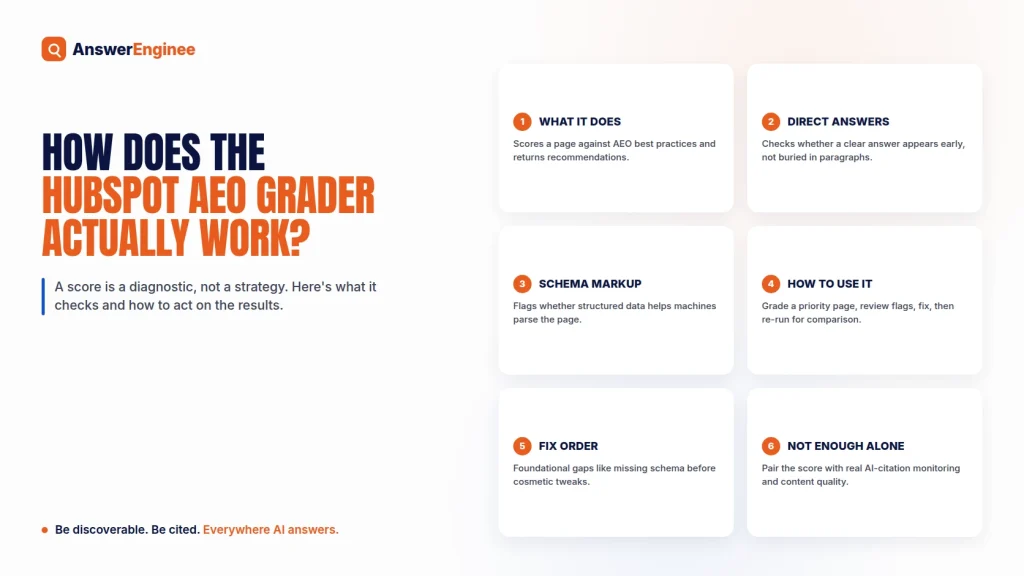
Schema markup, FAQ schema, Article schema, HowTo schema, and the rest, tells AI engines what your content is and how it’s structured. It’s a real and useful signal, but the mistake is treating it as the whole strategy rather than one supporting piece of it. A page with perfect FAQ schema wrapped around three vague, generic sentences will not outcompete a page with no schema at all but genuinely specific content, because structured markup helps an engine find and parse an answer faster. It cannot manufacture an answer that isn’t there.
The fix is straightforward: write the content first, make it genuinely useful, and add schema as a way of formalizing structure that’s already present. If you can’t clearly identify the direct, quotable answer your schema describes, the content needs work before the markup will help.
Mistake 2: Targeting Too Many Prompts at Once
It’s tempting to build a giant spreadsheet of every question a customer might plausibly ask and optimize for all of them at once. In practice, every prompt gets a shallow, rushed page instead of a smaller set getting the depth needed to win a citation.
A more effective approach borrows from how good SEO teams have always prioritized keywords: rank target prompts by business value and how winnable they realistically are, then focus resources on the top 10 to 20 rather than the full 200. A startup that dominates AI answers for its 15 most important buyer questions is in a far stronger position than one getting occasional, inconsistent citations across 150 loosely related ones. It also makes measurement easier: tracking citation rate across 15 well-chosen prompts gives a clear signal, while tracking it across 200 mostly unrealistic targets just buries the signal in noise.
Mistake 3: Ignoring Fact Consistency Across the Web
AI engines pull information from multiple sources when constructing an answer, and inconsistent facts about your own business, different pricing on different pages, an outdated founding date on your About page versus your Crunchbase profile, conflicting product descriptions across your site and directory listings, appear to actively undermine trust signals.
This is a mistake founders rarely think about, since it doesn’t show up as an obvious error on any single page. An AI engine synthesizing information from your site, your listings, and your social profiles at once may be pulling from sources that quietly contradict each other, and that can make it less confident about citing you at all. A practical fix is a periodic fact audit: check whether pricing, location, founding year, and product descriptions actually match across all your public profiles. It’s tedious work, and also one of the more effective things a small team can do that most competitors skip.
Mistake 4: Giving Up Before Authority Builds
AEO results compound over time, similar to how SEO results compound. A site with 5 well-optimized pages on a topic simply doesn’t carry the same weight with AI engines as a site with 40. The businesses that see the strongest results treat the first few months as foundational work, not as a test to judge and abandon quickly.
Businesses that quit early are usually the ones that expected AEO to behave like a paid ad campaign, where you flip a switch and see immediate results. AEO is closer to organic SEO in its pacing, and judging it after three weeks is a bit like judging a new gym routine after one visit. A reasonable minimum commitment is 3 months before drawing firm conclusions, with meaningful, category-wide results often taking longer than that.
Mistake 5: Copying Competitors Instead of Adding Real Depth
It’s common practice to look at what a competitor’s cited page covers and build something similar. The mistake is stopping there. If your page covers exactly the same ground as the one already getting cited, an AI engine has no clear reason to switch its preference to you. Businesses that successfully displace an established competitor usually cover the same core question with more specific, current detail, or answer a related question the existing page misses entirely. Either approach requires understanding the competitor’s content deeply enough to find a real gap, not just enough to imitate its structure.
Mistake 6: Treating All AI Engines the Same
ChatGPT, Perplexity, Google’s AI Overviews, and Gemini don’t source and weight information identically, and a page optimized purely for one engine’s apparent preferences may underperform on another. Teams that assume “AEO” is one undifferentiated target often miss this, optimizing for whichever engine they happen to test in most. The fix is to actually test target prompts across the engines that matter most to your audience, rather than assuming success on one translates automatically to the rest.
Why Is My Content Not Appearing in AEO Results?
If your content isn’t showing up in AI-generated answers, a few likely culprits explain most cases. The direct answer may be buried too deep in the page, several paragraphs of introduction before you actually answer what was asked, when AI engines favor content with the answer stated clearly near the top. Missing schema markup is another common cause, since it makes it harder for an engine to parse what your content is answering. Content that’s simply thinner than what’s already ranking is a third cause, and a robots.txt file blocking AI crawlers can keep otherwise strong pages invisible entirely.
How Do I Know if My AEO Strategy Isn’t Working?
A few signals reliably indicate a strategy isn’t working. If your citation rate on tracked prompts hasn’t moved at all after 3 consistent months, that’s a real warning sign, not just normal variance. If you can’t clearly say which specific prompts you’re targeting and why those particular ones matter, that’s a sign the strategy was never focused enough to succeed. And if you can’t explain what changed between your last content update and now, you’re running a habit, not a strategy, and habits without feedback loops rarely improve.
Frequently Asked Questions
What are common AEO mistakes?
Common AEO mistakes include treating schema markup as a checklist item instead of pairing it with genuinely clear content, targeting too many prompts at once rather than prioritizing the highest-value ones, ignoring fact consistency across the web, and abandoning the effort before topical authority has had time to build. Most stem from unrealistic expectations about how quickly AI search visibility develops, rather than a fundamentally flawed approach.
Why do AEO initiatives fail?
AEO initiatives usually fail from unrealistic timelines, spreading effort across too many low-priority prompts instead of a focused set, or implementing technical fixes like schema markup without improving the underlying content quality those fixes are meant to support. The common thread is treating AEO as a quick technical task rather than an ongoing content and trust-building effort.
Why is my content not appearing in AEO results?
Content often fails to appear because the direct answer is buried too deep in the page instead of stated clearly near the top, because the page lacks proper schema markup, or because the content is thinner than what a competitor already has covering the same topic. A robots.txt file blocking AI crawlers can also keep otherwise strong content from ever being considered.
How do I know if my AEO strategy isn’t working?
Your AEO strategy likely isn’t working if your citation rate has not improved after 3 months of consistent, focused effort, since that’s long enough for a reasonable approach to show some early signal. It’s also a warning sign if you cannot clearly say which specific prompts you are tracking and why they matter, since that usually means the effort was never focused enough to succeed.
Key Takeaways
- Most AEO failures come from predictable, avoidable mistakes rather than anything unique about a particular business.
- Schema markup supports good content, it doesn’t replace it. Write the content first.
- Prioritize 10 to 20 high-value prompts instead of spreading effort across hundreds of low-value ones.
- Keep facts consistent across your website, directory listings, and social profiles. Inconsistency quietly undermines trust signals.
- Give AEO at least 3 months before judging results. It compounds over time like SEO does.
- Different AI engines source and weight information differently, so test target prompts across each one that matters to your audience.