Quick Answer
They are using both.
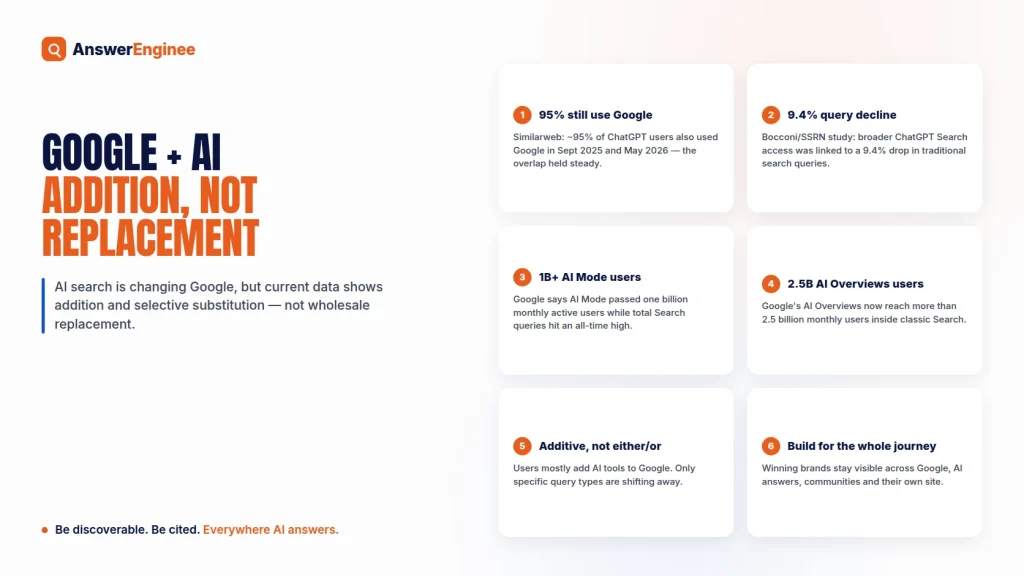
Similarweb’s 2026 Generative AI Landscape data found that 95% of ChatGPT users also used Google in the measured period. More importantly, that overlap reportedly remained at roughly 95% from September 2025 through May 2026 even as generative AI usage grew significantly.
At the same time, Google says its own AI Mode surpassed one billion monthly active users globally and that Search queries reached an all-time high in 2026.
Those data points should change the strategic question.
Instead of asking:
Should we invest in SEO or GEO?
brands should ask:
How do we become discoverable, understandable, credible and preferred across the full research journey—Google, AI assistants, third-party sources and our own website?
SEO remains the foundation for search discoverability, crawlability, authority and demand capture. GEO adds a new layer focused on how generative systems interpret, cite, summarize and recommend brands.
The strongest strategy is not SEO versus GEO.
It is SEO + GEO + brand authority + third-party validation, managed as one search ecosystem.
Why the SEO vs GEO Debate Is Misframed
The SEO industry loves binary debates.
SEO is dead.
AI is replacing Google.
GEO is replacing SEO.
Users will stop clicking websites.
ChatGPT will replace search engines.
These narratives are useful for headlines because they create conflict.
They are less useful for strategy.
The problem is that they assume users behave like technology categories.
They do not.
A real buyer may:
- discover a problem on LinkedIn;
- ask ChatGPT to explain it;
- Google the recommended companies;
- read Reddit discussions;
- visit three vendor websites;
- ask Gemini to compare them;
- search Google for pricing;
- return directly to one brand;
- convert.
Which channel “won”?
That is the wrong question.
Every surface contributed to the decision.
The Data Shows Addition, Not Simple Replacement
Similarweb’s 2026 analysis provides one of the strongest pieces of evidence against the simple replacement narrative.
The company reported that around 95% of ChatGPT’s audience also used Google.
In September 2025, the overlap was roughly 95%.
By May 2026—after substantial growth in generative AI usage—the overlap was still around 95%.
Source: Similarweb
That matters because growth and substitution are not the same thing. It is one of the clearest signals available that ChatGPT users still use Google rather than abandoning it.
If ChatGPT usage increases, there are two possible interpretations:
Substitution
Users move from Google to ChatGPT.
If this were happening at large scale, we would expect the percentage of ChatGPT users also using Google to decline over time.
Addition
Users keep Google and add ChatGPT.
In that scenario, ChatGPT grows while audience overlap with Google remains high.
The Similarweb data currently looks much more like the second pattern.
That does not mean AI search has no effect on Google usage.
It means user adoption is more layered than the replacement narrative suggests.
Google Search Is Also Becoming AI Search
There is another reason SEO vs GEO is increasingly difficult to separate:
Google itself is becoming more conversational and generative.
Google said in May 2026 that AI Mode had surpassed one billion monthly active users globally.
The company also said AI Mode queries had more than doubled every quarter since launch and that overall Search queries reached an all-time high.
Source: Google
Google has also made it easier for users to move from AI Overviews into conversational AI Mode while preserving context.
That creates an increasingly blurred distinction.
A person can:
- use Google;
- receive an AI-generated answer;
- open supporting links;
- continue into AI Mode;
- ask follow-up questions;
- return to traditional results.
Is that SEO?
Is it GEO?
It is both.
SEO and GEO Are Becoming Layers of the Same Discovery System
Traditional SEO and GEO have different optimization targets.
But they share a large foundation.
SEO Optimizes For
- crawling;
- indexing;
- ranking;
- relevance;
- authority;
- organic clicks;
- conversions.
GEO Adds Focus On
- AI retrieval;
- entity understanding;
- answer inclusion;
- citation;
- recommendation;
- machine-readable clarity;
- third-party corroboration.
These are not mutually exclusive.
A technically broken website will struggle in both.
A vague brand entity can create problems in both.
Weak authority hurts both.
Thin, generic content is weak in both.
Strong first-party information helps both.
This is why moving budget from “SEO” to “GEO” without defining the actual work is often meaningless.
The Same Search Asset Can Support Both
Consider a strong B2B product page.
Traditional SEO benefits from:
- descriptive title;
- crawlable content;
- internal links;
- authority;
- structured data;
- keyword relevance.
GEO benefits from:
- clear product definition;
- detailed features;
- explicit use cases;
- extractable facts;
- evidence;
- entity clarity.
Most of those improvements help both.
The same applies to:
- service pages;
- comparison pages;
- documentation;
- original research;
- case studies;
- product specifications.
This overlap should shape investment decisions.
Users Use Different Systems for Different Jobs
The real difference between Google and AI search is often not audience.
It is task.
Users may prefer different tools depending on what they are trying to accomplish.
Google Is Strong for Navigation
Examples:
- HubSpot login;
- Nike website;
- nearest dentist;
- Amazon;
- Salesforce pricing.
The user already knows where they want to go.
Google Is Strong for Current Discovery
Examples:
- restaurants nearby;
- local services;
- breaking news;
- current prices;
- product availability;
- websites.
AI Assistants Are Strong for Synthesis
Examples:
- explain this concept;
- summarize these options;
- compare approaches;
- turn research into a decision framework;
- analyze tradeoffs.
AI Assistants Are Strong for Complex Questions
Example:
Which CRM would be best for a 25-person B2B sales team using Salesforce, Slack and Gong, where the biggest problem is pipeline forecasting rather than lead generation?
That would be awkward as a traditional keyword search.
It is natural as a conversational prompt.
Google and AI Both Support Comparison
This is where the journeys overlap.
A buyer might ask AI:
Compare Product A and Product B.
Then Google:
Product A reviews.
Then Reddit:
Product A complaints.
Then AI:
Based on these concerns, which is safer for my use case?
The platforms are not competing for one isolated query.
They are sharing the buying journey.
Search Journeys Are Becoming Loops, Not Funnels
Traditional marketing diagrams show:
Awareness → Consideration → Conversion
Real behavior is messier.
Google itself now describes customer journeys as fluid loops where consumers are simultaneously:
- searching;
- scrolling;
- streaming;
- shopping.
Source: Think with Google
Generative AI accelerates this.
A buyer can move rapidly between:
- problem discovery;
- research;
- comparison;
- validation;
- transaction.
They can also move backward.
Example:
Step 1: AI Discovery
What tools can automate customer onboarding?
Step 2: Google Validation
Search the suggested brands.
Step 3: Website Evaluation
Read product pages.
Step 4: Reddit Validation
Check user complaints.
Step 5: AI Comparison
Ask which product fits the company’s exact requirements.
Step 6: Google Transaction
Search for pricing or the official demo page.
This is a search loop.
AI Can Create New Google Searches
One underappreciated effect of AI discovery is that it can create branded demand.
Imagine a user has never heard of:
Company X.
ChatGPT recommends Company X.
The user then searches:
Company X reviews
or:
Company X pricing
or:
Company X vs Company Y.
The AI interaction generated a Google search.
Traditional analytics may credit Google with the visit.
But AI influenced the demand.
This makes last-click measurement increasingly misleading.
Google Can Also Feed AI Discovery
The relationship works in the other direction.
AI systems often retrieve information from the open web.
Strong SEO can improve:
- discoverability;
- crawlability;
- relevance;
- authority;
- page architecture.
Those qualities can make pages stronger candidates for retrieval.
A 2026 Ahrefs study analyzing 1.4 million ChatGPT prompts found that cited pages were more semantically aligned with ChatGPT’s generated fan-out queries than non-cited retrieval candidates.
Source: Ahrefs
That does not mean:
Google rankings directly determine ChatGPT citations.
It does mean the underlying search and information architecture still matters.
SEO can support GEO.
GEO Can Also Improve SEO
Good GEO work often forces brands to fix weaknesses that traditional SEO tolerated.
Examples:
Clearer Entity Definitions
Instead of:
Transform your future.
write:
Acme is a B2B revenue intelligence platform for enterprise sales teams.
That improves both user and machine understanding.
Better First-Party Evidence
Publish:
- benchmarks;
- methodologies;
- case studies;
- product specifications.
These can earn:
- citations;
- links;
- search visibility;
- AI visibility.
Better Commercial Pages
Service and product pages become more specific.
That improves both:
- conversion;
- search relevance.
Better Third-Party Authority
Digital PR, reviews and industry coverage strengthen brand credibility across both traditional and AI discovery.
This is why SEO and GEO should be integrated operationally.
Why “SEO Budget vs GEO Budget” Is Often the Wrong Accounting Model
Imagine a company spends $20,000 per month on SEO.
It considers shifting $5,000 into GEO.
What exactly moves?
If the GEO work involves:
- improving product pages;
- publishing original research;
- technical crawlability;
- digital PR;
- structured data;
- internal linking;
- entity consistency;
those were already legitimate SEO activities.
Creating two budget buckets can produce double counting. This is exactly the kind of accounting confusion covered in our breakdown of how to structure an SEO budget for AI search.
A better model separates the work into three categories.
Shared Search Foundation
Benefits both SEO and GEO.
Examples:
- technical SEO;
- site architecture;
- internal linking;
- authority;
- content quality;
- product/service-page clarity;
- original research;
- structured data;
- brand/entity consistency.
Traditional Search-Specific Work
Examples:
- SERP CTR optimization;
- traditional rank tracking;
- local pack optimization;
- Google Business Profile work;
- search-feature optimization.
AI-Specific Incremental Work
Examples:
- prompt research;
- AI citation tracking;
- answer monitoring;
- AI share of voice;
- source-gap analysis;
- LLM-specific technical access;
- generative answer testing.
This is a much more useful budgeting framework.
SEO vs GEO: What Actually Changes?
The best way to compare SEO and GEO is not:
Which is better?
Instead ask:
What additional work does GEO require beyond strong SEO?
| Area | SEO | GEO |
|---|---|---|
| Crawlability | Critical | Critical |
| Indexability | Critical | Often relevant |
| Content relevance | Critical | Critical |
| Entity clarity | Important | Very important |
| Authority | Critical | Critical |
| Internal links | Important | Important |
| Structured data | Useful | Useful |
| Original evidence | Valuable | Highly valuable |
| External citations | Backlinks/authority | Corroboration/citation ecosystem |
| Rank tracking | Core KPI | Not enough |
| Prompt tracking | Rare | Core |
| Citation tracking | Rare | Core |
| Brand mentions | Helpful | Core KPI |
| Answer accuracy | Limited role | Critical |
| Source monitoring | Helpful | Critical |
The foundation overlaps.
The measurement and answer-selection layer expands.
Why Traffic Is Becoming a Less Complete Metric
Traditional SEO measurement heavily emphasizes:
- sessions;
- clicks;
- CTR;
- conversions.
AI answers can influence a buyer without generating an immediate click.
Example:
ChatGPT:
The strongest options are Company A, Company B and Company C.
The user later Googles:
Company B.
ChatGPT receives no referral credit.
But it influenced the shortlist.
This does not mean traffic no longer matters.
It means traffic alone cannot represent all search influence.
GEO Needs New KPIs
Track:
Brand Mention Rate
How often does your brand appear for relevant prompts?
Citation Rate
How often is your site cited?
Cited URL Mix
Which pages are cited?
Share of Voice
How often does your brand appear relative to competitors?
Recommendation Rate
How often is the brand positively recommended?
Accuracy
Is the AI description correct?
Third-Party Source Share
Which external domains are shaping the answer?
Branded Search
Does AI visibility correlate with increased branded demand?
Commercial Outcomes
Track:
- leads;
- demos;
- purchases;
- pipeline;
- revenue.
This produces a better picture of influence.
SEO Metrics Still Matter
Do not overcorrect.
Continue tracking:
- rankings;
- impressions;
- clicks;
- organic traffic;
- conversions;
- crawl/indexation;
- backlinks.
Why?
Because Google remains enormous.
Similarweb reported that traditional search still reached a much larger global audience than AI chatbot platforms in its 2026 landscape analysis.
Source: Similarweb
The correct response to AI growth is not abandoning mature demand channels.
It is expanding measurement.
The 95% Overlap Statistic Does Not Mean AI Is Unimportant
This requires careful interpretation.
The Similarweb statistic does not mean:
95% of ChatGPT users prefer Google.
It does not mean:
95% of ChatGPT queries are duplicated on Google.
It does not mean:
ChatGPT has no effect on search volume.
It means:
A very large share of ChatGPT users also use Google during the measured period.
That is audience overlap.
Behavior inside that audience can still change.
A person may use Google 30% less after adopting ChatGPT while still qualifying as a Google user.
Therefore:
High overlap proves coexistence more strongly than it proves unchanged behavior.
That nuance matters.
AI Search Can Reduce Some Queries Without Replacing Google
This is not contradictory.
Suppose someone used to search Google ten times for a research task.
Now they ask ChatGPT three questions and use Google five times.
Google query volume for that task has fallen.
But the person still uses Google.
This is why the idea that AI search is additive, not a replacement for Google, and the idea that AI changes Google behavior, can both be true at the same time.
The search ecosystem is being redistributed at the query level before it is being replaced at the user level.
Google’s Own AI Growth Makes the SEO/GEO Divide Even Less Useful
Google is integrating AI directly into Search.
In May 2026, Google announced:
- AI Mode had passed one billion monthly users;
- Search queries were at an all-time high;
- AI Mode questions were substantially longer than traditional search;
- users were increasingly using multimodal queries.
Source: Google
A user in Google can now engage in behavior that looks much more like ChatGPT.
That means a company can technically be optimizing for:
Google SEO
while also needing:
generative answer visibility inside Google.
The terminology is becoming less useful than the customer journey.
Replace “SEO vs GEO” With Search-Everywhere Optimization
The better strategic model is Search Everywhere Optimization.
Not as another acronym.
As an operating principle.
Your brand needs to be strong wherever users investigate the problem.
That includes:
Search Engines
- Google;
- Bing.
AI Assistants
- ChatGPT;
- Gemini;
- Perplexity;
- Claude;
- Copilot.
Communities
- Reddit;
- forums;
- specialist groups.
Review Platforms
- G2;
- Capterra;
- Trustpilot;
- industry-specific sites.
Marketplaces
- Amazon;
- app marketplaces;
- partner directories.
Your Own Website
- articles;
- product pages;
- service pages;
- documentation;
- research;
- case studies.
The goal is not to dominate every surface.
It is to ensure the brand is consistently represented across the high-value research path.
The Five-Layer Search-Everywhere Framework
Use this framework instead of SEO vs GEO.
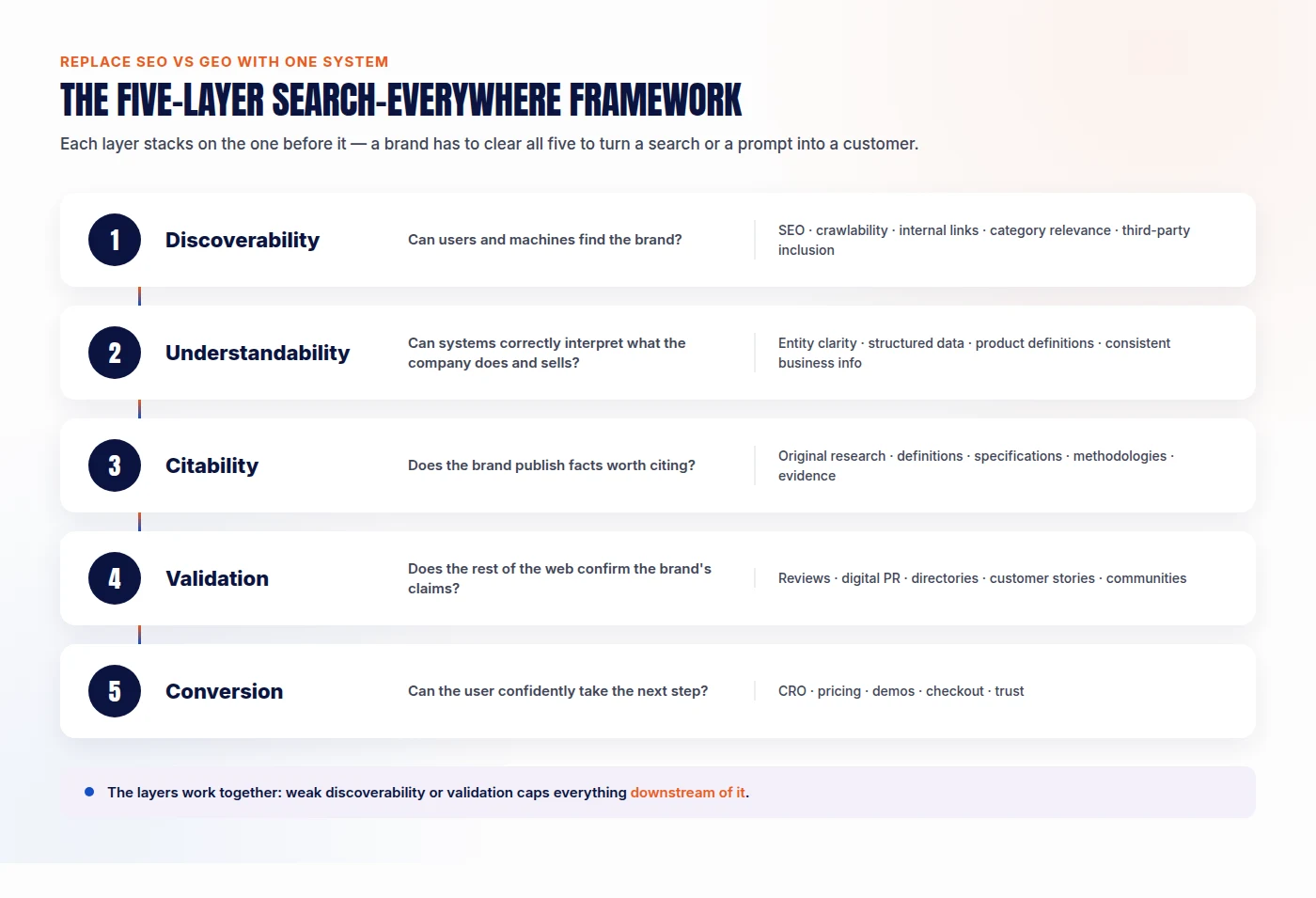
Layer 1: Discoverability
Can users and machines find the brand?
Optimize:
- SEO;
- crawlability;
- internal links;
- category relevance;
- third-party inclusion.
Layer 2: Understandability
Can systems correctly interpret:
- what the company does;
- what products it sells;
- who it serves;
- where it operates?
Optimize:
- entity clarity;
- structured data;
- product/service definitions;
- consistent business information.
Layer 3: Citability
Does the brand publish facts worth citing?
Optimize:
- original research;
- clear definitions;
- product specifications;
- methodologies;
- evidence;
- expert content.
Layer 4: Validation
Does the rest of the web confirm the brand’s claims?
Optimize:
- reviews;
- digital PR;
- directories;
- customer stories;
- industry coverage;
- communities.
Layer 5: Conversion
Can the user confidently take the next step?
Optimize:
- CRO;
- product pages;
- pricing;
- demos;
- checkout;
- trust.
This model aligns SEO and GEO around business outcomes.
How to Build an Integrated SEO + GEO Content Strategy
1. Map Buyer Questions
Collect questions from:
- Search Console;
- keyword research;
- sales calls;
- customer support;
- Reddit;
- reviews;
- AI prompts.
2. Classify the Journey
Label each question:
- awareness;
- discovery;
- evaluation;
- validation;
- transaction.
3. Identify the Best Content Type
Examples:
Educational
Use:
- articles;
- guides;
- research.
Product Facts
Use:
- product pages;
- documentation.
Service Evaluation
Use:
- service pages;
- case studies.
Comparison
Use:
- comparison pages;
- third-party lists;
- reviews.
Validation
Use:
- customer reviews;
- communities;
- independent coverage.
4. Optimize the Owned Source
Make it:
- clear;
- specific;
- crawlable;
- authoritative;
- evidence-rich.
5. Strengthen External Validation
Earn visibility on the sources buyers already trust.
6. Track Both Search and AI Outcomes
Do not use one dashboard for everything.
Track:
SEO
- impressions;
- rankings;
- clicks;
- organic conversions.
GEO
- mentions;
- citations;
- share of voice;
- recommendations;
- answer accuracy.
Then connect both to revenue.
A 100-Point SEO + GEO Readiness Score
This is a strategic audit framework, not an algorithm.
Technical Foundation — 20 Points
- Crawlability: 4
- Indexability: 4
- Site architecture: 4
- Performance: 4
- Structured data quality: 4
Content and Intent — 20 Points
- Search intent coverage: 4
- Buyer-stage coverage: 4
- Commercial pages: 4
- Information depth: 4
- Content freshness: 4
Entity Clarity — 20 Points
- Brand definition: 4
- Product/service categories: 4
- Organization consistency: 4
- Expert identity: 4
- Supporting profiles: 4
Authority and Validation — 20 Points
- Backlinks: 4
- Digital PR: 4
- Reviews: 4
- Third-party mentions: 4
- Original evidence: 4
Measurement — 20 Points
- SEO tracking: 4
- AI prompt tracking: 4
- Citation monitoring: 4
- Brand share of voice: 4
- Commercial attribution: 4
Score Interpretation
| Score | Assessment |
|---|---|
| 0–39 | Fragile search presence |
| 40–59 | Traditional foundation only |
| 60–74 | Emerging cross-channel visibility |
| 75–89 | Strong SEO + GEO system |
| 90–100 | Advanced search-everywhere operation |
A high score does not guarantee rankings or AI citations.
It indicates a stronger information and visibility system.
What Brands Should Do Now
Keep Funding SEO
Google still captures enormous search demand.
Do not abandon it because AI is growing.
Add AI Measurement
Start tracking:
- ChatGPT;
- Gemini;
- Perplexity;
- Google AI Mode.
Improve Commercial Pages
Do not keep all useful facts inside blogs.
Strengthen:
- product pages;
- service pages;
- pricing;
- comparisons;
- documentation.
Publish Original Information
Generic content is increasingly substitutable.
Invest in:
- research;
- data;
- frameworks;
- expert analysis;
- proprietary experience.
Build External Authority
AI systems frequently rely on third-party sources.
Invest in:
- PR;
- reviews;
- directories;
- industry coverage;
- genuine communities.
Integrate Teams
SEO, content, PR, product marketing, ecommerce and brand teams increasingly influence the same search journey.
The siloed model is becoming inefficient.
Common SEO vs GEO Mistakes
Mistake 1: Moving Budget Based on Headlines
Do not react to:
SEO is dead.
Use your customer data.
Mistake 2: Treating GEO as an Entirely New Discipline
Much GEO work builds on strong SEO.
Mistake 3: Treating GEO as Just Content Formatting
GEO includes:
- entities;
- authority;
- third-party sources;
- commercial pages;
- measurement.
Mistake 4: Ignoring Google AI Features
AI search is increasingly embedded inside Google itself.
Mistake 5: Measuring Only AI Referral Traffic
AI can influence branded search and later conversions without a direct click.
Mistake 6: Measuring Only Google Traffic
That misses AI-assisted research.
Mistake 7: Optimizing Every Surface Equally
Prioritize the platforms and query types your audience actually uses.
Mistake 8: Turning GEO Into an Acronym War
The customer does not care whether a tactic is called SEO, AEO, GEO or AI SEO.
They care whether they find the right answer and trust the brand.
FAQ
Is GEO replacing SEO?
No. GEO adds optimization for generative retrieval, citations, recommendations and AI answer visibility, but it shares a large foundation with traditional SEO. Search engines also continue to generate substantial demand.
Do ChatGPT users still use Google?
Yes. Similarweb’s 2026 analysis found that roughly 95% of ChatGPT users also used Google in the measured period.
Does the 95% overlap mean ChatGPT has not affected Google?
No. Audience overlap does not measure query frequency. A person can still use Google while shifting some research activity to ChatGPT.
Should companies invest in SEO or GEO?
Most companies should invest in both, but not as completely separate programs. Fund the shared technical, content and authority foundation first, then add AI-specific prompt research, citation tracking and answer monitoring.
Can SEO help GEO?
Yes. Strong crawlability, content relevance, authority, internal linking, page architecture and clear titles can improve the information environment from which AI systems retrieve sources.
Can GEO improve SEO?
Yes. GEO often encourages clearer entities, stronger first-party evidence, better commercial pages, original research and stronger third-party authority—all of which can also support traditional search.
Is Google becoming an AI search engine?
Google has integrated AI Overviews and AI Mode deeply into Search. In 2026, Google said AI Mode had surpassed one billion monthly active users globally.
Should brands stop measuring organic traffic?
No. Organic traffic remains an important performance metric. Brands should add AI visibility metrics rather than replace established SEO measurement.
What metrics should I use for GEO?
Track brand mentions, citations, cited URLs, share of voice, competitor visibility, recommendations, answer accuracy, third-party sources and eventual commercial outcomes.
What is Search Everywhere Optimization?
It is the strategy of optimizing a brand’s discoverability, understanding, credibility and conversion across search engines, AI assistants, communities, review platforms and other places customers research decisions.
Bottom Line
SEO vs GEO is the wrong debate because the customer has already moved beyond it.
People are not neatly dividing themselves into “Google users” and “AI users.” Similarweb’s 2026 data shows that the overwhelming majority of ChatGPT users still use Google, while Google’s own AI experiences are growing inside Search itself. At the same time, customer journeys increasingly move between AI assistants, search engines, reviews, communities, third-party publications and brand websites before a decision is made.
The strategic implication is clear: brands should stop treating SEO and GEO as competing ideologies and start managing them as connected layers of the same discovery system.
SEO remains essential for crawlability, rankings, demand capture and search authority. GEO expands the job to include machine understanding, citations, recommendations, prompt visibility and third-party corroboration. Much of the work—technical quality, clear entities, strong commercial pages, original evidence and authority—benefits both.
The companies most likely to win will not be those that choose SEO over GEO or GEO over SEO. They will be the companies that build a search presence strong enough to survive the user’s entire research loop: discoverable in Google, understandable to AI, validated across the web and persuasive when the buyer finally reaches the brand.