A better approach is to separate search investment into three buckets:
- Shared SEO + AI search foundation — technical SEO, commercial-page quality, entity clarity, authority, original research, internal linking and structured data.
- Traditional-search-specific work — keyword rankings, SERP optimization, local search, Google Business Profile, organic CTR and conventional search reporting.
- AI-search-specific work — prompt tracking, AI share of voice, citation/source analysis, answer accuracy, AI competitor monitoring and model-specific testing.
The reason is that SEO and GEO overlap far more than most budget discussions acknowledge.
AI search is important enough to deserve dedicated investment. Similarweb’s 2026 Generative AI Landscape report says worldwide visits to generative AI platforms reached 9.5 billion per month in May 2026, up 70% year over year. Similarweb’s downstream attribution research also reports that users exposed to an AI recommendation are around 2.5 times more likely to visit that brand, while 55.9% of AI-influenced traffic arrives via search rather than directly from the AI platform.
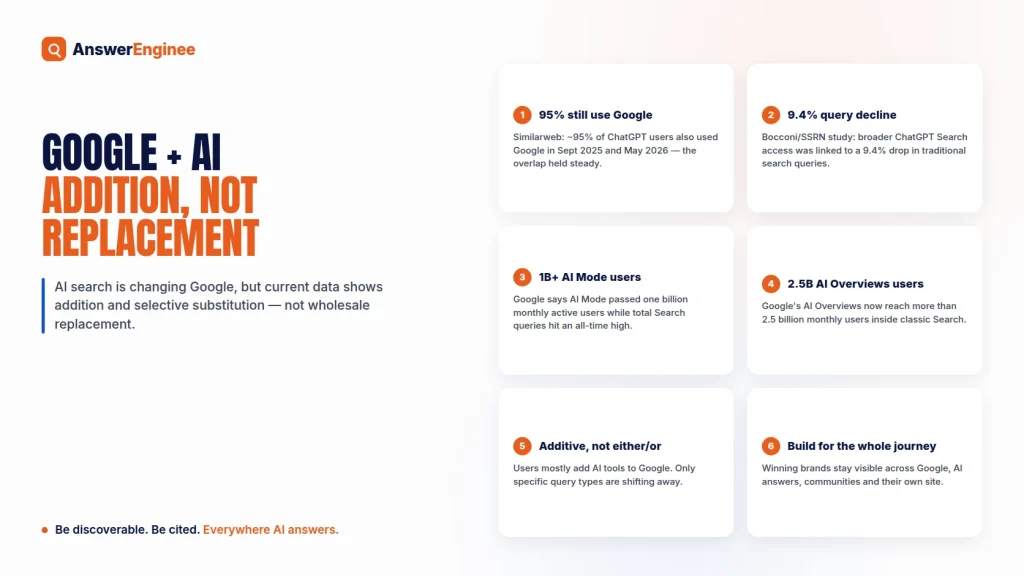
At the same time, Google says Search queries reached an all-time high in 2026, AI Mode surpassed one billion monthly users, and AI-powered search features are increasing overall search usage.
The strategic conclusion is:
Brands should add AI-search measurement and optimization where buyer behavior justifies it, but they should avoid weakening the SEO foundation that still captures discovery, validation and downstream demand.
The right question is not “How much SEO budget should we move to GEO?”
It is:
Which search investments are shared, which AI-specific gaps are currently costing us visibility, and which channel produces the next best marginal return?
Why This Budget Debate Is Happening Now
Search behavior is changing fast enough that marketing teams are being forced to rethink allocation.
A few years ago, search budgets were comparatively simple.
Companies typically invested in:
- SEO
- paid search
- content
- digital PR
- local SEO
- ecommerce search
Now another category has appeared:
- GEO
- AEO
- AI SEO
- AI search optimization
- LLM visibility
- AI citation optimization
That creates a predictable executive question:
Where does the money come from?
The easiest answer is:
Take it from SEO.
But that assumes AI search and SEO are separate systems competing for the same budget.
In practice, much of the work is shared — a point worth grounding before any reallocation decision, since SEO and GEO users are largely doing both rather than choosing one channel over the other.
The First Mistake: Treating SEO and GEO as Separate Cost Centers
Suppose a brand spends money to improve a product page.
The work includes:
- better title and headings
- clearer product definition
- richer specifications
- internal linking
- structured data
- stronger evidence
- comparison information
Is that SEO?
Yes.
Is it also GEO?
Yes.
Now suppose the company publishes original industry research and earns:
- backlinks
- press mentions
- third-party citations
- AI references
Is that SEO?
Yes.
Is it GEO?
Also yes.
This is why a budgeting conversation framed as:
SEO budget vs GEO budget
can create false accounting.
The real question is:
Which activities are shared infrastructure and which are genuinely incremental AI-search costs?
A Better Three-Bucket Budget Model
Instead of dividing everything into SEO and GEO, use three buckets.
Bucket 1: Shared Search Foundation
These investments support both traditional and generative search.
Examples:
- technical SEO
- crawlability
- site architecture
- content quality
- internal linking
- entity clarity
- product-page optimization
- service-page optimization
- original research
- digital PR
- reviews
- structured data
- authoritative third-party mentions
For most brands, this should remain the largest bucket.
Why?
Because AI search does not eliminate the need for:
- accessible pages
- clear information
- authority
- evidence
- accurate entities
In many cases, AI search makes these fundamentals more valuable.
Bucket 2: Traditional Search-Specific Investment
This includes work that is primarily tied to conventional search surfaces.
Examples:
- keyword rank tracking
- organic CTR testing
- SERP feature optimization
- local pack optimization
- Google Business Profile
- traditional Search Console analysis
- landing-page optimization for known search demand
These activities still matter because Google remains a major discovery and conversion channel.
Google said in May 2026 that:
- AI Mode surpassed one billion monthly users
- AI Mode queries more than doubled every quarter since launch
- total Search queries reached an all-time high
Source: Google
That is not evidence that every website is receiving more organic traffic.
But it is evidence that Google itself remains deeply relevant — search and AI answers are proving additive rather than a straight replacement, as explored in AI search vs. Google: additive, not replacement.
Bucket 3: AI-Specific Incremental Investment
This is where genuinely new spend belongs.
Examples:
- AI prompt research
- brand-mention tracking
- AI share-of-voice measurement
- citation monitoring
- source analysis
- sentiment tracking
- competitor prompt analysis
- AI answer accuracy audits
- model-specific testing
- technical access audits for AI crawlers
- Merchant Center AI visibility analysis for ecommerce
This is the budget category most companies did not need several years ago.
The goal should be to fund this layer without unnecessarily dismantling the shared foundation.
Why AI Search Now Deserves Real Budget
The case for investing in AI search is no longer theoretical.
Similarweb’s 2026 Generative AI Landscape report says visits to generative AI platforms reached approximately 9.5 billion per month in May 2026, up 70% year over year.
Source: Similarweb
That is meaningful audience growth.
AI platforms are becoming part of:
- product discovery
- vendor research
- comparison
- problem solving
- education
- decision support
Ignoring those surfaces entirely now creates a measurable visibility risk.
AI Visibility Can Influence Visits Even Without a Direct AI Click
One of the biggest challenges in AI search budgeting is attribution.
A buyer can see your brand in ChatGPT and later reach your site through Google — a sequence that shows up constantly in behavior data, since ChatGPT users still use Google for the follow-up research and verification step.
If you look only at AI referral traffic, the AI platform appears to have contributed nothing.
Similarweb’s 2026 downstream-impact research attempts to measure this hidden influence.
The company reports that:
- users exposed to an AI recommendation were roughly 2.5 times more likely to visit the recommended brand
- 55.9% of AI-influenced traffic arrived through search
- AI-influenced visitors showed about 2× deeper engagement
Source: Similarweb
This has a major budgeting implication.
If you measure AI only by direct referral traffic, you can underfund AI search.
If you treat every downstream branded search as an SEO win, you can over-credit SEO.
The two channels can work sequentially.
AI Search Can Create Demand That SEO Later Captures
Consider this journey:
Step 1
User asks ChatGPT:
Best fractional CFO firms for a Series A SaaS company.
Step 2
The AI recommends three firms.
Step 3
The buyer searches Google:
Firm A reviews
Step 4
The buyer visits the firm’s website.
Step 5
The lead converts.
Standard analytics may show:
Source: Google organic.
But the initial brand discovery happened in AI.
This is why budget attribution needs to move beyond last click.
SEO Can Also Feed AI Visibility
The relationship works both ways.
AI systems frequently retrieve information from the web.
Strong SEO can improve:
- crawlability
- page relevance
- titles
- information architecture
- authority
- internal linking
- source discoverability
Similarweb’s 2026 rank-tracking guidance explicitly recommends measuring organic rankings and AI visibility together because the two channels share the same content foundation even though they surface different outcomes.
Source: Similarweb
This reinforces the case against blindly cutting SEO.
A weak SEO foundation can also weaken your AI information environment.
The Budget Decision Should Be Based on Marginal Return
Marketing teams often ask:
What percentage should we spend on GEO?
There is no universal percentage.
The better question is:
What does the next $10,000 accomplish?
If an extra $10,000 in SEO would:
- fix major crawl issues
- improve high-converting service pages
- resolve indexation problems
while the same money in AI search would fund:
- a reporting dashboard
- prompt monitoring
- minor content rewrites
the SEO investment probably has higher marginal value.
But if SEO is already mature and the brand is:
- absent from high-value AI prompts
- frequently excluded from recommendations
- inaccurately described
- losing AI share of voice to competitors
incremental AI-search investment may have greater upside.
Budget should follow the constraint, not the trend.
When Brands SHOULD Increase AI Search Investment
Several situations justify meaningful incremental spend.
1. AI Is Already Part of the Buying Journey
This is especially likely for:
- B2B SaaS
- professional services
- software
- technology
- financial products
- high-consideration ecommerce
- travel
- education
If customers use AI to:
- compare
- shortlist
- research
- validate
AI visibility has commercial value.
2. Competitors Dominate Relevant Prompts
Suppose you test 100 commercial prompts and find:
- competitor A appears in 72
- competitor B appears in 61
- your brand appears in 18
That is a real visibility gap.
Budget can be directed toward:
- missing sources
- commercial pages
- third-party authority
- content gaps
- product data
3. AI Is Creating Branded Search
If brand demand rises after AI exposure, AI search is contributing upstream value.
This is where improved attribution can justify more investment.
4. Traditional SEO Is Mature
A company ranking strongly across its core commercial topics may find diminishing returns in additional conventional content production.
The next marginal dollar might work harder in:
- prompt research
- AI measurement
- third-party visibility
- original data
- brand mentions
5. The Category Is Comparison-Heavy
AI assistants are well suited to:
- “best X”
- X vs Y
- alternatives
- recommendations
- product research
Brands in comparison-heavy categories have greater exposure to AI shortlist formation.
6. Your Brand Is Frequently Misrepresented
If AI systems give incorrect information about:
- pricing
- products
- services
- locations
- features
that is an information-quality problem worth fixing.
When Traditional SEO Should Still Dominate
There are also cases where conventional SEO should remain the primary investment.
1. Local Services
Examples:
- plumbers
- dentists
- lawyers
- electricians
- restaurants
- emergency services
Google Maps, local packs and direct local search remain highly important.
AI can influence selection, but local SEO infrastructure is still critical.
2. High-Intent Transactional Search
Examples:
- buy Product X
- Product X price
- same-day flower delivery
- dentist near me
These queries are close to conversion.
Do not weaken the channel that captures them.
3. Strong Search Demand, Weak SEO Execution
If the business still has:
- crawl problems
- thin money pages
- poor rankings
- weak internal linking
AI-specific spending may be premature.
Fix the shared foundation.
4. AI Usage Is Low in the Category
Not every customer journey is AI-heavy.
Budget should follow real behavior.
5. The Business Depends on Google-Specific Surfaces
Examples:
- Maps
- Shopping
- image search
- news
- local results
These require continued Google optimization.
The Wrong Way to Shift Budget
A weak reallocation looks like this:
Before
| SEO | $20,000/month |
| AI Search | $0 |
After
| SEO | $12,000/month |
| AI Search | $8,000/month |
But what changed?
If the company simply relabels:
- content
- schema
- PR
- technical work
as GEO, no incremental capability was created.
That is budget theater.
The Better Way to Reallocate
Use activity-level accounting.
Shared Foundation
Keep stable or increase if weak.
Traditional Search
Reduce only where returns are genuinely declining.
AI-Specific Layer
Add based on observed opportunity.
This produces a more defensible allocation.
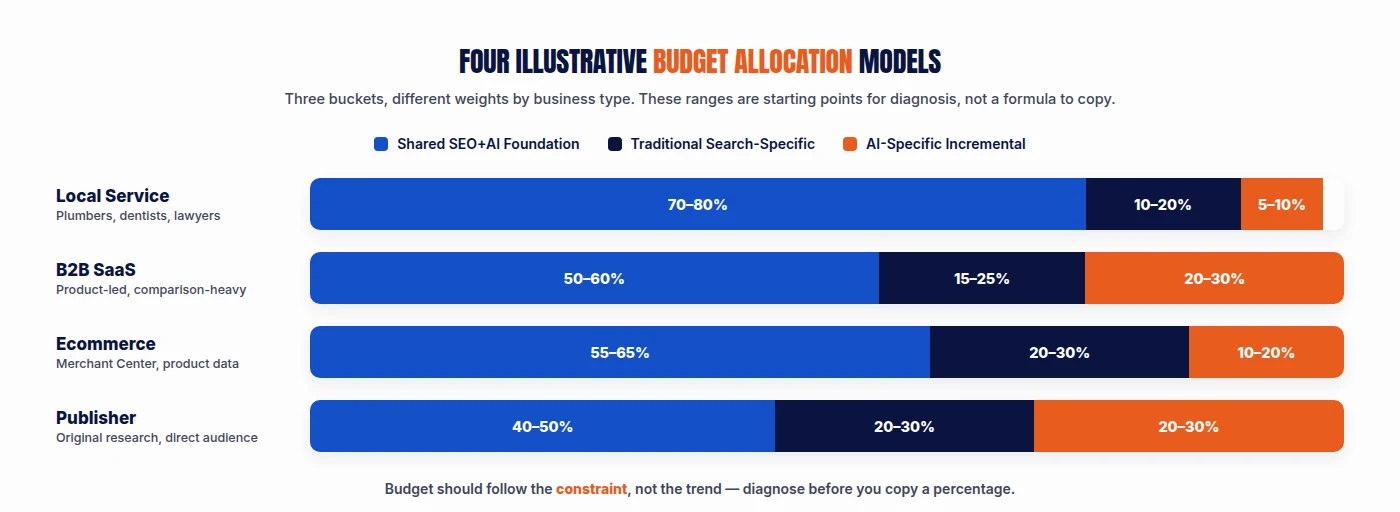
Four Illustrative Budget Models
These are examples, not universal recommendations.
Model 1: Local Service Business
Priority:
- Local SEO
- Google Business Profile
- reviews
- service/location pages
Illustrative split:
| Bucket | Illustrative Share |
|---|---|
| Shared/traditional SEO | 70–80% |
| Authority/reviews | 10–20% |
| AI-specific measurement/testing | 5–10% |
AI search matters, but it should not cannibalize critical local infrastructure.
Model 2: B2B SaaS Company
Priority:
- product pages
- comparison content
- integrations
- third-party mentions
- AI evaluation prompts
Illustrative split:
| Bucket | Illustrative Share |
|---|---|
| Shared SEO/GEO foundation | 50–60% |
| Traditional SEO-specific work | 15–25% |
| AI-specific measurement and optimization | 20–30% |
This category often justifies higher AI investment.
Model 3: Ecommerce Brand
Priority:
- Merchant Center
- product data
- category pages
- reviews
- Google AI shopping
Illustrative split:
| Bucket | Illustrative Share |
|---|---|
| Shared product/search infrastructure | 55–65% |
| Traditional SEO/Shopping optimization | 20–30% |
| AI shopping measurement and experimentation | 10–20% |
Much “AI work” is still product-data work.
Model 4: Publisher
Priority:
- defensible content
- direct audience
- original research
- brand authority
Illustrative split:
| Bucket | Illustrative Share |
|---|---|
| Shared search/content foundation | 40–50% |
| Traditional SEO | 20–30% |
| AI visibility, original research and diversification | 20–30% |
Publishers face greater exposure to zero-click informational answers.
Again, these numbers are illustrative.
Do not copy them without diagnosing your business.
A Better Way to Calculate Your Own Budget
Use five dimensions.
Score each from 1 to 5.
1. AI Audience Adoption
How likely is your audience to use AI during research?
2. AI Commercial Influence
Can AI realistically affect the shortlist or purchase?
3. Current SEO Maturity
How strong is your traditional search foundation?
4. AI Visibility Gap
How far behind are you in AI answers?
5. Measurement Confidence
Can you track whether AI visibility creates value?
Example
B2B SaaS brand:
- AI adoption: 5
- commercial influence: 5
- SEO maturity: 4
- AI gap: 5
- measurement: 3
Total:
22/25
That is a strong case for incremental AI investment.
Local emergency plumber:
- AI adoption: 2
- commercial influence: 2
- SEO maturity: 2
- AI gap: 2
- measurement: 1
Total:
9/25
Traditional local SEO probably deserves more attention first.
The AI Search Investment Score
Use this 100-point framework.
This is a budgeting tool, not a ranking system.
Audience Exposure — 20 Points
- Customers use ChatGPT/Gemini/Perplexity: 5
- Category has research-heavy journeys: 5
- Comparison prompts are common: 5
- AI features appear in Google for core topics: 5
Commercial Impact — 20 Points
- AI can shape shortlist: 5
- Branded searches follow AI discovery: 5
- AI referrals convert: 5
- AI misinformation creates risk: 5
Traditional SEO Maturity — 20 Points
- Technical SEO strong: 5
- Commercial rankings strong: 5
- Content coverage mature: 5
- Authority established: 5
Higher maturity increases the case for incremental experimentation.
AI Visibility Gap — 20 Points
- Competitors dominate prompts: 5
- Brand rarely mentioned: 5
- Owned pages rarely cited: 5
- Third-party source ecosystem weak: 5
Measurement Readiness — 20 Points
- Prompt tracking: 4
- Citation analysis: 4
- AI share of voice: 4
- Branded-search tracking: 4
- Revenue attribution: 4
Interpretation
| Score | Recommended Approach |
|---|---|
| 0–39 | Fix SEO/shared foundation first |
| 40–59 | Run targeted AI experiments |
| 60–74 | Build a formal AI-search workstream |
| 75–89 | Allocate meaningful incremental budget |
| 90–100 | Treat AI search as a core acquisition/influence channel |
Do not mechanically translate the score into a budget percentage.
Use it to prioritize investment.
What Should an AI Search Budget Actually Pay For?
This is where many plans become vague.
A serious AI-search budget can fund:
1. Prompt Research
Build prompt sets around:
- discovery
- comparison
- objections
- product features
- alternatives
- buying intent
2. Brand Visibility Tracking
Measure:
- mentions
- recommendation share
- share of voice
- sentiment
3. Citation and Source Analysis
Identify:
- which domains are cited
- which pages competitors use
- missing source types
4. Commercial Page Optimization
Improve:
- product pages
- service pages
- pricing
- integrations
- comparisons
5. Original Research
Create evidence worth citing.
6. Third-Party Visibility
Earn inclusion in:
- credible listicles
- reviews
- directories
- publications
7. Product Data
For ecommerce:
- Merchant Center
- attributes
- feeds
- product Q&A
8. Technical Access
Audit:
- AI crawlers
- renderability
- directives
- structured content
This is a real workstream.
“Write more AI-friendly content” is not a budget strategy.
Why Original Content May Be a Better AI Investment Than More Commodity SEO Content
Similarweb’s August 2026 expert discussion highlighted a recurring conclusion from AI search practitioners: original information and authority remain highly important.
Source: Similarweb
If your SEO budget currently funds ten generic articles per month, the best AI reallocation may be:
not
five generic SEO articles + five GEO articles.
It may be:
- four stronger articles
- one original study
- one data asset
- better commercial pages
- digital PR
- AI measurement
This is a change in quality and asset mix, not merely channel labeling.
AI Referral Traffic Should Not Be the Sole Budget Justification
AI referral traffic can be small.
Similarweb’s 2026 reporting suggests visibility and downstream influence may be more important than direct referrals alone.
That means the business case should include:
- AI mentions
- branded search lift
- assisted visits
- shortlist inclusion
- conversion quality
Do not demand that AI search match Google’s direct-click volume before investing.
But do not spend heavily without any commercial hypothesis either.
Build a Test-and-Earn Budget Model
A strong approach is to let AI search earn more budget.
Phase 1: Measurement
Fund:
- baseline prompt tracking
- competitor analysis
- source mapping
Phase 2: Intervention
Fix:
- commercial pages
- source gaps
- entity clarity
- product data
Phase 3: Commercial Validation
Track:
- mention lift
- branded demand
- referral quality
- assisted conversion
Phase 4: Scale
Increase budget only if:
- visibility improves
- commercial signals improve
- marginal return looks attractive
This protects the business from hype-driven reallocation.
Do Not Use One Budget Model Across Every Market
A B2B SaaS company and a local roofing contractor should not use the same allocation.
Neither should:
- ecommerce
- publishing
- travel
- healthcare
- finance
AI exposure depends on:
- category
- buyer journey
- search intent
- regulation
- geography
- platform behavior
The correct allocation is contextual.
The Role of Google AI Mode in the Budget Decision
There is one more reason brands cannot treat “SEO” and “AI search” as completely separate.
Google itself is integrating AI into Search.
Google says AI Mode has more than one billion monthly users and is increasing overall Search query volume.
Source: Google
So some of your “AI search budget” is still effectively Google search investment — one more sign that AI search and Google are additive, not a replacement relationship.
Examples:
- Merchant Center AI optimization
- product attributes
- AI Mode visibility
- AI Overview presence
The channels are converging.
A Practical Quarterly Budget Review
Every quarter, answer these questions.
Traditional SEO
- Are rankings growing?
- Are nonbrand clicks growing?
- Are conversions growing?
- Which topics have diminishing returns?
AI Search
- Is brand mention rate improving?
- Is share of voice growing?
- Which competitors dominate?
- Which sources repeatedly appear?
Cross-Channel
- Is branded search increasing?
- Are AI-influenced visitors converting?
- Are customer journeys starting in AI?
- Are sales teams hearing AI-assisted research questions?
Then reallocate.
Do not lock the budget for 12 months based on one annual forecast.
Common Budgeting Mistakes
Mistake 1: Cutting SEO Because AI Is Growing
Growth does not equal replacement.
Mistake 2: Funding GEO Without Measurement
If you cannot measure baseline visibility, you cannot prove improvement.
Mistake 3: Double Counting Shared Work
Technical SEO and digital PR do not need two invoices because they help both channels.
Mistake 4: Measuring Only AI Referral Traffic
AI influence often occurs before search or direct visits.
Mistake 5: Moving Budget to Generic “AI Content”
More content is not automatically better GEO.
Mistake 6: Ignoring Commercial Pages
AI buyer research often depends on product, service and comparison information.
Mistake 7: Copying Competitor Budget Percentages
Their audience, margins and maturity may be completely different.
Mistake 8: Treating Every AI Platform the Same
ChatGPT, Gemini, Perplexity and Google AI Mode can have different roles.
Mistake 9: Underfunding Brand Authority
Third-party corroboration increasingly matters.
Mistake 10: Expecting Instant Revenue Attribution
AI influence can be indirect.
Build a measurement model before declaring success or failure.
FAQ
Should brands shift SEO budget to AI search?
Usually not as a simple one-for-one transfer. Most brands should preserve the shared SEO/GEO foundation and add AI-specific measurement and optimization according to audience behavior, competitive gaps and marginal return.
How much should a company spend on GEO?
There is no universal percentage. Allocation should depend on AI adoption in the category, the importance of AI during the buying journey, current SEO maturity, AI visibility gaps and measurement capability.
Is SEO still worth funding in 2026?
Yes. Google says Search queries reached an all-time high in 2026, and traditional search remains important for navigation, local discovery, commercial intent and downstream demand capture.
Is AI search big enough to justify budget?
For many categories, yes. Similarweb reported 9.5 billion monthly visits to generative AI platforms in May 2026, up 70% year over year. Commercial relevance varies by industry.
Does AI search actually drive website visits?
Yes, but direct AI referrals capture only part of the influence. Similarweb reports that AI-recommended brands are more likely to receive subsequent visits and that a large share of AI-influenced traffic arrives later through search.
Should GEO have a separate team?
Not necessarily. In many organizations, SEO, content, PR, product marketing and analytics should share responsibility. A separate team can make sense at scale, but the work should not become disconnected from SEO.
What should an AI search budget include?
Typical investments include prompt research, AI share-of-voice tracking, citation analysis, commercial-page optimization, original research, third-party visibility, entity consistency, AI technical audits and ecommerce product-data improvements.
Should local businesses move budget from Local SEO to GEO?
Usually not aggressively. Local search and Google Business Profile remain critical for location-driven demand. Local businesses can add AI monitoring without weakening core local visibility.
Should publishers invest more heavily in AI search?
Potentially. Publishers face higher exposure to informational zero-click answers and may benefit from more original research, direct-audience development, AI visibility measurement and defensible content assets.
How can I know whether AI search deserves more budget?
Build a baseline across high-value prompts, measure competitor share of voice, identify whether AI influences your buyer journey, track branded-search lift and test whether improvements translate into stronger commercial outcomes.
Bottom Line
Brands should not respond to AI search growth by mechanically cutting SEO budgets.
The better response is to rethink what the search budget is buying.
A large portion of strong SEO work—technical quality, commercial-page clarity, authority, original research, structured data, internal linking and digital PR—is also the foundation of strong AI visibility. Cutting those activities to fund a separate “GEO program” can weaken both channels.
AI search does deserve dedicated investment where it is influencing discovery, shortlists, comparisons or branded demand. The new money should fund capabilities that traditional SEO programs often lack: prompt research, AI share-of-voice tracking, citation/source analysis, answer accuracy, platform testing and downstream attribution.
The strongest budget model is therefore shared foundation first, traditional search where it still captures demand, and incremental AI investment where the data shows an unresolved visibility opportunity.
Do not ask how much budget competitors are shifting to AI. Ask where your next dollar produces the highest marginal return across the entire search journey. If AI is creating demand and Google is capturing it later, both deserve credit—and both deserve to be optimized together.