Quick Answer
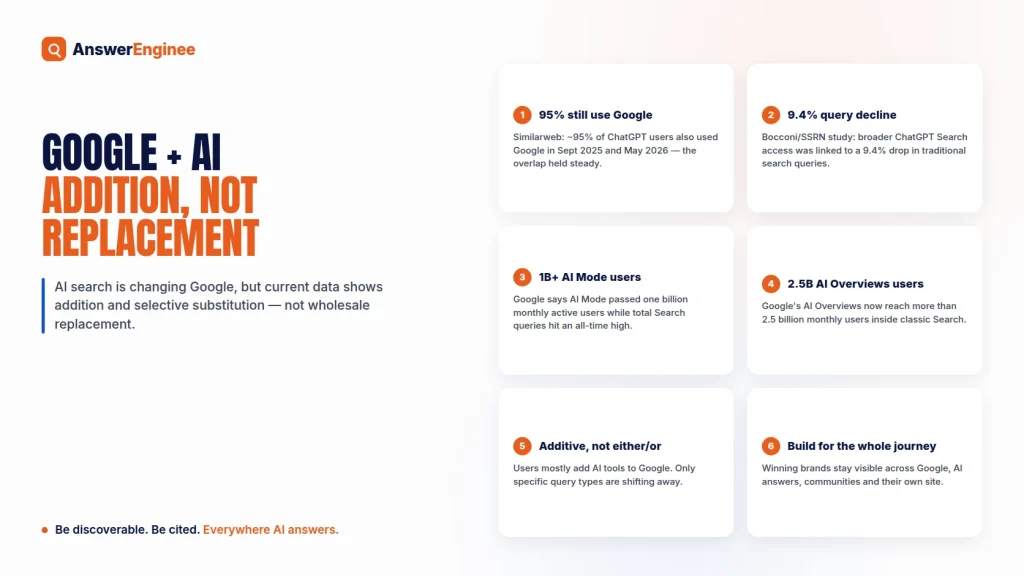
The more important detail is that this overlap remained roughly unchanged from September 2025 through May 2026, even while generative AI usage continued to grow.
That strongly suggests AI search is currently being added to existing search behavior more often than it is replacing Google at the user level.
But SEOs should not misread the statistic.
It does not mean:
- ChatGPT has no effect on Google usage;
- people use Google and ChatGPT for the same tasks;
- Google search volume cannot decline for some query types;
- AI assistants do not reduce clicks to websites;
- SEO budgets should remain unchanged.
A separate 2026 Bocconi University study using U.S. desktop clickstream data found that broader access to ChatGPT Search reduced traditional search queries by about 9.4% on average, with the effect reaching 17% after 20 weeks in one comparison.
Both findings can be true.
The same user can continue using Google while shifting some searches to ChatGPT.
For SEO, the correct response is not to choose Google or AI search. It is to optimize for a fragmented search journey where discovery, research, validation and conversion can happen across both.
Where the “95% of ChatGPT Users Still Use Google” Number Comes From
The statistic comes from Similarweb’s 2026 analysis of generative AI and traditional search behavior.
Similarweb reported that the share of ChatGPT users who also used Google was approximately:
95% in September 2025
and still:
95% in May 2026
Source: Similarweb
That matters more than a one-time overlap figure.
If ChatGPT were rapidly replacing Google at the user level, you would expect the overlap percentage to fall as more people became AI-only users.
Instead, AI usage expanded while the Google overlap remained remarkably stable.
Similarweb’s interpretation was that users are largely adding AI to their existing search habits, not abandoning traditional search altogether.
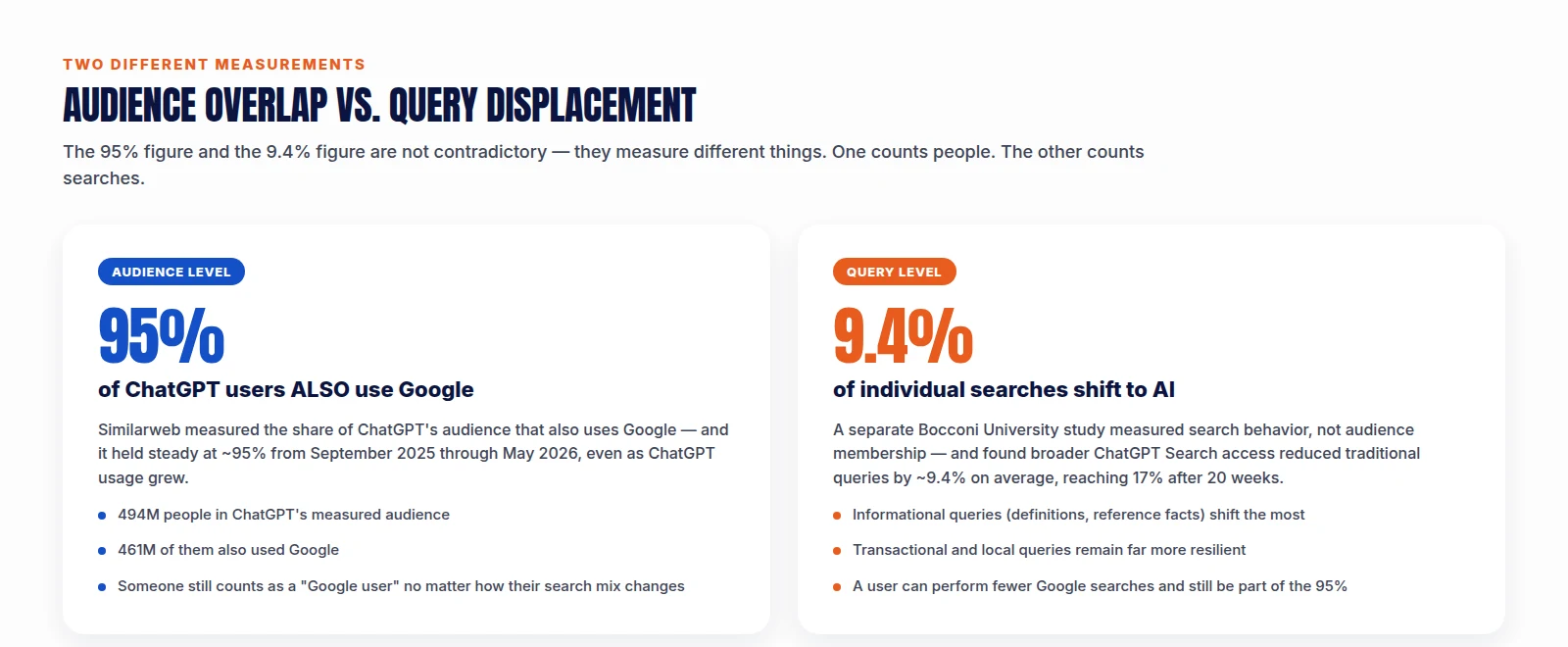
461 Million of 494 Million ChatGPT Users Also Used Google
Reporting based on Similarweb’s 2026 dataset estimated that roughly:
- 494 million people were in ChatGPT’s measured audience;
- about 461 million of them also used Google.
That works out to approximately 95%.
Source: Search Engine Journal
The exact audience numbers will change as platforms grow.
The durable insight is the overlap.
Most ChatGPT users are not living in a separate “AI-only” information ecosystem.
They are moving between systems.
The Search Market Is Not Splitting Into Google Users and AI Users
This is the first major strategic lesson.
The industry often imagines two groups.
Group A
Traditional Google users.
Group B
AI-first users who have replaced Google with ChatGPT.
That is convenient for presentations.
It does not appear to describe most real behavior.
A more realistic model is:
Group A
Google-heavy users who occasionally use AI.
Group B
Heavy users of both Google and AI assistants.
Group C
AI-heavy users who still use Google for specific tasks.
Group D
Traditional-search users who rarely use AI.
The platforms overlap.
That means brands need to think about search journeys, not platform tribes — the same reality that shows up in why users are doing both SEO-driven and GEO-driven search rather than picking one.
Audience Overlap Is Not the Same as Query Overlap
This is where the statistic is most commonly misunderstood.
Suppose one person used Google 50 times per week before adopting ChatGPT.
After adopting ChatGPT, they use:
- Google 35 times;
- ChatGPT 20 times.
That person still counts as a Google user.
So they remain part of the 95% overlap.
But Google has lost 15 weekly searches from that user.
Audience overlap has stayed the same.
Query behavior has changed.
This distinction explains why the Similarweb overlap data and research showing search displacement are not contradictory.
A 2026 Study Found ChatGPT Search Reduced Traditional Queries
Researchers from Bocconi University analyzed U.S. desktop clickstream data to study how broader access to ChatGPT Search changed traditional search behavior.
The paper, “Answering Without Referring: How AI Search Rewrites the Web’s Economic Bargain,” used Comscore data covering ChatGPT Search access expansions.
The researchers reported that broader access to ChatGPT Search was associated with an average 9.4% reduction in traditional search queries.
The reduction deepened over time, reaching 17% after 20 weeks in their primary comparison.
Source: Bocconi University researchers via SSRN
A secondary comparison — looking only at groups that already had ChatGPT access — found a smaller effect: roughly a 4.9% reduction initially, widening to about 8.2% by week 20.
That difference is important because it suggests some of the larger estimate may reflect differences between AI adopters and nonusers, not only the causal effect of access.
Still, the direction is meaningful.
ChatGPT Search can reduce traditional searching even when users continue to use Google.
The 95% Statistic and the 9.4% Statistic Can Both Be Correct
Put the two findings side by side.
Similarweb
Question being measured:
Do ChatGPT users also use Google?
Finding:
Approximately 95% do.
Bocconi / Comscore
Question being measured:
Does gaining access to ChatGPT Search change how many traditional search queries people perform?
Finding:
Traditional search use declined by roughly 9.4% on average in the main comparison.
These are different units of measurement.
Similarweb measures people.
The Bocconi study measures behavior.
This is the most important distinction for SEO planning.
User Retention Can Hide Query Displacement
Marketers commonly use platform-level audience data to answer:
Is Google losing users?
But SEO revenue depends more directly on:
Are people still performing the searches that drive our business?
Those are different questions.
Imagine a publisher depends heavily on informational searches.
A reader still uses Google every day.
But instead of Googling:
- how to clean a coffee machine;
- what causes lower-back pain;
- history of the Roman Empire;
- how to calculate compound interest;
they ask ChatGPT.
The user has not left Google.
But the publisher has lost potential search impressions.
That is why audience retention can coexist with traffic pressure.
Informational Search Appears More Exposed Than Transactional Search
The Bocconi study found that displacement was not uniform across query types.
Search Engine Journal’s coverage of the paper reported that the strongest declines affected informational categories.
Examples included:
- academic research;
- reference content.
Transactional and recreational search behavior changed much less in the study.
Source: Search Engine Journal
That makes intuitive sense.
AI assistants can often answer:
What is canonicalization?
directly.
They are less able to replace every aspect of:
pizza near me
or:
buy Nike Air Max size 10
or:
Salesforce login.
The SEO impact therefore varies by search intent.
The Risk Is Not “Google Dies”
The more realistic SEO risk is:
Some query classes become less valuable while others remain resilient or grow.
That is a far more useful planning model.
Higher AI Displacement Risk
Potentially includes:
- definitions;
- simple explanations;
- basic tutorials;
- reference information;
- summaries;
- comparison research.
More Resilient Search Intent
Often includes:
- navigation;
- local;
- transactions;
- availability;
- branded search;
- current product information;
- high-intent commercial actions.
This is not an absolute rule.
AI assistants increasingly support commercial and local tasks too.
But the economic effect is unlikely to be uniform.
ChatGPT Also Sends Fewer Outbound Clicks Than Google
The Bocconi paper identified another major difference.
The researchers reported that ChatGPT produced outbound clicks in only about 5.2% of conversation sessions in their measured environment.
That was substantially lower than the referral rate they observed for Google.
Source: SSRN
This creates a second SEO challenge.
AI can affect publishers in two ways:
1. Query Displacement
The user may not search Google.
2. Click Displacement
Even when the AI system uses web information, the user may receive the answer without visiting the source.
This means AI search can influence website traffic even before it replaces a large number of Google users.
Why Traffic Is No Longer Enough to Measure Search Influence
Traditional SEO has a fairly clean model:
Query → SERP → Click → Website
AI-assisted search can look like:
Prompt → AI answer → Brand mention → No click
Then later:
Google branded search → Website
Or:
Prompt → AI comparison → Direct visit
Or:
AI answer → Reddit → Google → Website
The initial AI interaction may influence the decision without creating referral traffic.
Traditional analytics may never attribute that influence.
This is why Similarweb’s 2026 report emphasizes mentions and influence as important AI-era metrics.
Google’s Own Data Complicates the “Search Is Shrinking” Narrative
Google says Search is not currently experiencing a simple collapse.
At Google I/O in May 2026, the company said:
- AI Mode had surpassed one billion monthly users;
- AI Mode queries had more than doubled every quarter since launch;
- Search queries reached an all-time high.
Source: Google
Google later reiterated that AI-powered features were contributing to increased Search usage.
Source: Google Q2 2026 remarks
These are Google’s own statements, so marketers should interpret them as company-reported platform data.
But they still matter.
AI adoption inside Google itself can increase search activity even while external AI assistants displace some traditional queries.
Google Is Also Turning Search Into an AI Product
The idea that the market is:
Google vs AI
is becoming increasingly outdated.
Google Search itself now includes:
- AI Overviews;
- AI Mode;
- conversational follow-ups;
- multimodal queries;
- agentic capabilities.
Google said AI Mode surpassed one billion monthly active users one year after launch.
Source: Google
That means a user can technically be:
using Google
and simultaneously:
using generative AI search.
The distinction between SEO and AI search is becoming less platform-specific.
What the 95% Number Actually Proves
The Similarweb statistic supports several reasonable conclusions.
1. ChatGPT Has Not Replaced Google for Most of Its Users
At least during the measured period, most ChatGPT users continued to use Google.
2. Multi-Platform Search Behavior Is Normal
People are comfortable using more than one discovery system.
3. AI Growth Does Not Automatically Mean Google Abandonment
A new platform can grow rapidly while an established platform remains heavily used.
4. Search Strategy Should Cover Multiple Surfaces
Brands cannot assume their audience is exclusively in one environment.
These conclusions are supported by the data.
What the 95% Number Does Not Prove
This is equally important.
It Does Not Prove Search Volume Is Unchanged
The same users can perform fewer Google searches.
It Does Not Prove Google Is Unaffected by ChatGPT
The Bocconi research suggests some traditional search displacement is occurring.
It Does Not Prove AI Search Is Small
ChatGPT remains one of the world’s most visited digital platforms, and generative AI usage continues to grow.
It Does Not Prove SEO Budgets Should Stay Exactly the Same
Budget should follow customer behavior and business outcomes.
It Does Not Prove Every Industry Has the Same Exposure
A local plumber, B2B SaaS company and informational publisher face different risks.
It Does Not Prove AI Visibility Is Optional
AI can influence brand discovery and consideration without replacing Google.
It Does Not Mean ChatGPT Users Use Google for the Same Queries
A user may assign different jobs to each platform.
This is the most important limitation.
Google and ChatGPT Are Often Used for Different Tasks
Consider a B2B buyer researching CRM software.
ChatGPT: “Which CRM is best for a 25-person sales team using Slack, Salesforce and Gong?”
The user wants:
- synthesis;
- recommendations;
- reasoning.
Google: “HubSpot pricing”
The user wants:
- navigation;
- current information.
ChatGPT: “Compare HubSpot and Pipedrive for forecasting.”
Google: “Pipedrive reviews Reddit”
Vendor site: Read product pages.
ChatGPT: “Based on these reviews, which would you choose?”
The buyer is moving between tools.
The question is not:
Which platform owns the buyer?
The question is:
Is our brand visible throughout the journey?
What This Means for SEO Strategy
The first implication is simple:
Do not abandon SEO.
The 95% overlap shows that Google remains part of the behavior of nearly all ChatGPT users in Similarweb’s measured audience.
But SEO strategies should evolve.
1. Protect High-Intent Search
Prioritize searches that are closest to business outcomes.
Examples:
- branded queries;
- local intent;
- product queries;
- pricing;
- service pages;
- comparison pages;
- transactional queries.
These areas can remain highly valuable even as some informational searches migrate to AI.
2. Reassess Commodity Informational Content
Ask whether an article provides something AI can easily summarize without sending the user to your site.
Weak: “What is CRM?”
Stronger:
- original CRM benchmark data;
- implementation study;
- proprietary framework;
- interactive calculator;
- expert comparison;
- current product research.
Generic information is increasingly substitutable.
Original evidence is less so.
3. Strengthen Commercial Pages
AI assistants increasingly support product and vendor evaluation.
Make sure your:
- product pages;
- service pages;
- pricing pages;
- comparison pages;
- integration pages;
- documentation
contain explicit, verifiable information.
Do not keep the best factual content exclusively in blog posts.
4. Measure AI Visibility
Track:
- brand mentions;
- citations;
- recommendation share;
- competitor presence;
- cited sources;
- sentiment;
- answer accuracy.
SEO rank tracking alone cannot capture AI influence.
5. Build Third-Party Authority
AI systems may rely on:
- reviews;
- editorial sites;
- directories;
- communities;
- comparison content.
Your own website cannot be the only source explaining why your brand matters.
How SEO KPIs Should Change
Keep traditional metrics.
Traditional SEO Metrics
- rankings;
- impressions;
- clicks;
- organic sessions;
- conversions;
- revenue.
Then add AI metrics.
AI Visibility Metrics
- prompt coverage;
- brand mention rate;
- citation rate;
- share of voice;
- recommendation rate;
- source share;
- answer accuracy.
Then connect them with business outcomes.
Cross-Channel Metrics
- branded search growth;
- direct traffic;
- assisted conversions;
- demo requests;
- pipeline;
- revenue.
This gives you a more realistic view of search influence.
Why Branded Search May Become More Important
AI assistants can introduce brands users have never searched before.
Example: “Best enterprise SEO agencies for a marketplace migration.”
ChatGPT recommends three firms.
The user then Googles: “Agency A reviews.”
That creates a branded query.
If you look only at Google Search Console, you may conclude:
Our brand demand increased.
True.
But what caused the demand?
Potentially AI discovery.
This is why branded search should increasingly be monitored as a cross-channel outcome, not only an SEO outcome.
Zero-Click Does Not Mean Zero Influence
AI systems can influence a purchase without sending a click.
A recommendation can:
- place a brand on a shortlist;
- change user perception;
- introduce a product;
- frame a comparison;
- eliminate a competitor.
That is economically meaningful even without referral traffic.
This is one reason AI visibility should not be evaluated only by sessions.
The SEO Opportunity: Become the Source AI Cannot Easily Replace
If AI can answer the query from commodity information, publishers face more pressure.
The strategic response is to produce information that has high source value.
Examples:
Original Data
- surveys;
- benchmarks;
- proprietary datasets.
First-Party Experience
- experiments;
- case studies;
- implementation lessons.
Commercial Facts
- pricing;
- specifications;
- capabilities;
- integrations.
Expert Judgment
- analysis;
- predictions;
- frameworks.
Useful Tools
- calculators;
- checkers;
- generators;
- diagnostics.
AI can summarize these assets.
But it still needs a source.
That makes original information more defensible.
The SEO Risk Varies by Business Model
Publishers
Higher exposure to:
- informational query displacement;
- fewer outbound clicks;
- AI summaries.
Priority:
- unique research;
- subscriptions;
- direct audience;
- high-value tools.
B2B SaaS
AI may influence:
- vendor discovery;
- comparisons;
- product evaluation.
Priority:
- product-page GEO;
- review presence;
- third-party comparisons;
- integration information.
Ecommerce
Google is integrating AI directly into shopping.
Priority:
- Merchant Center;
- product attributes;
- reviews;
- product data;
- AI Mode visibility.
Local Businesses
Google remains especially important for:
- maps;
- location;
- immediate services;
- navigation.
But AI can influence provider selection.
Priority:
- Local SEO;
- entity consistency;
- reviews;
- service clarity.
Different businesses need different balances.
Should Brands Shift SEO Budget to AI Search?
Not automatically. This is the exact question a practical SEO budget framework for AI search needs to answer.
Start by separating the work.
Shared SEO + GEO Foundation
- technical SEO;
- content quality;
- internal linking;
- authority;
- digital PR;
- commercial-page optimization;
- entity clarity.
Traditional SEO-Specific Work
- SERP optimization;
- local pack;
- organic rank tracking;
- Search Console analysis.
AI-Specific Work
- prompt tracking;
- citation tracking;
- source analysis;
- AI share of voice;
- answer accuracy;
- platform-specific technical monitoring.
Most brands should add AI measurement and optimization, not simply cut SEO.
A Practical Search Allocation Framework
Ask five questions.
1. Where Does Discovery Happen?
Google? ChatGPT? Gemini? Reddit? Marketplaces?
2. Which Query Types Drive Revenue?
Informational? Commercial? Local? Transactional?
3. Which Searches Are Most Vulnerable to AI Substitution?
Generic informational queries deserve scrutiny.
4. Which Searches Remain High-Intent?
Protect those aggressively.
5. Where Are Competitors Gaining AI Visibility?
Use prompt testing to identify gaps.
Budget should follow these answers.
A 100-Point SEO + AI Search Exposure Audit
This is a diagnostic framework, not a ranking formula.
Traditional Search Dependence — 20 Points
- Organic traffic concentration: 5
- Informational query dependence: 5
- Google revenue dependence: 5
- Low direct/brand demand: 5
Higher score = greater exposure.
AI Displacement Risk — 20 Points
- Commodity informational content: 5
- Simple answer queries: 5
- Few unique assets: 5
- High zero-click vulnerability: 5
AI Visibility — 20 Points
- ChatGPT monitoring: 5
- Gemini monitoring: 5
- Perplexity monitoring: 5
- Google AI Mode monitoring: 5
Brand Defensibility — 20 Points
- Original research: 5
- Strong commercial pages: 5
- Third-party authority: 5
- Branded demand: 5
Measurement Readiness — 20 Points
- Search Console: 4
- Analytics: 4
- AI citations: 4
- Brand mentions: 4
- Revenue attribution: 4
Interpretation
| Score | Assessment |
|---|---|
| 0–39 | Low preparedness |
| 40–59 | Traditional SEO heavy |
| 60–74 | Transitioning |
| 75–89 | Strong cross-channel strategy |
| 90–100 | Advanced search-everywhere operation |
The purpose is to identify where your business is exposed.
What SEOs Should Do in the Next 12 Months
Keep Technical SEO Strong
AI search still depends on accessible web information.
Protect Commercial Intent
Improve: product; service; pricing; comparison; local pages.
Reduce Commodity Content Dependence
Do not build the content strategy around questions AI can answer in one paragraph unless you can add unique value.
Publish Original Evidence
Create: research; benchmarks; proprietary data; expert frameworks.
Monitor AI Platforms
Track the prompts that influence your category.
Build Brand Demand
Brands are more defensible than isolated keywords.
Strengthen Third-Party Validation
Earn: reviews; editorial inclusion; expert coverage; citations.
Measure Beyond Referral Traffic
Track: mentions; branded search; share of voice; assisted conversions.
Common Misinterpretations of the 95% Statistic
“AI Search Isn’t Affecting Google.”
False. The overlap metric does not measure search frequency.
“ChatGPT Isn’t Important.”
False. A platform can influence behavior without replacing Google users.
“SEO Is Safe.”
Too broad. Some SEO segments are more exposed than others.
“AI Is Only Additive.”
Too simple. It appears additive at the audience level while potentially substituting for some queries.
“Google Is Being Replaced.”
Current audience data does not support large-scale replacement at the user level.
“We Need to Move Our Entire SEO Budget to GEO.”
Usually unjustified. A large amount of strong GEO work overlaps with strong SEO.
The Better Mental Model: Layering With Partial Substitution
The most accurate current model is not:
Google → replaced by ChatGPT
It is:
Google + ChatGPT + Gemini + AI Mode + communities + marketplaces
with some traditional queries being redistributed among them.
Call this: layering with partial substitution.
At the audience level: users keep Google.
At the query level: some searches move to AI.
At the traffic level: some answers produce fewer website visits.
At the purchase level: influence spreads across multiple platforms.
This model explains the available data much better than either extreme — and it is the same reasoning behind treating AI search as additive to Google rather than a replacement for it.
FAQ
Do 95% of ChatGPT users still use Google?
Similarweb’s 2026 analysis found that roughly 95% of ChatGPT users also used Google during the measured period. The overlap was approximately 95% in September 2025 and remained at that level in May 2026.
Does that mean ChatGPT is not replacing Google?
It suggests ChatGPT is not currently replacing Google for most users at the audience level. However, users can still shift individual searches from Google to ChatGPT while continuing to use Google overall.
Has ChatGPT reduced Google search usage?
A 2026 Bocconi University study using U.S. desktop clickstream data found broader ChatGPT Search access was associated with roughly a 9.4% reduction in traditional search queries in its main comparison.
How can 95% still use Google if searches fell 9.4%?
Because the studies measure different things. Similarweb measures whether people use both platforms. The Bocconi research measures how frequently traditional searches are performed. A person can use Google less often while still remaining a Google user.
Is Google Search still growing?
Google reported in 2026 that overall Search queries reached an all-time high and that AI-powered features were contributing to increased search activity. Those are Google-reported platform figures.
Is SEO still worth investing in?
Yes for most businesses, but strategies should evolve. High-intent, commercial, local, navigational and branded search remains extremely valuable, while commodity informational content faces greater AI substitution risk.
Should SEOs optimize for ChatGPT?
Yes when ChatGPT is relevant to the audience and buying journey. Track high-value prompts, brand mentions, citations, competitor visibility and source patterns — the same overlap that shows up in why users are doing both SEO and GEO instead of choosing one.
Does AI search send less website traffic?
Research suggests AI assistants often satisfy information needs without outbound clicks. The Bocconi study found ChatGPT produced outbound clicks in only a small share of the conversation sessions measured.
What SEO content is most vulnerable to AI?
Generic informational content that answers simple questions with widely available facts is especially vulnerable. Original research, first-party data, tools, expert analysis and high-intent commercial content are more defensible.
Should I shift my SEO budget to GEO?
Usually not as a simple transfer. Fund the shared technical, authority and content foundation first, then add AI-specific measurement, prompt research, citation analysis and source monitoring according to your audience.
Bottom Line
The fact that roughly 95% of ChatGPT users still use Google is strategically important—but only if it is interpreted correctly.
It does not prove that AI search is harmless to traditional SEO. It proves that adoption is happening largely through overlap rather than wholesale user migration. The same person can keep Google, add ChatGPT, reduce some Google searches, receive fewer outbound links from AI answers, and still use traditional search whenever Google is better suited to the task.
That is why the strongest current model is layering with partial substitution.
At the user level, Google remains deeply embedded in search behavior. At the query level, AI is already taking some informational activity. At the traffic level, generative answers can reduce referrals. At the commercial level, AI can influence brand discovery before the buyer ever performs a branded Google search.
For SEO professionals, the response should not be panic or complacency. Protect the search demand that still drives revenue. Reduce dependence on commodity informational content. Strengthen product and service pages. Publish original evidence worth citing. Build third-party authority. Track AI mentions and recommendations alongside rankings and clicks.
The future is not Google or ChatGPT. It is a search journey in which the same customer uses both—and the brands that remain visible across that entire journey will have the strongest advantage.