AEO in Marketing: The Core Definition
For most of the last two decades, digital marketing revolved around one core mechanic: rank on Google, get clicked, convert the visitor. AEO exists because that mechanic is no longer the only game in town. A growing share of research and product discovery now happens inside a conversation with an AI tool, and that conversation either mentions your brand or it doesn’t.
What is aeo marketing, then, in plain terms? It’s the set of activities (content structure, schema markup, digital PR, authority building) aimed at making sure your brand is one of the things an AI engine says when a prospective customer asks a relevant question. Instead of optimizing for a ranking position on a results page, you’re optimizing for inclusion in a generated answer.
A page can rank well in Google without ever being cited by an AI engine, and vice versa. Marketing teams that only measure success through traditional rank tracking are increasingly blind to a channel that’s already influencing buying decisions.
What Does AEO Stand For in Marketing and SEO?
What does aeo stand for in marketing is a question that comes up constantly, and the short answer is Answer Engine Optimization. The “answer engine” part refers to any AI tool whose core function is generating a direct answer rather than a list of links. ChatGPT, Perplexity, and Google’s AI Overviews all qualify.
In an SEO context, what is aeo in seo describes the adjacent discipline that shares tools and tactics with traditional search optimization but targets a different output. Both disciplines care about content quality, site authority, and technical health. Where they diverge is formatting priorities: SEO optimizes for how a page performs in a ranked list of results, while AEO optimizes for how easily a model can extract, trust, and cite a direct answer from that page.
What does aeo stand for in digital marketing follows the same logic scaled up to the full marketing function, not just content or SEO. It touches brand messaging and PR strategy too, because AI engines synthesize an answer from everything they can find about your brand across the web, not just your own website.
How AEO Fits Into a Modern Digital Marketing Strategy
AEO isn’t a replacement for the rest of your marketing stack. It’s a layer that sits alongside SEO, content marketing, and brand-building, pulling from the same assets but demanding a few specific adjustments.
AEO and Content Marketing
The biggest shift AEO brings to content marketing is a move toward answer-first writing. Traditional blog content often builds up to a conclusion, easing the reader in with context before getting to the point. AEO-friendly content flips that: state the direct answer in the first few sentences, then use the rest of the piece to support and expand on it.
This isn’t just a stylistic preference. It’s a functional requirement. AI engines scanning content for a citable answer are far more likely to pull from a paragraph that clearly answers the question than one buried in narrative setup. For a startup with limited resources, this often means rewriting existing high-performing posts with a direct-answer opening rather than starting from scratch.
AEO and Brand Authority
Trust signals matter more in AEO than in classic SEO, because AI engines are making a judgment call about which sources are reliable enough to cite by name. A model is more likely to cite a brand that shows up consistently across multiple credible sources (industry publications, review sites, other companies’ comparison content) than one whose only footprint is its own website.
This is why digital PR, guest content, and being featured in third-party roundups has become more valuable, not less, in the AEO era. Every credible external mention reinforces the model’s confidence in citing your brand when a relevant question comes up. A startup that invests in getting mentioned across a handful of respected industry sites often sees AI visibility gains a single well-optimized page can’t produce alone.
AEO in Digital Marketing vs Traditional SEO
The core difference for marketers: SEO targets Google’s ranking algorithm to win a position among blue links, while AEO targets an AI model’s citation behavior to win a mention inside a generated, conversational answer.
SEO rewards keyword-optimized pages that rank for dozens of related terms over time. AEO rewards content structured around one specific question with a specific, extractable answer, where breadth matters less than clarity. SEO’s metric is rank position and click-through rate; AEO’s is citation frequency and share of voice, which needs different tracking tools entirely.
Structured data also plays a bigger role in AEO. Schema markup, especially FAQPage, Article, and HowTo schema, gives AI engines a machine-readable shortcut to your key facts, which matters more when the “reader” is a model parsing your page for citable information rather than a human scanning it visually.
What Is AI Engine Optimization for Websites?
What is ai engine optimization aeo at the website level comes down to a handful of concrete practices. It starts with structuring content in clear question-and-answer formats, using headers phrased the way real users phrase questions, so both AI engines and human readers can locate the relevant section instantly.
It also includes schema markup across key pages, particularly FAQ and Article schema, which gives AI crawlers explicit signals about what a page answers. Site speed still matters: a slow, poorly indexed site is harder for any crawler to trust. Finally, it requires enough topical depth in a niche that an AI engine has reason to treat your site as credible rather than one of many similar pages.
How to Start Implementing AEO in Your Marketing Plan
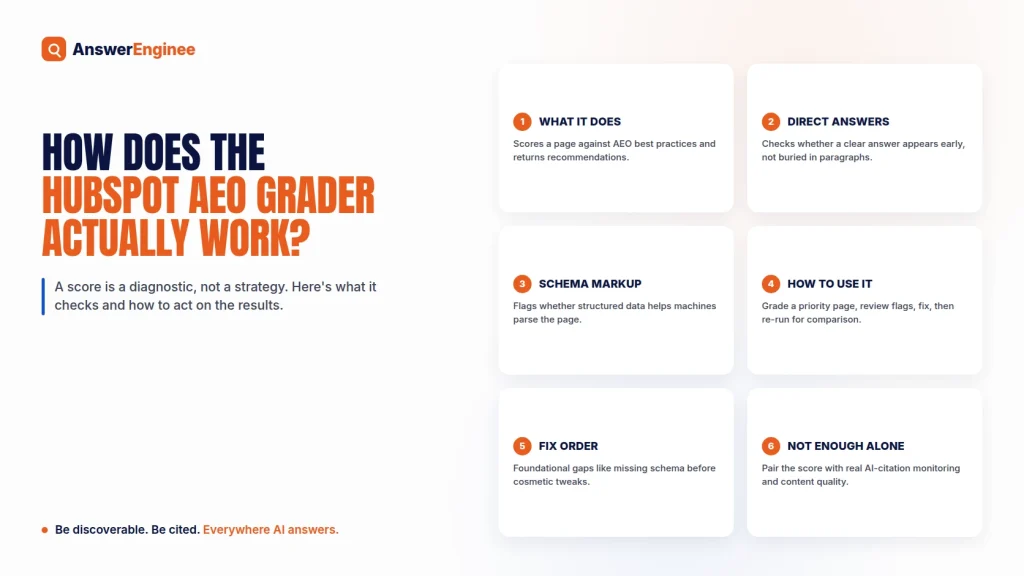
Begin with an audit of your best-performing content and rewrite the openings to directly answer the primary question each piece targets, in the first fifty to eighty words. This single change often produces the fastest improvement, since it doesn’t require new content, just restructuring what’s already useful.
From there, add FAQ schema to your most important pages, focusing first on ones that already answer common customer questions. Build a habit of pursuing mentions on third-party sites relevant to your industry (guest posts, expert quotes, comparison articles) since these external citations compound the authority your own site can’t generate alone. Finally, set up a simple process for periodically checking how AI engines describe your brand today, the same tracking discipline that helps startups build AI visibility fast, so you have a baseline to measure progress against.
Frequently Asked Questions
What does AEO stand for in marketing?
In marketing, AEO stands for Answer Engine Optimization: optimizing your content and brand presence so AI engines cite you as an authoritative answer within your category. It draws on many of the same assets as SEO (quality content, technical health, authority) but applies them toward a different goal: being named directly inside a generated AI response rather than ranking well on a traditional results page.
What is AEO in digital marketing?
AEO in digital marketing is a discipline focused on making your brand visible inside AI-generated responses rather than traditional search listings. It combines answer-first content strategy, schema markup, ongoing brand authority building through PR and third-party mentions, and dedicated AI visibility tracking to measure how often and how accurately your brand gets cited by tools like ChatGPT or Perplexity.
How is AEO different from SEO in marketing?
SEO targets Google’s ranking algorithm to win a high position among blue-link search results. AEO targets AI engines’ citation behavior to win a mention inside a generated, conversational answer. Both require genuinely quality content, but AEO adds requirements SEO doesn’t strictly need: direct-answer formatting up front, structured data like FAQ schema, and consistent third-party authority signals that help a model trust your brand enough to cite it by name.
Why does AEO matter for brand marketing?
AEO matters because AI engines are increasingly the first touchpoint in a customer’s research process, ahead of a traditional search results page. A brand that appears inside an AI-generated answer gains visibility and trust before the user even reaches a search results page, effectively skipping several steps of the traditional funnel. Brands that ignore this shift risk becoming invisible at the exact moment a prospective customer is deciding who to consider.
What is AI engine optimization for websites?
AI engine optimization for websites involves structuring content in clear question-and-answer formats, implementing schema markup like FAQPage and Article schema so AI crawlers can easily parse key facts, maintaining fast load times, and building enough topical authority in a niche that AI engines have reason to treat your site as a trustworthy, citable source rather than one of many undifferentiated pages competing for the same queries.
Key Takeaways
- AEO stands for Answer Engine Optimization: making your brand visible inside AI-generated answers, not just search rankings.
- Content strategy shifts toward answer-first writing: state the direct answer in the opening paragraph, then elaborate.
- Brand authority and third-party mentions matter more in AEO, since AI engines weigh trust signals across the whole web.
- SEO and AEO share a foundation but differ in success metrics: rank position versus citation frequency and share of voice.
- Schema markup, especially FAQ and Article schema, gives AI engines a machine-readable shortcut to your key facts.
- Start by rewriting top-performing content with direct-answer openings, then layer in schema markup and third-party PR.