What Is PEEC AI?
PEEC AI is a platform in the fast-growing category of AEO and GEO monitoring tools. In plain terms, it tracks how a brand shows up (or doesn’t) inside AI-generated answers on tools like ChatGPT, Perplexity, and Google’s AI Overviews, then reports that back in a way marketing teams can act on.
This category exists because traditional analytics were not built for this problem. Google Analytics can tell you how many people visited your site from organic search. It cannot tell you whether ChatGPT mentioned your brand by name when someone asked “what’s the best project management tool for a 10-person startup” and never clicked through at all. That’s the gap PEEC AI and its competitors are trying to close.
For a founder or marketer new to this space, it helps to think of PEEC AI the same way you’d think of a rank tracker for traditional SEO, except instead of tracking your position in Google’s search results, it’s tracking whether and how often you show up inside an AI-generated answer. The mechanics differ (there’s no single “position 3” the way there is on a search results page), but the underlying job is similar: give you visibility into something that used to be invisible.
What Makes PEEC AI Different From Other AEO/GEO Tools?
The AEO and GEO tooling space has grown crowded fast, with multiple platforms launching within roughly the same 18-month window as AI search adoption accelerated. PEEC AI’s specific mechanism is source classification paired with gap analysis: rather than just logging whether your brand got cited, it categorizes the domains doing the citing (editorial, corporate, user-generated, and so on) and flags where a competitor is showing up in sources you’re absent from. That’s a more concrete differentiator than “competitive insight” as a general claim.
Pricing and engine coverage are two areas where PEEC AI’s positioning is genuinely distinct, not just marketing language. Base tiers generally track ChatGPT, Perplexity, and Google’s AI Overviews, with broader coverage (Claude, Gemini, DeepSeek, Grok, and others) available as paid add-ons rather than bundled in from the start. Entry pricing has been reported in the roughly $90 to $100 per month range for a limited prompt volume, positioned below Profound’s enterprise-oriented pricing but above lighter, cheaper entrants like Otterly. Reviewers commonly describe PEEC AI as the pick for a mid-market company with some execution capacity, versus Profound for enterprise teams with compliance requirements and analyst resources, or Otterly for an early-stage team on a tighter budget.
Because this is a fast-moving space where vendors update their offerings frequently, treat the specific numbers above as directional rather than final. Feature sets, engine coverage, and pricing in AEO and GEO tools change often enough that any specific claim made today could shift within a few months, so confirm current tiers directly with PEEC AI before budgeting against them.
PEEC AI vs Other AEO Platforms: What to Compare
When comparing PEEC AI against alternatives like Profound, Otterly, or LLMRefs, a few dimensions matter more than a feature checklist.
First, engine coverage. Which AI platforms does each tool actually monitor, ChatGPT, Perplexity, Google AI Overviews, Gemini, Copilot, and does that list match where your customers actually ask questions? A tool that covers five engines you don’t care about and misses the one your buyers use isn’t useful to you regardless of how polished its dashboard is.
Second, data methodology. How does the tool generate the prompts it tracks, and how often does it re-test them? Some platforms rely more on a fixed prompt list you configure, others do more automated discovery of relevant prompts in your category. Ask each vendor directly how their tracking works and how fresh the data is, since AI-generated answers can shift from one query to the next even for the same prompt.
Third, pricing and reporting depth. AEO and GEO tools price differently based on the number of prompts tracked, competitors monitored, and users on the account. Get a real quote for your actual use case rather than relying on published starting prices, which often don’t reflect what a working setup costs.
Fourth, how the tool handles competitive benchmarking specifically, since that’s the area PEEC AI emphasizes. Ask to see actual competitor comparison reports during a demo so you can judge whether the insight is genuinely useful or a repackaged citation count.
Fifth, check what the tool doesn’t do. A commonly cited gap with PEEC AI, and with LLMRefs and most tools in this category, is that visibility monitoring stops at diagnosis: it can tell you that a competitor is winning a citation, but it won’t write the content, build the schema, or fix the technical issue that closes the gap. Standard plans also tend to skip native CRM integrations (HubSpot, Salesforce) and public API access, both of which matter if you want AI visibility data flowing into a broader reporting stack rather than living in its own dashboard.
Who Should Consider PEEC AI?
Teams actively evaluating AEO and GEO monitoring tools should put PEEC AI on their shortlist alongside the other established players in the category. Reviewers most often position it as a fit for a mid-market company with some in-house execution capacity, rather than the smallest or the largest end of the market. A very early-stage team on a tight budget may find a lighter, cheaper option a better starting point; our roundup of AEO tools for SMBs covers some of those lighter-weight alternatives.
The best way to evaluate it is the same way you’d evaluate any specialized software purchase: request a demo, ask the vendor pointed questions about engine coverage and data methodology, and, if possible, run a short trial against your actual target prompts rather than a generic demo account. Compare what you see against at least one or two alternatives before signing a contract, since pricing and feature depth in this category still vary between vendors.
Founders who are just starting to think about AEO might find it more useful to first nail down which prompts and topics actually matter to their business, then bring that list to a demo with PEEC AI or any competitor. Walking in with your own priority prompt list, rather than letting the vendor set the agenda, produces a much more useful evaluation.
Frequently Asked Questions
What is PEEC AI?
PEEC AI is a platform in the AEO and GEO monitoring space, built to track how brands appear across AI-generated search and answer responses. It helps marketing teams understand their visibility inside tools like ChatGPT and Perplexity, an area traditional analytics platforms were never designed to measure, so they can identify gaps and improve how often they get cited.
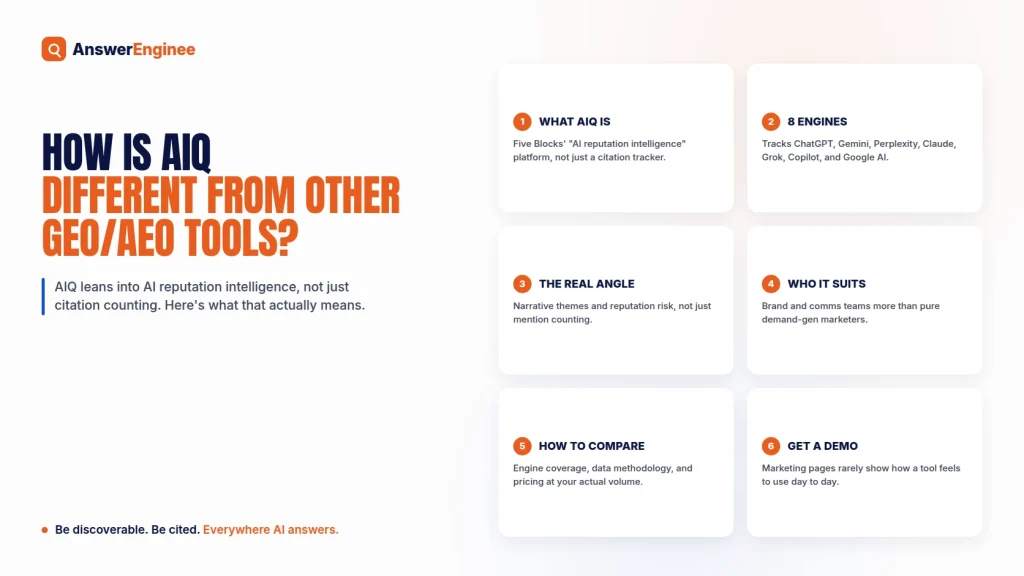
How is PEEC AI different from other GEO/AEO tools?
PEEC AI positions itself around AI search visibility tracking with a particular emphasis on competitive insight, aiming to show not just whether you’re cited but why competitors might be winning citations instead. To see how that plays out in practice, compare its specific engine coverage, data methodology, and pricing directly against alternatives like Profound, Otterly, and LLMRefs, since feature depth varies and changes over time.
Who should consider PEEC AI?
Teams actively evaluating AEO and GEO monitoring tools should consider PEEC AI alongside other platforms in the category, particularly if competitive benchmarking against other brands is a priority. Request demos from PEEC AI and at least one or two alternatives, such as AIQ or Profound, and compare data transparency, engine coverage, and reporting depth against your specific use case before making a decision.
Key Takeaways
- PEEC AI is one of several platforms in the AEO and GEO monitoring category, tracking brand visibility inside AI-generated answers.
- Its stated positioning centers on AI search visibility tracking paired with competitive insight, not just a raw citation count.
- Feature sets and pricing in this space change quickly, so verify current capabilities directly with the vendor rather than relying on older comparisons.
- Compare engine coverage, data methodology, and competitive benchmarking depth against alternatives like Profound, Otterly, and LLMRefs.
- Bring your own priority prompt list to any vendor demo instead of letting the vendor set the agenda.
- No single AEO tool is the automatic right choice. The right fit depends on which engines your customers actually use and what you need to act on.