Quick Answer
The strongest evidence comes from two directions.
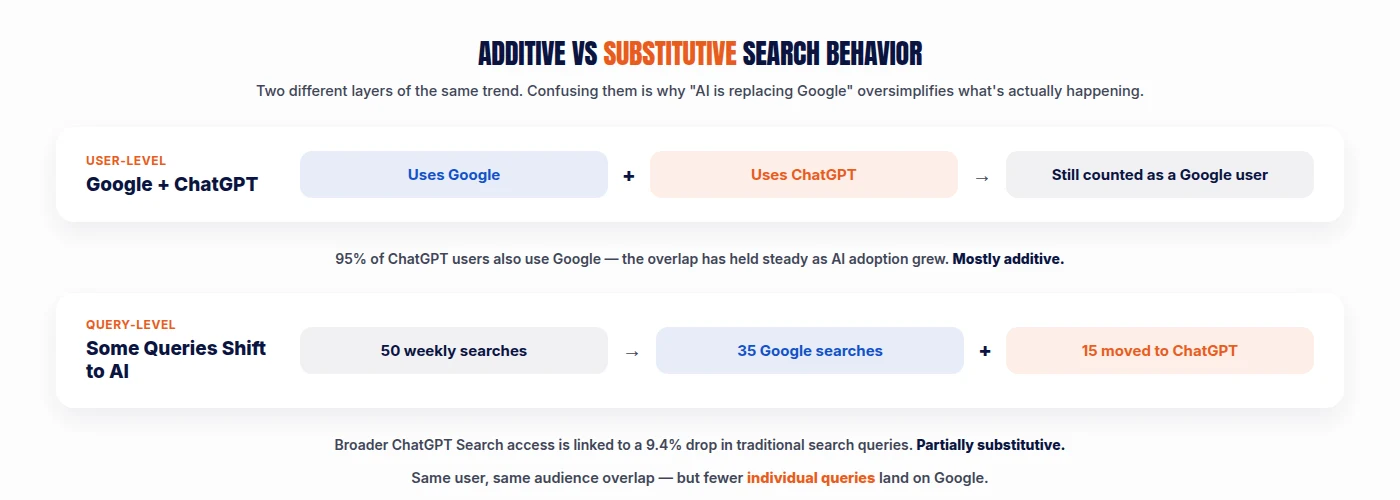
Similarweb reported that 95% of ChatGPT users also used Google in both September 2025 and May 2026, even as generative AI usage expanded sharply. That suggests users are generally adding AI assistants rather than abandoning Google at the audience level.
At the same time, a 2026 Bocconi University study found that broader access to ChatGPT Search was associated with roughly a 9.4% reduction in traditional search queries in its main comparison.
Those findings are not contradictory.
They point to a more accurate model:
AI search is additive at the user level but partially substitutive at the query level.
A person can continue using Google every day while moving definitions, explanations, comparisons, summaries or research tasks to ChatGPT, Gemini or another AI assistant.
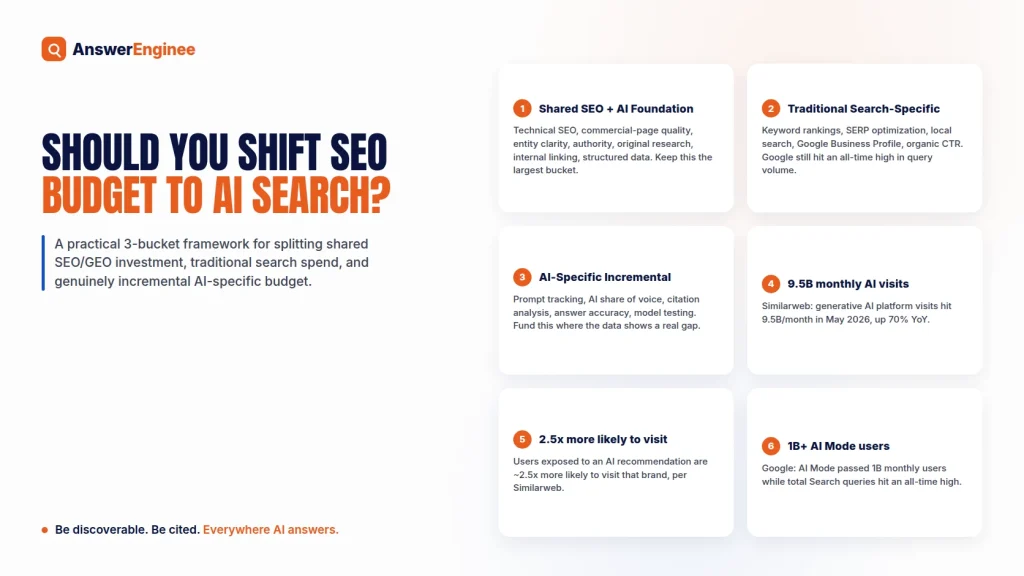
Google itself is also becoming more AI-driven. In 2026, Google said AI Mode had surpassed one billion monthly active users and that AI-powered Search features were helping push total Search queries to an all-time high.
For brands, the implication is not “choose Google or AI.”
It is:
Build visibility across the entire search journey—traditional results, AI answers, third-party sources, communities and your own website.
Why the “AI Will Replace Google” Story Is Too Simple
Technology markets love replacement stories.
Streaming replaced DVDs.
Smartphones replaced many standalone devices.
Cloud software replaced many on-premise systems.
So when ChatGPT emerged as a new way to find information, the obvious prediction was:
ChatGPT will replace Google.
But search is not one task.
People use search systems for very different jobs.
Someone might search Google because they need:
- a website;
- a nearby business;
- a current price;
- a map;
- a product;
- breaking information;
- a login page.
The same person may use ChatGPT because they need:
- synthesis;
- explanation;
- comparison;
- brainstorming;
- planning;
- decision support.
These functions overlap, but they are not identical.
That is why search behavior can expand into more tools without one tool immediately eliminating another.
The 95% ChatGPT–Google Overlap Is the Strongest Evidence for Addition
Similarweb’s 2026 analysis found that approximately 95% of ChatGPT users also used Google.
More importantly, that percentage remained roughly unchanged between:
- September 2025;
- May 2026.
Source: Similarweb
This pattern is consistent with independent reporting that ChatGPT users still use Google at very high rates rather than abandoning it outright.
During the same period, generative AI usage continued to grow rapidly.
Similarweb reported that worldwide visits to generative AI platforms reached around 9.5 billion per month in May 2026, up approximately 70% year over year.
If AI adoption were causing users to abandon Google wholesale, we would expect the overlap between the two audiences to fall.
It did not.
That suggests the most common behavior is:
Google + AI
rather than:
Google → AI
But 95% Overlap Does Not Mean Search Behavior Is Unchanged
This is where the analysis needs more nuance.
Suppose a person previously performed:
50 Google searches per week
After adopting ChatGPT:
35 Google searches + 20 ChatGPT prompts
The user is still counted as:
a Google user.
The overlap metric remains unchanged.
But 15 Google searches have been displaced.
This is why user-level overlap cannot tell us what is happening at the query level.
AI Search Can Be Additive and Substitutive at the Same Time
The best current framework has two layers.
User-Level Behavior
Question:
Do AI users still use Google?
Current evidence:
Mostly yes.
Query-Level Behavior
Question:
Do AI users shift some information tasks away from traditional search?
Current evidence:
Also yes.
A 2026 Bocconi University study using U.S. desktop clickstream data found broader access to ChatGPT Search was associated with an average 9.4% reduction in traditional search queries in its main comparison.
Source: SSRN
This gives us a more realistic description:
AI search is layering onto Google while partially cannibalizing specific query types.
That is very different from saying Google is being replaced.
Query Displacement Is Likely to Be Uneven
Not every search query is equally vulnerable to AI.
Consider:
What is canonicalization in SEO?
An AI assistant can answer that directly.
Now consider:
Thai restaurant open near me.
Google’s local data, maps and business ecosystem provide a very different experience.
Or:
Salesforce login.
The user wants navigation, not synthesis.
Or:
Buy Nike Pegasus size 10.
The task is transactional.
This suggests the future of search will not be defined by one percentage of “search replacement.”
Different query classes will evolve differently.
Informational Queries Are More Exposed
The Bocconi research found that traditional search-referral losses were especially significant for informational categories.
That makes intuitive sense.
AI assistants are strong at:
- definitions;
- summaries;
- explanations;
- reference information;
- research synthesis.
Historically, publishers could rank for these questions and receive a click.
AI can now satisfy some of those information needs inside the interface.
This is a real threat to commodity informational SEO.
Commercial Queries Are More Complicated
AI is also becoming important for product and vendor research.
Users ask:
- best CRM for a small agency;
- Product A vs Product B;
- alternatives to Product X;
- best laptop for video editing.
But those journeys frequently continue elsewhere.
The user may still visit:
- Google;
- review platforms;
- vendor sites;
- Reddit;
- ecommerce marketplaces.
AI can influence the shortlist without completing the transaction.
This creates a multi-touch search journey.
Navigational Search Remains Highly Defensible
AI has less reason to replace:
- Facebook login;
- OpenAI website;
- Amazon;
- Gmail;
- Stripe dashboard.
The user knows the destination.
Search engines remain efficient navigation systems.
AI assistants may increasingly perform actions directly, but navigation remains structurally different from informational synthesis.
Local Search Also Has Strong Structural Advantages
Queries such as:
- dentist near me;
- emergency plumber;
- coffee shop open now;
- lawyer in Dallas;
depend on:
- location;
- hours;
- reviews;
- maps;
- availability;
- proximity.
AI can summarize options.
But it still needs local information infrastructure.
That means Local SEO remains strategically important even as AI enters the journey.
Google Is Not Standing Still
The “Google vs AI” framing has another major flaw:
Google itself is becoming an AI search platform.
In May 2026, Google said AI Mode had surpassed one billion monthly active users globally.
Google also said AI Mode queries had more than doubled every quarter since launch.
Most importantly, Google reported that Search queries had reached an all-time high and said its new AI features were a major reason users were searching more.
Source: Google
Google later reiterated in its Q2 2026 update that AI-powered features were driving incremental Search usage.
Source: Google
So the market is not:
Traditional Google vs AI
It increasingly looks like:
AI-native platforms + AI-enhanced Google
AI Overviews Further Blur the Boundary
Google has also embedded generative answers directly into conventional search through AI Overviews.
Google’s June 2026 investor presentation said AI Overviews had more than 2.5 billion monthly users.
Source: Google
A person can therefore:
- open Google;
- receive an AI-generated answer;
- inspect cited sources;
- continue into AI Mode;
- ask follow-up questions;
- click a website.
Is that traditional search?
AI search?
Both.
The interface itself is converging.
The Better Model: Search Is Becoming a Discovery Network
Brands should stop thinking of search as one destination.
The modern discovery network can include:
- Google Search;
- Google AI Mode;
- AI Overviews;
- ChatGPT;
- Gemini;
- Perplexity;
- Claude;
- Reddit;
- YouTube;
- marketplaces;
- review sites;
- brand websites.
Each surface can influence a different step.
The buyer may move between them without consciously thinking about the distinction.
A Realistic Search Journey
Imagine a company choosing an enterprise analytics platform.
Step 1: ChatGPT
What analytics platforms are best for product-led SaaS companies?
The AI produces a shortlist.
Step 2: Google
Search:
Company A reviews
Step 3: G2
Read customer feedback.
Step 4: Vendor Website
Review:
- product features;
- integrations;
- security;
- pricing.
Step 5: Perplexity
Company A vs Company B for product analytics.
Step 6: Google
Search:
Company B pricing
Step 7: Reddit
Look for implementation complaints.
Step 8: Direct Visit
Book a demo.
There is no single winning channel.
The winning brand is the one that remains credible throughout the loop.
AI Search Often Changes Discovery Before It Changes Transactions
This is one reason AI impact can be difficult to measure.
AI may influence:
- which brands enter the shortlist;
- which criteria matter;
- how a product is described;
- which competitors are considered.
But the actual conversion may still happen through:
- Google;
- direct traffic;
- a marketplace;
- the brand website.
Traditional attribution can therefore undercount AI influence.
AI Can Generate Google Demand
Suppose a user asks:
What are the best AEO agencies?
ChatGPT introduces a brand the user has never seen.
The user then Googles:
Brand X reviews
or:
Brand X pricing
or:
Brand X case studies.
The AI generated the branded search.
Search captured the visit.
This is why AI and Google should not be evaluated only as competing referral channels.
They can operate sequentially.
Google Can Feed AI Search Too
The relationship works in reverse.
AI systems retrieve information from the web.
Strong SEO improves:
- crawlability;
- information architecture;
- page titles;
- relevance;
- internal linking;
- authority.
Those improvements can strengthen the information environment from which AI systems retrieve sources.
This means traditional SEO can support AI visibility.
Search Is Moving From Query Competition to Presence Competition
Traditional SEO asks:
Where do we rank for this keyword?
AI search adds another question:
Are we present when the category is discussed?
A brand could rank strongly for several keywords but still be missing from AI recommendations.
Another brand could receive AI mentions through third-party sources even if its own website is not cited.
This changes the unit of competition.
The unit becomes:
brand presence across the decision environment.
Search Traffic and Search Influence Are Separating
Historically, search influence was easier to measure because discovery often created a click.
AI answers can influence without sending traffic.
Similarweb’s 2026 Generative AI Landscape report highlights this shift toward measuring:
- citations;
- mentions;
- visibility;
- branded search effects.
Source: Similarweb
Traffic is still important.
But it no longer captures every interaction that shapes the buyer.
Zero-Click Behavior Is Expanding
Search already had zero-click behavior before generative AI.
Users could get:
- weather;
- calculations;
- definitions;
- sports scores;
- snippets;
without visiting a site.
AI accelerates that pattern.
Similarweb’s August 2026 analysis noted that generative AI platforms now attract billions of monthly visits while operating without the traditional SERP-click structure.
Source: Similarweb
For publishers especially, this changes the economics of informational SEO.
Additive Does Not Mean Harmless
This distinction is critical.
Calling AI “additive” does not mean:
- publishers will lose no traffic;
- Google query volumes cannot fall;
- SEO is unchanged;
- AI referral traffic will compensate for lost clicks.
The accurate claim is narrower:
AI is currently expanding the number of discovery tools people use rather than causing most users to stop using Google.
Within that additive environment, economic disruption can still be substantial.
What AI Search Is Most Likely to Replace
AI is particularly well suited to replacing parts of the research process.
Examples:
- summarizing several sources;
- explaining terminology;
- creating initial comparisons;
- synthesizing reviews;
- narrowing options;
- answering follow-up questions.
These tasks previously required multiple Google searches.
One AI conversation can compress them.
That reduces some search volume even though Google remains part of the journey.
What AI Is Less Likely to Fully Replace
Google retains strong structural advantages in:
Navigation
Finding known websites.
Local
Maps, businesses, hours, directions.
Current Web Discovery
Recent pages, live information and fresh results.
Commerce
Shopping infrastructure, offers and merchant data.
Verification
Opening primary sources.
Transaction
Moving from information to action.
AI systems are expanding into all of these areas, but replacement is much harder than replacing a simple informational query.
The Search Journey Is Becoming a Loop
The old funnel:
Search → Website → Conversion
is increasingly insufficient.
The new journey can look like:
AI → Google → Website → Reddit → AI → Google → Conversion
Or:
Google AI Overview → Publisher → ChatGPT → Brand → Google → Purchase
The user moves between discovery systems according to the task.
This is why brands should optimize journeys rather than isolated platforms.
SEO Is Still Necessary in an AI Search World
There are several reasons.
1. The Web Remains the Evidence Layer
AI systems still need information.
Brands need accessible, authoritative pages.
2. Google Still Captures Massive Demand
The audience has not disappeared.
3. Search Handles High-Intent Tasks
Many local, commercial, branded and navigational searches remain valuable.
4. SEO Assets Often Support GEO
Strong:
- titles;
- information architecture;
- authority;
- commercial pages;
can improve both.
5. AI Visibility Can Create Search Demand
Branded search may increase after AI exposure.
The channels reinforce one another.
GEO Is Also Necessary
SEO alone cannot tell you:
- whether ChatGPT recommends your brand;
- whether Gemini misrepresents your product;
- which third-party sites Perplexity cites;
- whether your competitors dominate AI answers;
- whether Google AI Mode includes your products.
That requires additional measurement.
GEO adds the visibility layer SEO historically did not track. For a closer look at why brands increasingly need both disciplines running together, see SEO vs GEO: users are doing both.
The Search-Everywhere Optimization Model
A strong 2026 strategy should cover five layers.
1. Discoverability
Can the brand be found?
Focus on:
- SEO;
- technical accessibility;
- category relevance;
- third-party presence.
2. Understandability
Can systems correctly explain the brand?
Focus on:
- entity clarity;
- product definitions;
- service definitions;
- structured data;
- consistent information.
3. Citability
Does the brand publish information worth using as evidence?
Focus on:
- original data;
- research;
- specifications;
- methodologies;
- expert analysis.
4. Validation
Does the web corroborate the brand?
Focus on:
- reviews;
- PR;
- customer stories;
- directories;
- communities.
5. Conversion
Can the buyer take action?
Focus on:
- product pages;
- service pages;
- pricing;
- checkout;
- demos;
- trust.
This framework works whether the journey starts in Google or AI.
How Brands Should Allocate Effort
Do not optimize every platform equally. This is also a budget question, not only a tactics question — see how SEO budgets are shifting in an AI search world for a deeper look at reallocating spend.
Start with customer behavior.
If Google Drives Most Revenue
Protect:
- commercial SEO;
- local SEO;
- product search;
- branded search.
Add AI measurement incrementally.
If AI Strongly Influences Research
Invest more in:
- prompt visibility;
- product/service clarity;
- third-party inclusion;
- comparisons;
- citation sources.
If You Are an Informational Publisher
Prioritize:
- original reporting;
- direct audience;
- unique tools;
- data assets;
- defensible expertise.
Commodity information faces greater pressure.
If You Are Ecommerce
Treat:
- Merchant Center;
- product attributes;
- reviews;
- product schema;
- AI shopping visibility;
as one connected system.
A Better KPI Framework
Traditional search metrics remain important.
Track:
SEO
- impressions;
- rankings;
- clicks;
- conversions;
- revenue.
Add:
AI Visibility
- brand mention rate;
- citation rate;
- share of voice;
- recommendation rate;
- answer accuracy.
Then add:
Cross-Channel Outcomes
- branded search;
- direct visits;
- assisted conversions;
- lead quality;
- revenue.
The goal is to understand influence across the journey.
The 100-Point Additive Search Readiness Audit
This is a strategic diagnostic model, not an algorithm.
Google Search Strength — 20 Points
- Technical SEO: 4
- Commercial rankings: 4
- Brand rankings: 4
- Local/product visibility where relevant: 4
- Search conversion tracking: 4
AI Visibility — 20 Points
- ChatGPT monitoring: 4
- Gemini monitoring: 4
- Perplexity monitoring: 4
- Google AI Mode monitoring: 4
- Citation/share-of-voice tracking: 4
Information Quality — 20 Points
- Clear entities: 4
- Strong product/service pages: 4
- Original information: 4
- Current factual content: 4
- Technical accessibility: 4
External Validation — 20 Points
- Reviews: 4
- Digital PR: 4
- Third-party comparisons: 4
- Directories/marketplaces: 4
- Community presence: 4
Cross-Channel Measurement — 20 Points
- Branded search tracking: 4
- AI referrals: 4
- Assisted conversions: 4
- Brand mention trends: 4
- Revenue attribution: 4
Interpretation
| Score | Assessment |
|---|---|
| 0–39 | Single-channel dependency |
| 40–59 | Search foundation but weak AI visibility |
| 60–74 | Emerging multi-platform presence |
| 75–89 | Strong additive search strategy |
| 90–100 | Advanced search-everywhere operation |
A high score does not guarantee rankings or citations.
It means the brand is less dependent on one discovery surface.
What Brands Should Stop Doing
Stop Asking Whether SEO Is Dead
The useful question is which query classes and journeys are changing.
Stop Comparing Total AI Traffic With Google Traffic
One can influence the other.
Stop Measuring AI Only Through Referral Sessions
AI can create later branded searches.
Stop Treating Google as Non-AI
Google Search itself now contains large-scale generative experiences.
Stop Publishing Commodity Content at Scale
Simple informational answers are increasingly easy to synthesize.
Stop Assuming Every AI Mention Needs Your Own Citation
A third-party citation can still introduce your brand.
Stop Building Separate SEO and GEO Silos
The technical, content and authority foundations overlap too heavily.
Stop Expecting One Stable “Future of Search”
The market is fragmenting across several AI assistants and search experiences.
There may never be one replacement winner.
What Brands Should Do Next
1. Protect High-Intent Google Search
Keep investing in the search terms closest to revenue, and revisit your SEO budget for an AI search world before cutting spend on channels that still convert.
2. Measure AI Discovery
Build prompt sets around:
- category discovery;
- comparison;
- product questions;
- buyer objections.
3. Improve Commercial Pages
Make:
- product;
- service;
- pricing;
- comparison;
- integration;
pages clear enough for both humans and machines.
4. Publish Information AI Needs to Cite
Examples:
- original research;
- first-party data;
- product specifications;
- expert frameworks.
5. Build Third-Party Validation
Earn:
- reviews;
- editorial coverage;
- comparison inclusion;
- trusted citations.
6. Track Branded Demand
AI recommendations can create later Google searches.
7. Diversify Measurement
Combine:
- SEO;
- GEO;
- brand;
- conversion data.
FAQ
Is AI search replacing Google?
Current data does not show wholesale replacement at the user level. Similarweb found approximately 95% of ChatGPT users also used Google in both September 2025 and May 2026. However, AI can still replace individual traditional search queries.
Is AI search additive?
At the audience level, current evidence strongly suggests it is largely additive. Users are adding AI tools while continuing to use Google. At the query level, some substitution is occurring.
Has ChatGPT reduced traditional Google searching?
A 2026 Bocconi University study found broader access to ChatGPT Search was associated with around a 9.4% decline in traditional search queries in its main comparison.
How can AI reduce search queries if users still use Google?
A person can perform fewer Google searches and still use Google regularly. Audience overlap measures whether the person uses both platforms, not how many searches they perform in each.
Is Google becoming an AI search engine?
Yes. Google has integrated AI Overviews and AI Mode deeply into Search. Google said AI Mode exceeded one billion monthly active users in 2026.
Are Google Search queries declining?
Google reported in 2026 that Search queries reached an all-time high and that its AI-powered Search features were contributing to incremental query growth. That is company-reported platform data.
Which SEO queries are most vulnerable to AI?
Generic informational queries such as simple definitions, summaries and reference questions appear especially exposed because AI assistants can often satisfy them directly.
Will ecommerce search be replaced by AI?
AI will increasingly influence ecommerce discovery and comparison, but Google Shopping, merchant data, product pages, marketplaces and transaction infrastructure remain important. The likely outcome is integration rather than immediate replacement.
Should brands invest in SEO or GEO?
Most brands should invest in both through a shared search foundation. SEO captures traditional demand and supports web discoverability, while GEO adds measurement and optimization for AI mentions, citations and recommendations.
What should brands measure in an additive search environment?
Track rankings, organic traffic and conversions alongside AI brand mentions, citations, share of voice, recommendations, branded search growth, direct traffic and assisted commercial outcomes.
Bottom Line
AI search is changing Google, but current evidence does not support the idea that it is simply replacing Google.
The more accurate model is addition with selective substitution.
At the audience level, AI users overwhelmingly continue to use Google. At the query level, some informational and research tasks are moving into AI conversations. At the platform level, Google itself is becoming increasingly generative through AI Overviews and AI Mode. At the customer-journey level, users are moving between AI assistants, traditional search, communities, reviews and brand websites rather than committing to one discovery system.
That creates both risk and opportunity.
Generic informational SEO can lose queries and clicks. AI answers can satisfy users without referrals. But AI can also introduce new brands, generate branded searches and create research demand that Google later captures. Meanwhile, strong SEO assets can make a brand easier for AI systems to discover and understand.
The strategic response is therefore not to predict which platform kills the other. It is to build a brand that remains visible wherever the customer continues the research.
Protect high-intent search. Measure AI visibility. Publish original information. Strengthen commercial pages. Build third-party authority. Track branded demand and assisted conversions.
The future of search is not Google versus AI. It is a fragmented discovery network in which Google and AI increasingly feed one another—and the brands that optimize for that entire network will be far more resilient than those betting everything on a single interface.