Here’s why that matters more than it used to: Ahrefs’ latest large-scale study found only 38% of AI Overview citations now come from pages ranking in the organic top 10, down from about 76% just seven months earlier. A separate BrightEdge analysis puts that overlap closer to 17%. Either way, traditional ranking position alone is no longer a reliable predictor of citation.
That single shift should reframe how you think about this whole task. It’s not the same job as traditional SEO, and the tactics below only make sense once that difference is clear. For how to check where you currently stand, see how to measure AI Overview visibility in an SEO audit.
Why ranking and citation have come apart
Traditional SEO optimizes a page for overall authority and relevance, competing for a fixed position against every other page targeting the same query. AI Overviews evaluate something narrower: passage-level relevance and extractability, judged against the specific sub-question being answered in that moment.
That’s why a page ranking #15 can still get cited if it answers a specific piece of the question more clearly than the page sitting at #1. The AI Overview isn’t picking the single “best” page. It’s assembling an answer from whichever passages, across however many sources, most directly and cleanly address each part of the question. Overall page authority still matters, but it’s no longer the dominant signal it once was.
Content structure tactics
Lead with the answer, not the setup. Each section should state its core claim in the first sentence or two, before any context, caveats, or background. A model looking to extract a clean answer has an easier time pulling a passage that states its conclusion upfront.
Write headers the way people actually ask questions. “What is X” and “How does X work” match conversational query patterns far better than a clever or branded header that requires inference to connect to the underlying question.
Give each section one specific claim or answer, rather than spreading related but distinct points across a single diffuse paragraph. A section that tries to answer three related questions at once is harder to extract cleanly than three sections that each answer one.
Use lists and tables wherever the query implies a comparison or a structured set of options. These formats are inherently easier to extract and repackage than long-form prose making the same point.
Entity and factual clarity
Consistency in how you name things matters more than it might seem. If your brand, product, or key terms are described differently across different pages or sources, models have a harder time building confident, repeatable associations.
Specific numbers and dates beat vague claims every time. “Response times improved by 40% in Q2 2026” extracts and cites more cleanly than “we’ve significantly improved response times.” The specificity itself is a signal of verifiability, which appears to matter to how confidently a model treats a claim.
Sourcing your own content well helps too. Content that clearly attributes its own claims and data tends to read as more trustworthy and more extractable than unsourced assertions, even when the underlying facts are accurate either way.
The technical and schema layer
FAQPage, HowTo, and Article schema don’t guarantee citation, but they help search systems parse your content’s structure and intent more reliably, reinforcing signals that are already there in well-written content rather than creating them from nothing.
The basics still matter too. AI Overview sourcing still depends on Google’s index, so page speed, crawlability, and clean technical SEO remain a prerequisite, not something you can skip because AI-era optimization sounds like a different discipline entirely.
Where citations are actually coming from now
This part is worth confronting directly rather than glossing over, and it’s more nuanced than a single ranking of sources. Reddit and YouTube both show up heavily in AI citation data, but which one leads depends on which platform you’re looking at.
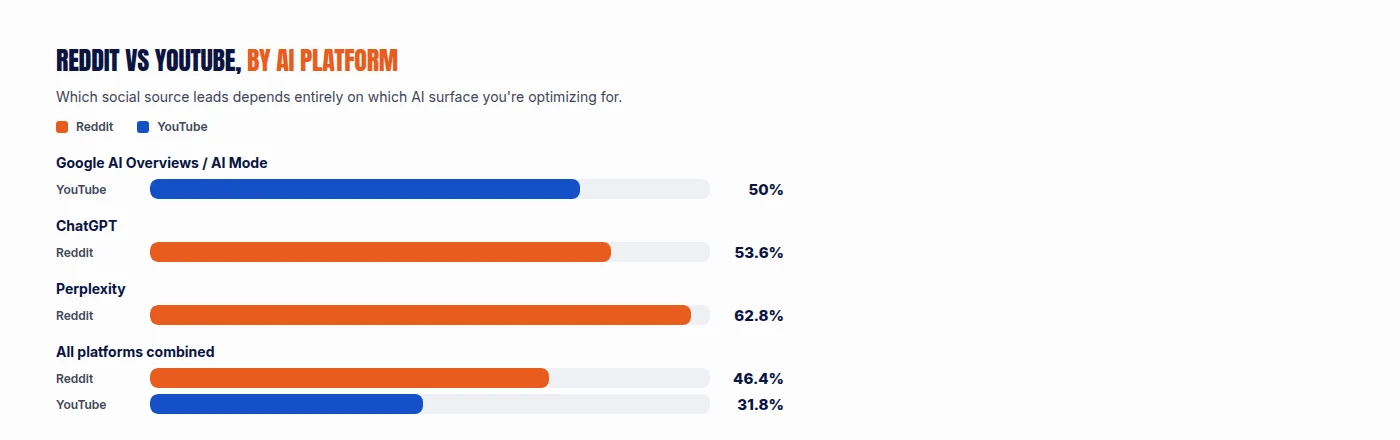
Within Google’s AI Overviews and AI Mode specifically, Ahrefs found YouTube is the single most-cited domain, with its citation share climbing 34% over a recent six-month stretch to around 5.6% of all AI Overview citations. Otterly’s tracking of more than 100 million citations backs this up: YouTube captures more than half of all social and video citations inside Google’s AI surfaces specifically.
Zoom out to other platforms and the picture flips. Reddit leads by a wide margin on ChatGPT, taking 53.6% of social citations there, and an even larger 62.8% share on Perplexity. Across every AI platform combined, Reddit edges ahead overall, at roughly 46.4% of social and video citations versus YouTube’s 31.8%, a pattern consistent with a separate analysis of 30 million sources that also ranked Reddit first and YouTube second industry-wide.
The practical takeaway: don’t assume one social platform matters equally everywhere. If Google is your primary AI-visibility target, YouTube presence deserves real attention. If ChatGPT or Perplexity citation matters more for your audience, Reddit discussion and community presence is the bigger lever. Wikipedia and a small set of major editorial outlets round out most of the rest across every platform.
That means a meaningful share of AI Overview citations go to sources most brands don’t own or control. It’s an uncomfortable finding if you’re optimizing your own website and hoping that’s the whole game. It isn’t. A complete strategy has to account for how your brand is discussed on Reddit, YouTube, and similar platforms, not just what’s published on your own domain.
Testing your own visibility
You don’t need an enterprise tool to get a rough read on where you stand. Search your priority target queries directly, note whether an AI Overview appears at all, and if it does, note exactly which URLs are cited.
Repeat this across your most important queries on a regular cadence, since both AI Overview presence and citation patterns shift over time. Over a few weeks, you’ll start to see which of your pages are winning citations, which competitors or third-party sources are winning instead, and where the gap actually sits. This is exactly the kind of tracking worth formalizing; see what is AI Overview occupancy for how to prioritize where to look first.
What not to do
Don’t chase AI Overview citation at the expense of clarity for human readers. The extractability signals that help AI citation, direct answers, clear structure, specific claims, are the same qualities that make content genuinely useful to a person reading it. If a tactic makes your content worse to read, it’s probably not a real optimization even if it seems aligned with what’s described above.
Don’t over-optimize into keyword-stuffed, low-value content chasing a citation. Models are evaluating whether a passage actually and accurately answers the question, not whether it hits a target phrase a certain number of times. Content built primarily to game extraction rather than to genuinely inform tends to underperform both goals at once.
FAQ
Does my page need to rank #1 to be cited in an AI Overview?
No, and increasingly this isn’t guaranteed even at #1. Recent data shows only around 38% of AI Overview citations now come from pages ranking in the organic top 10, per Ahrefs, down sharply from about 76% roughly seven months earlier. Citation depends more on how clearly and specifically a passage answers the question than on overall ranking position.
What content format works best for AI Overview citation?
Content that answers the core question directly within the first sentence or two of a section, uses headers phrased the way people actually ask questions, and supports claims with specific, verifiable facts tends to perform best, since AI Overviews extract and cite passage-level answers rather than entire pages.
Does schema markup guarantee AI Overview citation?
No schema markup guarantees citation, but FAQPage, HowTo, and Article schema help search systems parse and understand your content’s structure and intent more reliably, which supports rather than replaces the underlying need for genuinely clear, well-organized, extractable content.
Why do platforms like Reddit and YouTube get cited so often in AI Overviews instead of brand websites?
It depends on the platform. Within Google’s AI Overviews and AI Mode specifically, YouTube is the most-cited social source, capturing more than half of social and video citations there per Otterly’s tracking. On ChatGPT and Perplexity, Reddit leads instead, at 53.6% and 62.8% of social citations respectively. Across every AI platform combined, Reddit edges ahead overall. Either way, a meaningful share of AI visibility now depends on how your brand is discussed on platforms you don’t control, not just what’s published on your own site.